Mar Del Plata Canyon

Mar del Plata Canyon

Mar Del Plata Canyon Latest News

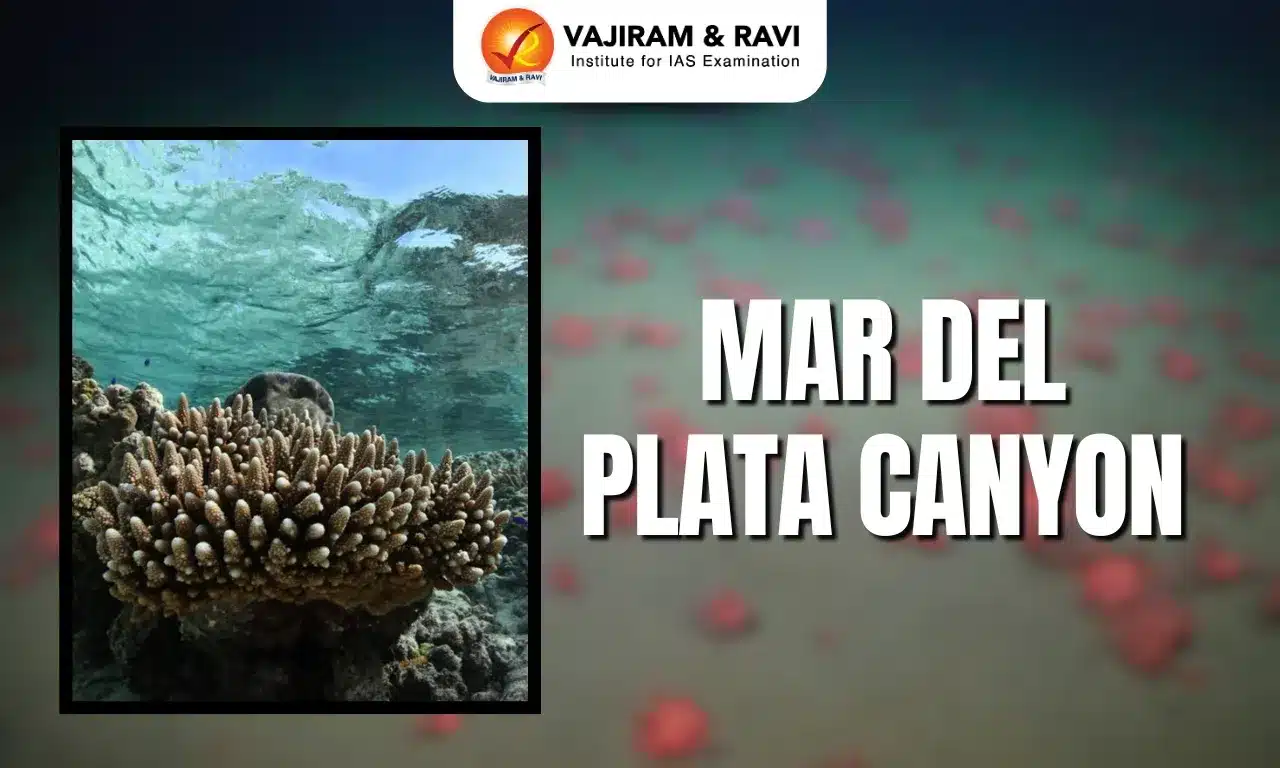
A groundbreaking expedition to Argentina's Mar del Plata Canyon uncovered over 40 potential new deep-sea species, including glass squids and pink lobsters.

About Mar Del Plata Canyon

  • It is located at the continental margin off the coast of Buenos Aires Province, Argentina.
  • It lies about 250-300 km offshore from the city of Mar del Plata.
  • It is one of Argentina’s largest submarine canyons.
  • The area is characterised by fine sand with a mixture of terrigenous material and planktonic foraminifera substrate.
  • It is highly productive and influenced by the permanent Argentine Shelf-break Front.
    • This front marks the boundary where subantarctic shelf waters meet the cooler, more saline waters of the Falkland-Malvinas Current, creating a significant thermohaline front.

What are Submarine Canyons?

  • A submarine canyon is any of a class of narrow, steep-sided valleys that cut into continental slopes and continental rises of the oceans. 
  • Submarine canyons originate either within continental slopes or on a continental shelf. 
  • They are rare on continental margins that have extremely steep continental slopes or escarpments. 
  • Most submarine canyons extend only about 48 km (30 miles) or less in length, but a few are more than 320 km (200 miles) long.
  • They usually are many kilometres in width; for instance, the Grand Bahama Canyon measures 37 km (23 miles) at its widest point.
  • Submarine canyons are so called because they resemble canyons made by rivers on land.
  • A relatively large number of submarine canyons are located directly offshore of river canyons of adjacent land areas and may have once been connected to extensions of the latter. 
  • In most cases, however, the characteristics of the submarine variety and those of the nearby land canyons are quite distinct. 
    • The submarine canyons, for example, tend to have steeper side slopes, much higher gradients, and considerably narrower floors. 
  • Like rivers on land, these underwater features act as the primary conduits for sediments (and associated nutrients and organic carbon) transported from the continental shelf to the deep ocean basins.
    • Here the sediment is deposited, forming enormous sediment accumulations, called submarine fans, that resemble river deltas.

Source: TOI

Mar Del Plata Canyon FAQs

Q1: Where is the Mar del Plata Canyon located?

Ans: Off the coast of Buenos Aires Province, Argentina.

Q2: Which oceanographic front influences the productivity of the Mar del Plata Canyon?

Ans: The Argentine Shelf-break Front influences the productivity of the Mar del Plata Canyon.

Q3: Where do submarine canyons usually originate?

Ans: Within continental slopes or on continental shelves.

Q4: What role do submarine canyons play in marine sediment transport?

Ans: They act as conduits carrying sediment from continental shelves to deep ocean basins.
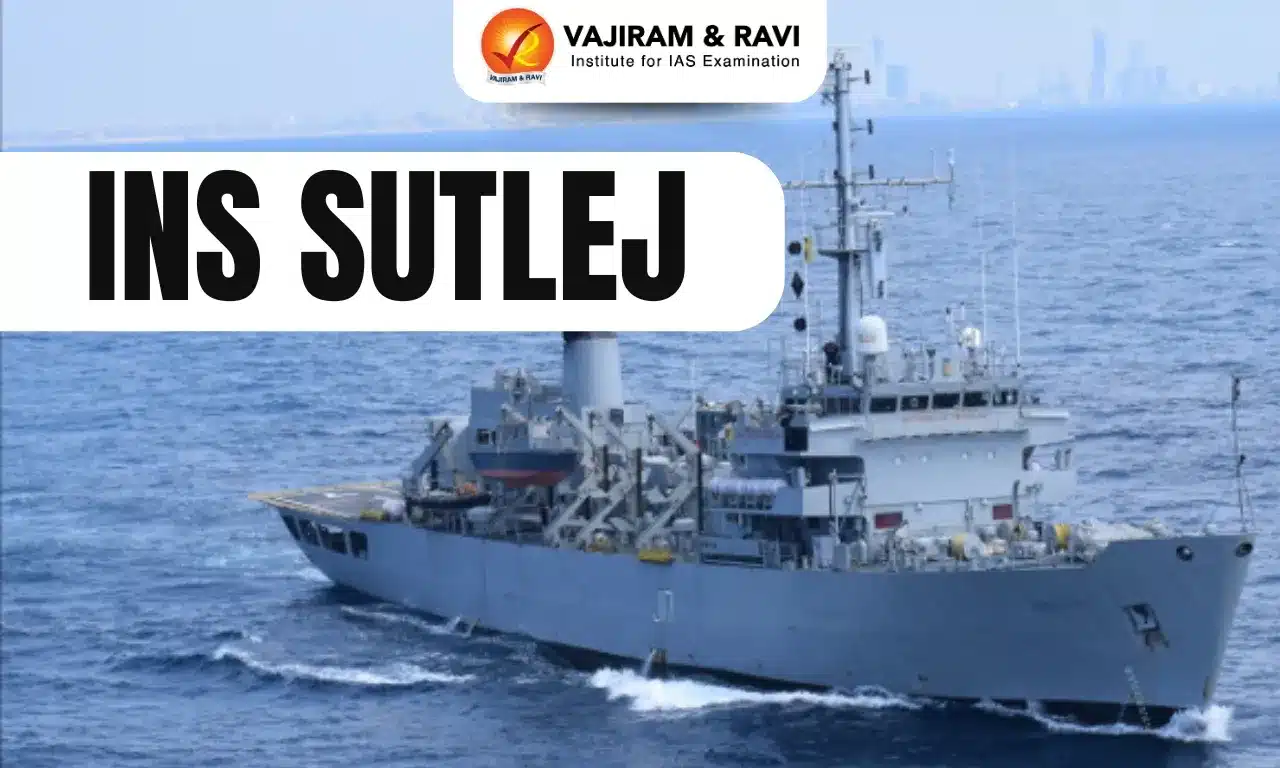
INS Sutlej

INS Sutlej

INS Sutlej Latest News

INS Sutlej recently arrived at Port Louis to undertake the 18th Joint Hydrographic Survey at Mauritius.

About INS Sutlej

  • It is a specialised hydrographic survey vessel of the Indian Navy.
  • It was built by the Goa Shipyard Limited and commissioned into the Indian Navy in 1993.
  • It is currently based at Kochi under the Southern Naval Command.
  • It is equipped with a range of surveying, navigational, and communication systems. 
  • The next-generation surveying systems provided on board include the multi-beam swath echo sounding system, differential global positioning system, motion sensors, sea gravimeter, magnetometer oceanographic sensors, side scan sonars, and an automated data logging system. 
  • These are designed to meet the stringent international/ISO 9002 digital survey accuracy standards required for the production of electronic navigation charts and publications. 
  • The ship also carries a Chetak helicopter and four survey motorboats.

Source: PIB

INS Sutlej FAQs

Q1: What is INS Sutlej?

Ans: It is a specialised hydrographic survey vessel of the Indian Navy.

Q2: INS Sutlej is based at which naval command?

Ans: It is currently based at Kochi under the Southern Naval Command.

Q3: INS Sutlej was commissioned in which year?

Ans: 1993

Clean Slate Doctrine under the Insolvency and Bankruptcy Code (IBC)

Clean Slate Doctrine under the Insolvency and Bankruptcy Code

Clean Slate Doctrine under the Insolvency and Bankruptcy Code (IBC) Latest News

The Delhi High Court recently confirmed the “clean slate” doctrine under the Insolvency and Bankruptcy Code (IBC) by holding that a successful resolution applicant cannot be burdened with the criminal liabilities of a corporate debtor’s past management.

About Clean Slate Doctrine under the Insolvency and Bankruptcy Code 

  • The Clean Slate Doctrine is a key legal principle embedded in the Insolvency and Bankruptcy Code, 2016 (“IBC”), which plays a pivotal role in the corporate insolvency process in India.  
  • The doctrine suggests that once a company successfully undergoes the insolvency resolution process and is taken over by a new buyer, the new owner should not be held accountable for any of the company’s pre-existing debts, penalties, or liabilities.  
  • This principle is designed to give the company a fresh start, essentially, a “clean slate” free from the baggage of its prior financial troubles.  
  • The Clean Slate Doctrine has been upheld in several landmark rulings by India’s Supreme Court (SC), reaffirming its crucial role in the IBC framework.
    • In the Essar Steel India case, the SC emphasized that one of the primary objectives of the IBC is to streamline insolvency procedures in India and bring all claims under a unified system.  
      • The SC ruled that once a resolution plan is approved by the National Company Law Tribunal (NCLT), any and all previous liabilities, including debts and penalties, are extinguished.  
      • This means no party can initiate or continue any legal proceedings related to a claim that is not included in the approved resolution plan.
    • In the Edelweiss Asset Reconstruction case, the SC held that government dues, such as taxes and duties, are extinguished if they are not part of the resolution plan. 
    • In the Surya Exim case, the Gujarat High Court, following the SC rulings, held that any tax demands issued after the NCLT’s approval of a resolution plan should be cancelled, reinforcing the idea that claims not included in the approved plan are no longer valid.

Source: TAXS

Clean Slate Doctrine under the Insolvency and Bankruptcy Code (IBC) FAQs

Q1: What is the Clean Slate Doctrine under the Insolvency and Bankruptcy Code (IBC)?

Ans: A principle stating that after insolvency resolution, the new owner is not liable for pre-existing debts and liabilities.

Q2: What is the main purpose of the Clean Slate Doctrine?

Ans: To provide a fresh start for the company free from prior financial troubles.

Q3: According to the Clean Slate Doctrine, what happens to claims not included in the approved resolution plan?

Ans: They are extinguished and no legal proceedings can be initiated.

Urban Flood Risk Management Programme

Urban Flood Risk Management Programme

Urban Flood Risk Management Programme Latest News

Recently, a high-level committee headed by the Union Home Minister approved the Urban Flood Risk Management Programme (UFRMP) Phase-2.

About Urban Flood Risk Management Programme

  • The programme will complement the states in mitigating the risk of urban flooding in the cities through uniform structural and non-structural intervention measures.
  • Cities Involved (11 cities) -- Bhopal, Bhubaneshwar, Guwahati, Jaipur, Kanpur, Patna, Raipur, Trivandrum, Vishakhapatnam, Indore and Lucknow
  • Selection Criteria: The 11 cities were selected on the basis of their status of being the most populous cities/state capitals, primarily prone to floods, as well as consideration of other physical, environmental, socio-economic and hydro-meteorological factors
  • Funding: The funding pattern will be on a cost-sharing basis between the Centre and the states according to the NDMF guidelines, i.e., 90 per cent from the Centre and 10 per cent from the states.
  • Activities under Urban Flood Risk Management Programme
    • Structural measures of Interlinking of water bodies to Stormwater Management, Construction of flood protection wall, Erosion Control and Soil Stabilisation using Nature-Based Solutions (NBS),etc.
    • Non-structural measures such as Flood Early Warning System and Data Acquisition System and capacity building, etc.

 Source: ET

Urban Flood Risk Management Programme FAQs

Q1: How is the Urban Flood Risk Management Programme funded?

Ans: 90% funding from the Centre and 10% from the State.

Q2: Which cities are included in the Urban Flood Risk Management Programme Phase-II?

Ans: 11 cities. The cities included are Bhopal, Bhubhaneshwar, Guwahati, Jaipur, Kanpur, Patna, Raipur, Trivandrum, Vishakhapatnam, Indore, and Lucknow.

Cassini Spacecraft

Cassini Spacecraft

Cassini Spacecraft Latest News

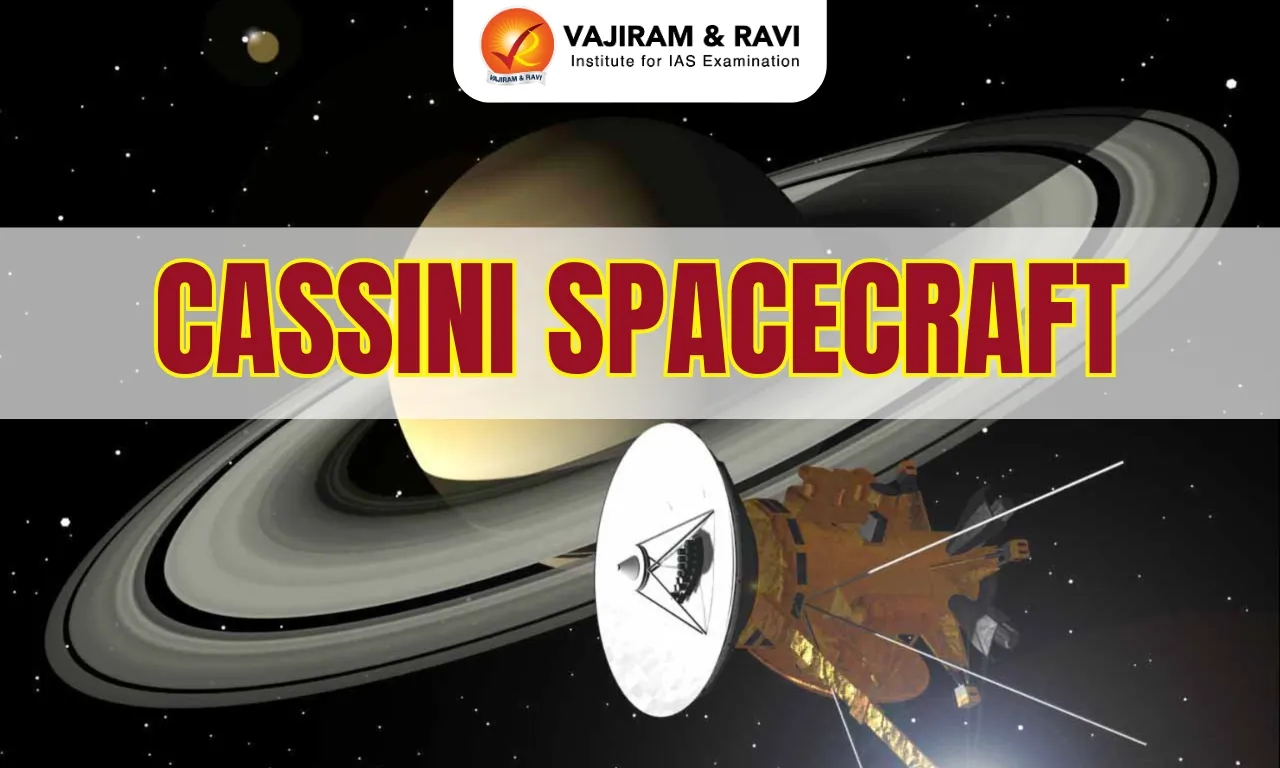
A fresh look at data collected by NASA’s Cassini spacecraft has uncovered more evidence that Saturn’s moon Enceladus may be able to support life.

About Cassini Spacecraft

  • It is a joint project of NASA, the European Space Agency and the Italian space agency (ASI).
  • Cassini was a sophisticated robotic spacecraft sent to study Saturn and its complex system of rings and moons in unprecedented detail.
  • It was launched on October 15, 1997. It was one of the largest interplanetary spacecraft.
  • The mission consisted of NASA’s Cassini orbiter, which was the first space probe to orbit Saturn, and the ESA’s Huygens probe, which landed on Titan, Saturn’s largest moon

Objectives of Cassini Spacecraft

  • Saturn—Study cloud properties and atmospheric composition, winds and temperatures, internal structure and rotation, ionosphere, origin, and evolution
  • Rings—Observe their structure and composition, dynamical processes, interrelation of rings and satellites, dust and micrometeoroid environment.
  • Titan—Study abundances of atmospheric constituents, distribution of trace gases and aerosols, winds and temperatures, composition and state of the surface, and upper atmosphere
  • Saturn’s Magnetosphere—Study its structure and electric currents; composition, sources, and sinks of particles within it; dynamics; interaction with the solar wind, satellites, and rings; Titan’s interaction with solar wind and magnetosphere

Components of Cassini Spacecraft

  • The instruments on board Cassini included radar to map the cloud-covered surface of Titan and a magnetometer to study Saturn’s magnetic field. 
  • The disk-shaped Huygens probe was mounted on the side of Cassini and carried six instruments designed to study the atmosphere and surface of Titan.

Key Facts about Enceladus

  • It is named after a giant in ancient Greek mythology,
  • It is one of the innermost moons of the ringed gas giant Saturn.
  • It has a diameter of 313 miles (504 km) and orbits Saturn at a distance of roughly 148,000 miles (238,000 km).
  • Scientists believe Enceladus possesses the chemical ingredients needed for life and has hydrothermal vents releasing hot, mineral-rich water into its ocean, the same type of environment that may have spawned Earth’s first living organisms.
  • Its ocean resides under a crust of ice about 12-19 miles (20-30 km) thick.

Source: DD News

Cassini Spacecraft FAQs

Q1: What was the primary mission of the Cassini spacecraft?

Ans: To study the geology and magnetic field of Saturn

Q2: What significant discovery was made by the Cassini spacecraft regarding Enceladus?

Ans: Geysers of water vapor and ice particles.

National Dam Safety Authority (NDSA)

National Dam Safety Authority (NDSA)

National Dam Safety Authority Latest News

After two years of political and administrative controversy over the structural ability of the barrages of the Kaleshwaram project, the government recently decided to repair the three barrages based on the suggestions of the National Dam Safety Authority (NDSA).

About National Dam Safety Authority 

  • It is a statutory body set up by the Central Government under the Dam Safety Act, 2021.
  • It operates with a clear mandate to regulate, oversee, and inspect dams.
  • It is headed by a chairman and assisted by five members to lead its five wings - policy and research, technical, regulation, disaster and resilience, and administration and finance.
  • It has its headquarters at New Delhi.
  • Functions of the Authority include: 
    • implementing the policies formulated by the National Committee on Dam Safety;
    • resolving issues between State Dam Safety Organisations (SDSOs), or between a SDSO and any dam owner in that state;
    • specifying regulations for inspection and investigation of dams;
    • providing accreditation to agencies working on construction, design, and alteration of dams.
  • One of the standout features of the NDSA’s approach is its commitment to establishing and enforcing comprehensive safety standards. 
    • These standards encompass various aspects, including structural integrity, environmental impact, and emergency response protocols.
  • The NDSA actively engages in nationwide awareness programs to educate citizens about dam safety.
  • In the face of natural calamities or unforeseen events, the NDSA ensures that comprehensive emergency response plans are in place.

Source: TH

National Dam Safety Authority FAQ's

Q1: The National Dam Safety Authority (NDSA) was established under which Act?

Ans: National Dam Safety Authority (NDSA) is a statutory body set up by the Central Government under the Dam Safety Act, 2021.

Q2: What is the primary mandate of the National Dam Safety Authority (NDSA)?

Ans: It operates with a clear mandate to regulate, oversee, and inspect dams.

Q3: Where is the headquarters of the National Dam Safety Authority (NDSA) located?

Ans: It has its headquarters at New Delhi.

Electronics Components Manufacturing Scheme

Electronics Components Manufacturing Scheme

Electronics Component Manufacturing Scheme Latest News

Recently, the central Minister of Electronics & IT highlighted that the Electronics Components Manufacturing Scheme has received an overwhelming response from both domestic and international industry leaders.

About Electronics Component Manufacturing Scheme

  • It is the first dedicated production-linked incentive (PLI) scheme to promote the manufacturing of select passive electronic components, including resistors, capacitors, speakers, microphones, special ceramics, relays, switches, and connectors. 
  • Objective: To develop a robust component manufacturing ecosystem by attracting investments (global / domestic) across the value chain by integrating its domestic electronic industry with the Global Value Chains (GVCs).
  • The scheme will offer three incentive structures
    • Turnover-linked incentive (based on revenue)
    • Capex-linked incentive (for investments in plants & machinery)
    • Hybrid incentive model (a combination of both)
    • Incentives for incremental investments and turnover range from 1–10% depending on the year and the component.
  • Employment generation will be a mandatory requirement for all applicants, including both component manufacturers and capital equipment producers. Thus, the scheme not only boosts manufacturing but also creates skilled jobs.
  • Tenure: This scheme has a tenure of six years, with a one-year gestation period.
  • The scheme focuses particularly on passive electronic components. In contrast, active components fall under the purview of the India Semiconductor Mission (ISM).
  • This scheme is set to benefit a number of industries, such as automobiles, consumer electronics, and electronics.

 Source: PIB

Electronics Component Manufacturing Scheme FAQs

Q1: What is the tenure of the Electronics Component Manufacturing Scheme?

Ans: 6 years

Q2: What is the primary objective of the Electronics Component Manufacturing Scheme?

Ans: To develop a robust component ecosystem and increase domestic value addition

The Commission for Air Quality Management in NCR & Adjoining Areas (CAQM)

Commission for Air. Quality Management in National Capital Region and Adjoining Areas,

Commission for Air Quality Management in National Capital Region and Adjoining Areas (CAQM) Latest News

With the paddy harvest season beginning in northern India, the Commission for Air Quality Management in the National Capital Region and Adjoining Areas (CAQM) has stepped up measures to curb stubble burning, one of the key contributors to winter air pollution in the Capital.

About Commission for Air Quality Management in National Capital Region and Adjoining Areas 

  • It is a statutory body established under the Commission for Air Quality Management in National Capital Region (NCR) and Adjoining Areas, Act 2021.
  • Mandate: Better coordination, research, identification, and resolution of problems surrounding the air quality index and for matters connected therewith or incidental thereto.
  • It undertakes action for the prevention and control of Air pollution in Delhi-NCR & Adjoining Areas which impacts the air quality of the National Capital Territory (NCT) of Delhi.
  • The Commission is required to coordinate its actions on monitoring of air quality with the government of Delhi and the adjoining states, which includes Punjab, Haryana, Rajasthan, and Uttar Pradesh. 

Commission for Air Quality Management Powers

  • Restricting activities influencing air quality.
  • Investigating and conducting research related to environmental pollution impacting air quality, preparing codes and guidelines to prevent and control air pollution.
  • Issuing directions on matters including inspections, or regulations, which will be binding on the concerned person or authority.
  • All the directions and orders by the Commission are of binding nature, and any person, officer, or authority shall be bound to comply with the same.
  • The commission is directly accountable to the parliament. 

Commission for Air Quality Management Composition

  • Chairperson: To be chaired by a government official of the rank of Secretary or Chief Secretary. He will hold the post for three years or until s/he attains the age of 70 years.
  • It will also have five ex-officio members who are either Chief Secretaries or Secretaries in charge of the department dealing with environment protection in the States of Delhi, Punjab, Haryana, Rajasthan, and Uttar Pradesh.
  • Three full time technical members.
  • Three members from non-government organisations.
  • Technical members from the Central Pollution Control Board (CPCB), the Indian Space Research Organisation, and NITI Aayog.

Source: TH

Commission for Air Quality Management in National Capital Region and Adjoining Areas (CAQM) FAQs

Q1: The Commission for Air Quality Management (CAQM) was established under which Act?

Ans: Commission for Air Quality Management in National Capital Region (NCR) and Adjoining Areas, Act 2021.

Q2: What is the main mandate of Commission for Air Quality Management (CAQM)?

Ans: Coordination, research, and resolution of problems related to air quality in Delhi-NCR and adjoining states

Q3: To whom is the Commission for Air Quality Management directly accountable?

Ans: The commission is directly accountable to the parliament.

Q4: The Commission for Air Quality Management coordinates its actions with Delhi and which adjoining states?

Ans: Punjab, Haryana, Rajasthan, and Uttar Pradesh.

Kanha Tiger Reserve (KTR)

Kanha Tiger Reserve (KTR)

Kanha Tiger Reserve Latest News

Recently, three tigers, including two female cubs, have been found dead inside the Kanha Tiger Reserve (KTR) attributing the deaths to territorial fights among big cats.

About Kanha Tiger Reserve

  • Location: It is located in the “Maikal” ranges of the Satpuras in the state of Madhya Pradesh.
  • It was declared a reserve forest in 1879 and revalued as a wildlife sanctuary in 1933. Its position was further upgraded to a national park in 1955.
  • Corridor: It has an active corridor between Kanha and Pench Tiger Reserves. Kanha is also connected with the Achanakmar Tiger Reserve of Chhattisgarh State. 
  • Habitat: It is characterized mainly by forested shallow undulations, hills with varying degrees of slopes, plateaus, and valleys.
  • Tribal Communities: The region is known for some of the ancient tribal communities, like the Gond and Baiga still inhabit the region. 
  • It is also the first tiger reserve in India to officially introduce a mascot, “Bhoorsingh the Barasingha”. 
  • Flora: It is primarily a moist Sal and moist mixed deciduous forest where Bamboo, Tendu, Sal, Jamun, Arjun, and Lendia flourish.
  • Fauna: The Park has a significant population of Royal Bengal Tigers, leopards, sloth bears, and Indian wild dogs.
  • The Park is respected globally for saving the Barasingha (the state animal of Madhya Pradesh) from near extinction and has the unique distinction of harbouring the last world population of this deer species.

Source: TH

Kanha Tiger Reserve FAQ's

Q1: Where is the Kanha Tiger Reserve located?

Ans: Madhya Pradesh

Q2: What type of forests can be found in the Kanha Tiger Reserve?

Ans: The Kanha Tiger Reserve is characterized by deciduous forests, including sal, teak, and other tree species

Enquire Now