Easter Island

Easter Island

Easter Island Latest News

New research reveals Easter Island's moai statues were "walked" upright using ingenious engineering, not dragged or rolled.

About Easter Island

  • It is a Polynesian island located in the southeastern Pacific Ocean. 
  • Named Rapa Nui by its earliest residents, it is one of the most isolated inhabited islands in the world. 
  • It is a special Chilean territory situated about 3,540 km to the west of Chile and about 1,900 km to the east of Pitcairn Island.
  • It covers a total area of 163.6 sq.km.
  • It is a small, triangular-shaped volcanic island. It is about 24 km in length and has a maximum width of about 12 km at its widest point. 
  • The island comprises three extinct volcanoes, namely Terevaka, Poike, and Rano Kau.
  • It faces a tropical rainforest climate.
  • UNESCO named Easter Island a World Heritage Site on March 22, 1996, and major parts of the island have been protected under the Rapa Nui National Park.

What are Moai Statues?

  • Rapa Nui is famous for its large megalithic statues called moai.
  • They are shaped like large human heads and erected on stone pedestals.
  • They are famous for their carved heads and “Pukao,” a hat-like covering made from a soft red stone.
  • Some moai stand 40 feet tall and weigh 75 tonnes.
  • They were carved in volcanic stone at quarries and then moved to their current locations across the island.
  • Scholars believe the Rapa Nui people built the moai between the 13th and the 16th centuries and represented their revered ancestors.
  • Over 900 moai have been found on the island to date.
  • What do Moais represent?
    • They were built to honor chieftains or other important people who had passed away.
    • They were placed on rectangular stone platforms called ahu, which are tombs for the people that the statues represented.
    • The moais were intentionally made with different characteristics since they were intended to keep the appearance of the person they represented.

Source: ARCH

Easter Island FAQs

Q1: Where is Easter Island located?

Ans: Southeastern Pacific Ocean

Q2: What is the local name of Easter Island given by its earliest residents?

Ans: Rapa Nui

Q3: Easter Island is a special territory of which country?

Ans: Chile

Q4: What are the famous megalithic statues found on Easter Island called?

Ans: Moai

Indian Radio Software Architecture Standard

Indian Radio Software Architecture Standard

Indian Radio Software Architecture Standard Latest News

Recently, the Defence Research and Development Organisation (DRDO), in collaboration with the Integrated Defence Staff and the Tri-Services released Indian Radio Software Architecture (IRSA) standard 1.0. 

About Indian Radio Software Architecture Standard

  • It provides a standardised software architecture defining how different radio systems communicate securely and efficiently.
  • It is India’s first national specification defining a standardized software architecture for Software Defined Radios. 
  • Vision: To position IRSA as a global benchmark — enabling India to shape the future of SDR technology and export IRSA-compliant solutions to friendly nations.
  • It is a comprehensive software specification for Software Defined Radios (SDR), defining standardized interfaces, APIs, execution environments, and waveform portability mechanisms, SDR Interoperability, Certification and Conformance.
  • India’s IRSA now joins the elite group of global SDR frameworks — alongside the US Software Communications Architecture (SCA), Europe’s ESSOR, and NATO’s STANAG SDR standards.
  • It is prepared as per Standardization of Indigenous Software Defined Radio initiative of Directorate of Standardization (DoS) under Department of Defence Production (DDP) in Ministry of Defence (MOD) India.

What is Software Defined Radio?

  • SDR is a radio communication system that employs reconfigurable software-based components for the processing and conversion of digital signals.
  • Unlike traditional radio communication systems, these radio devices are highly flexible and versatile.
  • This is an emerging technology used to connect an ever-increasing wireless world.

Source: PIB

Indian Radio Software Architecture standard FAQs

Q1: When was IRSA Version 1.0 approved?

Ans: It was approved by the High-Level Advisory Committee (HLAC) in 2025.

Q2: What are the benefits of IRSA?

Ans: Enhanced security and interoperability and Increased efficiency and waveform portability.

Online National Drugs Licensing System (ONDLS) Portal

Online National Drugs Licensing System (ONDLS) Portal

Online National Drugs Licensing System (ONDLS) Portal Latest News

While 18 State drug control authorities across the country have adopted the Online National Drugs Licensing System (ONDLS) for processing drug-related licences, no State has yet fully complied with the Corrective and Preventive Action (CAPA) guidelines, confirmed a source in the Union Health Ministry recently. 

About Online National Drugs Licensing System (ONDLS) Portal

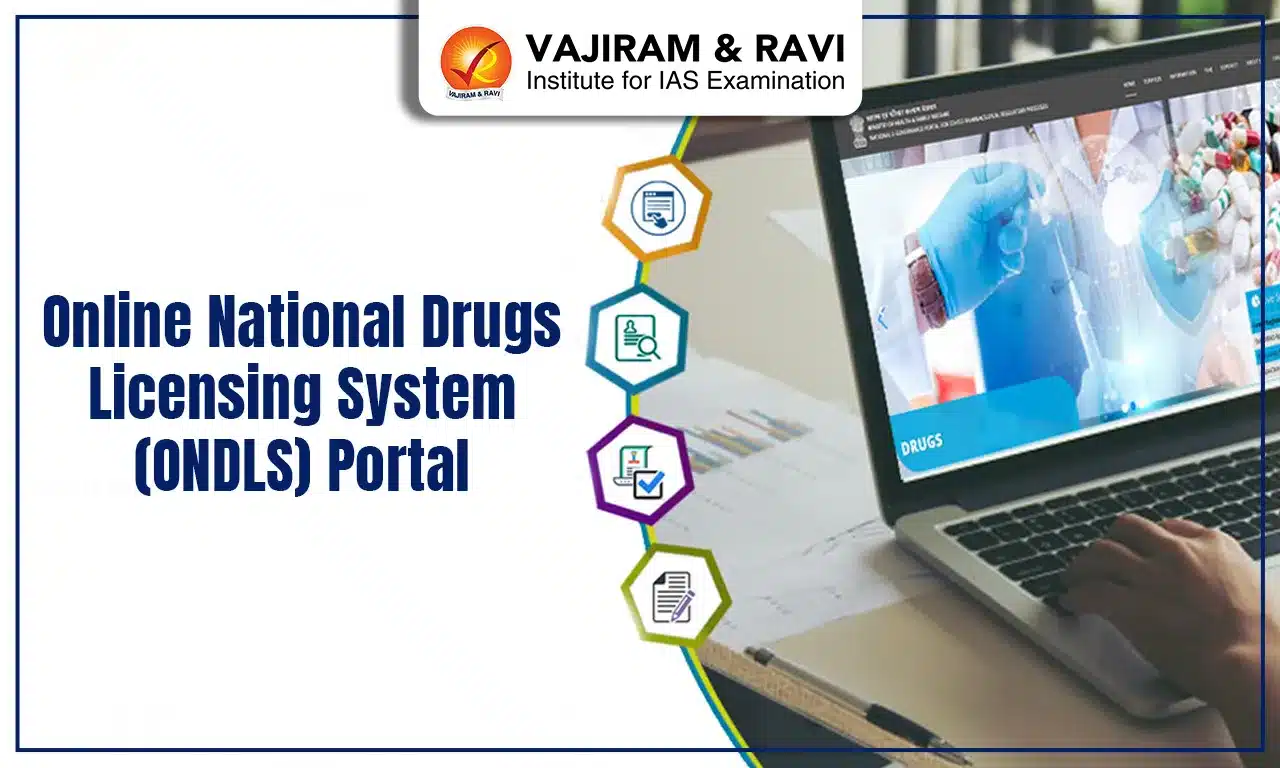
  • It is a digital, single-window platform for processing various drug-related licences in India.
  • It is developed by the Centre for Development of Advanced Computing (CDAC) in coordination with the Central Drugs Standard Control Organisation (CDSCO), Directorate General of Health Services, Ministry of Health and Family Welfare,  and State/UT Drugs Regulatory Authorities.
  • It is designed to create a uniform, transparent, and accountable process for drug licensing across all States and Union Territories. 
  • It handles applications submitted by the applicants for issuance of manufacturing and sales licenses, including Blood Banks, and other certificates like COPP, GMP, WHO-GMP, Market Standing certificate, etc., and post-approval changes.
  • ONDLS will help in the establishment of uniformity w.r.t. the requirement of submission of documents for different types of applications as well as issuance of licenses/permissions throughout India.

Source: TH

Online National Drugs Licensing System (ONDLS) Portal FAQs

Q1: What is the primary objective of the Online National Drugs Licensing System (ONDLS) portal?

Ans: To process various drug-related licences through a single digital platform.

Q2: The Online National Drugs licensing system (ONDLS) Portal was developed by which organisation?

Ans: It was developed by the Centre for Development of Advanced Computing (CDAC) in coordination with the Central Drugs Standard Control Organisation (CDSCO).

Q3: What types of licences can be obtained through the ONDLS Portal?

Ans: Manufacturing, sales, and Blood Bank licences.

Marine Stewardship Council (MSC) Certification

Marine Stewardship Council (MSC) Certification

Marine Stewardship Council (MSC) Certification Latest News

About 10 Indian marine and saline fish and shrimp varieties are set to get the global Marine Stewardship Council (MSC) certification soon. 

About Marine Stewardship Council (MSC) Certification

  • The Marine Stewardship Council (MSC) is an international non-profit organisation that sets globally recognised, science-based standards for sustainable fishing and seafood traceability.
  • The MSC certification program recognises and rewards sustainable fishing practices and is helping create a more sustainable seafood market.
  • Assessment: The MSC certification scheme is based on independent third-party assessments and is built on three principles: Stock health, Environmental impacts, Effective management. 
  • This certification is open to all fisheries that wish to voluntarily demonstrate that their operations are sustainable, regardless of their location, size and fishing gear.
  • Validity: The certification is valid for 5 years, but subjected to annual surveillance audits.
  • It is the only wild-capture fisheries certification based on the Food and Agriculture Organisation’s (FAO) Code of Conduct for Responsible Fishing and Guidelines for the Eco-labelling of Fish and Fishery Products from Marine Capture Fisheries.
  • Astamudi clam (Paphia malabarica) is India’s first Marine Stewardship Council (MSC) certified fisheries.

Source: TH

Marine Stewardship Council (MSC) Certification FAQs

Q1: What is the scientific name of the short-neck clam found in Ashtamudi Lake?

Ans: Paphia malabarica

Q2: What is the primary goal of the Marine Stewardship Council (MSC) certification?

Ans: To ensure sustainable fishing practices.

Nesolynx Banabitanae

Nesolynx Banabitanae

Nesolynx Banabitanae Latest News

A new species of wasp named Nesolynx banabitanae was recently discovered in Salt Lake, West Bengal.

About Nesolynx Banabitanae

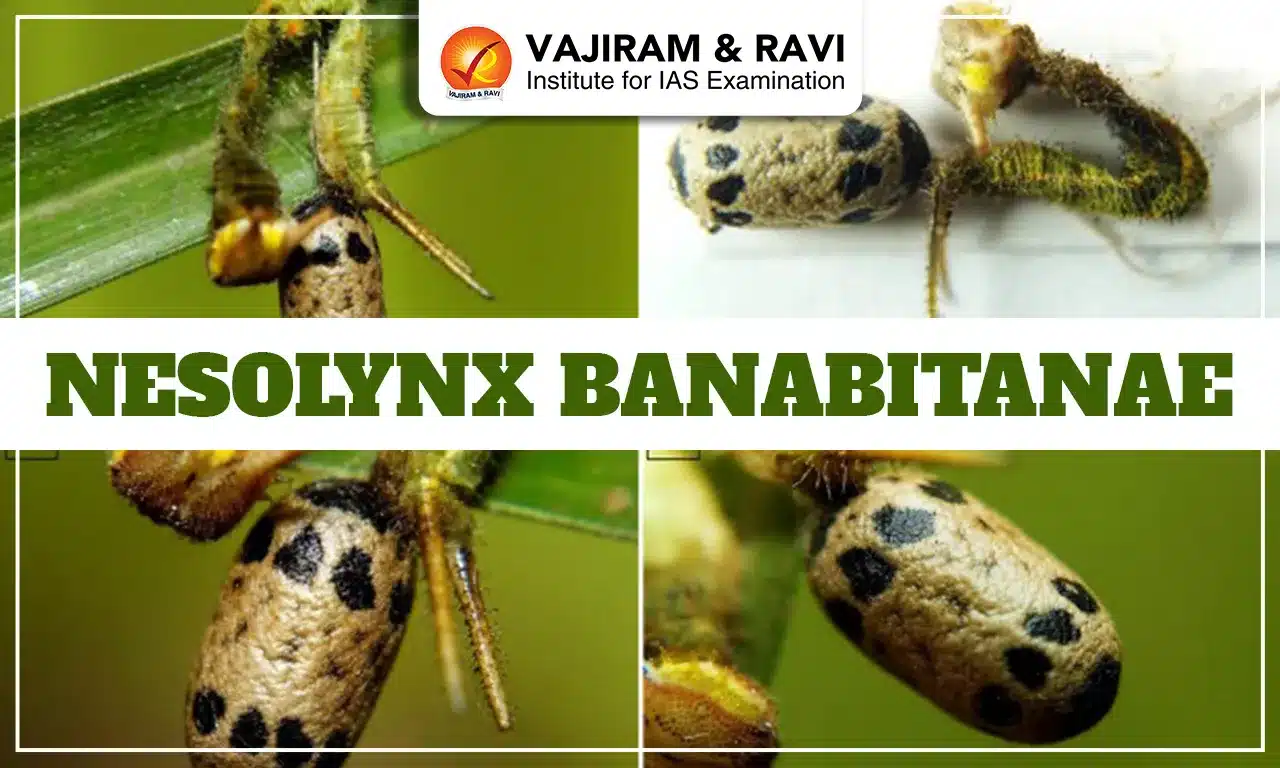
  • It is a new species of wasp.
  • It was found in the lush environs of Central Park, Salt Lake, West Bengal.
  • It was named ‘Nesolynx banabitanae' in honour of Banabitan, the local name for Central Park, where the wasp was first identified. 
  • The discovery marks only the seventh wasp species to be identified in India. 
  • It belongs to the Eulophidae family, a group known for its diverse parasitic behaviours. 
    • This particular species is a hyperparasitoid, meaning it parasitises other parasitoid wasps, adding a complex layer to the ecological interactions within its habitat.
    • The wasp was found to be a hyperparasitoid of the ichneumonid parasitoid Charops aditya, which itself parasitises caterpillars of the common palmfly and Common castor butterflies.

Source: TOI

Nesolynx Banabitanae FAQs

Q1: Nesolynx banabitanae, recently discovered, belongs to which insect group?

Ans: It is a new species of wasp.

Q2: The new wasp species Nesolynx banabitanae was discovered in which Indian state?

Ans: West Bengal

Q3: What type of parasitoid is Nesolynx banabitanae?

Ans: It is a hyperparasitoid, meaning it parasitises other parasitoid wasps.

Nangal Wildlife Sanctuary

Nangal Wildlife Sanctuary

Nangal Wildlife Sanctuary Latest News

About 100 wild boars were found dead in Nangal Wildlife Sanctuary in March this year, and the postmortem report of the dead wild boars indicates that the wild boars might have died due to toxic waste in Nangal Lake, which is part of the sanctuary.

About Nangal Wildlife Sanctuary

  • It is a protected area located in the foothills of the Shivalik Hills in the Rupnagar district, in the state of Punjab.
  • Established as a sanctuary in 2009, it was designated a Ramsar site in 2019.
  • It spans an area of 116 hectares and forms a part of the larger Nangal Wetland, situated on the banks of the Sutlej River.
  • It occupies a human-made reservoir constructed as part of the Bhakra-Nangal Project in 1961.
  • The site is of historic importance, as the Indian and Chinese Prime Ministers formalized the “Five Principles of Peaceful Coexistence” there in 1954.
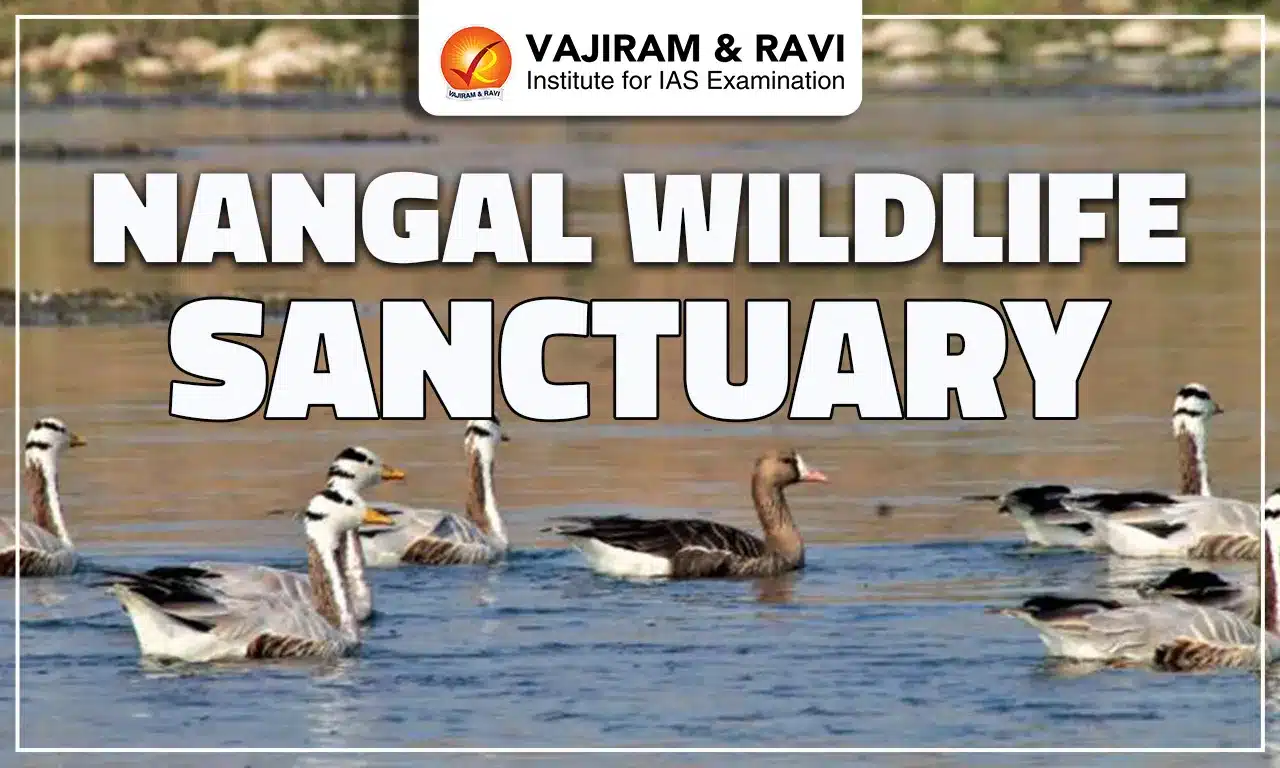
  • It supports rich biodiversity, including over 150 bird species and several threatened animals such as the Indian pangolin, Egyptian vulture, and leopards.
  • This sanctuary is a crucial migratory stopover for many bird species, particularly waterfowl.

Source: TRIB

Nangal Wildlife Sanctuary FAQs

Q1: In which state is the Nangal Wildlife Sanctuary located?

Ans: Punjab

Q2: When was the Nangal Wildlife Sanctuary designated as a Ramsar site?

Ans: 2019

Q3: Nangal Wildlife Sanctuary is located on the banks of which river?

Ans: Sutlej River

Q4: The Nangal Wildlife Sanctuary occupies a reservoir created under which project?

Ans: It occupies a human-made reservoir constructed as part of the Bhakra-Nangal Project in 1961.

Unicorn Company

Unicorn Company

Unicorn Company Latest News

Startups are emerging as the new driving force of India’s defence innovation ecosystem, said Defence Minister recently, while calling upon young entrepreneurs to set new benchmarks and create India’s first defence unicorn.

About Unicorn Company

  • A unicorn company is a privately owned start-up that has been valued at over $1 billion. 
  • It is commonly used in the venture capital industry. The term was first popularized by venture capitalist Aileen Lee in 2013, when she referred to the 39 startups that had a valuation of over $1 billion as unicorns.
  • Key Characteristics of a Unicorn Startup: 
    • Valuation: A billion-dollar valuation or more.    
    • Private Ownership: Not publicly traded on a stock market.    
    • High Growth Potential: Demonstrates rapid growth and innovation.    
    • Disruptive Technology: Often introduces innovative products or services that disrupt existing industries.    
    • Attracts Significant Investment: Secures substantial funding from venture capitalists and other investors. 
  • The valuation of unicorns is not expressly linked to their current financial performance, but largely based on their growth potential as perceived by investors and venture capitalists who have taken part in various funding rounds.
  • Some unicorns choose to go public by launching an initial public offering (IPO); some opt to remain private using their funding rounds to avoid going public; and still others end up getting acquired by bigger companies. 
  • As of July 2025, there are over 1,200 unicorns around the world

What are Gazelles and Cheetahs in the Startup Ecosystem?

  • Gazelle is a startup founded after 2000 with the potential to go unicorn in two years, while “cheetah” may go unicorn in the next four years. 
  • Gazelles have an estimated valuation ranging from $500 million to $1 billion, and the valuation of cheetahs ranges from $200 million to $500 million.

Source: TH

Unicorn Company FAQs

Q1: What is a unicorn company?

Ans: A privately owned startup valued at over $1 billion.

Q2: Who first popularized the term “unicorn” in the startup ecosystem?

Ans: The term was first popularized by venture capitalist Aileen Lee in 2013.

Q3: What is a a “Gazelle” startup?

Ans: Gazelle is a startup founded after 2000 with the potential to go unicorn in two years.

Q4: What is the typical valuation range of a Gazelle startup?

Ans: Gazelles have an estimated valuation ranging from $500 million to $1 billion.

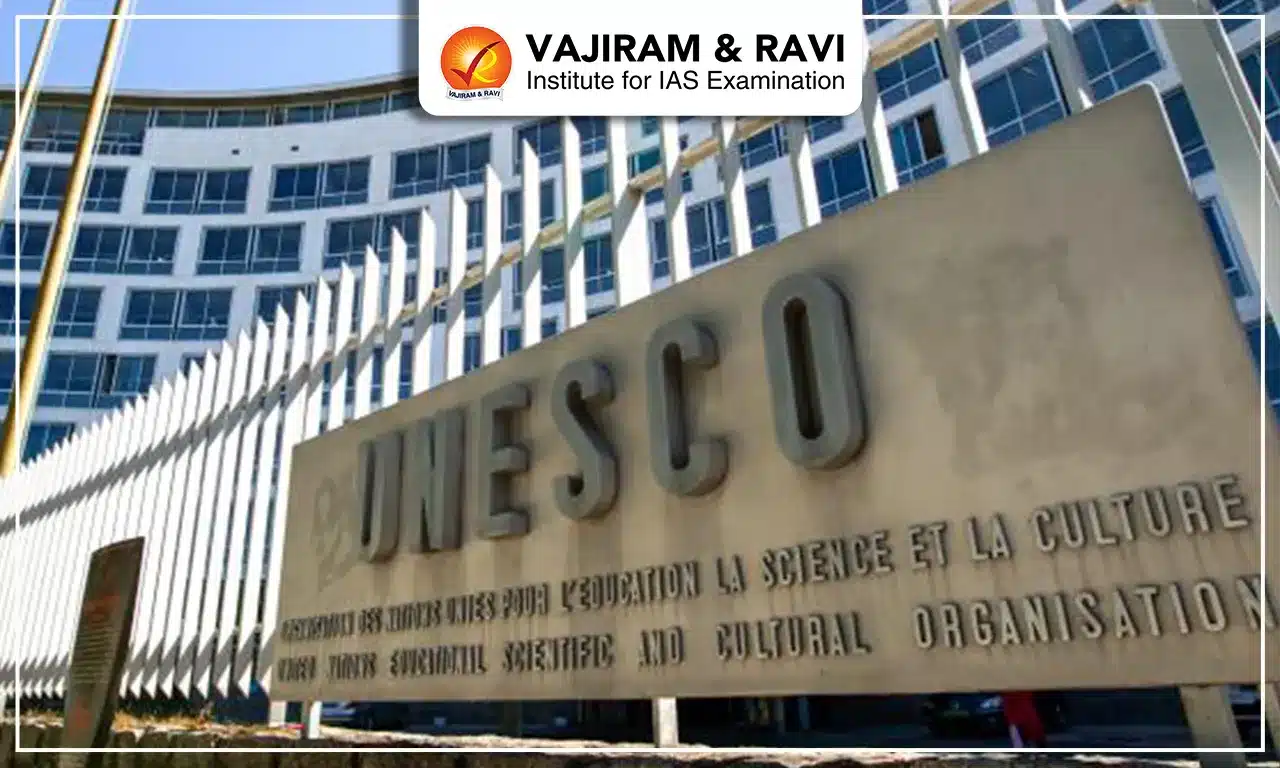
United Nations Educational, Scientific and Cultural Organization (UNESCO)

UNESCO

UNESCO Latest News

Recently, Unesco's executive board has nominated an Egyptian former tourism and antiquities minister, Khaled el-Anani, to be the agency's next director.

About UNESCO

  • The United Nations Educational, Scientific and Cultural Organization (UNESCO) is a specialized agency of the United Nations.
  • Goal: It is dedicated to strengthening our shared humanity through the promotion of education, science, culture, and communication.
  • UNESCO was started in 1945 after World War II. It took over from an older group called the International Committee on Intellectual Cooperation.
  • UNESCO is part of the United Nations Sustainable Development Group.
  • UNESCO focuses on five main areas: Education, Natural sciences, Social and human sciences, Culture, Communication and information.
  • Member countries: UNESCO has 194 member countries and 12 associate members. 
  • Headquarter: Paris, France

Functions of UNESCO

  • It supports member states’ efforts to eliminate illiteracy, encouraging the extension of free education, and acts as a clearinghouse for the exchange of ideas and knowledge. 
  • It also works with many other groups, including non-governmental organizations and private companies.
  • UNESCO designates and maintains a list of World Heritage Sites, which are places of outstanding universal value that deserve protection for future generations.

Source: IE

UNESCO FAQs

Q1: Where is the headquarters of UNESCO located?

Ans: Paris, France.

Q2: What is the World Heritage program of UNESCO?

Ans: A program to protect and preserve cultural and natural heritage sites.

PM Surya Ghar Muft Bijli Yojana

PM Surya Ghar Muft Bijli Yojana

PM Surya Ghar Muft Bijli Yojana Latest News

The PM Surya Ghar Muft Bijli Yojana (PMSGMBY) has crossed a milestone, with Public Sector Banks (PSBs) sanctioning over 5.79 lakh loan applications amounting to ₹10,907 crore as of September 2025. 

About PM Surya Ghar Muft Bijli Yojana

  • It was launched on February 15, 2024, and aims to provide free electricity to households in India.
  • Under the scheme, households will be provided with a subsidy to install solar panels on their roofs.
  • The scheme provides for a subsidy of 60% of the solar unit cost for systems up to 2 kW capacity and 40 percent of additional system cost for systems between 2 to 3 kW capacity. 
  • The subsidy has been capped at 3 kW capacity.
  • One of the components of the scheme is the development of Model Solar Village in each district of the country.
  • Under the component Incentives to Local Bodies, the scheme has provision of providing an incentive at Rs 1,000 per rooftop solar installation in the respective jurisdiction of the Urban Local Bodies (ULBs) and Panchayat Raj Institutions (PRIs) at the Gram Panchayat level.
  • Implementing agency: It is implemented by a National programme Implementation Agency (NPIA) at the National level and by the State Implementation Agencies (SIAs) at the state level. 
    • Under the scheme, DISCOMs are designated as State Implementation Agencies (SIAs) responsible for facilitating various measures, including net meter availability, timely inspection, and commissioning of installations. 
    • DISCOMs will receive incentives based on their achievement in the installation of additional grid-connected rooftop solar capacity beyond a baseline level.

Eligibility Criteria for PM Surya Ghar Muft Bijli Yojana

  • The household must be an Indian citizen.
  • The household must own a house with a roof that is suitable for installing solar panels.
  • The household must have a valid electricity connection.
  • The household must not have availed any other subsidy for solar panels.

Source: PIB

PM Surya Ghar Muft Bijli Yojana FAQs

Q1: What is the primary aim of the PM Surya Ghar Muft Bijli Yojana?

Ans: To provide free electricity to households in India.

Q2: What is the subsidy percentage for solar systems up to 2 kW capacity under the scheme?

Ans: The scheme provides a subsidy of 60% of the solar unit cost for systems up to 2 kW capacity.

Supermoon

Supermoon

Supermoon Latest News

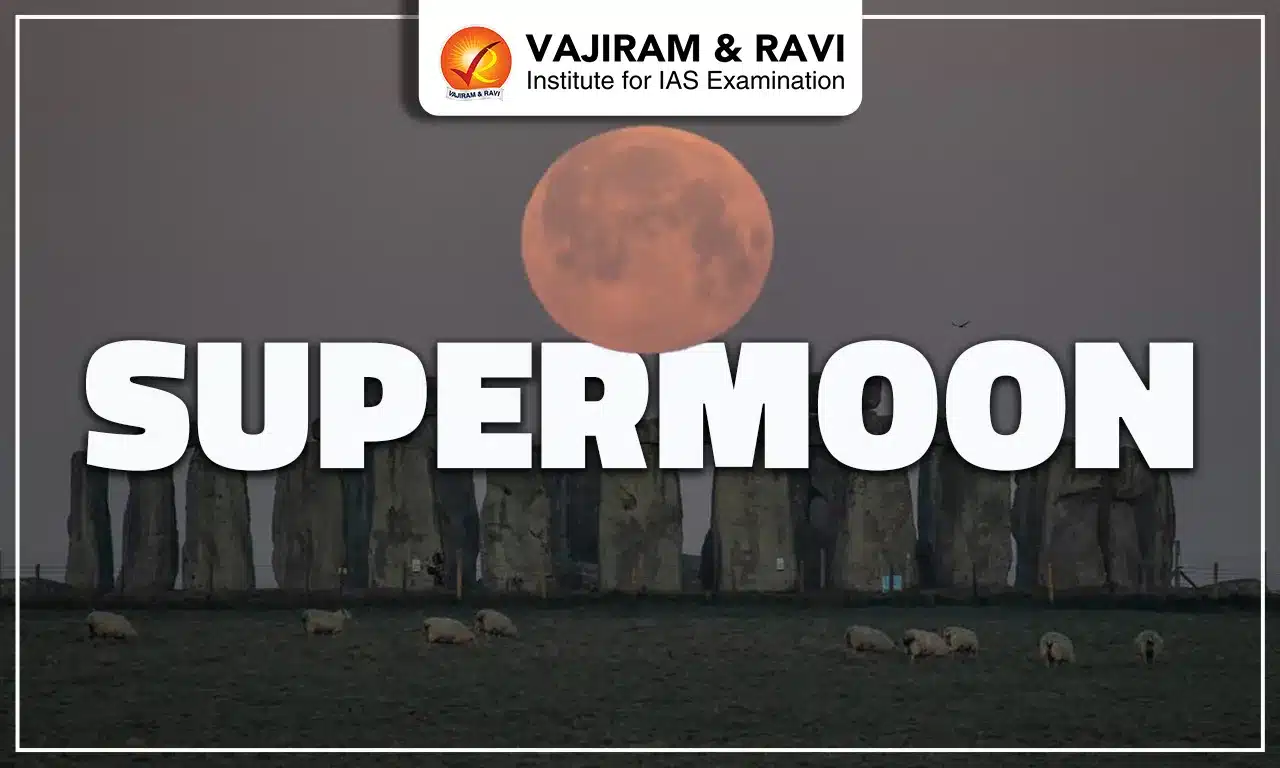
Recently, a rare celestial supermoon illuminated the skyline around the world.

About Supermoon

  • A supermoon occurs when a full moon or new moon coincides with the perigee or moon’s closest approach to the earth in its elliptical orbit.
  • Because the moon’s orbit is not a perfect circle, its distance from the earth varies throughout the month by around 50,000 km.
  • When the moon is near its perigee and also directly opposite the sun, the full moon appears about 14% larger and 30% brighter than when it is at its farthest point.
  • The term “Supermoon” was coined by astrologer Richard Nolle in 1979, defining it as a special event when a full moon is within 90 percent of its closest point to Earth.
  • Impact of Supermoon
    • Supermoons influence the tides, creating perigean spring tides.
    • These tides are slightly higher and lower than usual because the moon’s stronger gravitational pull acts in concert with that of the sun.
    • These changes are typically modest, they can exacerbate coastal flooding when combined with storm surges.

Source: TH

Supermoon FAQs

Q1: What is the effect of a Supermoon on Earth's tides?

Ans: Supermoons can cause higher-than-usual tides due to the moon's closer proximity to Earth [5].

Q2: Can a Supermoon occur multiple times in a year?

Ans: Yes, it can occur multiple times in a year.

Enquire Now