United Nations Global Geospatial Information Management for Asia and the Pacific

United Nations Global Geospatial Information Management for Asia and the Pacific

United Nations Global Geospatial Information Management for Asia and the Pacific Latest News

India has been elected as Co-Chair of the Regional Committee of the United Nations Global Geospatial Information Management for Asia and the Pacific (UN-GGIM-AP) for a three-year term till 2028.

About United Nations Global Geospatial Information Management for Asia and the Pacific

  • The UN-GGIM-AP is one of the five regional committees of the United Nations Committee of Experts on Global Geospatial Information Management.
  • It is the apex inter-governmental mechanism for making joint decisions and setting directions with regard to the production, availability and use of geospatial information within national, regional and global policy frameworks.
  • History of UN-GGIM-AP
    • It was initially established in 1995 as the Permanent Committee on GIS Infrastructure for Asia and the Pacific (PCGIAP).
    • It was rebranded as UN-GGIM-AP in 2012, subsequent to the establishment of UN-GGIM in 2011.
  • Aim: To address global challenges regarding the use of geospatial information.
  • Members: It is represented by the National Geospatial Information Agencies of 56 countries in Asia and the Pacific region,
  • Functions: It works to maximize the economic, social, and environmental benefits of geospatial information through cooperation, capacity development, and shared solutions.
  • Secretariat: United Nations Economic and Social Commission for Asia and the Pacific (ESCAP) serves as secretariat since 2018. 

 Source: News On Air

United Nations Global Geospatial Information Management for Asia and the Pacific FAQs

Q1: What is the primary objective of UN-GGIM-AP?

Ans: To coordinate global geospatial information management

Q2: Where was the 13th Plenary meeting of UN-GGIM-AP held?

Ans: New Delhi, India
Taftan Volcano

Taftan Volcano

Taftan Volcano Latest News

New research shows that Taftan volcano in Iran seems to be waking up after a 700,000-year-long sleep.

About Taftan Volcano

  • It is a 12,927-foot (3,940 meters) semi-active stratovolcano located in southeastern Iran, 56 km from the Pakistan border.
  • It is the only active volcano in the Makran continental volcanic arc.
  • It is situated among a rumple of mountains and volcanoes that was formed by the subduction of the Arabian ocean crust under the Eurasian continent. 
  • It hosts an active hydrothermal system and smelly, sulfur-emitting vents called fumaroles.
  • The volcano contains two summits (Narkuh and Matherkuh).
  • It isn't known to have erupted in human history.

What is a Stratovolcano?

  • It is a tall, steep, and cone-shaped type of volcano.
  • Unlike flat shield volcanoes, they have higher peaks.
  • They are typically found above subduction zones, and they are often part of large volcanically active regions, such as the Ring of Fire that frames much of the Pacific Ocean.
  • Stratovolcanoes comprise the largest percentage (~60%) of the Earth’s individual volcanoes, and most are characterized by eruptions of andesite and dacite, lavas that are cooler and more viscous than basalt.
  • These more viscous lavas allow gas pressures to build up to high levels. Therefore, these volcanoes often suffer explosive eruptions. 
  • They are usually about half-half lava and pyroclastic material, and the layering of these products gives them their other common name of composite volcanoes.
  • At the peak, stratovolcanoes usually have a small crater.

Source: LS

Taftan Volcano FAQs

Q1: Where is the Taftan Volcano located?

Ans: Southeastern Iran

Q2: What type of volcano is the Taftan Volcano?

Ans: Stratovolcano

Q3: What is the approximate height of the Taftan Volcano?

Ans: 3,940 meters

Q4: What geological process led to the formation of the Taftan Volcano?

Ans: Subduction of the Arabian ocean crust under the Eurasian continent.

Public Trust Doctrine

Public Trust Doctrine

Public Trust Doctrine Latest News

The Supreme Court recently held that the doctrine of public trust is not confined only to natural waterbodies such as rivers, lakes, and wetlands but also extends to man-made or artificially created waterbodies that serve ecological or environmental purposes.

About Public Trust Doctrine

  • It is a legal principle establishing that certain natural and cultural resources are preserved for public use. 
  • Rooted in Roman law and developed through English common law, this doctrine encompasses various public assets such as tidal waters, lakes, rivers, wetlands, and ecosystems. 
  • It rests on the principle that certain resources have such great importance to the people as a whole that it would be wholly unjustified to make them a subject of private ownership.
  • The public is considered the owner of the resources, and the government protects and maintains these resources for the public's use.
  • The doctrine enjoins upon the government to safeguard the resources for the enjoyment of the final public instead of to allow their use for personal possession or industrial functions.
  • Three types of restrictions on governmental authority are often thought to be imposed by the public trust: 
    • the property subject to the trust must not only be used for a public purpose, but it must be held available for use by the general public; 
    • the property may not be sold, even for a fair cash equivalent;
    • the property must be maintained for particular types of uses.

Source: LAWB

Public Trust Doctrine FAQs

Q1: What is the main objective of the Public Trust Doctrine?

Ans: To preserve certain natural and cultural resources for public use.

Q2: What does the Public Trust Doctrine consider the role of the government to be?

Ans: Trustee of natural resources for the benefit of the public.

Q3: What fundamental idea does the Public Trust Doctrine uphold?

Ans: Certain resources belong collectively to the people.

Q4: Which landmark case applied the Public Trust Doctrine in India?

Ans: M.C. Mehta v. Kamal Nath

Scheme for Innovation and Technology Association with Aadhaar

Scheme for Innovation and Technology Association with Aadhaar

Scheme for Innovation and Technology Association with Aadhaar Latest News

Recently, the Unique Identification Authority of India (UIDAI) has launched the Scheme for Innovation and Technology Association with Aadhaar (SITAA).

About Scheme for Innovation and Technology Association with Aadhaar

  • It was launched to strengthen India’s digital identity ecosystem and combat emerging security threats such as deepfakes, spoofing, and presentation attacks.
  • It aims to bring together startups, academic institutions, and industry players to co-develop secure, scalable, and globally benchmarked solutions that enhance Aadhaar authentication.
  • The program will particularly focus on advanced biometric technologies, authentication frameworks, artificial intelligence, and data privacy.
  • The SITAA pilot phase will roll out three targeted challenges designed to address critical areas of Aadhaar authentication security:
    • Face Liveness Detection: Startups are invited to develop software development kits (SDKs) for passive and active face liveness detection.
      • Solutions must prevent spoofing through photos, videos, masks, morphs, deepfakes, and adversarial inputs.
    • Presentation Attack Detection (PAD): Academic and research institutions can submit proposals for advanced PAD solutions that leverage AI/ML to detect a wide range of attacks, including print, replay, masks, morphs, and deepfakes.
      • Solutions must be privacy-compliant, scalable, and capable of real-time or near-real-time detection.
    • Contactless Fingerprint Authentication: It focuses on developing SDKs for fingerprint authentication using standard smartphone cameras or low-cost imaging devices.
      • The solutions must ensure high-quality image capture, spoof detection, and compatibility with Aadhaar’s authentication ecosystem.

 Source: PIB

Scheme for Innovation and Technology Association with Aadhaar FAQs

Q1: What is the primary purpose of Aadhaar?

Ans: To serve as a digital identity proof

Q2: What information does an Aadhaar contain?

Ans: Personal details, biometric data, and demographic information.

Celestial Body –Chiron

Celestial Body –Chiron

Celestial Body –Chiron Latest News

Recently, astronomers for the first time observed a ring system formation around icy celestial body Chiron.

About Celestial Body –Chiron

  • Chiron is part of a class of objects called centaurs (which populate the outer solar system between Jupiter and Neptune), displaying characteristics of both asteroids and comets.
  • It was discovered in 1977 by astronomer Charles Kowal.

Features of Celestial Body –Chiron

  • It has a diameter of about 200 kilometers (125 miles) and takes about 50 years to complete one orbit around the sun.
  • Ring system: Its observations clearly showed that it is surrounded by well-defined 4 rings. The three inner rings are embedded within dust swirling around in a disk-like shape.
  • These rings are likely composed mainly of water ice mixed with small amounts of rocky material, like those of Saturn. 
  • Composition: It mainly consists of rock, water ice and complex organic compounds.
  • Chiron exhibits occasional comet-like activity – ejecting gas and dust into space.
  • A method called stellar occultation was used by a team including Brazilian, French and Spanish researchers to observe the rings. 

Source: DD News

Celestial Body –Chiron FAQs

Q1: What is Chiron?

Ans: A centaur (icy body with characteristics of both asteroids and comets)

Q2: Why is Chiron considered significant?

Ans: It's a potential source of water and organic materials.

Chikungunya

Chikungunya

Chikungunya Latest News

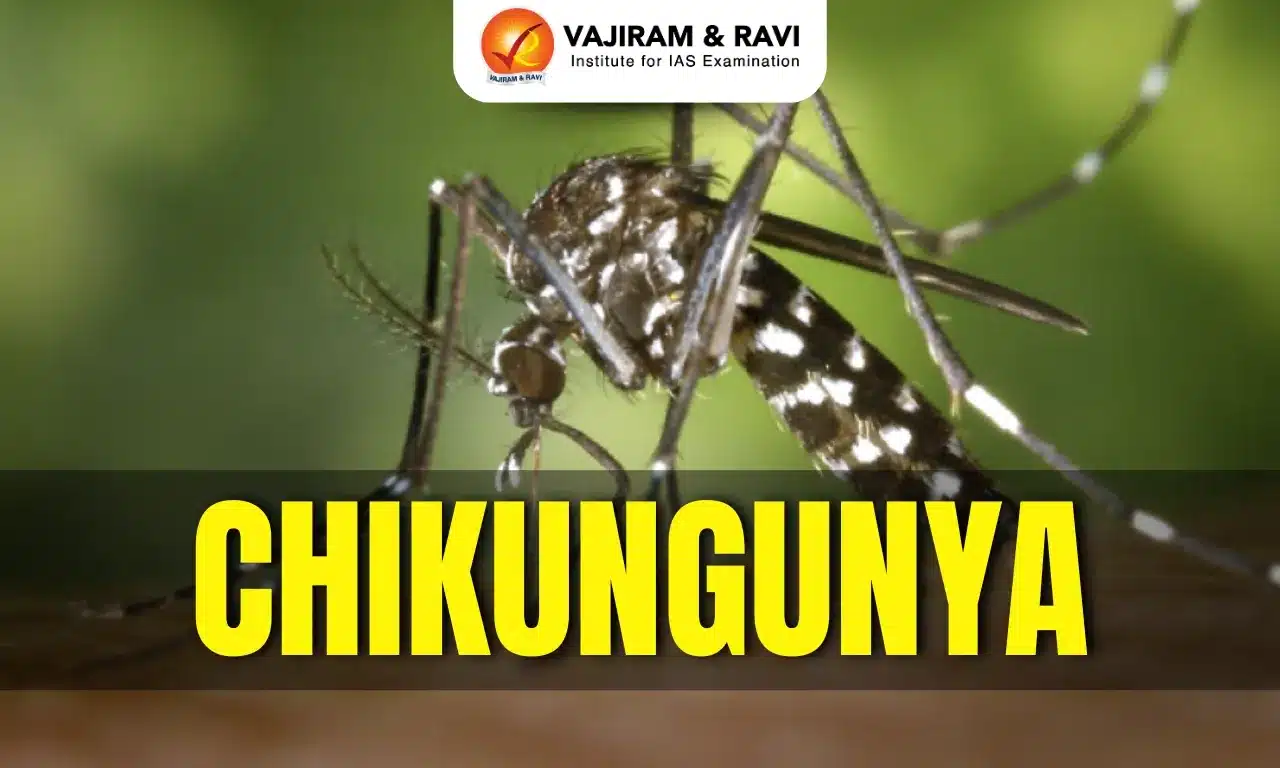
The New York State Department of Health recently confirmed the first locally acquired case of chikungunya in the United States in over six years.

About Chikungunya

  • It is a mosquito-borne viral disease caused by the chikungunya virus (CHIKV). 
  • It causes fever and severe joint pain. 
  • It was first described during an outbreak in southern Tanzania in 1952 and has now been reported in more than 110 countries in Asia, Africa, the Americas, and Europe.
  • The name “chikungunya” derives from a word in the Kimakonde language of southern Tanzania, meaning “that which bends up” and describes the stooped appearance of infected people with severe joint pain (arthralgia).

Chikungunya Transmission

  • It is transmitted to humans by the bites of infected female mosquitoes, most commonly Aedes aegypti and Aedes albopictus mosquitoes. 
  • These two species can also transmit other viruses, including dengue and Zika viruses.
  • It is not transmitted from one person to another. (i.e., it is not a contagious disease).

Chikungunya Symptoms

  • In symptomatic patients, CHIKV disease onset is typically 4–8 days (range 2–12 days) after the bite of an infected mosquito. 
  • The most common symptom is an abrupt onset of fever, often accompanied by joint pain. 
  • Other symptoms include muscle pain, headache, nausea, fatigue, and rash. 
  • Severe joint pain usually lasts a few days but can persist for months or even years. 
  • Serious complications are uncommon, but atypical severe cases can cause long-term symptoms and even death, especially in older people and in children under one year old.

Chikungunya Treatment

  • There is no vaccine or antiviral drug treatment for chikungunya.
  • Treatment is focused on relieving the symptoms.

Source: FE

Chikungunya FAQs

Q1: What causes the disease Chikungunya?

Ans: A virus.

Q2: How is Chikungunya transmitted to humans?

Ans: It is transmitted to humans by the bites of infected female mosquitoes, most commonly Aedes aegypti and Aedes albopictus mosquitoes.

Q3: What is the most common symptom of Chikungunya?

Ans: Fever and severe joint pain.

Henley Passport Index

Henley Passport Index 2025

Henley Passport Index Latest News

India’s passport has slipped to 85th rank in Henley Passport Index 2025, down five places from the previous year.

About Henley Passport Index

  • It is a popular ranking of global passports that measures passport strength by the number of destinations that holders can visit without a prior visa.
  • The index ranks countries based on statistics provided by the International Air Transport Association (IATA).
  • It started in 2006 as the Henley & Partners Visa Restrictions Index (HVRI).
  • The index includes 199 different passports and 227 different travel destinations
  • Significance: The stronger the passport, the more countries its holders can enter without a prior visa — a privilege that reflects diplomatic ties, economic influence, and international trust.

Key Highlights of Henley Passport Index 2025

  • Globally, Singapore leads the 2025 list with visa-free access to 193 destinations, followed by South Korea (190) and Japan (189).
  • Several European nations, including Germany, Italy, Spain, Luxembourg, and Switzerland, share the next few ranks with access to around 188–189 countries.
  • The United States has slipped out of the top 10 for the first time in two decades, ranking 12th this year with access to 180 destinations.
  • Afghanistan sits at the bottom (106th) offering visa-free access to just 24–26 countries.

Source: IE

Henley Passport Index FAQs

Q1: Which country topped the Henley Passport Index 2025?

Ans: Singapore

Q2: What is India's rank in the Henley Passport Index 2025?

Ans: 85th rank

Blackbuck

Blackbuck

Blackbuck Latest News

Over the last five years, the Chhattisgarh government has successfully reintroduced the blackbuck back into the state’s forests through its five-year reintroduction plan.

About Blackbuck

  • It is a species of antelope native to India and Nepal.
  • Scientific Name: Antilope cervicapra
  • Distribution
    • It is widespread in the states of Rajasthan, Gujarat, Madhya Pradesh, Tamil Nadu, Odisha, and other areas throughout peninsular India.
    • It has been declared as the state animal by the governments of Punjab, Haryana, and Andhra Pradesh. 
  • Habitat: The blackbuck mostly lives in open grasslands, dry scrub areas, and thinly forested areas.

Blackbuck Features

  • It is a medium-sized antelope. 
  • It is known for its beautiful spiraling horns. Only the male blackbucks have these horns. They can grow quite long, sometimes over 20 inches.
  • Male blackbucks are usually dark brown or black on their backs and sides. They have white fur on their bellies, inner legs, and around their eyes. This creates a striking contrast. 
  • Young males and females are lighter in color, often yellowish-brown.
  • They have very good eyesight and are also very fast runners, which comprise their main defense against predators. They can reach speeds of up to 50 miles per hour.
  • They are gregarious and social animals with herds generally ranging from 5 to 50 animals.

Blackbuck Conservation Status

It is classified as 'Least Concerned' under the IUCN Red List.

Source: IE

Blackbuck FAQs

Q1: What is the scientific name of the Blackbuck?

Ans: Antilope cervicapra

Q2: In which countries is the Blackbuck naturally found?

Ans: India and Nepal

Q3: In which Indian states is the Blackbuck commonly distributed?

Ans: Rajasthan, Gujarat, Madhya Pradesh, Tamil Nadu, and Odisha.

Q4: What type of habitat does the Blackbuck prefer?

Ans: Open grasslands and dry scrublands.

IN-RoKN Exercise

IN-RoKN Exercise

IN-RoKN Exercise Latest News

Indian Naval Ship (INS) Sahyadri recently arrived at Busan Naval Harbour, South Korea, on 13 October 2025 to participate in the inaugural India–Republic of Korea Navy (IN–RoKN) Bilateral Exercise.

About IN-RoKN Exercise

  • It is the Indian Navy (IN)–Republic of Korea Navy (RoKN) bilateral naval exercise.
  • The inaugural IN–RoKN Exercise is taking place in South Korea.
  • It will be conducted in two phases—harbour and sea—to deepen interoperability, enhance coordination, and promote professional exchanges between the two navies.
  • As part of the harbour phase, IN and RoKN officials will engage in reciprocal cross-deck visits, sharing of best practices, cross-training sessions, and sport fixtures. 
  • The Commanding Officer of INS Sahyadri will also call on senior officers of the Republic of Korea Navy, local dignitaries, and representatives from the Indian community in South Korea, reaffirming India's diplomatic goodwill and naval outreach.
  • The harbour phase will be followed by the sea phase, wherein, INS Sahyadri and ROKS Gyeongnam will undertake joint exercises.

Key Facts about INS Sahyadri

  • Commissioned in 2012, INS Sahyadri (F49) is the third ship of the Shivalik Class of Guided Missile Stealth Frigates.
  • It was designed and built indigenously by Mazagon Dock Shipbuilders Limited (MDL), Mumbai. 
  • Armed with advanced stealth features, state-of-the-art weapon systems, and cutting-edge sensors, INS Sahyadri can conduct multi-dimensional warfare operations—surface, subsurface, and air—making it a versatile asset for India's blue-water naval ambitions.
  • The frigate is based at Visakhapatnam, under the Eastern Fleet of the Eastern Naval Command.

Source: DEVD

IN-RoKN Exercise FAQs

Q1: What does the IN–RoKN Exercise?

Ans: A bilateral naval exercise between India and South Korea.

Q2: Where is the inaugural IN–RoKN Exercise taking place?

Ans: South Korea

Q3: Which Indian naval ship is participating in the inaugural IN–RoKN Exercise?

Ans: INS Sahyadri

MERCOSUR Group

MERCOSUR group

MERCOSUR Group Latest News

Recently, India and Brazil agreed to significantly expand their existing trade agreement between India and the MERCOSUR bloc.

About MERCOSUR Group

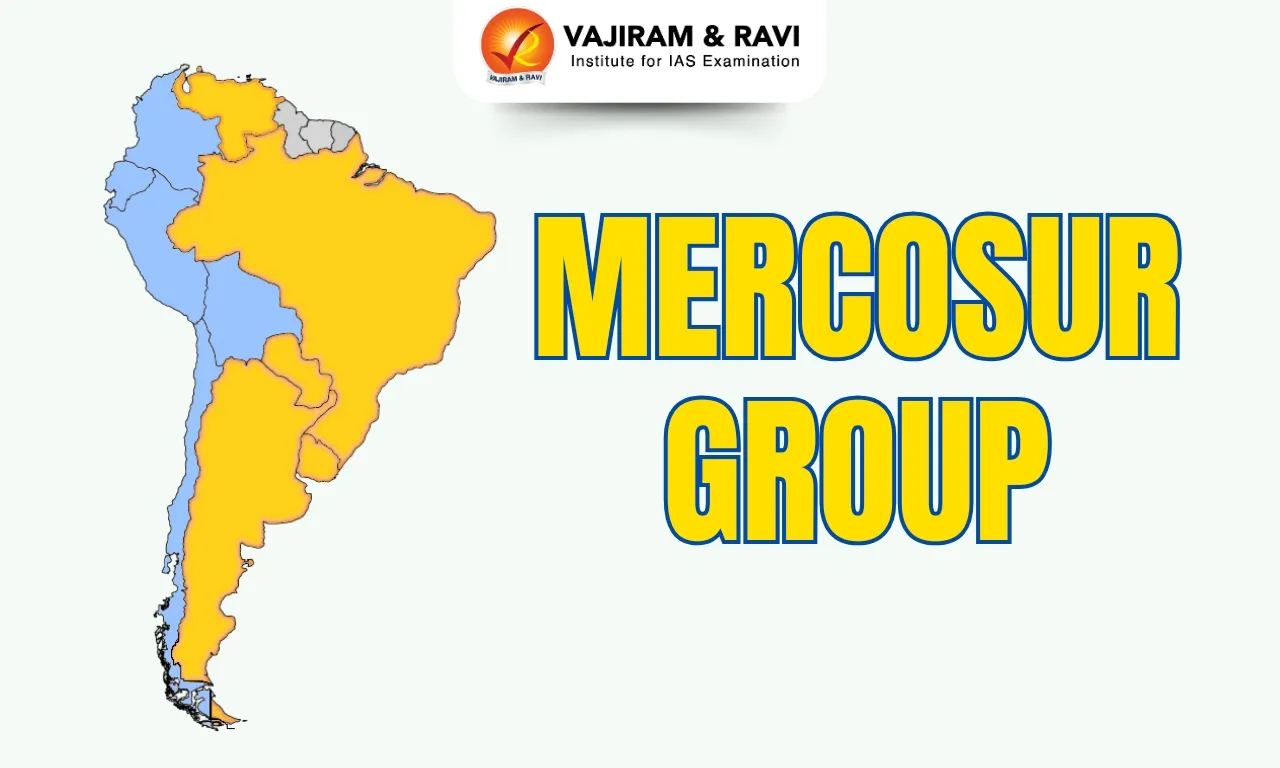
  • The Southern Common Market (MERCOSUR for its Spanish initials) is a South American regional economic organization.
  • It is the fourth largest integrated market after the European Union (EU), North American Free Trade Agreement (NAFTA), and ASEAN.
  • It was created in 1991 by signing the Treaty of Asunción.
  • Objective: Free movement of goods, services, capital and people and it became a customs union in January 1995. 
  • Member countries: 
    • It originally comprised Argentina, Brazil, Paraguay, and Uruguay as its members. 
    • Bolivia and Venezuela joined it later. (Venezuela has been suspended since December 1, 2016).
    • Mercosur also counts Chile, Colombia, Ecuador, Guyana, Peru, and Suriname as associate members.
  • Headquarters: Montevideo, Uruguay.
  • Its official working languages are Spanish and Portuguese.
  • Governance of MERCOSUR Group
    • Common Market Council:  It is the bloc's highest decision-making body, and provides a high-level forum for coordinating foreign and economic policy. 
    • The group consists of the foreign and economic ministers of each member state, or their equivalent, and decisions are made by consensus. 
    • The group’s presidency rotates every six months among its full members.
  • India and MERCOSUR: India and MERCOSUR signed a Preferential Trade Agreement (PTA) in 2004.

Source: DD News

MERCOSUR Group FAQs

Q1: What is the primary objective of MERCOSUR?

Ans: To facilitate free trade and economic cooperation

Q2: Where is the headquarters of MERCOSUR located?

Ans: Montevideo, Uruguay

Enquire Now