MAHA MedTech Mission

MAHA MedTech Mission

MAHA MedTech Mission Latest News

Recently, the Anusandhan National Research Foundation (ANRF), in collaboration with the Indian Council of Medical Research (ICMR) and the Gates Foundation, has launched the Mission for Advancement in High-Impact Areas (MAHA)-Medical Technology. 

About MAHA MedTech Mission

  • It aims to accelerate innovation in India’s medical technology sector, reduce reliance on high-cost imports, and promote equitable access to affordable and high-quality medical technologies.
  • The primary focus of the mission will be supporting the development and commercialization of high-quality, affordable, and innovative medical technologies. 

Key Objectives of MAHA MedTech Mission

  • Drive public health impact by supporting technologies that address priority disease areas and expand access to safe, high-quality care;
  • Ensure affordability and accessibility by supporting solutions that reduce costs; and
  • Enhance self-reliance and competitiveness by catalyzing indigenous MedTech development, manufacturing, and industry–academia collaboration.

Features of MAHA MedTech Mission

  • The Mission will provide funding support to Academic and R&D institutions, Hospitals, Startups, MSMEs, MedTech industry and collaborations between entities.
  • Funding: With milestone-linked funding of ₹5–25 crore per project (and up to ₹50 crore in exceptional cases), the Mission will support projects that bring impactful MedTech solutions to market.
  • The Mission will also provide enabling support through national initiatives such as;
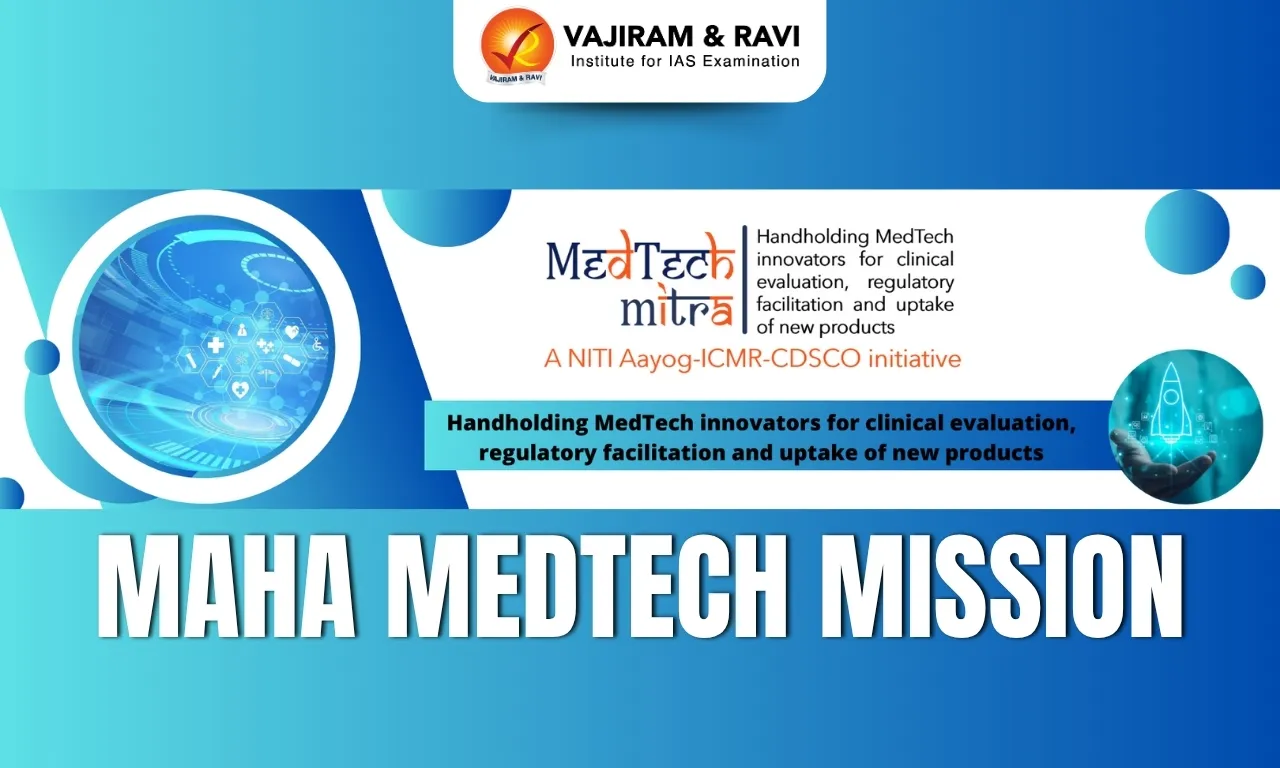
    • Patent Mitra (IP protection and technology transfer), MedTech Mitra (regulatory guidance and clearances), a Clinical Trial Network (for clinical validation and evidence generation), as well as mentorship from industry experts.
  • Total duration of the Mission: 5 Years

Source: PIB

MAHA MedTech Mission FAQs

Q1: What is the primary objective of the MAHA MedTech Mission?

Ans: To enhance healthcare equity through affordable and sustainable medical technologies.

Q2: Which organizations are collaborating on the MAHA MedTech Mission?

Ans: Anusandhan National Research Foundation (ANRF) and Gates Foundation
Pilot Whales

Pilot Whales

Pilot Whales Latest News

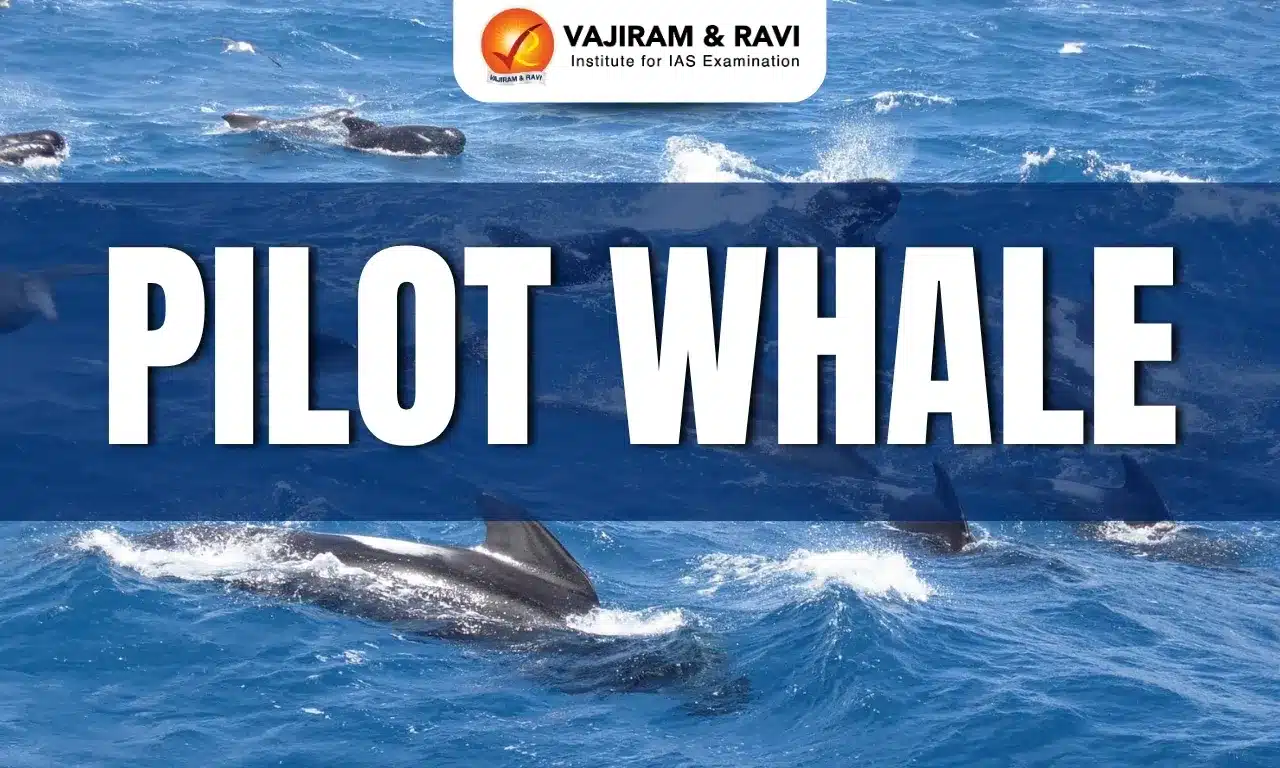
Recently, more than two dozen pilot whales have died after becoming stranded on a remote beach in New Zealand.

About Pilot Whales

  • Pilot whales are one of the largest members of the Delphinidae family.
  • There are two species of pilot whales: Short-finned pilot whales (Globicephala macrorhynchus) and Long-finned pilot whales (G. melas),
  • Habitat: Short-finned pilot whales found in tropical and warm-temperate waters, while long-finned species inhabit cold-temperate and sub-polar oceans.
  • Distribution: They are distributed in the Pacific Ocean, Atlantic Ocean and seas near Australia, New Zealand, Japan, and India.

Features of Pilot Whales

  • They are characterized by a round bulging forehead, a short beaklike snout, and slender pointed flippers. 
  • Both long-finned and short-finned pilot whales are about 4–6 metres (13–20 feet) long.
  • Males of both species are larger than females.
  • These whales live in groups numbering from dozens to hundreds or even thousands of individuals and feed mainly on squid.
  • These groups are based on matrilineal lines – meaning that calves stay with their mothers through adulthood. 
  • Conservation Status: IUCN: Least concern

Source: DD News

Pilot Whale FAQs

Q1: What is a distinctive behavior of Pilot Whales?

Ans: They are known for their complex social structures and group behavior.

Q2: Where are Pilot Whales commonly found?

Ans: In tropical and subtropical oceans

ICGS Ajit and ICGS Aparajit

ICGS Ajit and ICGS Aparajit

ICGS Ajit and ICGS Aparajit Latest News

Recently, the Indian Coast Guard (ICG) launched two advanced Fast Patrol Vessels (FPVs) — ICGS Ajit and ICGS Aparajit — at Goa Shipyard Limited (GSL).

About ICGS Ajit and ICGS Aparajit

  • These two vessels are the seventh and eighth in a series of eight indigenously built Fast Patrol Vessels (FPVs).
  • Built By:  The Goa Shipyard Limited (GSL).

Features of ICGS Ajit and ICGS Aparajit

  • Design:  52 metres in length and displacing 320 tonnes,
  • Propulsion: These vessels are equipped with Controllable Pitch Propellers (CPP) offering superior manoeuvrability and propulsion efficiency.
  • Roles: They are capable of multi-mission roles including fisheries protection, coastal patrol, anti-smuggling, anti-piracy and search & rescue operations, particularly around India’s island territories and Exclusive Economic Zone.

Key Facts about the Indian Coast Guard

  • It was formally established in 1978 by the Coast Guard Act, 1978 as an independent armed force of India.
  • Administration: The organization is headed by the Director General Indian Coast Guard (DGICG).
  • Nodal ministry: It operates under the Ministry of Defence.
  • Headquarter: New Delhi

Functions of Indian Coast Guard

  • Ensuring the safety and protection of artificial Islands, offshore terminals, installations and other structures and devices in any maritime zone.
  • Providing protection and assistance to fishermen in distress while at Sea.
  • Preservation and protection of our maritime environment including prevention and control of marine pollution.
  • Enforcement of Maritime Zones of India Act.

 Source: PIB

ICGS Ajit and ICGS Aparajit FAQs

Q1: What type of vessels are ICGS Ajit and ICGS Aparajit?

Ans: Fast Patrol Vessels (FPVs)

Q2: What is the primary purpose of ICGS Ajit and ICGS Aparajit?

Ans: To enhance India's maritime security and surveillance capabilities

Key Facts About Timor Leste

Key Facts About Timor Leste

Timor Leste Latest News

Recently, Timor Leste (East Timor) formally admitted to the Association of Southeast Asian Nations (ASEAN) in the group’s first expansion since the 1990s.

About Timor Leste

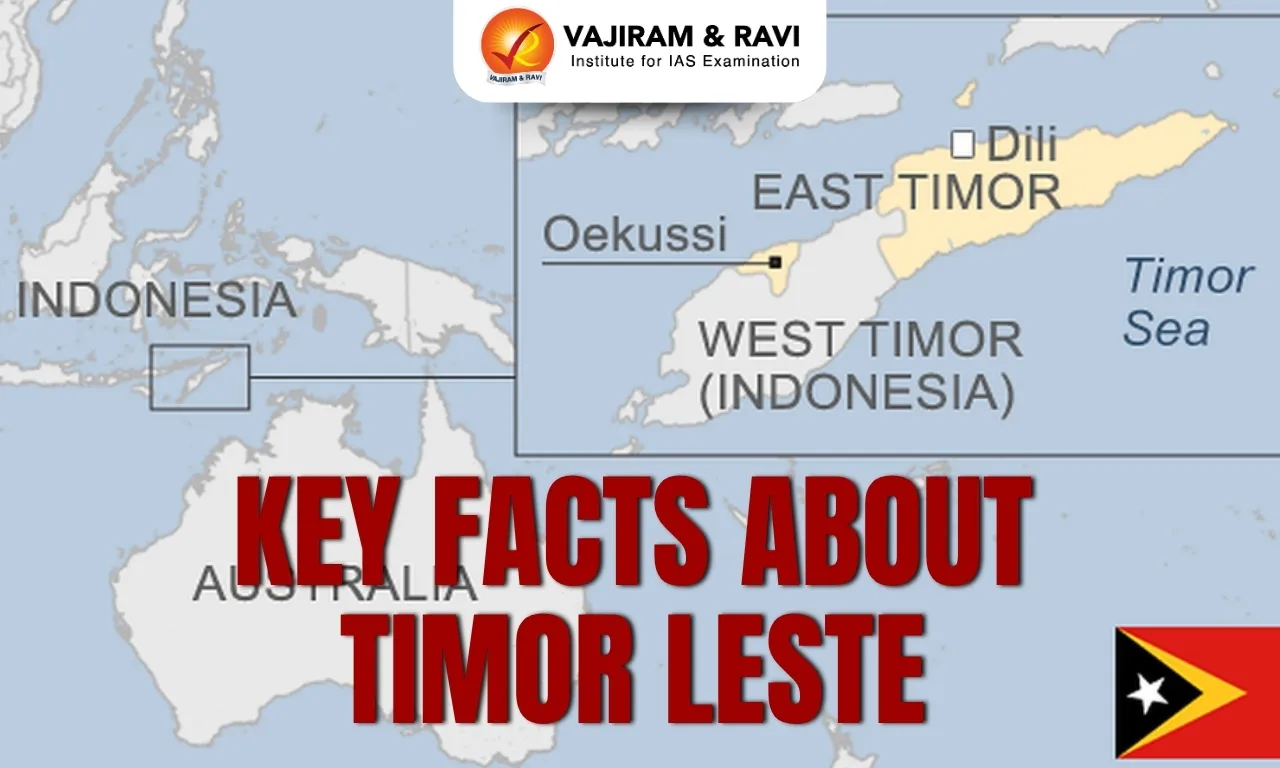
  • Timor Leste or East Timor is an island country in the Eastern Lesser Sunda Islands, at the southern extreme of the Malay Archipelago in Southeast Asia.
  • It also includes an exclave on this island's northwestern side that is bounded by West Timor of Indonesia.
  • It is bounded by the Wetar Strait in the north and the Ombai Strait in the northwest, Timor Sea to southeast and Western Timor to the southwest.
  • Climate and biodiversity: The area has a dry tropical climate and moderate rainfall. Hilly areas are covered with sandalwood.
  • Scrub and grass grow in the lowlands, together with coconut palms and eucalyptus trees.
  • Highest Point: Mount Tatamailau
  • Rivers: The most significant rivers are the Lakla, Lies and Seical.
  • Natural resources: Gold, petroleum, natural gas, manganese, marble
  • Population: Most of the people are of Papuan, Malayan, and Polynesian origin 
  • Capital City: Dili

Source: TH

Timor Leste FAQs

Q1: What is the capital of Timor-Leste?

Ans: Dili

Q2: What is the main source of revenue for Timor-Leste?

Ans: Oil and gas

SWAMIH Fund

SWAMIH Fund

SWAMIH Fund Latest News

The Reserve Bank of India will exempt a government-backed SWAMIH fund from its tightened rules for alternate investment funds (AIF).

About SWAMIH Fund

  • The Special Window for Affordable and Mid-Income Housing (SWAMIH) Investment Fund I was set up in 2019 to rescue stressed real estate projects by providing debt financing for stalled housing projects.
  • The Fund is sponsored by the Ministry of Finance, Government of India.
  • Fund Managed by: It is managed by SBICAP Ventures Ltd
  • It is a Category-II AIF (Alternate Investment Fund) debt fund registered with the Securities and Exchange Board of India.
  • The SWAMIH Fund is considered the lender of last resort for distressed projects for established developers with troubled projects.

Eligibility Criteria for Funding

  • Real estate projects must be registered under the Real Estate (Regulation and Development) Act (RERA) 2016.
  • The project must be classified as a non-performing asset (NPA) or be under insolvency proceedings.
  • The project should have been declared as a “stalled” or “delayed” project by a competent authority.
  • The fund is available only for projects that fall under the affordable and mid-income housing categories.

Source: ET

SWAMIH Fund FAQs

Q1: What does SWAMIH stand for?

Ans: Special Window for Affordable and Mid-Income Housing

Q2: What is the primary objective of the SWAMIH Fund?

Ans: To provide debt financing for stressed residential projects in the affordable and mid-income categories.

Kamlang Tiger Reserve

Kamlang Tiger Reserve

Kamlang Tiger Reserve Latest News

Arunachal Pradesh Deputy Chief Minister recently said the state government will develop a nature trail and an angling spot in the Kamlang Tiger Reserve area in the Lohit district to promote tourism and empower local communities.

About Kamlang Tiger Reserve

  • It is located in the southeastern part of Lohit District in Arunachal Pradesh near the border with Myanmar.
  • It is a part of the larger Eastern Himalayan Biodiversity Hot Spot.
  • It is named after the Kamlang River, which flows through the reserve and joins the Brahmaputra.
  • It is spread between the famed Namdapha National Park on its south and the Lang River on its north.
  • The western border is formed by the Lati River, while its eastern part is bordered by the Tawe River. 
  • The local inhabitants of the Sanctuary are known as Hishmi, Digaru, and Mizo. 
  • Landscape: It encompasses a diverse range of landscapes, including dense tropical forests, grasslands, rivers, and hills.
  • Climate: It enjoys a subtropical climate as it falls within the subtropical zone.
  • Vegetation: The vegetation types include moist evergreen tropical forests in the foothills and subtropical and temperate forests in higher elevations.
  • Flora: Common species of trees in the reserve include Ammora wallichi (Amari), Gmelina arborea (Gamari), Terminalia chebula (Hillika), Canarium resigniferum (Dhuna), and many others.
  • Fauna:
    • All four big cats, including the Snow Leopard, Clouded Leopard, Leopard and Tiger, are the common inhabitants. 
    • Certain endangered species, such as Himalayan Palm Civets, Leopard Cat, Slow Lories and Hoolock Gibbon, can also be spotted in the sanctuary.
    • Other species commonly found here are Giant and Flying Squirrels, Hornbills, Deer, Civets, Boar, Capped Langur, Stump Tailed Macaque etc.

Source: ET

Kamlang Tiger Reserve FAQs

Q1: Where is the Kamlang Tiger Reserve located?

Ans: It is located in the southeastern part of Lohit District in Arunachal Pradesh.

Q2: Kamlang Tiger Reserve lies close to the international border with which country?

Ans: Myanmar

Q3: The Kamlang River, after flowing through the reserve, ultimately joins which major river?

Ans: Brahmaputra

Q4: Kamlang Tiger Reserve shares its southern boundary with which famous national park?

Ans: Namdapha National Park

Lower Subansiri Hydroelectric Project

Lower Subansiri Hydroelectric Project

Lower Subansiri Hydroelectric Project Latest News

India’s largest hydroelectric project, the 2000-MW Subansiri Lower Hydroelectric Project, has begun its commissioning phase.

About Lower Subansiri Hydroelectric Project

  • It is a 2000 MW run-of-the-river hydro project being constructed on the Subansiri River, a tributary of the Brahmaputra.
  • It is located at Gerukamukh on the Arunachal Pradesh–Assam border.
  • It will be the single largest hydroelectric plant in India when completed.
  • The project is being developed by the state-run National Hydro Power Corporation (NHPC).
  • The construction of the project has been underway since 2005.
  • The project cost was met through 70% equity and 30% debt financing by the provision of a term loan. The central government is providing budgetary support as part of the equity component.

Lower Subansiri Hydroelectric Project Features

  • It consists of a concrete gravity dam, which will be 116 m high from the riverbed level and 130 m from the foundation. 
  • The length of the dam will be 284 m. The gross storage capacity of the reservoir will be 1.37 km3.
  • The powerhouse will comprise eight Francis-type turbines capable of generating 250 MW of electricity each. 
  • It will also have eight horseshoe-shaped headrace tunnels, eight horseshoe-shaped surge tunnels , and eight circular penstocks.
  • A tailrace channel (35 m long and 206 mwide) will take the water discharged by the turbines back to the river.

Source: TOI

Lower Subansiri Hydroelectric Project FAQs

Q1: The Lower Subansiri Hydroelectric Project is being constructed on which river?

Ans: It is being constructed on the Subansiri River, a tributary of the Brahmaputra.

Q2: The Lower Subansiri Hydroelectric Project is located on the border between which two states?

Ans: Arunachal Pradesh and Assam

Q3: What is the total installed capacity of the Lower Subansiri Hydroelectric Project?

Ans: 2,000 MW

Q4: What type of hydroelectric project is the Lower Subansiri?

Ans: Run-of-the-river project.

Indo-Tibetan Border Police (ITBP)

Indo-Tibetan Border Police

Indo-Tibetan Border Police (ITBP) Latest News

Prime Minister recently extended greetings to the Indo-Tibetan Border Police (ITBP) on its 64th Raising Day, commending the force for its unwavering dedication, courage, and humanitarian service in protecting the nation’s frontiers.

About Indo-Tibetan Border Police (ITBP)

  • It is a Central Armed Police Force functioning under the Ministry of Home Affairs, Government of India.
  • This force guards the 3,488 km long India-China border through 197 BOPs situated at altitudes ranging from 9,000 ft to 18,750 ft from Karakoram Pass in Ladakh to Jachep La in Arunachal Pradesh.
  • Background:
    • It was raised in 1962, in the wake of the Sino-Indian War of 1962, for deployment along India’s border with China’s Tibet Autonomous Region.
    • ITBP was initially raised under the CRPF Act. However, in 1992, parliament enacted the ITBPF Act, and the rules thereunder were framed in 1994.
    • In 2004, ITBP was declared as a full-fledged central armed police force under the Ministry of Home Affairs.
  • Motto: “Shaurya-Dridhata-Karma Nishtha” (Valour – Determination – Devotion to Duty).
  • Known as one of the most specialized mountain forces in the world, ITBP operates in some of the harshest and most remote areas, where temperatures can drop below -40°C.
  • ITBP trains its personnel in mountaineering, skiing, and tactical combat, in addition to maintaining readiness for disaster response and relief operations in the Himalayan region. 
  • It is headed by a Director General under the Ministry of Home Affairs.
  • Headquarter: New Delhi.

Source: DDN


Indo-Tibetan Border Police (ITBP) FAQs

Q1: The Indo-Tibetan Border Police (ITBP) functions under which Ministry?

Ans: Ministry of Home Affairs

Q2: The Indo-Tibetan Border Police (ITBP) primarily guards India’s border with which country?

Ans: China

Q3: What is the total length of the border guarded by the ITBP?

Ans: 3,488 km

Q4: What is the motto of the Indo-Tibetan Border Police (ITBP)?

Ans: Shaurya-Dridhata-Karma Nishtha

Rashtriya Vigyan Puraskar

Rashtriya Vigyan Puraskar

Rashtriya Vigyan Puraskar Latest News

The Centre recently announced the Rashtriya Vigyan Puraskar (RVP) — its Padma-style national awards for scientific achievement — with 24 individual awards and one team award.

About Rashtriya Vigyan Puraskar 

  • Modelled on the Padma awards, the Rashtriya Vigyan Puraskar is one of the highest recognitions in the field of science, technology, and innovation in India.
  • Objective: To recognize the notable and inspiring contribution made by the scientists, technologists, and innovators individually or in teams in various fields of science, technology, and technology­-led innovation.
  • Eligibility: 
    • Scientists/technologists/innovators working in government or private sector organizations or any individual working outside any organization, who have made distinguished contributions in terms of path-breaking research or innovation or discovery in any field of science, technology, or technology-led innovation shall be eligible for the awards. 
    • People of Indian Origin staying abroad with exceptional contributions benefiting the Indian communities or society shall also be eligible for the awards.
  • The awards shall be given in the following four categories:
    • Vigyan Ratna (VR) award will recognize lifetime achievements & contributions made in any field of science and technology.
    • Vigyan Shri (VS) award will recognize distinguished contributions in any field of science and technology.
    • Vigyan Yuva-Shanti Swarup Bhatnagar (VY-SSB) award will recognize & encourage young scientists up to the age of 45 years who made an exceptional contribution in any field of science and technology.
    • Vigyan Team (VT) award to be given to a team comprising three or more scientists/researchers/innovators who have made an exceptional contribution working in a team in any field of science and technology.
  • It shall be given in the 13 domains, namely Physics, Chemistry, Biological Sciences, Mathematics & Computer Science, Earth Science, Medicine, Engineering Sciences, Agricultural Science, Environmental Science, Technology & Innovation, Atomic Energy, Space Science and Technology, and Others.
    • The representation from each domain/field, including gender parity will be ensured.

Source: TH

Rashtriya Vigyan Puraskar (RVP) FAQs

Q1: What is the primary objective of the Rashtriya Vigyan Puraskar (RVP)?

Ans: To recognize notable contributions in science, technology, and innovation.

Q2: Who is eligible to receive the Rashtriya Vigyan Puraskar (RVP)?

Ans: Scientists, technologists, and innovators from both government and private sectors.

Q3: How many scientific domains are covered under the Rashtriya Vigyan Puraskar?

Ans: It shall be given in the 13 domains.

PM- Ayushman Bharat Health Infrastructure Mission (PM-ABHIM)

PM- Ayushman Bharat Health Infrastructure Mission (PM-ABHIM)

PM- Ayushman Bharat Health Infrastructure Mission (PM-ABHIM) Latest News

The Pradhan Mantri–Ayushman Bharat Health Infrastructure Mission (PM-ABHIM), launched in October 2021, has emerged as one of India’s largest healthcare initiatives aimed at strengthening the nation’s preparedness for future pandemics and health emergencies.

About PM- Ayushman Bharat Health Infrastructure Mission (PM-ABHIM)

  • Launched in 2021, PM-ABHIM is one of India’s largest pan-national programmes aimed at developing a resilient, accessible, and self-reliant public health system.
  • It is a Centrally Sponsored Scheme (CSS) with some Central Sector Components (CS), which has an outlay of Rs. 64,180 crores for the scheme period (2021-22 to 2025-26).
  • The Mission focuses on strengthening health infrastructure from the grassroots to the district level through the establishment and upgradation of Ayushman Arogya Mandirs (AAMs), Block Public Health Units, Integrated District Public Health Labs, and Critical Care Hospital Blocks in every district. 
    • These facilities aim to bridge service delivery gaps and ensure comprehensive primary, secondary, and critical care closer to communities.
  • PM-ABHIM also prioritises pandemic and disaster preparedness by expanding an IT-enabled, real-time disease surveillance network that integrates laboratories at block, district, regional, and national levels to detect, investigate, and prevent outbreaks effectively.
  • Additionally, it promotes health research and innovation, particularly on COVID-19 and other infectious diseases, by advancing the One Health approach, which recognises the interdependence of human, animal, and environmental health.
  • The Mission also aims to fill critical gaps in both urban and rural areas by creating Urban Health and Wellness Centres (AAM) in slum areas and converting Sub-Centres into AAMs.
  • Collectively, PM-ABHIM envisions a robust health ecosystem capable of withstanding future health emergencies while ensuring equitable and quality healthcare for all citizens.

Source: LOKMAT

PM- Ayushman Bharat Health Infrastructure Mission (PM-ABHIM) FAQs

Q1: When was the PM–Ayushman Bharat Health Infrastructure Mission (PM-ABHIM) launched?

Ans: 2021

Q2: What is the primary objective of PM-ABHIM?

Ans: To strengthen health infrastructure and build a resilient public health system.

Q3: What is the total financial outlay of PM-ABHIM for the period 2021–22 to 2025–26?

Ans: ₹64,180 crore

Q4: PM-ABHIM is implemented as which type of scheme?

Ans: It is a Centrally Sponsored Scheme (CSS) with some Central Sector Components (CS).

Enquire Now