Taal Volcano

Taal Volcano

Taal Volcano Latest News

Recently, the Taal Volcano in the Philippines reportedly erupted three times.

About Taal Volcano

  • Location: It is located in Batangas province about 70 kilometers south of Manila, Philippines.
  • Taal is classified as a “complex” volcano by the Philippine Institute of Volcanology and Seismology (PHIVOLCS).
  • Previous eruptions: Taal is an active volcano within a massive caldera, with at least 38 recorded eruptions in the last 450 years.
  • The caldera is believed to have formed during a series of prehistoric eruptions between 140,000 and 5,380 BCE.

Features of Taal Volcano

  • It is a stratovolcano with a crater lake on a 5-km-wide volcanic island within a large caldera.
  • It does not rise from the ground as a distinct, singular dome but consists of multiple stratovolcanoes, conical hills and craters of all shapes and sizes.

What is a Complex Volcano?

  • It is also called a compound volcano, is one that consists of a complex of two or more vents, or a volcano that has an associated volcanic dome, either in its crater or on its flanks. Examples: Vesuvius, besides Taal.

Source: India TV

Taal Volcano FAQs

Q1: Where is Taal Volcano located?

Ans: Philippines

Q2: What type of volcano is Taal Volcano?

Ans: Complex volcano

Loktak Lake

Loktak Lake

Loktak Lake Latest News

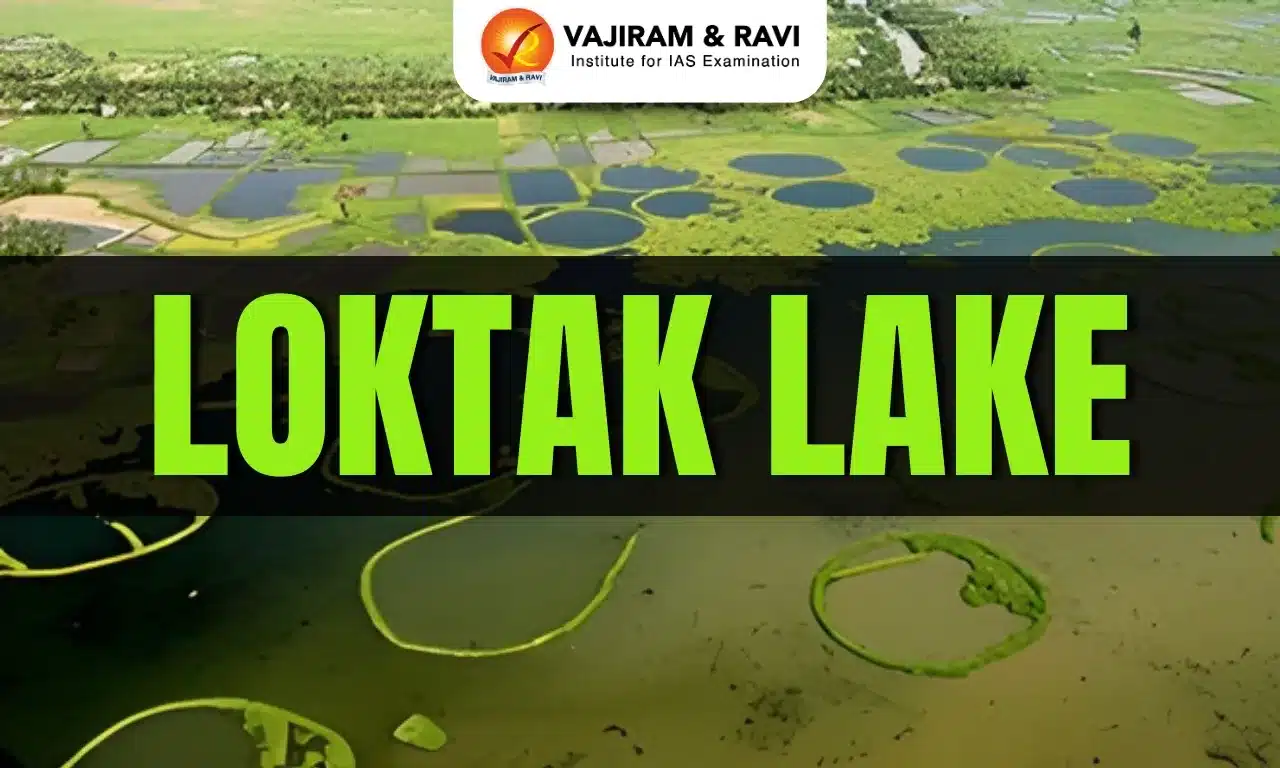
Recently, a Nagaland University study has flagged an environmental worry for Manipur’s Loktak Lake.

About Loktak Lake

  • Location: It is located in the state of Manipur.
  • It is the largest freshwater lake in Northeast India. 
  • It is famous for the phumdis floating over it. 
  • The Keibul Lamjao National Park, home to the rare brow-antlered deer, is an integral part of the lake.
  • Rivers like Khuga, Western, Nambul, Imphal, Kongba, Iril, Thoubal, Heirok, and Sekmai drain into this lake.
  • It was designated as a wetland of international importance under the Ramsar Convention in 1990. 
  • It features under the Montreux Record in 1993, “a record of Ramsar sites where changes in ecological character have occurred, are occurring or are likely to occur”.
  • Flora and Fauna: Loktak Lake is home to 132 plant species and 428 animal species.
  • It supports hydropower, fisheries, transport, and tourism.

Issues Highlighted by the Study

  • Changes in land use, agriculture, settlements, and shifting cultivation have been deteriorating the water quality of rivers feeding the lake.
  • These activities are threatening its biodiversity and the livelihoods of the local communities.

Source: TH

Loktak Lake FAQs

Q1: What is the unique feature of Loktak Lake?

Ans: It has floating phumdis (biomass)

Q2: Where is Loktak Lake located?

Ans: Manipur

Dilmun Civilization

Dilmun Civilization

Dilmun Civilization Latest News

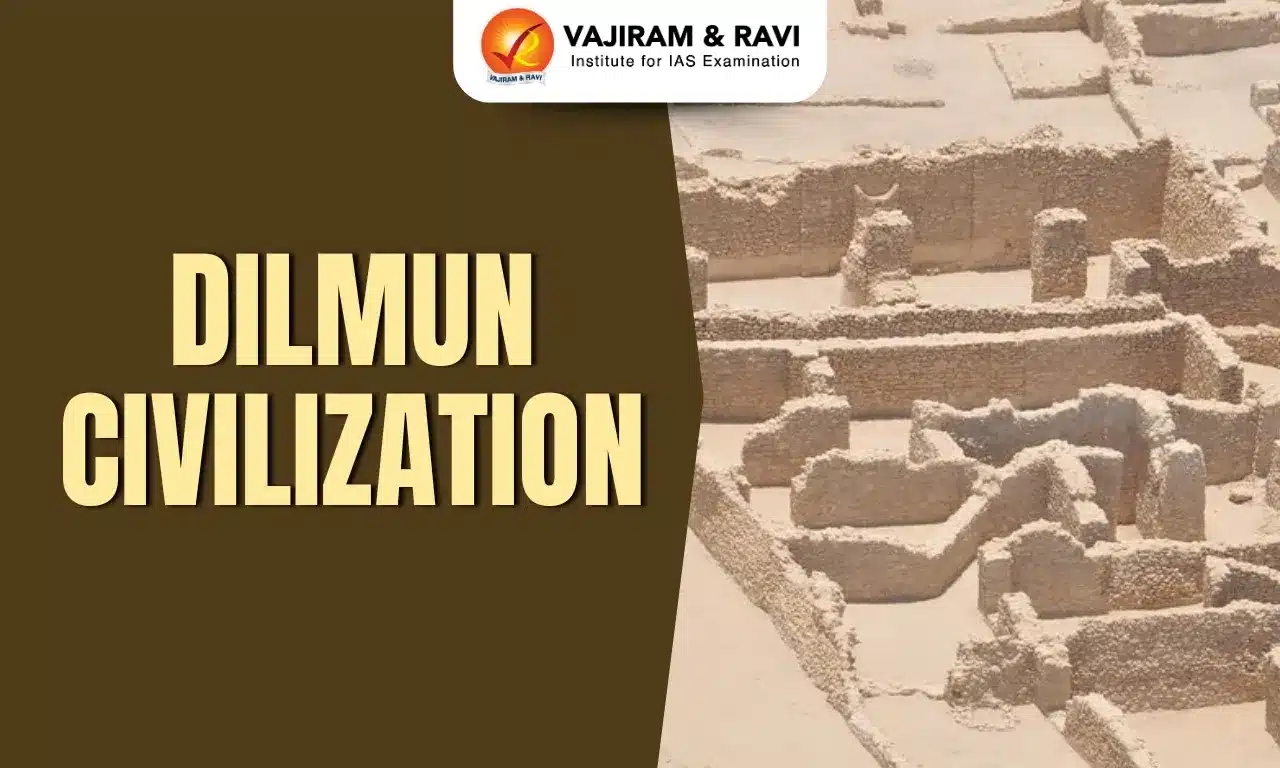
Kuwait's Failaka Island has just yielded one of its most significant secrets in decades: a 4,000-year-old temple belonging to the powerful Bronze Age Dilmun civilization.

About Dilmun Civilization

  • Dilmun (Telmun) was a civilization located in the eastern part of the Arabian Peninsula.
  • Dilmun was mainly located on the islands of Bahrain and Failaka Island in Kuwait. 
  • It also had a presence in parts of Saudi Arabia, Qatar, Oman, and the nearby Iranian coast in the Persian Gulf.
  • Although this was quite an old civilization, it is much less famous than the four cradles of civilization of the Old World, i.e., Mesopotamia, Ancient Egypt, the Indus Valley Civilization, and the Yellow River Civilization.
  • Growth
    • The Dilmun civilization first took shape towards the end of the 4th millennium BCE, around 3200 to 3000 BCE, starting out as a modest trading hub. 
    • By the early 3rd millennium BCE, it had grown into a recognised power in the region. 
    • Dilmun acted as a central point for trade between two of the biggest ancient civilizations: Mesopotamia (modern-day Iraq) and the Indus Valley Civilization (modern-day Pakistan and India). 
    • Goods like copper, pearls, and other materials passed through Dilmun. This made it a rich and powerful place.
  • The Land of Copper: 
    • One of Dilmun's most important roles was providing copper. Copper was a vital metal in the Bronze Age, used for tools, weapons, and art. 
    • Dilmun helped supply this important metal to Mesopotamia, which needed it for its growing cities and armies.
  • Decline
    • After 1600 BCE, the empire began to dwindle, then slowly declined like many other empires. 
    • It was eventually absorbed into Mesopotamia and Persia at a later date.
  • Archaeologists have found many ancient sites in Bahrain and Kuwait that match the descriptions of Dilmun.
    • These sites include old settlements, burial mounds, and artifacts like unique stamp seals.

Source: TOI

Dilmun Civilization FAQs

Q1: The Dilmun Civilization was primarily located in which part of the world?

Ans: Eastern part of the Arabian Peninsula.

Q2: The main centers of the Dilmun Civilization were located on which islands?

Ans: Dilmun was mainly located on the islands of Bahrain and Failaka Island in Kuwait.

Q3: Around which period did the Dilmun Civilization first take shape?

Ans: The Dilmun civilization first took shape towards the end of the 4th millennium BCE, around 3200 to 3000 BCE.

Q4: The Dilmun Civilization acted as an important trading link between which two ancient civilizations?

Ans: Mesopotamia and Indus Valley Civilization.

Bondla Wildlife Sanctuary

Bondla Wildlife Sanctuary

Bondla Wildlife Sanctuary Latest News

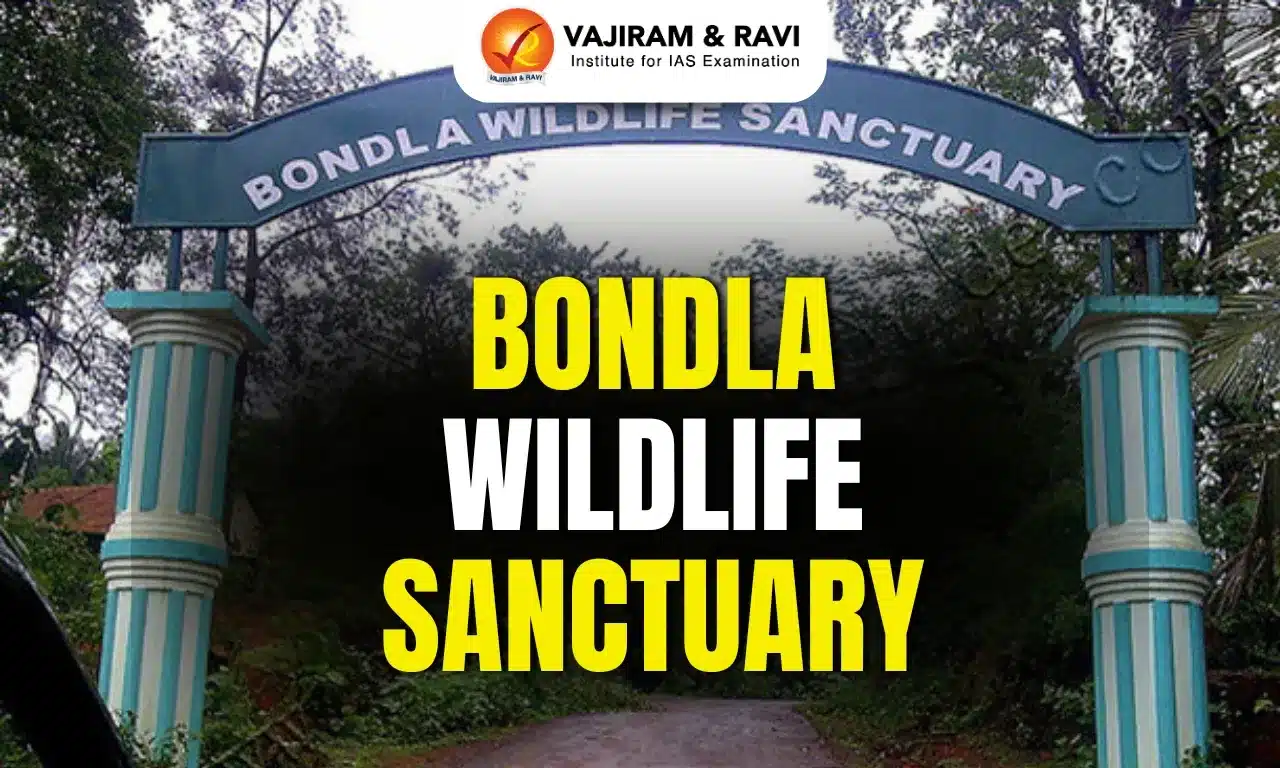
Goa’s only zoo, located within the Bondla Wildlife Sanctuary, is set to welcome new animals after 12 years—a barking deer and a pair of sloth bears.

About Bondla Wildlife Sanctuary

  • It is located in the northeastern portion of Goa.
  • It is spread over an area of approximately 8 sq.km. and is located 3000 ft. above on the lush foothills of the Western Ghats
  • Because of the fact that it is very small in size, the Bondla Wildlife Sanctuary is better known as a wildlife resort. 
  • This sanctuary was initially set up as a refuge for orphaned and injured animals. 
  • Today, apart from the wildlife species, the sanctuary houses a deer safari park, a rose garden, a zoo, and a botanical garden too.
  • The Rangado river flows on the eastern side, while the Madhel flows across the northern side.
  • Vegetation: The sanctuary is mostly covered with moist deciduous forest with small patches of semi-evergreen forest and cane along streams. 
  • Flora: The dominant trees in this Sanctuary are Terminalia crenulata (Matti, the state tree of Goa) and Rosewood.
  • Fauna
    • It is home to animals like Panthers, Leopard Cats, Deer, Wild Boar, Gaur, and Malabar Giant Squirrel.
    • The bird species include Common Grey Hornbills, Golden-Backed Woodpeckers and  Ruby-Throated Yellow Bulbuls.

Source: TOI

Bondla Wildlife Sanctuary FAQs

Q1: In which Indian state is the Bondla Wildlife Sanctuary located?

Ans: Goa

Q2: What is the approximate area of the Bondla Wildlife Sanctuary?

Ans: It is spread over an area of approximately 8 sq.km.

Q3: The Bondla Wildlife Sanctuary was initially set up for what purpose?

Ans: As a refuge for orphaned and injured animals.

Q4: Which type of forest vegetation dominates the Bondla Wildlife Sanctuary?

Ans: Moist deciduous forest with patches of semi-evergreen forest.

INS IKSHAK

INS IKSHAK

INS IKSHAK Latest News

The Indian Navy’s indigenously built Survey Vessel (Large), Ikshak, is set to be commissioned at Naval Base Kochi. 

About INS IKSHAK

  • It is the indigenously built Survey Vessels (Large) (SVL) which will study underwater hydrography.
  • The ship’s name, Ikshak, meaning “The Guide”, symbolises its purpose: to chart unexplored waters, ensure safe navigation for mariners.
  • It is constructed by Garden Reach Shipbuilders & Engineers (GRSE) Ltd, Kolkata.

Features of INS IKSHAK

  • It boasts over 80% indigenous content.
  • The Survey Vessel (Large) ships are 110 m long, 16 m wide with deep displacement of 3400 tons.
  • The propulsion system of the ship consists of two Main Engines in twin shaft configuration and is designed with cruise speed of 14 knots and maximum speed of 18 knots.
  • Role: Beyond its primary role in hydrographic survey operations, Ikshak is equipped with dual-role functionality, enabling it to operate as a Humanitarian Assistance and Disaster Relief (HADR) platform and a hospital ship during emergencies.
  • It is the first vessel in the SVL class to feature dedicated accommodation for women officers and sailors

Source: PIB

INS IKSHAK FAQs

Q1: What is the primary role of INS Ikshak?

Ans: Hydrographic survey operations

Q2: What is the significance of INS Ikshak's design?

Ans: It has a dedicated women-specific accommodation.

Sunni Dam Hydro Electric Project

Sunni Dam Hydro Electric Project

Sunni Dam Hydro Electric Project (HEP) Latest News

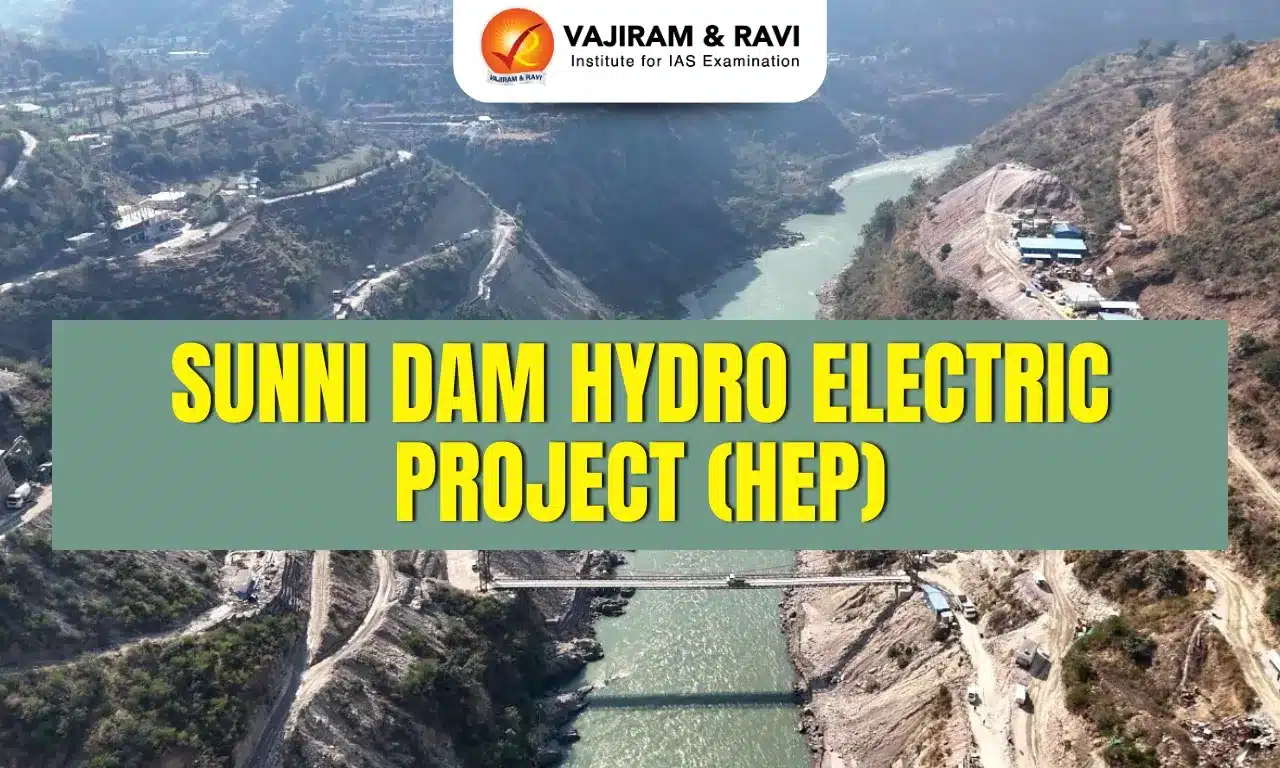
The National Green Tribunal (NGT) has taken cognisance of a complaint alleging illegal dumping of muck into the Sutlej during blasting activities for the construction of the Sunni Dam hydroelectric project in Shimla district’s Sunni tehsil.

About Sunni Dam Hydro Electric Project (HEP)

  • It is a 382 MW run-of-the-river hydroelectric project.
  • It is being developed on the Satluj River in the Shimla and Mandi districts of Himachal Pradesh.
  • The project is owned by Satluj Jal Vidyut Nigam (SJVN), a collaborative venture between the government of India and the state government of Himachal Pradesh.
  • Sunni HEP will involve building a concrete gravity dam across the Satluj River and an underground powerhouse on the right bank of it.
  • The project will generate 1,382 million units of electricity annually.
  • The project is a part of the larger Luhri HEP, which is being developed in three distinct stages along the Satluj River within the northern Indian state of Himachal Pradesh.
    • The stages comprise the 210 MW Luhri Stage-1, the 172 MW Luhri Stage-II, and the 382 MW Sunni HEP.

Source: TI

Sunni Dam Hydro Electric Project (HEP) FAQs

Q1: On which river is the Sunni Dam Hydro Electric Project (HEP) being developed?

Ans: Satluj River

Q2: The Sunni Dam Hydro Electric Project is located in which Indian state?

Ans: Himachal Pradesh

Q3: What is the total installed capacity of the Sunni Dam Hydro Electric Project?

Ans: 382 MW

Benzene

Benzene

Benzene Latest News

Two centuries after Benzene discovery, the simple yet revolutionary molecule benzene continues to shape our world.  

About Benzene

  • Benzene is a colorless liquid with a sweet odor.
  • Discovered by: In 1825, the English scientist Michael Faraday, isolated a new substance from the oily residue of the illuminating gas used to light London and August Kekulé proposed a revolutionary cyclic structure for benzene.

Properties of Benzene

  • It evaporates into the air very quickly and dissolves slightly in water.
  • It is highly flammable and is formed from both natural processes and human activities.
  • Natural sources of benzene include volcanoes and forest fires.
  • It forms the base for styrene, phenol, cyclohexane, nylon, and polystyrene.
  • It belongs to the BTEX family (Benzene, Toluene, Ethylbenzene, Xylene) of so called aromatics because of their sweet, pleasant smell.

Applications of Benzene

  • Some industries use benzene to make other chemicals which are used to make plastics, resins, and nylon and synthetic fibers.
  • Benzene is also used to make some types of rubbers, lubricants, dyes, detergents, drugs, and pesticides.
  • Impact on Health: Long-term exposure to Benzene leads to acute myeloid leukaemia, aplastic anemia, and myelodysplastic syndrome.

Source: TH

Benzene FAQs

Q1: What is benzene classified as?

Ans: Aromatic hydrocarbon

Q2: What is a major use of benzene?

Ans: Production of plastics and synthetic fibers

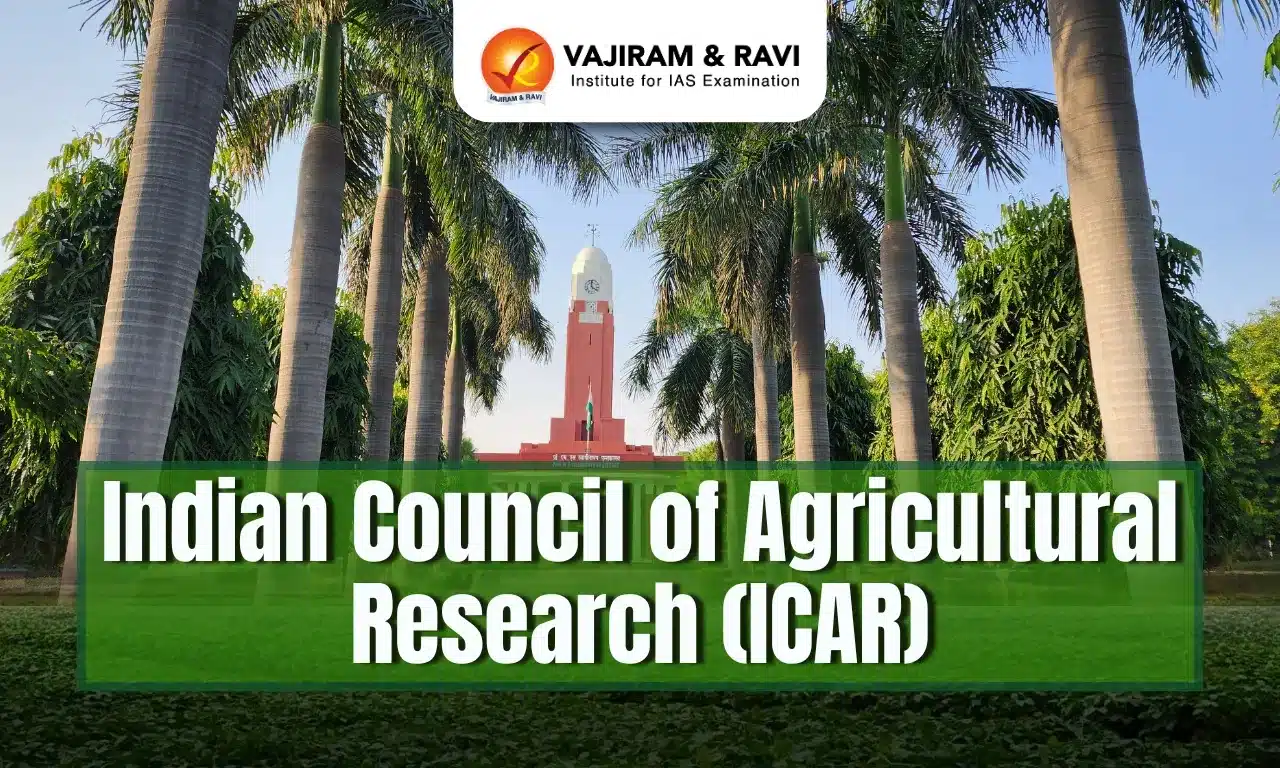
Indian Council of Agricultural Research (ICAR)

Indian Council of Agricultural Research

Indian Council of Agriculture Research Latest News

Expressing concern over the large number of vacant posts in agricultural institutions, Union Agriculture Minister recently directed the Indian Council of Agriculture Research (ICAR) to immediately fill all vacant posts.

About Indian Council of Agriculture Research

  • It is an autonomous organisation under the Department of Agricultural Research and Education (DARE), Ministry of Agriculture and Farmers Welfare, Government of India. 
  • It is the apex body for coordinating, guiding, and managing research and education in agriculture, including horticulture, fisheries, and animal sciences, throughout the country.
  • Formerly known as the Imperial Council of Agricultural Research, it was established on 16 July 1929 as a registered society under the Societies Registration Act, 1860, in pursuance of the report of the Royal Commission on Agriculture. 
  • The ICAR has its headquarters in New Delhi. 
  • With 101 ICAR institutes and 71 agricultural universities spread across the country, this is one of the largest national agricultural systems in the world. 
  • ICAR’s primary mandate focuses on the thematic areas of Crop Science, Horticultural Science, Natural Resource Management, Agricultural Engineering, Animal Science, Fisheries Science, Agricultural Education and Agricultural Extension.
  • The ICAR has played a pioneering role in ushering in the Green Revolution and subsequent developments in agriculture in India through its research and technology development. 
  • It has played a major role in promoting excellence in higher education in agriculture. 
  • It is engaged in cutting-edge areas of science and technology development and its scientists are internationally acknowledged in their fields.

Source: TH

Indian Council of Agriculture Research (ICAR) FAQs

Q1: The Indian Council of Agricultural Research (ICAR) functions under which ministry?

Ans: Ministry of Agriculture and Farmers Welfare

Q2: When was the Indian Council of Agricultural Research (ICAR) established?

Ans: Formerly known as the Imperial Council of Agricultural Research, ICAR was established on 16 July 1929

Q3: Where is the headquarters of the Indian Council of Agricultural Research (ICAR) located?

Ans: The ICAR has its headquarters in New Delhi.

Coffee

Coffee

Coffee Latest News

Recently, the Prime Minister of India said that Indian coffee is gaining popularity globally.

About Coffee

  • It is a tropical plant generally grown under shady trees.
  • Types of Coffee:  Robusta and Arabica
  • Major Coffee growing states: It is largely cultivated in Karnataka, Kerala, Tamil Nadu, Andhra Pradesh and Odisha, among which, Karnataka produces the most with over 70% of the total output.
  • Europe is the top destination for India’s coffee exports.
  • The major countries which import the commodity from India include Italy, Germany, Belgium, Middle East nations, Korea, and Japan.

Required Climatic Conditions for Coffee Cultivation

  • It is grown on hill slopes at elevations from 600 to 1,600 metres above sea level.
  • Climate: It requires a hot and humid climate for its growth.
  • Temperature: 15°C and 28 °C
  • Rainfall: It requires 150 to 250 cm of rainfall.
  • Soil: Well-drained, loamy soil containing a good deal of humus and minerals like iron and calcium are ideal for coffee cultivation.
  • Dry weather is necessary at the time of ripening of the berries.

Source: IE

Coffee FAQs

Q1: What type of soil is ideal for coffee cultivation?

Ans: Well-drained loamy soil

Q2: Which state is the largest producer of coffee in India?

Ans: Karnataka

Enquire Now