Neasden Temple

BAPS Shri Swaminarayan Mandir

Neasden Temple Latest News

King Charles III and Queen Camilla made a memorable visit to the BAPS Shri Swaminarayan Mandir, widely known as Neasden Temple, in London.

About Neasden Temple

  • Neasden Temple, or BAPS Shri Swaminarayan Mandir, is a Hindu Temple, located in Neasden, London.
  • It was the first traditional Hindu stone temple in Europe
  • The temple opened in 1995.
  • It was built using old, traditional methods and materials. 
  • The Guinness World Records 2000 once called it the "Biggest Hindu Temple outside India." 
  • It was built by Pramukh Swami Maharaj, a respected spiritual leader. 
  • The temple used a lot of special stone: 2,828 tonnes of Bulgarian limestone and 2,000 tonnes of Italian marble. 
  • This stone was sent to India to be carved by 1,526 sculptors. T
  • The temple cost about £12 million to build.
  • Since 2000, other BAPS temples have been built that are even bigger. 
  • The Neasden Temple was built and paid for entirely by the Hindu community. 
  • The whole project took five years, but the main temple building was finished in just two and a half years. 
  • Building work started in August 1992.
  • The temple complex is made up of a few important parts:
    • A mandir, which is the main temple building. It is made from hand-carved Italian marble and Bulgarian limestone.
    • A permanent exhibition called "Understanding Hinduism."
    • The BAPS Shri Swaminarayan Haveli, which is a cultural centre. It has a big hall, a gym, a bookshop, and offices.

Source: RW

Neasden Temple FAQs

Q1: Where is the Neasden Temple (BAPS Shri Swaminarayan Mandir) located?

Ans: Neasden, London

Q2: When was the Neasden Temple officially opened?

Ans: 1995

Q3: What is significant about the Neasden Temple in Europe?

Ans: It is the first traditional Hindu stone temple in Europe.

Q4: Who was the spiritual leader behind the construction of the Neasden Temple?

Ans: Pramukh Swami Maharaj

Global Virus Network (GVN)

Global Virus Network

Global Virus Network (GVN) Latest News

The Global Virus Network (GVN) has expanded its international coalition by incorporating three distinguished Centers of Excellence located in the Americas, broadening its capacity to address pressing viral threats on a global scale.

About Global Virus Network (GVN)

  • It is a voluntary consortium of virology laboratories and affiliated scientists that seek to prevent and control global viral threats.
  • It represents more than 25 countries and includes experts in every class of virus-causing disease in humans.
  • No single institution in the world has expertise in all viral areas. 
  • GVN brings the best medical virologists together to leverage individual strengths and to focus global teams of scientists on key scientific problems. 
  • The power of GVN lies in its global reach, the depth of its science, and its commitment to solving viral challenges facing the human population. 
  • The GVN has 3 main interest areas:
    • Support for cutting-edge research
    • Public education
    • Advocacy

Source: BE

Global Virus Network (GVN) FAQs

Q1: What is the Global Virus Network (GVN)?

Ans: It is a voluntary consortium of virology laboratories and affiliated scientists.

Q2: What is the main objective of the Global Virus Network?

Ans: To prevent and control global viral threats.

Q3: What are the three key interest areas of the Global Virus Network?

Ans: Research, Public education, and Advocacy

Bordetella holmesii

Bordetella holmesii

Bordetella holmesii Latest News

A team at the Postgraduate Institute of Medical Education and Research (PGIMER), Chandigarh, has reported a significant rise in infections caused by a lesser-known bacterium Bordetella holmesii that mimics whooping cough in north India.

About Bordetella holmesii

  • It is a bacterium recently recognized in 1995.
  • It is a gram-negative coccobacillus that can cause pertussis-like symptoms in humans as well as invasive infections.
  • It can cause endocarditis, community acquired pneumonia, cellulitis, suppurative arthritis, and pyelonephritis. 
    • Researchers discovered that nearly 37 per cent of infections in North India were caused by Bordetella holmesii (bacterium), surpassing the number of infections from Bordetella pertussis.

What is Whooping cough?

  • It is also known as pertussis.
  • It is a highly contagious infection which impacts the respiratory tract and is caused by Bordetella pertussis bacteria.
  • It gets its name from the “whooping” sound which the patient experiences while coughing.
  • It is particularly severe in infants and in case of complications may lead to pneumonia and even death.
  • Treatment: Diphtheria, tetanus, and pertussis (DTaP) vaccines.

Transmission of Whooping Cough

  • A person catches this bacteria via droplets when an infected person coughs or sneezes.
  • It attaches itself to the throat lining and then produces toxins which damage hair-like projections which clear debris and mucus.
  • This leads to inflammation in the airways and causes severe coughing fits.

Symptoms of Whooping Cough

  • It begins with cold-like symptoms accompanied with low-grade fever. As it progresses, coughs get accompanied with a “whooping” sound.
  • It causes sleep apnea in children.

Source: TH

Bordetella holmesii FAQs

Q1: What is Bordetella holmesii?

Ans: A bacterium that can cause pertussis-like symptoms.

Q2: Which population is most susceptible to severe Bordetella holmesii infections?

Ans: Immunocompromised individuals

Meteor Missile

What is a Meteor Missile?

Meteor Missile Latest News

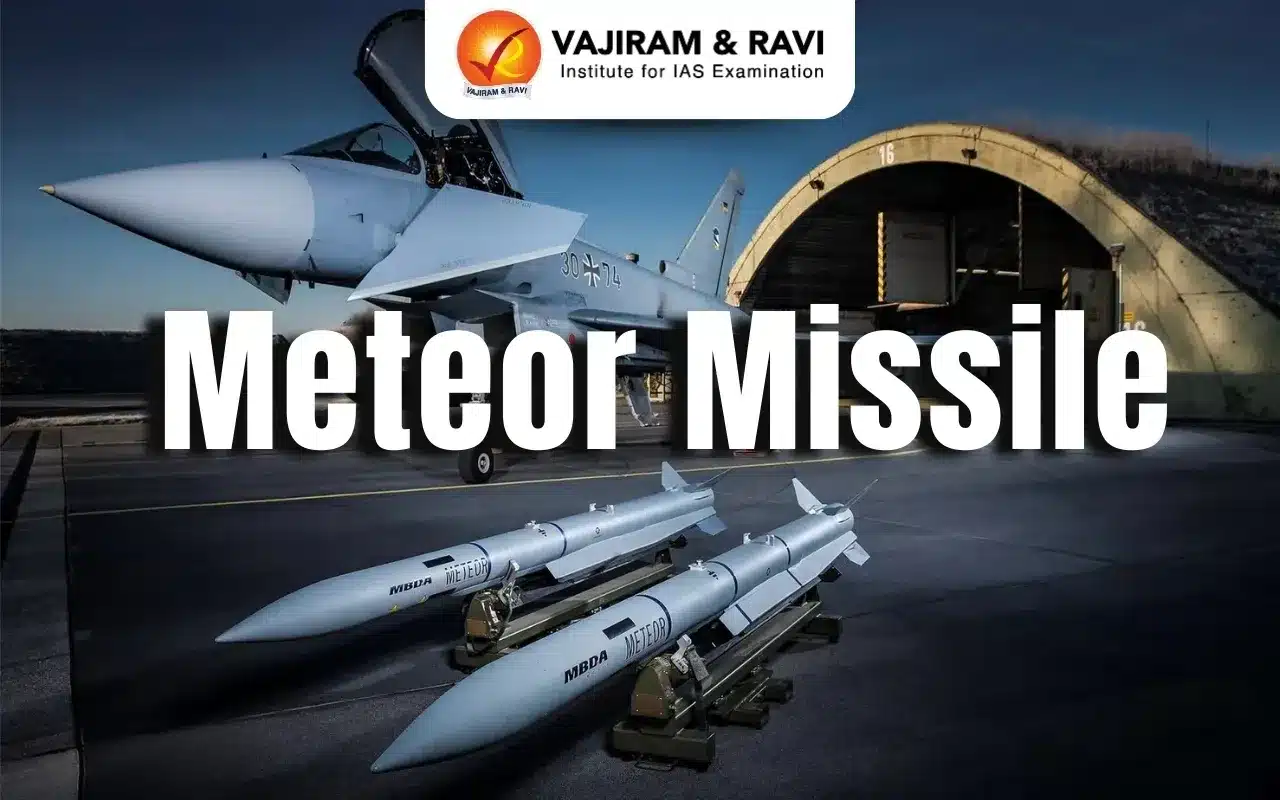
After defeating Pakistan in the recent conflict through Operation Sindoor, India is set to further enhance its air combat capabilities through the planned acquisition of a substantial number of Meteor air-to-air missiles.

About Meteor Missile

  • It is an advanced radar-guided, beyond-visual-range air-to-air missile (BVRAAM).
  • METEOR has been developed by a group of European partners led by MBDA to meet the needs of six European nations: the UK, Germany, Italy, France, Spain, and Sweden.
  • MBDA is a European multinational corporation specialized in the design, development, and manufacturing of missiles and related systems.

Meteor Missile Features

  • It has a length of 3.65 m and a diameter of 0.178 m. 
  • Unlike most similar solid-fuel missiles, the Meteor is equipped with a ramjet engine, which allows for controlled flight speed and complex maneuvers.
  • It has a range of up to 200 kilometres. 
  • Designed for a speed greater than Mach 4, the missile has a large no-escape zone.
  • Guided by an advanced active radar seeker, Meteor provides all-weather capability to engage a wide variety of targets from agile fast jets to small UAVs and cruise missiles. 
  • It is equipped with a two-way datalink, which allows the launch platform to provide updates on targets or re-targeting when the missile is in flight. 
  • It is equipped with a blast-fragmentation warhead.

Source: IT

Meteor Missile FAQs

Q1: The Meteor missile is primarily designed for which type of combat?

Ans: Beyond-visual-range air-to-air combat.

Q2: The Meteor missile has been developed through collaboration among which European nations?

Ans: UK, Germany, Italy, France, Spain, and Sweden.

Q3: The Meteor missile is powered by which type of engine?

Ans: Ramjet engine

Q4: What is the approximate maximum range of the Meteor missile?

Ans: 200 km

Iberian lynx

Iberian Lynx

Iberian Lynx Latest News

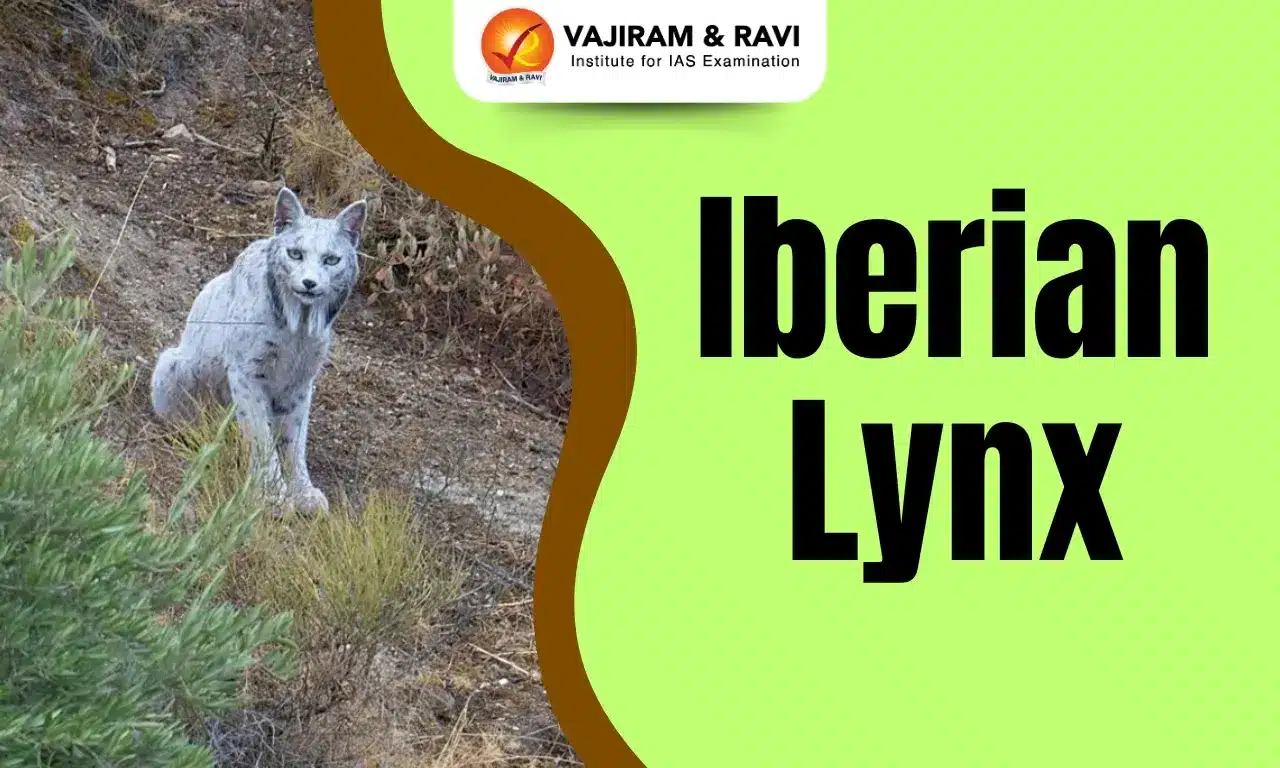
Recently, a photographer in Spain spotted the world’s first-ever white Iberian lynx.

About Iberian Lynx

  • It is a carnivore species endemic to Europe.
  • Appearance: It is the world’s most endangered and known for its pointy ears, long legs and leopard-like spotted fur.
  • This species, like other cat species, is sexually dimorphic, with males being heavier and longer than females. 
  • This lynx is generally nocturnal and its activity patterns are closely synchronized with those of their major prey, the rabbit.
  • Habitat: It requires variable terrain below 1300 m, containing a mosaic of closed Mediterranean scrubland interspersed with open patches of grassland, often with marsh ecotones.
  • Distribution: Iberian lynx are found only in two small areas of southwest Spain on the Iberian Peninsula, west of the Pyrenees mountains. 
  • Threats: These are related to human activities, such as poaching and habitat destruction, Illegal Hunting and decreased food base etc.

Conservation Status of  Iberian Lynx

  • IUCN Red list: Vulnerable
  • CITES: Appendix II

Source: IE

Iberian Lynx FAQs

Q1: Where is the Iberian Lynx primarily found?

Ans: Spain and Portugal

Q2: What is the current conservation status of the Iberian Lynx?

Ans: Vulnerable

Key Facts about Tajikistan

Key Facts about Tajikistan

Tajikistan Latest News

The Indian military has wound up its presence at a strategic Ayni  airbase in Tajikistan, after the lapse of a bilateral agreement.

About Tajikistan

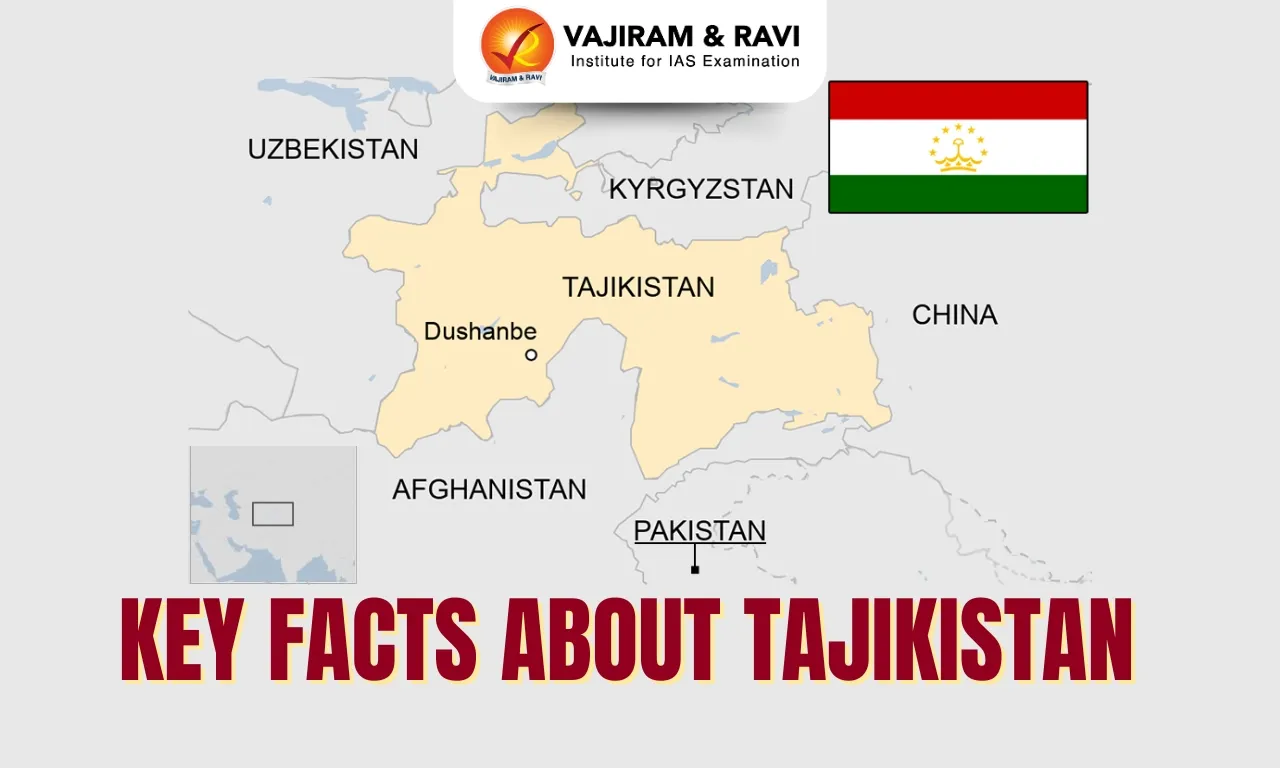
  • Tajikistan is a landlocked country in the heart of Central Asia.
  • Bordering countries: It is bordered with Kyrgyzstan (North), Uzbekistan (West), China (East), and Afghanistan (South).
  • It is one of the members of Shanghai Cooperation Organisation.
  • Political Structure: It is governed by the President, and the legislative function is assigned to the bicameral parliament

Geographic Features of Tajikistan

  • Terrain: Mountainous region dominated by the Alay Mountains in the north and the Pamirs in the southeast.
  • Highest Point: Tajikistan's highest point is Qullai Ismoili Somoni which peaks at 24,589 ft. (7,495 m).
  • Rivers:  It has a dense river network, including the Syr Darya and the Amu Darya.
  • Climate: It consists of mid-latitude continental, hot summers, mild winters; semiarid to polar in Pamir Mountains.
  • Lakes: Lake Karakul and Iskanderkul 
  • Natural resources: Petroleum, Uranium, Mercury, brown coal, lead, zinc, antimony, tungsten, silver, gold etc.
  • Capital City: Dushanbe

Source: HT

Tajikistan FAQs

Q1: Where is Tajikistan located?

Ans: Central Asia

Q2: Which countries share a border with Tajikistan?

Ans: China, Kyrgyzstan, Uzbekistan, and Afghanistan

Axial Seamount

Axial Seamount

Axial Seamount Latest News

The Axial Seamount underwater volcano near the Oregon coast could erupt soon, scientists have warned, following the detection of more earthquakes in the region.

About Axial Seamount

  • It is an underwater volcano located about 300 miles off the coast of Oregon, United States, in the Pacific Ocean.
  • It is a shield volcano with a summit marked by a large caldera.
  • It rises to a depth of 1400 m below sea level.
  • It is formed by a hot spot, an area in the Earth’s mantle where hot plumes of molten material rise into the crust. 
  • It is located on the Juan de Fuca Ridge, the boundary between the Pacific and Juan de Fuca tectonic plates.
  • The volcano is home to hydrothermal vents, underwater hot springs where seawater is heated by magma and ejected in mineral-rich plumes. 
    • These vents support diverse marine life, including microbes that use volcanic gases for energy, forming the basis of an ecosystem that includes giant tubeworms, spider crabs, clams, fish and octopuses.
  • It is the most active submarine volcano in the northeast Pacific, with known eruptions in 1998, 2011, and 2015. 
  • While Axial Seamount’s eruptions are not dangerous to people on land, they offer valuable opportunities for scientific observation.
  • It is part of the Ocean Observatories Initiative (OOI) and hosts the world’s first underwater volcanic observatory called New Millennium Observatory (NeMO).
    • NeMO provides real-time data originating from Axial through a variety of undersea cables to a shore station in Pacific City, Oregon.

Source: WION

Axial Seamount FAQs

Q1: Where is the Axial Seamount located?

Ans: In the Pacific Ocean, about 300 miles off the coast of Oregon.

Q2: What type of volcano is the Axial Seamount?

Ans: Shield volcano

Q3: The Axial Seamount is situated on which tectonic plate boundary?

Ans: Pacific and Juan de Fuca plates.

Q4: What is the name of the underwater volcanic observatory located at Axial Seamount?

Ans: New Millennium Observatory (NeMO)

Eturnagaram Wildlife Sanctuary

Eturnagaram Wildlife Sanctuary

Eturnagaram Wildlife Sanctuary Latest News

A butterfly and moth survey is set to be conducted at the Eturnagaram Wildlife Sanctuary in Mulugu, Telangana.

About Eturnagaram Wildlife Sanctuary

  • It is located near the border of Maharashtra, Chhattisgarh, and Telangana in the village of Eturnagaram, a tribal village in the Mulugu district of Telangana.
  • It is located 100 km from Warangal and 250 km from Hyderabad.
  • Established in 1952, this sanctuary spreads over an area of approximately 812 sq.km.
  • It has a water source called Dayyam Vagu, which separates the sanctuary into two parts.
  • The river Godavari also passes through it.
  • The landscape is undulating, ranging from steep slopes to gentle slopes from west to east. 
  • The famous Sammakka-Saralamma Temple is situated inside the sanctuary.
  • Flora:
    • The region is covered completely with thick natural vegetation, and it falls in the tropical dry deciduous.
    • It is rich in the growth of teak, bamboo, and other trees like madhuca and terminalia.
  • Fauna: This sanctuary provides shelter to Tiger, Leopard, Panther, Wolf, Wild Dogs, Jackals, Sloth Bear, Chousingha, Black Buck, Nilgai, Sambar, Spotted Deer, Four Horned Antilope, Chinkara, Black Buck, Gaur, and Giant Squirrels.

Source: TH

Eturnagaram Wildlife Sanctuary FAQs

Q1: In which state is the Eturnagaram Wildlife Sanctuary located?

Ans: Telangana

Q2: When was the Eturnagaram Wildlife Sanctuary established?

Ans: 1952

Q3: What is the total area covered by the Eturnagaram Wildlife Sanctuary?

Ans: 812 sq. km.

Q4: Which water body divides the Eturnagaram Wildlife Sanctuary into two parts?

Ans: Dayyam Vagu

National e-Vidhan Application(NeVA)

National e-Vidhan Application

National e-Vidhan Application Latest News

Recently, the Ministry of Parliamentary Affairs successfully concluded the 3rd National Conference on the National e-Vidhan Application (NeVA).

About National e-Vidhan Application

  • It is an online platform designed to digitize the legislative processes of all state and union territory assemblies.
  • It is one of the 44 Mission Mode Projects (MMPs) under the Digital India Programme of the Government of India.
  • It aims to make the functioning of all State Legislatures paperless and integrate all 37 Legislative Houses on a single digital platform under the vision of ‘One Nation, One Application’.
  • NeVA is a device neutral and member centric application created to equip them to handle diverse House Business smartly by putting entire information regarding member contact details, rules of procedure, list of business, notices, bulletins, bills etc.
  • It assists the Chair of the House in conducting proceedings smoothly while enabling members to fulfill their responsibilities efficiently.
  • The NeVA platform is hosted on Meghraj 2.0, India’s cloud infrastructure, ensuring robust scalability, security, and data integrity.

Features of National e-Vidhan Application

  • It provides real-time access to key legislative documents, such as agendas, bills, and reports.
  • The platform features a secure digital repository, safeguarding the confidentiality and integrity of legislative data.
  • The platform also offers multilingual capabilities, catering to the linguistic diversity across states and regions, making it accessible to a broader range of users.
  • Its device-agnostic nature allows it to be accessed seamlessly across smartphones, tablets, laptops, and desktops.

Source: PIB

National e-Vidhan Application FAQs

Q1: What is the theme of the National e-Vidhan Application (NeVA)?

Ans: One Nation – One Application

Q2: What is the primary purpose of the National e-Vidhan Application (NeVA)?

Ans: To digitize the legislative processes of all state and union territory assemblies.

Mount Kilimanjaro

Mount Kilimanjaro

Mount Kilimanjaro Latest News

Recently, a new study has revealed that land-use change was the main driver behind the loss of nearly 75 per cent of natural plant species on the lower slopes of Mount Kilimanjaro.

About Mount Kilimanjaro

  • Location: It is located in northeastern Tanzania, near the Kenya border.
  • It is Africa’s tallest mountain (5,895 m) and the world’s largest free-standing mountain (which means not part of a mountain range).
  • It extends approximately east-west for 50 miles (80 km).
  • Also called a stratovolcano (a term for a very large volcano made of ash, lava and rock), Kilimanjaro is made up of three cones: Kibo, Mawenzi and Shira.
    • Among these cones Kibois, the tallest of the three volcanic formations, which is also a dormant volcano, while the other two are extinct volcanoes?
    • Uhuru Peak, the highest free-standing peak in Africa, is located on the volcanic cone Kibo.
  • Kilimanjaro is also known for its snow-capped peak.
  • Vegetation: The mountain has five main vegetation zones, from the lowest to the highest point: Lower slopes, montane forest, heath and moorland, alpine desert, and summit. 
  • The Kilimanjaro National Park was named a United Nations Educational, Scientific, and Cultural Organization (UNESCO) World Heritage Site in 1987.

Source: India Today

Mount Kilimanjaro FAQs

Q1: Where is Mount Kilimanjaro located?

Ans: Tanzania

Q2: What type of mountain is Mount Kilimanjaro?

Ans: Volcanic mountain

Enquire Now