Indian Institute of Packaging (IIP)

Indian Institute of Packaging

Indian Institute of Packaging Latest News

The Indian Institute of Packaging (IIP) opened its Bengaluru Centre recently.

About Indian Institute of Packaging 

  • It is an autonomous body in the field of packaging and working under the administrative control of the Ministry of Commerce and Industry, Government of India. 
  • It was established on 14th May, 1966, with its headquarters and principal laboratories in Mumbai. 
  • The Institute set up its first branch office at Chennai in 1971, followed by branches at Kolkata, Delhi, and Hyderabad in 1976, 1986, and 2006, respectively. 
  • The main objective of the Institute is to promote the export market by way of innovative package design and development as well as to upgrade the overall standards of packaging in the country.
  • The Institute is involved in various activities like testing and evaluation of packaging materials and packages, consultancy services, and research & development related to packaging. 
  • Besides this, the Institute is involved in training and education in the field of packaging. 
  • It imparts training in innovative and aesthetic packaging to the artisans, weavers, exporters, stakeholders, etc.
  • It is closely working with various commodity boards and export promotion councils such as APEDA, Spices Board, MPEDA, Tea Board, MoFPI, and others.
  • The Institute has linkages with international organisations and is a founding member of the Asian Packaging Federation (APF); a member of the Institute of Packaging Professionals (IOPP), USA; the Institute Packaging (IOP), UK; Technical Association of Pulp and Paper Industry (TAPPI), USA.
  • The Institute organizes a biannual event i.e. International Packaging Exhibition, i.e., INDIAPACK, and a national contest for excellence in packaging, i.e., INDIASTARA.

Source: TH

Indian Institute of Packaging FAQs

Q1: Under which Ministry does the Indian Institute of Packaging (IIP) function?

Ans: Ministry of Commerce and Industry

Q2: When was the Indian Institute of Packaging (IIP) established?

Ans: 1966

Q3: Where is the headquarters of the Indian Institute of Packaging located?

Ans: Mumbai

Ayni Air Base

Ayni Air Base

Ayni Air Base Latest News

India has rounded off its operation at the strategic Ayni Air Base in Tajikistan after helping it run since 2002.

About Ayni Air Base

  • It is located in Tajikistan.
  • It is the first overseas military facility operated by India.
  • Located just west of Dushanbe, the capital of Tajikistan, the base had been a neglected Soviet-era facility before India stepped in to modernize it.
  • India began developing the Ayni airbase in the early 2000s under an agreement with Tajikistan. 
  • India invested close to $100 million in the development and modernization of the airbase. 
  • It extended the runway to 3,200 metres and upgraded facilities for refuelling, repairs, and hangars. 
  • At times, India even stationed around 200 personnel from the army and air force at the site.
  • India temporarily deployed Su-30MKI fighter jets and helicopters to the base roughly a decade ago. 
  • India withdrew from the airbase after a bilateral agreement on stationing Indian personnel at the location ended in 2022.

Why the Ayni Air BaseMattered for India?

  • The base enabled India to maintain contact with anti-Taliban forces before 2001 and later provided a route for humanitarian aid to Afghanistan. 
  • Ayni’s location gave India a unique advantage. The base is just about 20 kilometres from Afghanistan’s Wakhan Corridor, which borders Pakistan-occupied Kashmir (PoK). 
  • From there, Indian forces could theoretically target key Pakistani cities such as Peshawar. 
  • Ayni served as a gateway for India to enhance its presence in Central Asia, a region traditionally dominated by Russia and increasingly influenced by China.
  • The airbase was also used in 2021 to evacuate Indian nationals and officials from Afghanistan after the Taliban takeover.

Source: FP

Ayni Air Base FAQs

Q1: Where is the Ayni Air Base located?

Ans: Tajikistan

Q2: Which country developed the Ayni Air Base under an agreement with Tajikistan?

Ans: India

Q3: When did India begin developing the Ayni Air Base?

Ans: Early 2000s.

Q4: When did India withdraw from the Ayni Air Base?

Ans: 2022

Know Your Vehicle

Know Your Vehicle

Know Your Vehicle Latest News

Recently, the National Highways Authority of India (NHAI) has simplified the Know Your Vehicle (KYV) process for FASTag users.

About Know Your Vehicle

  • It is a system where all FASTag users submit images of their vehicle and registration certificate to verify that the tag is linked to the correct vehicle.
  • Purpose: It was implemented in 2024, in an attempt to prevent the leakages in the FASTag system.
  • The whole process has to be repeated every three years to ensure no misuse.
  • It is an initiative of the National Highways Authority of India (NHAI), KYV was notified by National Payments Corporation of India (NPCI). 
  • Know Your Vehicle Ensures
    • The 'One Vehicle One FASTag' rule: KYV supports the idea that each vehicle should have its own valid FASTag account.
    • Preventing fraud or misuse: verifying images and documents helps reduce fake tags, mis-linked vehicles.
    • Ensuring smooth toll travel: without a verified KYV your FASTag may be blocked or flagged, causing delays and extra costs.

What is FASTag?

  • It is a device that employs Radio Frequency Identification (RFID) technology for making toll payments directly while the vehicle is in motion. 
  • It is a tag used for making toll payments directly from the customers linked prepaid or savings/current account.
  • It is also vehicle specific and once it is affixed to a vehicle, it cannot be transferred to another vehicle.
  • FASTag can be purchased from any of the National Electronic Toll Collection (NETC) Member Banks.

Source: IE

Know Your Vehicle FAQs

Q1: Which government agency is responsible for implementing the "Know Your Vehicle" scheme?

Ans: Ministry of Road Transport and Highways

Q2: What is the primary function of the National Highways Authority of India (NHAI)?

Ans: To develop and maintain national highways

Doctrine of Party Autonomy

Doctrine of Party Autonomy

Doctrine of Party Autonomy Latest News

The Supreme Court recently held that the Doctrine of Party Autonomy is not limitless, and the same is the bedrock of arbitration.

About Doctrine of Party Autonomy

  • The fundamental principle governing arbitration is party autonomy. 
  • The freedom of the parties to choose the process of resolving disputes is known as party autonomy. 
  • It confers on the parties the freedom to determine laws, place of arbitration, selection of arbitrators, etc.
  • Almost all international arbitration laws, rules, and conventions recognize the principle of party autonomy. 
    • The concept is recognised under the New York Convention, the UNCITRAL Model Law, the Indian Arbitration and Conciliation Act, 1996, the International Chamber of Commerce (ICC) Arbitration Rules, etc.
  • However, party autonomy is not unlimited, and it may be subject to certain legal or public policy constraints depending on the jurisdictions involved.
  • The Supreme Court of India (SC), in the April 2021 judgment, ruled that “Party autonomy is the guiding spirit of arbitration”.
  • The SC also held that such autonomy must be exercised on an equal footing, with both parties having a meaningful participation in the arbitrator appointment process.
  • Any imbalance, where one party has disproportionate control, risks undermining the arbitrator’s independence and impartiality.

Source: VERD

Doctrine of Party Autonomy FAQs

Q1: What does the Doctrine of Party Autonomy primarily relate to?

Ans: Freedom of parties to choose their dispute resolution process.

Q2: The Doctrine of Party Autonomy is most closely associated with which field of law?

Ans: Arbitration Law

Q3: The Doctrine of Party Autonomy is recognized under which Indian legislation?

Ans: Indian Arbitration and Conciliation Act, 1996

The Aabhar Collection

The Aabhar Collection

The Aabhar Collection Latest News

Indian Railways will patronise the newly launched ‘Aabhar’ online store that will showcase a range of exquisite gift items manufactured by indigenous tribes, handloom weavers.

About The Aabhar Collection

  • It is an online store on the Government e-Marketplace (GeM) portal dedicated to showcasing exquisite gift items and hampers.
  • The collection, which currently features over 150 items, is part of GeM's mandate to promote social inclusion.
  • Products in the collection are select One District One Product (ODOP) and Geographical Indication (GI) items. 
  • They are sourced exclusively from:
    • Central Cottage Industries Emporium (CCIE)
    • Khadi and Village Industries Commission (KVIC)
    • Various Central and State Handicraft and Handloom Emporiums

Key Facts about Government e-Marketplace (GeM)

  • It is the Public Procurement Portal for procurement of goods and services for all Central Government and State Government Ministries, Departments, Public Sector Units (PSUs), and affiliated.
  • The portal was launched in August 2016 by the Ministry of Commerce & Industry.
  • GeM endeavours to make the public procurement process transparent, efficient, and inclusive. 
  • The purchases through GeM by government users have been authorized and made mandatory by the Ministry of Finance by adding a new Rule No. 149 in the General Financial Rules, 2017.

Source: TH

The Aabhar Collection FAQs

Q1: What is The Aabhar Collection?

Ans: An online store on the Government e-Marketplace (GeM) showcasing gift items and hampers.

Q2: Approximately how many items are featured in The Aabhar Collection?

Ans: ODOP (One District One Product) and GI (Geographical Indication) items.

Q3: What type of items are mainly displayed in The Aabhar Collection?

Ans: Exquisite gift items and hampers.

National Marine Fisheries Census 2025

National Marine Fisheries Census 2025

National Marine Fisheries Census 2025 Latest News

Recently, the union Minister of State, Ministry of Fisheries, Animal Husbandry and Dairying, launched the Marine Fisheries Census (MFC) 2025.

About National Marine Fisheries Census 2025

  • It is the fifth edition of the Marine Fisheries Census. 
  • It is a coast-wide activity fully funded by the Department of Fisheries, Government of India.
  • Nodal Agency: ICAR-Central Marine Fisheries Research Institute (CMFRI) as the nodal agency and Fishery Survey of India (FSI) as the operational partner.

Features of National Marine Fisheries Census 2025

  • Coverage: 13 coastal States and Union Territories, including the Andaman & Nicobar Islands and Lakshadweep,
  • Time Period: The core household data collection is scheduled for an extended period of 45 days.
  • Digital Architecture: It is powered by a suite of custom-made, multilingual Android applications—VyAS–NAV (for validation of fishing villages and harbours), VyAS–BHARAT (household and infrastructure enumeration) and VyAS–SUTRA (for real-time supervision and monitoring of households and enumerators) developed by the the ICAR–Central Marine Fisheries Research Institute (CMFRI).
  • Expanded Socio-economic Data: For the first time, census includes detailed information on crucial indicators like total family income, homeownership, outstanding liabilities, and sources of credit.
  • Focus on Vulnerability: It covers data on insurance status, major losses or disabilities, the specific socio-economic impacts of the COVID-19 pandemic on fisher families, and the receipt of benefits from schemes like PMMSY/PM-MKSSY.
  • Institutional Mapping: New schedules focusing on Fish Farmer Producer Organizations (FFPOs) and Self-Help Groups (SHGs) are introduced to facilitate collectivization and strengthen the value chain.

Source: PIB

National Marine Fisheries Census 2025 FAQs

Q1: What is the primary objective of the National Marine Fisheries Census 2025?

Ans: To collect socio-economic data of fisher households

Q2: What is the duration of the National Marine Fisheries Census 2025?

Ans: 45 days

Kunming Biodiversity Fund

Kunming Biodiversity Fund

Kunming Biodiversity Fund Latest News

Recently, seven countries have secured $5.8 million from the Kunming Biodiversity Fund to enhance nature-friendly agriculture.

About Kunming Biodiversity Fund

  • It is a Multi-Partner Trust Fund (MTPF) launched in 2021 during Part 1 of the COP 15 of Convention of Biological Diversity.
  • It aims to facilitate the successful implementation of the Kunming-Montreal Global Biodiversity Framework (KMGBF) at regional, national, subnational and local level.
  • Initial contribution: 1.5 billion yuan (about $200 million) from China.
  • It was established under the leadership of the Ministry of Environment and Ecology (MEE) of China and the United Nations Environment Program (UNEP), with the Secretariat of the Convention on Biological Diversity (SCBD) and United Nations Development Programme (UNDP).
  • Focus area: It supports developing countries to accelerate and upscale their actions for the National Biodiversity Strategies and Action Plans (NBSAPs).

What is Kunming-Montreal Global Biodiversity Framework?

  • It was adopted during the 15th meeting of the Conference of the Parties to the UN Convention on Biological Diversity in December 2022.
  • It aims to support the achievement of sustainable development goals and build on previous strategic plans.
  • It sets a bold path towards global harmony with nature by 2050.
  • Goals and targets: The GBF consists of 23 targets (set for 2030) and four global goals (set for 2050) to preserve biodiversity for current and future generations.

Source: DTE

Kunming Biodiversity Fund FAQs

Q1: What is the primary objective of the Kunming Biodiversity Fund (KBF)?

Ans: To assist developing nations in implementing the Kunming-Montreal Global Biodiversity Framework .

Q2: What is the initial contribution to the Kunming Biodiversity Fund?

Ans: $200 million

Kunar River

Kunar River

Kunar River Latest News

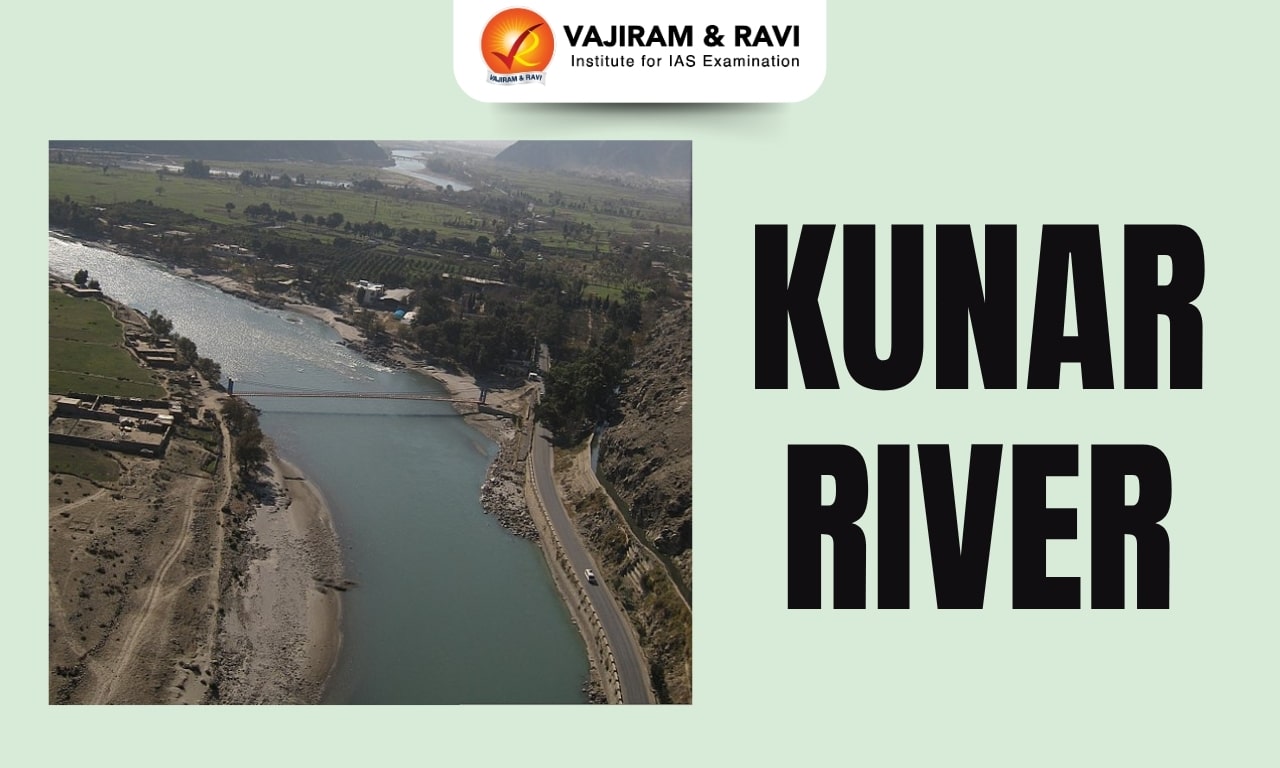
New Delhi recently extended its support to Afghanistan to build a dam over the Kunar River, which it shares with Pakistan, at a time when the two nations are at loggerheads.

About Kunar River

  • The Kunar River, also known as the Kama River, is a long and important river. 
  • It flows for about 480 kilometers (298 miles) through northern Khyber Pakhtunkhwa in Pakistan and eastern Afghanistan. 
  • This river starts high up in the Hindu Kush mountains
  • Its waters come from melting glaciers and snow.
  • In Pakistan, this river is known as the Chitral River.
  • It is a tributary of the Kabul River.
  • The Kabul River then flows into the much larger Indus River. This makes the Kunar River part of the Indus watershed.
  • Course:
    • The Kunar River begins just south of the Broghil Pass. This area is in the upper part of the Chitral District in Khyber Pakhtunkhwa, Pakistan. 
    • It is very close to the border with Afghanistan, known as the Durand Line.
    • As the river flows, it passes through different regions.
    • It eventually reaches Jalalabad in Afghanistan. Here, the Kunar River joins the Kabul River.
  • Tributaries
    • On its left side, the Shishi River joins it.
    • On its right side, rivers like the Lotkoh River, the Landai Sin River, and the Pech River add their waters.

Source: FP

Kunar River FAQs

Q1: Through which two countries does the Kunar River flow?

Ans: Afghanistan and Pakistan

Q2: What is the approximate length of the Kunar River?

Ans: 480 km

Q3: The Kunar River originates from which mountain range?

Ans: Hindu Kush Mountains

Q4: The Kunar River is a tributary of which major river?

Ans: Kabul River

Kendriya Grihmantri Dakshata Padak

Kendriya Grihmantri Dakshata Padak

Kendriya Grihmantri Dakshata Padak Latest News

Recently, the ‘Kendriya Grihmantri Dakshata Padak’ has been awarded for the year 2025.

About Kendriya Grihmantri Dakshata Padak

  • It has been instituted by the Ministry of Home Affairs, Government of India in 2024.
  • The award aims to encourage professional standards and boost the morale of officers and officials across the country.
  • It is given to recognize excellent work, promote high professional standards and boost the morale of the concerned official/officer in the following four fields:
    • Special Operation
    • Investigation
    • Intelligence
    • Forensic Science
  • It was created by merging the 4 previously existing MHA awards
    • The Special Operation Medal,
    • The Medal for Excellence in Investigation,
    • The Exceptional Intelligence Efficiency Medal, and
    • The Union Home Minister's Award for Meritorious Service.
  • Eligibility: It is conferred on members of the Police Forces, Security Organization, Intelligence Wing/Branch/Special Branch of State/Union Territories/Central Police Organizations (CPOs)/Central Armed Police Forces (CAPFs) and Forensic Science (Central / State / Union Territories) throughout the Indian Union.
  • The medal is announced on 31st of October every year, on the occasion of the Birth Anniversary of Sardar Vallabhbhai Patel.

Source: PIB

Kendriya Grihmantri Dakshata Padak FAQ's

Q1: What is the Kendriya Grihmantri Dakshata Padak awarded for?

Ans: Outstanding service in police and security organizations

Q2: What are the fields in which the Kendriya Grihmantri Dakshata Padak recognizes excellence?

Ans: Special Operations, Investigation, Intelligence, and Forensic Science

Nauradehi Wildlife Sanctuary

Nauradehi Wildlife Sanctuary

Nauradehi Wildlife Sanctuary Latest News

Recently, the Madhya Pradesh Chief Minister said that Nauradehi Wildlife Sanctuary will become the third home for cheetahs in the state. 

About Nauradehi Wildlife Sanctuary

  • Location: It is located in the state of Madhya Pradesh.
  • It was declared a wildlife sanctuary in 1975. 
  • It is the largest wildlife sanctuary in Madhya Pradesh.
  • The entire sanctuary is situated on a plateau, forming part of the upper Vindhyan range.
  • It acts as a corridor for Panna Tiger Reserve and Satpura Tiger Reserve while indirectly connecting Bandhavgarh Tiger Reserve via Rani Durgawati Wildlife Sanctuary
  • It is classified under the Deccan peninsula biogeographic region and forms part of the Ganga and Narmada basins.
  • Vegetation: The forest type of this sanctuary is classified as the Tropical Dry Deciduous forest which consists of the Central Indian monsoon forests. 
  • Drainage: Three fourth of Nauradehi Wildlife Sanctuary falls in the Yamuna [Ganges] basin and one fourth of the sanctuary falls in the Narmada basin.
  • The north flowing Kopra River, Bamner River, Bearma River, which are tributaries of the Ken River, are the major rivers of this sanctuary.
  • Flora: Teak, Saja, Dhaora, Bhirra, Ber, Bel, Mahua, Tendu, Gunja and Amla etc.
  • Fauna: Tiger, Panther, Sloth-beer wild dog, blue bull, chinkara, spotted deer, sambhar etc.

Source: PTI

Nauradehi Wildlife Sanctuary FAQs

Q1: Where is the Nauradehi Wildlife Sanctuary located?

Ans: Madhya Pradesh

Q2: What is the significance of Nauradehi Wildlife Sanctuary?

Ans: It is the largest wildlife sanctuary in Madhya Pradesh

Enquire Now