Amphipods

Amphipods

Amphipods Latest News

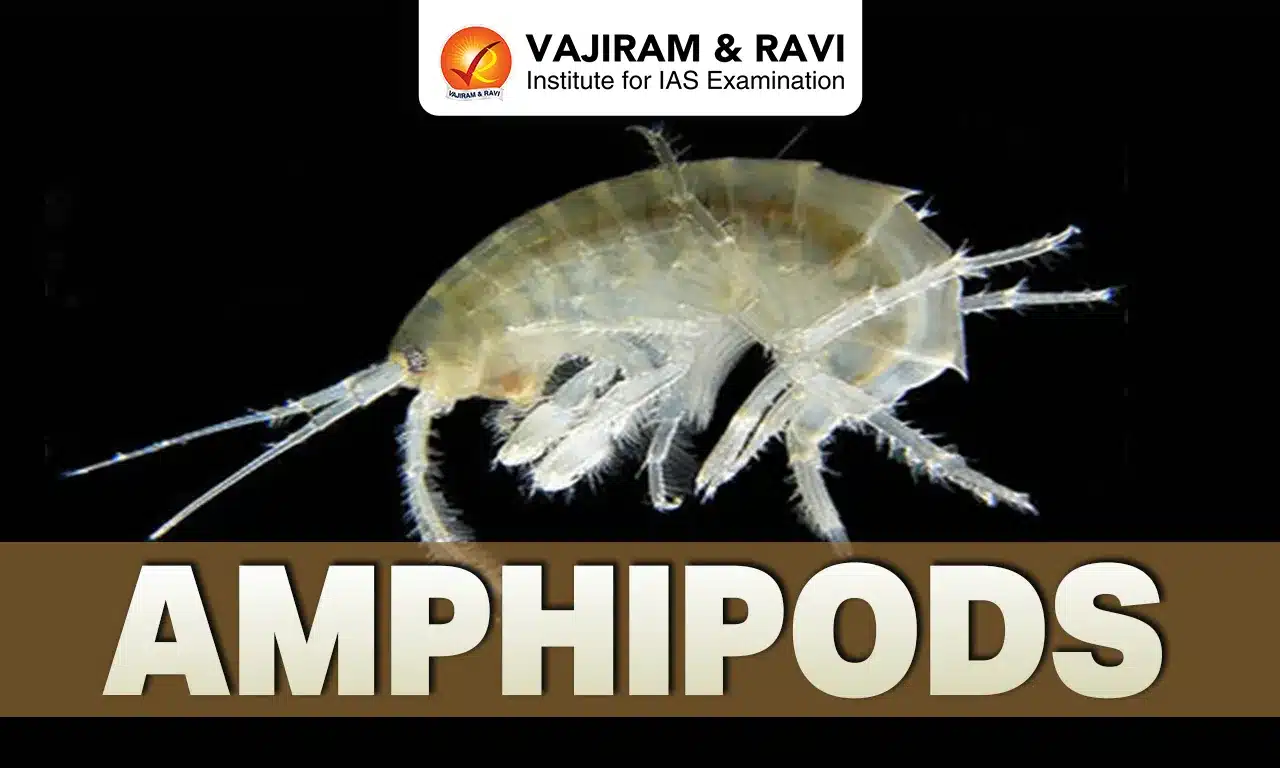
Two new species of marine amphipods, Grandidierella geetanjalae and Grandidierella khambhatensis, have been found by a team of researchers from Chilika and the Gulf of Khambhat, recently.

About Amphipods

  • They are a type of small crustacean. 
  • They are related to crabs, lobsters, and shrimp. 
  • They can be found in almost all water environments. 
  • They live in the ocean, in fresh water, and even on land.
  • The name ‘amphipoda’ means "different-footed." 
    • This is because they have many different kinds of legs. 
    • Unlike some other crustaceans, their legs are not all the same.
  • There are over 7,000 known species of amphipods. Most of them belong to a group called Gammaridea.
  • Amphipods can be very tiny, about 0.1 centimeters (0.04 inches) long. But some can grow quite large, up to 34 centimeters (13 inches).
  • Most amphipods eat tiny bits of dead plants and animals. Some are also scavengers, eating what they find.
  • They live in many places. 
    • About 750 species live in caves
    • Some amphipods are terrestrial animals, like sandhoppers. 
    • The largest amphipods live deep down on the sea floor.  They can be found seven kilometers (about 4.3 miles) deep.

About Grandidierella Geetanjalae and Grandidierella Khambhatensis

  • They are two new species of marine amphipods.
  • Grandidierella geetanjalae was collected from the Chilika lagoon near Rambha in Ganjam district, Odisha.
  • Grandidierella khambhatensis was collected from the Gulf of Khambhat, Gujarat.
  • Both species measure between 5.5 and 6 mm in length.
  • They are detritivorous, feeding primarily on organic matter and playing an important role in maintaining ecosystem health by contributing to natural cleaning processes.

Source: TOI


Amphipods FAQs

Q1: Amphipods belong to which group of animals?

Ans: Crustaceans

Q2: The name ‘Amphipoda’ refers to what special feature?

Ans: Having different types of legs.

Q3: Amphipods can be found in which type of environment?

Ans: Marine, freshwater, and terrestrial habitats.
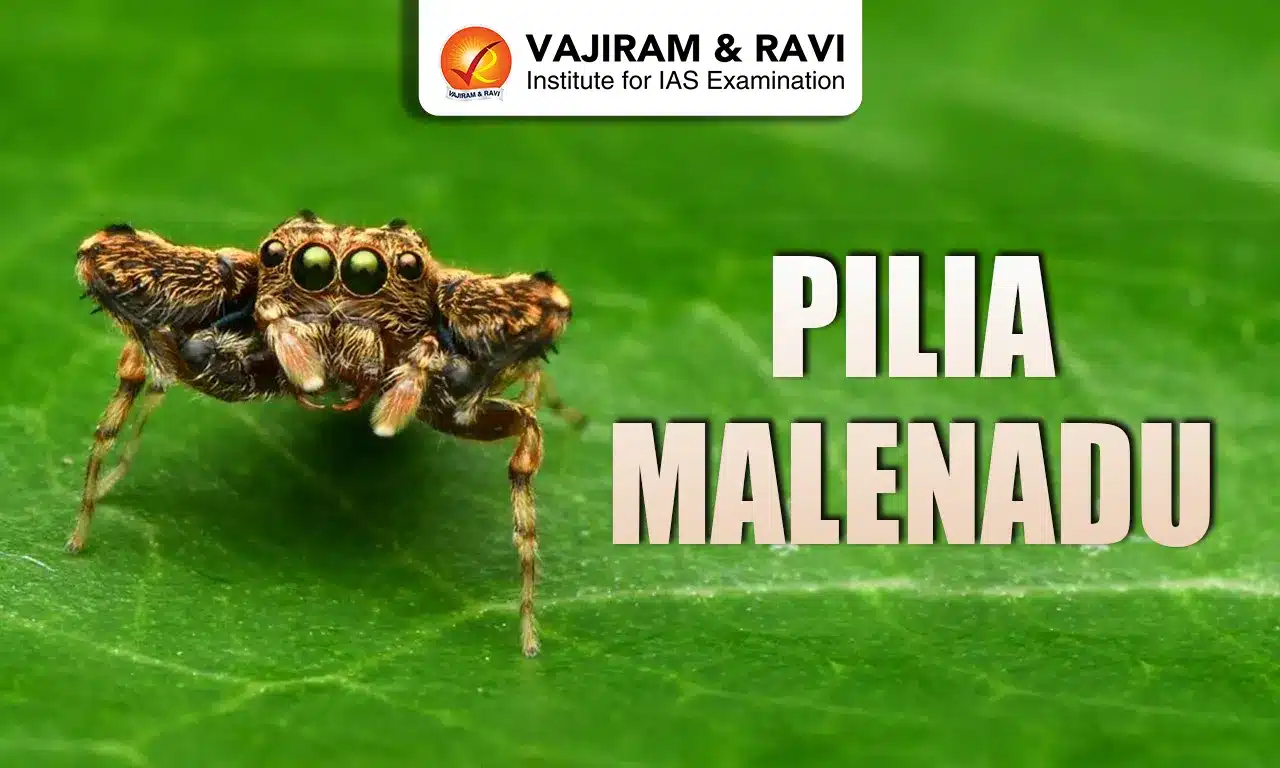
Pilia malenadu

Pilia malenadu

Pilia malenadu Latest News

A team of researchers exploring biodiversity in the Western Ghats recently discovered a new species of spider named Pilia malenadu.

About Pilia malenadu

  • It is a new species of spider.
  • It belongs to Pilia, a genus of jumping spiders.
  • It was discovered in Madhugundi in the Mudigere taluk of Chikkamagaluru, Karnataka, at the foothills of the Western Ghats.
  • The researchers named it “Pilia malenadu”, to give credit to the place it was found.
  • The discovery is significant because the last time a species of spiders belonging to the pilia genus was discovered was about 123 years ago (1902) in Kerala. 
  • Further, the researchers, for the first time, have found both male and female spiders of the species.
  • These spiders were found in only two plant species — Memecylon umbellatum and Memecylon malabaricum.
  • In fact, the spiders were found concealed between the leaves of these plants.

Source: TH

Pilia malenadu FAQs

Q1: What is Pilia malenadu?

Ans: It is a new species of spider.

Q2: To which genus does Pilia malenadu belong?

Ans: It belongs to the genus Pilia, which is a genus of jumping spiders.

Q3: Where was Pilia malenadu discovered?

Ans: It was discovered in Madhugundi in the Mudigere taluk of Chikkamagaluru district, Karnataka.

Heavy Metals

Heavy Metals

Heavy Metals Latest News

Heavy metals are polluting the Cauvery River and its fish, researchers from Tamil Nadu have reported.

About Heavy Metals

  • The term ‘heavy metal' refers to any metallic chemical element that has a relatively high density and is toxic or poisonous at low concentrations. 
  • Examples of heavy metals include mercury (Hg), cadmium (Cd), arsenic (As), chromium (Cr), thallium (Tl), and lead (Pb). 
  • Heavy metals are natural components of the Earth's crust. They cannot be degraded or destroyed. 
  • To a small extent they enter our bodies via food, drinking water, and air. 
  • As trace elements, some heavy metals (e.g. copper, selenium, and zinc) are essential to maintain the metabolism of the human body. 
  • However, at higher concentrations they can lead to poisoning.
  • Heavy metal poisoning could result, for instance, from drinking-water contamination (e.g. lead pipes), high ambient air concentrations near emission sources, or intake via the food chain. 
  • Heavy metals are dangerous because they tend to bioaccumulate. 
    • Bioaccumulation means an increase in the concentration of a chemical in a biological organism over time, compared to the chemical's concentration in the environment. 
    • Compounds accumulate in living things any time they are taken up and stored faster than they are broken down (metabolized) or excreted. 
  • Heavy metals can enter a water supply by industrial and consumer waste, or even from acidic rain breaking down soils and releasing heavy metals into streams, lakes, rivers, and groundwater.
  • Mercury, lead, and cadmium are of greatest concern because of their ability to travel long distances in the atmosphere.

Source: TH

Heavy Metals FAQs

Q1: What are heavy metals?

Ans: The term ‘heavy metal' refers to any metallic chemical element that has a relatively high density and is toxic or poisonous at low concentrations.

Q2: Why are heavy metals considered dangerous to living organisms?

Ans: Because they tend to bioaccumulate and are toxic even at low concentrations.

Q3: How do heavy metals enter the human body?

Ans: Through food, drinking water, and air.

Q4: What are the main sources of heavy metal contamination in water?

Ans: Industrial and consumer waste, and acidic rain breaking down soils and releasing heavy metals into water bodies.

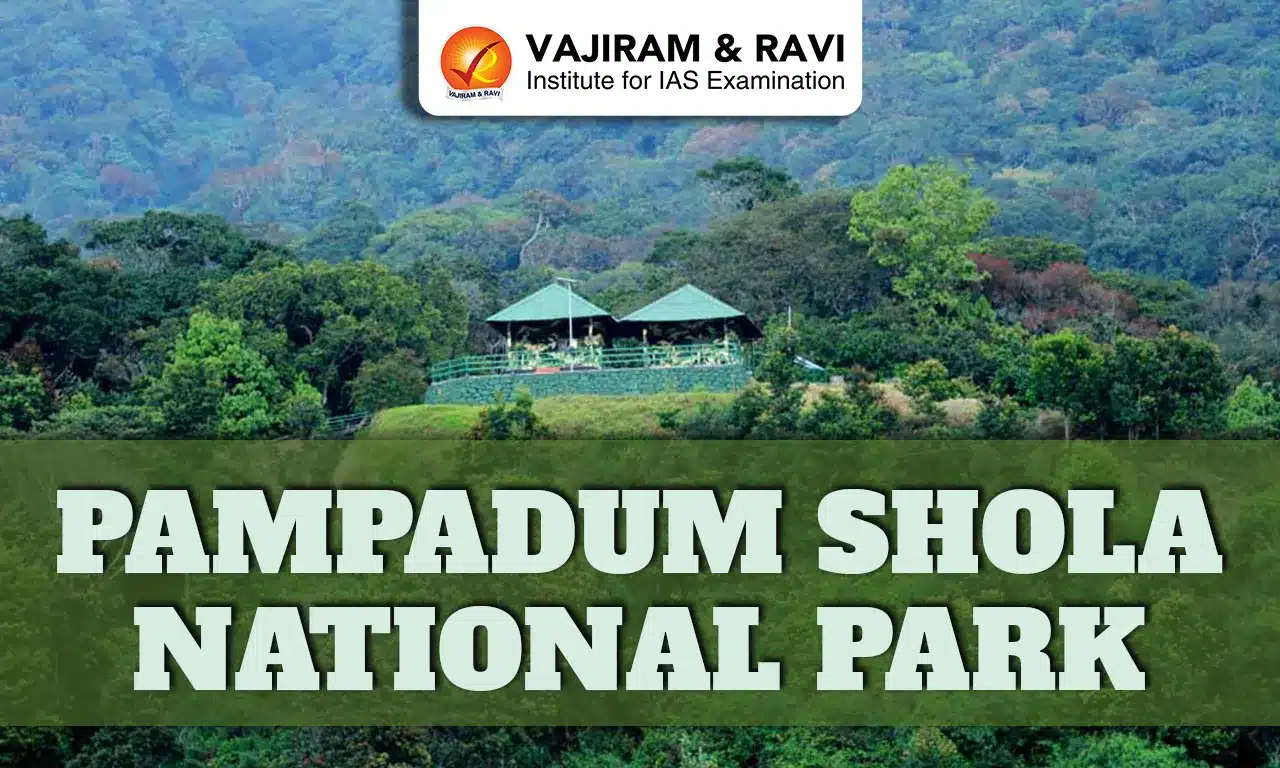
Pampadum Shola National Park

Pampadum Shola National Park

Pampadum Shola National Park Latest News

The Pampadum Shola National Park which was once dominated by invasive Australian wattles is undergoing a remarkable transformation and its grasslands are being restored, reviving streams and native species.

About Pampadum Shola National Park

  • Location: It is located in the eastern part of Southern Western Ghats of Kerala.
  • It is the smallest national park of Kerala and shares a border with Dindigul district of Tamil Nadu. 
  • It was declared a national park in 2004.
  • It is the southernmost shola–grassland mosaic in the Western Ghats, one of the world’s oldest mountain systems predating the Himalayas.
  • It is a part of Palani hills stretched up to Vandaravu peak.
  • It connects the Eravikulam National Park and the Palani Hills, providing a free range for many animals. 
  • Pampadum Shola Forests receive heavy rain in the North-East monsoon.
  • Topography: The terrain is undulating with hillocks of varying heights. The altitudes range between 1600-2400 m. 
  • Flora: The park’s unique shola forests are a mix of grasslands and patches of tropical montane forests. The park is rich in medicinal plants, orchids, ferns, and other native species.
  • Fauna: Nilgiri marten, Kerala laughing thrush, black-and-orange flycatcher etc.

Source: DTE

Pampadum Shola National Park FAQs

Q1: Where is Pampadum Shola National Park located?

Ans: Kerala

Q2: What type of forest is found in Pampadum Shola National Park?

Ans: Montane evergreen shola forest

Encephalomyocarditis Virus

encephalomyocarditis virus

Encephalomyocarditis Virus Latest News

Recently, an autopsy report from the Indian Veterinary Research Institute revealed that a lone African elephant at the National Zoological Park in Delhi died due to the rare rodent-borne virus — encephalomyocarditis virus (EMCV). 

About Encephalomyocarditis Virus

  • It is a non-enveloped, positive-sense, single-stranded RNA virus that is part of the Cardiovirus genus and Picornaviridae family.
  • It is the causative agent of encephalomyocarditis (EMC) infection in swine and other mammals.
  • African elephants are particularly susceptible to the virus, with outbreaks reported worldwide in captivity and in the wild.
  • EMCV is a zoonotic disease, therefore humans are susceptible to infection. Most infections in humans are asymptomatic.
  • Transmission: The virus can be transmitted by food or water contamination caused from feces or urine of a rodent species.
  • Symptoms of Encephalomyocarditis Virus infection in humans: Symptoms of EMCV infection in humans can include fever, headache, muscle aches, nausea, vomiting, and in severe cases, neurological symptoms like confusion and seizures.
  • Hosts: Pigs, non-human primates, zoo animals, and various wild species can be affected.
  • Treatment: Supportive care to manage symptoms and complications, with no specific treatment available.

Source: IE

Encephalomyocarditis Virus FAQs

Q1: What is the primary mode of transmission of Encephalomyocarditis Virus (EMCV)?

Ans: Direct contact with infected animals

Q2: What is the impact of Encephalomyocarditis Virus (EMCV) on animals?

Ans: It causes severe neurological and cardiac symptoms.

Integrated Sohra Tourism Circuit

Integrated Sohra Tourism Circuit

Integrated Sohra Tourism Circuit Latest News

Recently, the Union Minister for Development of North Eastern Region laid the foundation stone for the Integrated Sohra Circuit Development under the Prime Minister’s Development Initiative for North Eastern Region (PM-DevINE) scheme.

About Integrated Sohra Tourism Circuit

  • It is jointly being developed by the Ministry of DoNER and the Government of Meghalaya.
  • It aims to transform Sohra into a multi-day experiential tourism destination rooted in sustainability and local livelihoods.

Key Components of Integrated Sohra Tourism Circuit

  • Sohra Experience Centre: It will serve as the cultural nucleus of the circuit, showcasing Meghalaya’s diverse tribal heritage through amphitheatres, rain experience parks, art galleries, and craft pavilions.
  • Supporting projects: It includes Nohkalikai Falls precinct, Mawsmai Eco Park, Shella Riverside Development, and Wahkaliar Canyon with adventure tourism.

Key Facts about the PM-DevINE scheme

  • The Prime Minister’s Development Initiative for North Eastern Region (PM-DevINE), was launched in 2022 as a Central Sector scheme, with 100% Central funding.
  • The scheme has an outlay of Rs.6,600 crore for the 4 year period from 2022-23 to 2025-26.

Objectives of PM-DevINE scheme 

  • Fund infrastructure convergently, in the spirit of PM GatiShakti;
  • Support social development projects based on felt needs of the NER;
  • Enable livelihood activities for youth and women; and
  • Fill the development gaps in various sectors. 

Source: PIB

Integrated Sohra Tourism Circuit FAQs

Q1: What is the primary objective of the Integrated Sohra Tourism Circuit project?

Ans: To enhance tourism infrastructure and promote sustainable livelihoods

Q2: Under which scheme the Integrated Sohra Tourism Circuit project is being developed?

Ans: PM-DevINE Scheme

Nagarjunsagar-Srisailam Tiger Reserve (NSTR)

Nagarjunsagar-Srisailam Tiger Reserve (NSTR)

Nagarjunasagar-Srisailam Tiger Reserve Latest News

The forest department is preparing to launch the next round of tiger census in the Nagarjuna Sagar Tiger Reserve (NSTR).

About Nagarjunasagar-Srisailam Tiger Reserve

  • It is located in the Nallamala hill ranges (an offshoot of the Eastern Ghats) of Andhra Pradesh.
  • It is one of the largest tiger reserves in India, spreading over an area of 3,728 sq km.
  • It hosts the largest tiger population in the Eastern Ghat landscape.
  • It is named after two major dams in the area, Nagarjuna Sagar Dam and Srisailam Dam.
  • Two wildlife sanctuaries, namely Rajiv Gandhi Wildlife Sanctuary and Gundla Brahmeswaram Wildlife Sanctuary (GBM), constitute the NSTR.
  • The river Krishna traverses through this reserve for a linear distance of around 270 kilometers.
  • The reserve holds significant importance with ancient temples like the Mallikarjuna Swamy Temple at Srisailam and several archaeological sites, including Buddhist relics from the Nagarjuna Konda area.
  • Topography: It consists of plateaus, ridges, gorges, and deep valleys.
  • Vegetation: Tropical dry deciduous forests having an undergrowth of bamboo and grass.
  • Flora: The habitat has several endemics like Andrographis nallamalayana, Eriolaena lushingtonii, Crotalaria madurensis Var, Dicliptera beddomei, and Premna hamiltonii.
  • Fauna:
    • Top faunal species include Tiger, Leopard, Wolf, Wild Dog and Jackal.
    • The prey species are represented by Sambar, Chital, Chowsingha, Chinkara, Mouse Deer, Wild boar, and Porcupine.
    • The river Krishna has Muggers, Otters and Turtles.

Source: TOI

Nagarjunasagar-Srisailam Tiger Reserve FAQs

Q1: In which Indian state is the Nagarjunasagar–Srisailam Tiger Reserve located?

Ans: Andhra Pradesh

Q2: Nagarjunasagar–Srisailam Tiger Reserve is situated in which hill ranges?

Ans: It is located in the Nallamala hill ranges (an offshoot of the Eastern Ghats).

Q3: Which major river flows through the Nagarjunasagar–Srisailam Tiger Reserve?

Ans: Krishna River

Melatonin

Melatonin

Melatonin Latest News

Recently, concerns have been raised by doctors about melatonin supplements being taken by a large number of people with no medical supervision.

About Melatonin

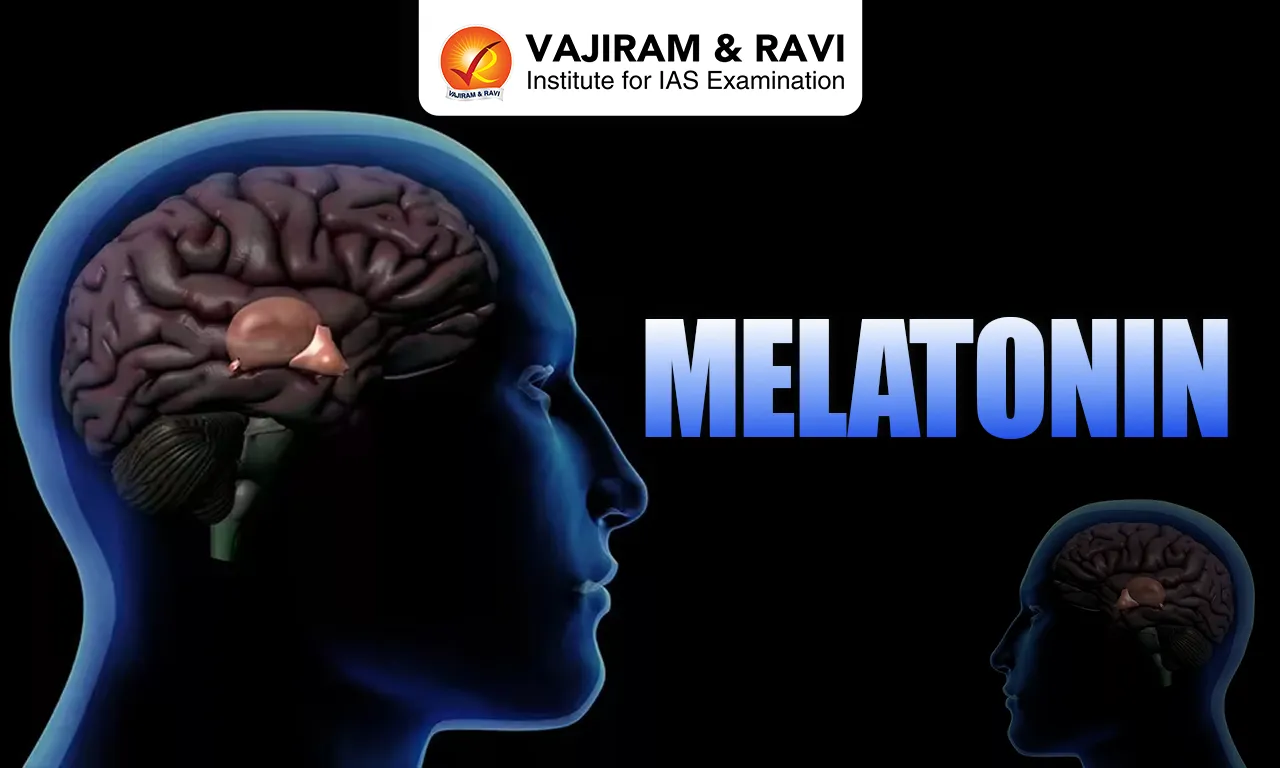
  • Melatonin is a naturally-occurring hormone in human beings that controls sleep and wake cycles in our daily lives. 
  • Its levels rise in the evening, helping to promote sleep.
  • It is secreted by the pineal gland in the human body.
    • Pineal gland releases the most melatonin when there’s darkness and decreases melatonin production when you’re exposed to light. 
  • Melatonin makes us sleepy at certain times of the day. It starts to secrete when our bodies are getting ready to go to sleep and usually takes about 30 to 45 minutes to take full effect.
  • Its secretion is at its highest in the middle of the night and gradually starts to decrease until we are ready to wake up and start our day.
  • Melatonin can also be made synthetically in a lab and sold as a dietary supplement. It’s called exogenous melatonin.
  • Those people whose sleep is not optimal and who travel frequently across time zones prefer melatonin supplements.
  • Side Effects of Melatonin supplements
    • Overuse of melatonin may cause headaches, hormonal changes, or mood swings, disturbing the very rhythm and sleep cycle.

Source: TH

Melatonin FAQs

Q1: What is the primary function of Melatonin in the human body?

Ans: Regulating sleep-wake cycle

Q2: Where is Melatonin produced in the human body?

Ans: Pineal gland

Silicon Carbide

Silicon Carbide

Silicon Carbide Latest News

Recently, the Chief Minister of Odisha performed the groundbreaking ceremony for  the country’s first end-to-end silicon carbide semiconductor production plant. 

About Silicon Carbide

  • It is a synthetically produced crystalline compound of silicon and carbon.
  • Its chemical formula is SiC and it is the most widely used non-oxide ceramic.
  • It was discovered by the American inventor Edward G. Acheson in 1891

Properties of Silicon Carbide

  • Hardness: It is the hardest ceramic material and has excellent thermal conductivity, low thermal expansion.
  • Conductivity: It is also classed as a semiconductor, having an electrical conductivity between that of metals and insulating materials.
  • It has excellent mechanical properties, and excellent resistance to wear and oxidation.

Applications of Silicon Carbide

  • Abrasives: Its primary application is as an abrasive because of its high hardness, which is surpassed only by diamond, cubic boron nitride, and boron carbide.
  • Refractory linings: It is used in refractory linings and heating elements for industrial furnaces, in wear-resistant parts for pumps and rocket engines.
  • Semiconducting substrates: It is used in semiconducting substrates for light-emitting diodes.
  • It is a promising ceramic material with excellent thermo mechanical characteristics.

Source: IE

Silicon Carbide FAQs

Q1: What is Silicon Carbide used for in the electronics industry?

Ans: It is used as a semiconductor substrate.

Q2: What is the chemical formula of Silicon Carbide?

Ans: SiC

Katkari Tribe

Katkari Tribe

Katkari Tribe Latest News

To highlight the plight of the Katkari Tribe, the Shramjeevi Organisation will hold a two-day protest featuring silent fasts and symbolic lamps, demanding land rights, unpaid wages, and dignity for the marginalised community.

About Katkari Tribe

  • It is a primitive tribe found in Maharashtra (Pune, Raigad, and Thane districts) and parts of Gujarat. 
  • It is one of the 75 Particularly Vulnerable Tribal Groups (PVTGs) in India.
  • They were historically forest dwellers.
  • Katkaris are also known as Kathodis because of their old occupation of making Katha (Catechu), the thickened sap from wood of Khair (Acacia catechu).
  • The Katkaris were also one of the few tribal communities of India that consumed rodents. 
  • Many of them still live in their traditional huts made of bamboo and anything they can find in the forest.
  • Despite having a patriarchal system, does not follow the joint family structure, preferring the nuclear family model.
  • Language
    • They are bilingual, speaking the Katkari language amongst themselves and Marathi with others. 
    • A few of them speak Hindi as well.
  • Occupation:
    • They serve as agricultural labourers and sell firewood and some jungle fruits.
    • They also take up fishing for domestic consumption, coal making, and brick manufacturing.
  • They have tremendous knowledge about uncultivated foods like fish, crabs, animals, birds, tubers/rhizomes, wild vegetables, fruits, nuts, etc.
  • A majority of the Katkari families are landless. The landless rate of 87% among the Katkari is much higher than 48% for rural households in India as a whole.
  • As a result of landlessness, migration is rampant, and livelihoods are seasonal.

Source: FPJ

Katkari Tribe FAQs

Q1: The Katkari tribe is primarily found in which Indian state?

Ans: Maharashtra

Q2: The Katkari tribe is also known by which other name?

Ans: Kathodi

Q3: Why are the Katkaris also called Kathodis?

Ans: Because of their occupation of making Katha (Catechu).

Q4: What is the approximate landlessness rate among the Katkari families?

Ans: 87%

Enquire Now