Acanthosis Nigricans

Acanthosis Nigricans

Acanthosis Nigricans Latest News

Acanthosis Nigricans identification in early stages gives both children and adults a chance to detect prediabetes or diabetes before any major complications.

About Acanthosis Nigricans

  • It is a skin condition characterised by dark, velvety patches on skin folds. 
  • Causes: It can be obesity, insulin resistance, metabolic syndrome, diabetes mellitus and extremely rarely, in melanomas, stomach or liver malignancies. 

Symptoms of Acanthosis Nigricans

  • It can manifest in skin folds and creases such as behind the neck, underarms, under the breasts, the groin, even the elbows or behind the knees as dark, thick, rough or velvety skin patches.
  • The skin changes associated with this condition develop gradually over the course several months.
  • The affected skin may sometimes be itchy or emit a foul odour along with hyperpigmentation.
  • If it is associated with insulin resistance, the darkening often progresses fast.

Treatment for Acanthosis Nigricans

  • It depends on the cause of Acanthosis Nigricans
  • If it is due to an underlying condition, such as diabetes or a hormonal condition, treating the condition will treat the skin problems.
  • Prescription creams to lighten the area.
  • Even laser therapy or dermabrasion is preferred to reduce thickness.

Source: TH

Acanthosis Nigricans FAQs

Q1: Which hormone is often associated with Acanthosis Nigricans?

Ans: Insulin

Q2: What is the typical appearance of Acanthosis Nigricans lesions?

Ans: Dark, velvety patches
Protidricerus albocapitatus

Protidricerus albocapitatus

Protidricerus albocapitatus Latest News

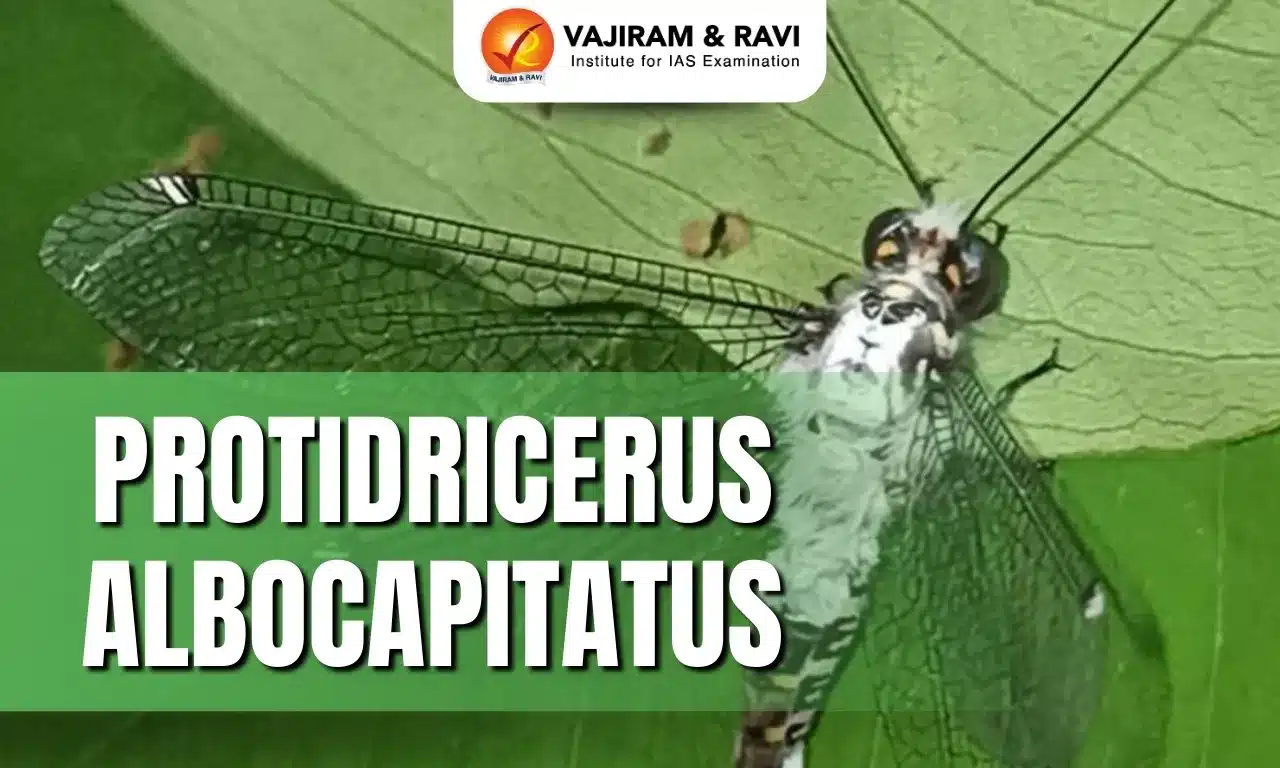
Recently, scientists have discovered a new species of owlfly in Kerala after 134 years and named it Protidricerus albocapitatus.

About Protidricerus albocapitatus

  • It was found in the Nedumkayam forest in Malappuram district of Kerala.
  • It is a species of owlfly belongs to the family Myrmeleontidae and order Neuroptera.
  • With this addition, Kerala now hosts five known species of owlflies, and India’s total rises to 37.
  • Appearance: It has white tufted head and clubbed antennae.

Key Facts about Owlflies

  • They belong to the order Neuroptera, comprising holometabolous insects.

Characteristics of Owlflies

  • Habitat: Adult owlflies perch on blades of grass growing in lateritic soils and also in village households, surrounded by dense vegetation.
  • Appearance: The two distinguishing characteristics of owlflies are their long, clubbed antennae and their bulging eyes.
  • Some species of owlflies develop some color in their wings after their emergence.
  • Behaviour
    • They become active during dusk and take flight. 
    • They are aerial predators feeding on other insects.
    • They release a strong, musk-like chemical to deter enemies.
  • Reproduction: Usually lay their eggs in groups at the tips of limbs and twigs. The female creates a protective shield below the eggs in order to prevent predators from reaching them.

Source: PIB

Protidricerus albocapitatus FAQs

Q1: Where was the Protidricerus albocapitatus discovered?

Ans: Kerala

Q2: What do Owlflies primarily feed on?

Ans: Small insects

Global Methane Status Report

Global Methane Status Report

Global Methane Status Report Latest News

The recent Global Methane Status Report 2025 warns that crop-residue burning is turning India into a global methane hotspot.

About Global Methane Status Report

  • It is produced by the UN Environment Programme and the Climate and Clean Air Coalition (CCAC).
  • It provides updates on global progress on methane mitigation and the remaining work needed to achieve the Global Methane Pledge.

Key Highlights of Global Methane Status Report 2025

  • Methane’s atmospheric concentrations have more than doubled since pre-industrial times. 
  • The rising global emissions would contribute to almost 24,000 additional premature deaths and 2.5 Mt of crop losses annually by 2030.
  • India is the world’s third-largest methane emitter.
  • India’s agricultural activities alone contribute 12% of global agricultural methane emissions, among the highest shares worldwide.
  • If countries fully implement their Nationally Determined Contributions (NDCs) and Methane Action Plans, emissions could fall by eight% by 2030.
  • The report underscores that 72% of global methane mitigation potential lies in G20+ countries, which emit 65% of global anthropogenic methane.

What is Methane?

  • Methane (CH4) is a hydrocarbon that is a primary component of natural gas.
  • It is a colorless odorless gas, flammable water insoluble gas.
  • It is also known as marsh gas or methyl hydride.
  • It is responsible for approximately a third of the warming we are experiencing these days.

Source: DTE

Global Methane Status Report FAQs

Q1: What is the primary goal of the Global Methane Pledge (GMP)?

Ans: Reduce global methane emissions by 30% from 2020 levels by 2030.

Q2: Which sector is the largest contributor to human-caused methane emissions?

Ans: Agriculture

West Seti Hydropower Project

West Seti Hydropower Project

West Seti Hydropower Project Latest News

Nepal has extended the date for survey license for West Seti Hydropower Project being developed by NHPC and approved to work for a direct agreement for another by SJVN with an aim to facilitate Indian power companies to execute projects in the Himalayan nation.

About West Seti Hydropower Project

  • It is planned to be developed as a 750 MW hydroelectric storage project on the Seti River (a tributary of the Karnali River) in Nepal.
  • Unlike typical run-of-river projects that generate power only based on river flow, West Seti is designed as a storage hydropower project with a large reservoir. 
    • This allows water to be accumulated during the monsoon wet season and enables steady electricity generation throughout the year, including the dry months.
  • The project is being developed by India’s National Hydro Power Corporation Ltd. (NHPC).
  • Core Infrastructure Includes:
    • A 195-meter-high concrete-faced rockfill dam.
    • A reservoir approximately 25 kilometers long, inundating parts of the river valley and surrounding forests. 
    • The power distribution infrastructure will include a power station and a transmission line.
  • Annual Energy Generation: Approximately 3,636 GWh.
  • Ownership and Development Model: Public-Private Partnership led by NHPC.
  • Power Purchase Agreement: Nepal receives 21.9 percent free electricity from West Seti; the remainder exported via Power Trade Corporation India Limited.

Source: TH

West Seti Hydropower Project FAQs

Q1: West Seti Hydropower Project is being developed on which river?

Ans: Seti River (a tributary of the Karnali River)

Q2: West Seti Hydropower Project is located in which country?

Ans: Nepal

Q3: What is the planned installed capacity of the West Seti Hydropower Project?

Ans: 750 MW

Q4: West Seti is designed as what type of hydropower project?

Ans: West Seti is designed as a storage hydropower project with a large reservoir.

Q5: Which Indian organization is developing the West Seti Hydropower Project?

Ans: National Hydro Power Corporation Ltd. (NHPC).

Meerut Bugle

Meerut Bugle

Meerut Bugle Latest News

Recently, the Meerut Bugle has received a Geographical indication tag.

About Meerut Bugle

  • It is a brass wind instrument common with the drills of armed forces and used in wars, ceremonies, and parades for decades.
  • It is used to signal the start of movements or events, and carries a deep historical imprint. 
  • Origin: Meerut’s association with bugle-making dates back to the late 19th century.
  • The bugle’s story is closely linked to the development of India’s military traditions.

How is a Bugle Made?

  • The making of a bugle is entirely manual. A brass sheet is cut and hammered into shape using a specialised die.
  • The sheet is moulded and processed through several stages to achieve a smooth finish, and finally fitted with a mouthpiece.
  • Types of bugles are manufactured
    • Copper bugle: the highest in demand across India.
    • Gold-finish bugle: featuring a polished gold-like surface.
    • Silver-finish bugle: Produced on request.

Source: NIE

Meerut Bugle FAQs

Q1: What is the purpose of a bugle?

Ans: The bugle is used mainly in the military, where the bugle call is used to indicate the daily routines of camp.

Q2: What is the benefit of obtaining a GI tag for a product?

Ans: Protection from imitation and unfair competition

SARAL SIMS

SARAL SIMS

SARAL SIMS Latest News

Recently, the Ministry of Steel has introduced a simplified registration facility called ‘SARAL SIMS’ under the Steel Import Monitoring System (SIMS), effective from November 21.

About SARAL SIMS

  • It is a new system designed to simplify the process of registration for imports of small consignments under the Steel Import Monitoring System (SIMS).
  • Purpose: It is designed to ease the procedural burden associated with importing small quantities and export-oriented shipments through frameworks like Advance Authorization, Special Economic Zones (SEZs), and Export-Oriented Units (EOUs).

Key Features of SARAL SIMS

  • It will apply to steel and iron items falling under Chapters 72, 73, and 86 of the Indian Trade Classification (Harmonized System), 2022 classification system.
  • Simplified Registration: Importers need to make a single annual declaration of their intended import quantity and receive a SARAL SIMS number for multiple consignments throughout the financial year.
  • It eliminates the earlier requirement to generate a new SIMS number for every shipment.
  • Annual Return: Importers must file an annual return by April 30 detailing actual imports made against SARAL SIMS registrations.
  • The importer can avail the facility of SARAL SIMS for-
    • SARAL SIMS for small imports: Allows consignments up to 10 tonnes with an annual cap of 500 tonnes for FY 2025-26, increasing to 1000 tonnes from FY 2026-27.
    • SARAL SIMS for export purposes: Covers imports under Advance Authorization, SEZ, and EOU routes without any quantity limit.

Source: PIB

SARAL SIMS FAQs

Q1: What is the primary purpose of the Steel Import Monitoring System (SIMS)?

Ans: To monitor steel imports and provide data to the domestic industry

Q2: Which ministry launched the Steel Import Monitoring System (SIMS) 2.0?

Ans: Ministry of Steel and Heavy Industries

Kuno National Park

Kuno National Park

Kuno National Park Latest News

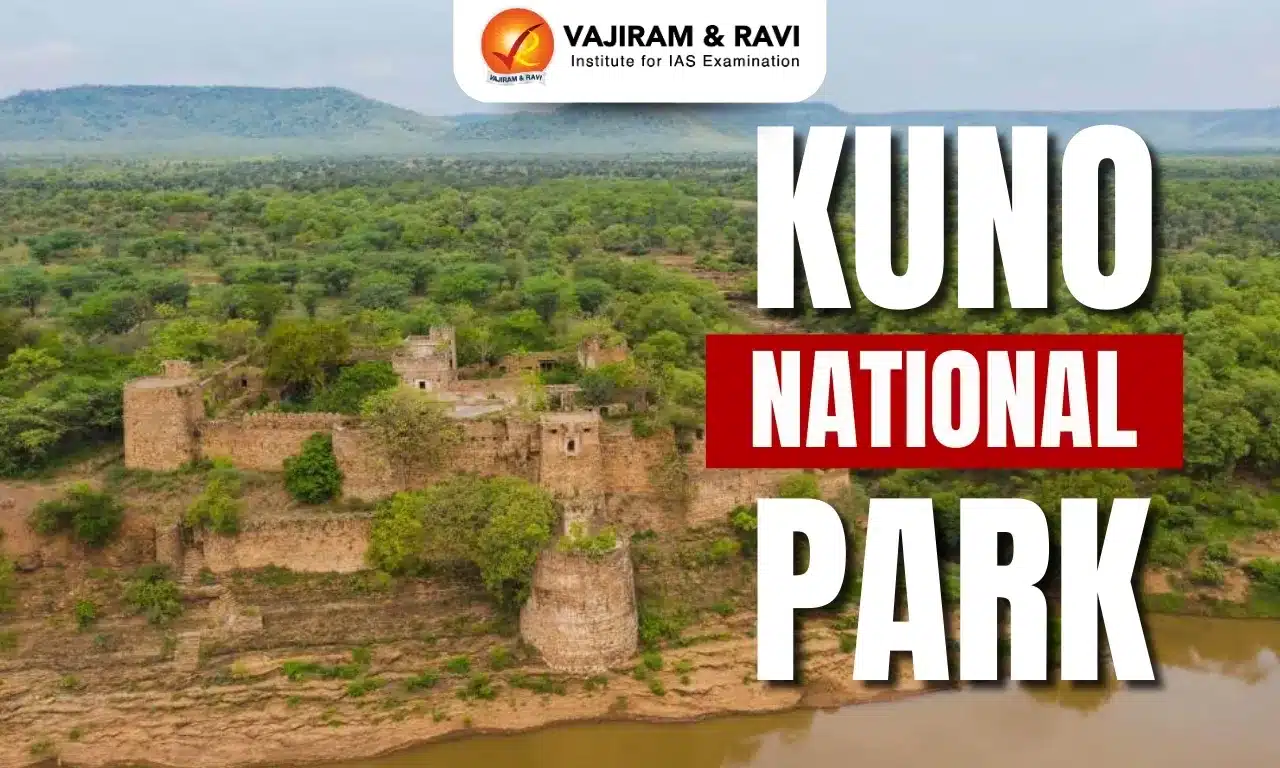
The first India-born cheetah, Mukhi, has given birth to five cubs at Kuno National Park in Madhya Pradesh recently.

About Kuno National Park

  • It is located in the Sheopur district of Madhya Pradesh.
  • It is nestled near the Vindhyan Hills.
  • Originally established as Kuno Wildlife Sanctuary in 1981, it was upgraded to a national park in 2018.
  • The park’s historical significance lies in its role as a relocation site for Asiatic lions under the “Asiatic Lion Reintroduction Project,”.
  • It covers an area of 750 sq.km.
  • It derives its name from the meandering Kuno River (one of the main tributaries of the Chambal River), which flows from south to north and divides the park into two sections.
  • The park’s terrain is dotted with plateaus, valleys, and seasonal rivers, creating varied ecosystems.
  • Vegetation: The park boasts diverse vegetation, including tropical dry deciduous forests, savannah grasslands, and riverine forests.
  • Flora:  Dominant trees include Khair (Acacia catechu), Salai (Boswellia serrata), and Ber (Ziziphus mauritiana).
  • Fauna
    • The protected area of the forest is home to the jungle cat, Indian leopard, sloth bear, Indian wolf, striped hyena, golden jackal, Bengal fox, and dhole, along with more than 120 bird species.
    • It was selected under the ‘Action Plan for Introduction of Cheetah in India’.
    • A total of 20 cheetahs were introduced in Kuno National Park (NP), eight from Namibia in September 2022, followed by 12 more from South Africa in February 2023 under the Cheetah Project.

Source: NOA

Kuno National Park FAQs

Q1: Kuno National Park is located in which Indian state?

Ans: Madhya Pradesh

Q2: Kuno National Park is situated near which hill range?

Ans: It is nestled near the Vindhyan Hills.

Q3: What is the total area covered by Kuno National Park?

Ans: It covers an area of 750 sq.km.

Q4: From which two countries were cheetahs brought to Kuno National Park in 2022 and 2023?

Ans: Namibia and South Africa

Guru Tegh Bahadur

Guru Tegh Bahadur

Guru Tegh Bahadur Latest News

Following a car blast near Red Fort recently, the Delhi police have stepped up security near the heritage site, which will host an event to commemorate the 350th death anniversary of Guru Tegh Bahadur.

About Guru Tegh Bahadur

  • Guru Tegh Bahadur (1621–1675) was the ninth of ten Gurus of the Sikh religion.
  • He was born as Tyaga Mal. He was the fifth and the youngest son of the sixth Sikh Guru, Guru Hargobind.
  • He came to be known by the name Teg Bahadur (Mighty of The Sword), given to him by Guru Hargobind after he showed his valour in a battle against the Mughals.
  • In 1664, Guru Teg Bahadur succeeded Guru Har Krishan Ji as the ninth Sikh Guru. 
  • His son, Guru Gobind Singh, became the tenth Sikh guru.
  • Life and Works:
    • He built the city of Anandpur Sahib (in Rupnagar/Ropar district, on the edge of Shivalik Hills, near the Sutlej River, in Punjab). Here the last two Sikh Gurus lived and where Guru Gobind Singh Ji founded the Khalsa Panth in 1699.
    • He contributed more than 100 poetic hymns to the Granth Sahib, which cover various topics, such as the nature of God, human attachments, body, mind, dignity, service, etc.
    • He resisted the forced conversions of Kashmiri Pandits and non-Muslims to Islam.
  • Martyrdom:
    • He was publicly beheaded in 1675 on the orders of Mughal emperor Aurangzeb in Delhi for refusing to convert to Islam. 
    • Gurdwara Sis Ganj Sahib in Chandni Chowk marks the place of his execution.
    • Gurdwara Rakab Ganj Sahib marks the place of cremation of his body.
    • He is remembered for giving up his life for freedom of religion.
    • His martyrdom is remembered as the Shaheedi Divas of Guru Tegh Bahadur every year on 24 November, according to the Nanakshahi calendar released by the Shiromani Gurdwara Parbandhak Committee in 2003.

Source: TH

Guru Tegh Bahadur FAQs

Q1: Who was Guru Tegh Bahadur?

Ans: Guru Tegh Bahadur (1621–1675) was the ninth of ten Gurus of the Sikh religion.

Q2: Who was the father of Guru Tegh Bahadur?

Ans: Guru Tegh Bahadur was the fifth and the youngest son of the sixth Sikh Guru, Guru Hargobind.

Q3: Which city was established by Guru Tegh Bahadur?

Ans: He built the city of Anandpur Sahib (in Rupnagar/Ropar district, on the edge of Shivalik Hills, near the Sutlej River, in Punjab).

Q4: Guru Tegh Bahadur was executed on the orders of which Mughal ruler?

Ans: Aurangzeb

Javelin Missile

Javelin Missile

Javelin Missile Latest News

The U.S. State Department recently approved a possible sale of Javelin missiles and Excalibur projectiles and related equipment to India for an estimated total cost of $92.8 million.

About Javelin Missile

  • It is an American-made, man-portable, anti-tank guided missile. 
  • It is developed and produced jointly by American defence majors Raytheon and Lockheed Martin.
  • It was designed to defeat heavily armored vehicles such as main battle tanks and lighter-skinned military vehicles.
  • The weapon also has capability against other target types like fortifications, bunkers, and helicopters.
  • It first entered service with the U.S. military in 1996. 

Javelin Missile Features

  • It has an effective range of 2.5 km, with newer models reportedly capable of reaching up to 4 kilometers.
  • Weight: 5.11 kg
  • It can be employed from confined spaces due to its soft-launch mechanism.
  • It uses “fire-and-forget” technology to guide itself to the target without external commands or target designation. 
  • Its imaging-infrared seeker enables independent homing once fired, allowing operators to take cover immediately.
  • The missile can engage targets using either a direct or top-attack mode, with the latter designed to exploit vulnerabilities in the thinner armor on the tops of tanks.
  • Its tandem high-explosive anti-tank (HEAT) warhead is designed to defeat explosive reactive armour, which is increasingly common on contemporary main battle tanks.

What is the Excalibur Projectile?

  • It is a GPS-guided artillery shell fired from large guns like howitzers. 
  • It was developed in a collaborative effort between the U.S. Army Research Laboratory (ARL) and the United States Army Armament Research, Development and Engineering Center (ARDEC). 
  • India already uses the Excalibur artillery ammunition in its M-777 Howitzer guns. 
  • Excaliburs are capable of engaging targets beyond the reach of conventional artillery even in challenging terrains.
  • They are capable of striking within two metres of the target “regardless of range.” 
  • This weapon system also extends the reach of 39-calibre artillery to 40 kilometres, 52-calibre artillery to 50 kilometres, and 58-calibre artillery to 70 kilometres
  • The guided shells are capable of causing little to no collateral damage due to this accuracy factor.

Source: TH

Javelin Missile FAQs

Q1: The Javelin missile is jointly developed by which American companies?

Ans: Raytheon and Lockheed Martin.

Q2: What type of missile is the Javelin?

Ans: It is a man-portable, anti-tank guided missile.

Q3: What is the approximate effective range of the Javelin missile (standard version)?

Ans: 2.5 km

Q4: Excalibur is primarily what type of weapon?

Ans: GPS-guided artillery shell.

Enquire Now