Boreendo

Boreendo

Boreendo Latest News

Boreendo, an ancient musical instrument from Pakistan, was recently inscribed on the UNESCO’s List of Intangible Cultural Heritage in Need of Urgent Safeguarding.

About Boreendo

  • The boreendo, or bhorindo, is a traditional musical instrument from Pakistan’s Sindh region.
  • It is a 5,000-year-old musical instrument with a rich history that originates in Mohenjo Daro, part of the Indus Valley Civilisation.
  • It has a hollow, spherical shape with sound holes and is made of clay that is sun-dried and kiln-fired. 
  • It is played by men, while women are involved in decorating the instrument with clay paint.
  • The boreendo produces sound when air is blown into it, and its tone can be adjusted by tilting the mouthpiece. 
  • Its size affects its sound, and recent changes include extra holes to widen its musical range.
  • The boreendo is mainly played at winter bonfires, weddings, and festivals.

Source: DEVD

Boreendo FAQs

Q1: What is Boreendo?

Ans: It is a traditional musical instrument.

Q2: The boreendo is traditionally associated with which region?

Ans: Sindh, Pakistan

Q3: The historical origins of the boreendo trace back to which ancient site?

Ans: It has a rich history that originates in Mohenjo Daro, part of the Indus Valley Civilisation.

Q4: The boreendo is typically made from which material?

Ans: It is made of clay that is sun-dried and kiln-fired.

Pallas’s Gull

Pallas's Gull

Pallas's Gull Latest News

The rare migratory Pallas's Gull was recently spotted in Jharkhand's Udhwa Bird Sanctuary, marking its return after almost a decade.

About Pallas's Gull

  • Pallas's Gull, also called the Great Black-headed Gull, is a large bird species.
  • It is the world's largest black-headed gull and the third-largest species of gull in the world.
  • It belongs to the family Laridae.
  • Scientific Name: Ichthyaetus ichthyaetus

Pallas's Gull Distribution

  • It breeds in colonies in marshes and islands from southern Russia to Mongolia. 
  • It is migratory, wintering in the Mediterranean Sea, the Arabian Peninsula, and India.
  • Habitat: It prefers wetlands, salt lakes, lagoons, and slow-flowing rivers

Pallas's Gull Features

  • It measures 55–72 cm in length with a 142 to 170 cm wingspan. 
  • Summer adults are unmistakable, since no other gull of this size has a black hood. 
  • The adults have grey wings and back, with conspicuous white "mirrors" at the wing tips. 
  • The legs are yellow, and the bill is orangey-yellow with a red tip.
  • In all other plumages, a dark mask through the eye indicates the vestiges of the hood.
  • Pallas's Gulls feed on fish, including dead fish. They also prey upon insects, crustaceans, reptiles, other birds, and small mammals.

Pallas's Gull Conservation Status

It is classified as Least Concern under the IUCN Red List.

Key Facts about Udhwa Lake Bird Sanctuary 

  • It is located in the Sahebganj district of Jharkhand
  • It is the state's only bird sanctuary.
  • It comprises two interconnected wetlands, Pataura Lake and Berhale Lake, which are part of the Ganga River floodplain and surrounded by the Rajmahal Hills.
  • It was declared a Ramsar Site in 2025.
  • It supports a diverse ecosystem with over 146 species of birds, including endangered ones like the band-tailed fish eagle, lesser adjutant stork, and common pochard. 
  • It also hosts a variety of aquatic plants, fish, reptiles, and mammals, such as fishing cats and otters.
  • The sanctuary is an important habitat within the Central Asian flyway, attracting migratory birds during the winter.

Source: DEVD

Pallas's Gull FAQs

Q1: What is Pallas's Gull?

Ans: It is a large bird species.

Q2: In which regions does Pallas’s Gull breed?

Ans: It breeds in colonies in marshes and islands from southern Russia to Mongolia.

Q3: Where does Pallas’s Gull migrate in winter?

Ans: The Mediterranean Sea, Arabian Peninsula, and India.

Q4: What is the IUCN conservation status of Pallas’s Gull?

Ans: Least Concern

National Film Heritage Mission (NFHM)

National Film Heritage Mission (NFHM)

National Film Heritage Mission Latest News

In response to a question in Lok Sabha recently, the Minister of State for Information & Broadcasting said that till date 1,469 titles, equaling 4.3 lakh minutes of films, have been digitized under the National Film Heritage Mission (NFHM).

About National Film Heritage Mission

  • It was launched in 2015 by the Ministry of Information and Broadcasting for restoring and preserving the film heritage of India. 
  • Implementation Agency: National Film Archive of India, Pune.
  • Objectives:
    • Condition assessment of film reels to ascertain the remaining life of the film.
    • 2K/4K picture and sound restoration of landmark films of India and recording of new picture and sound inter-negatives of each film.
    • Digitization of films.
    • Construction of archival and preservation facilities called vaults.
    • Training and workshops for in-house capacity building.
    • Web-based end-to-end IT solution.

Key Facts about National Film Archive of India (NFAI)

  • It was established in February 1964 as a media unit of the Ministry of Information and Broadcasting, Government of India.
  • Its primary objective is to acquire and preserve Indian cinematic heritage. 
  • This includes preservation of film and non-film material, including but not limited to celluloid, stills, glass slides, posters, lobby cards, scripts, and song booklets.
  • Beyond safeguarding celluloid history, the NFAI actively promotes Indian cinema. 
    • They organize screenings, film appreciation courses, and research programs, fostering a deeper understanding of Indian film culture.
  • It is headquartered in Pune with regional centers in Bangalore, Kolkata, and Trivandrum.
  • It has been a member of the International Federation of Film Archives (FIAF) since 1969.

Source: PIB

National Film Heritage Mission FAQs

Q1: Which Ministry launched the National Film Heritage Mission?

Ans: It was launched in 2015 by the Ministry of Information and Broadcasting.

Q2: Which organisation is the implementing agency for National Film Heritage Mission?

Ans: National Film Archive of India (NFAI), Pune

Q3: What is the objective of National Film Heritage Mission?

Ans: Restoring and preserving the film heritage of India.

Diving Support Craft A20

Diving Support Craft A20

Diving Support Craft A20 Latest News

The Indian Navy will commission Diving Support Craft (DSC) A20, at Kochi under the aegis of Southern Naval Command.  

About Diving Support Craft A20

  • It is the first vessel of the indigenously designed and constructed Diving Support Craft.
  • DSC A20 is the lead ship in a series of five Diving Support Craft being built by M/s Titagarh Rail Systems Limited (TRSL), Kolkata. 
  • Purpose: It is built for a wide spectrum of diving and underwater missions in coastal waters.

Features of Diving Support Craft A20

  • It has a catamaran hull design form, the ship offers superior stability, enhanced deck area, and improved seakeeping characteristics,
  • It is equipped with advanced, state-of-the-art diving systems that meet the highest standards of safety and operational efficiency.
  • Capacity: It has a displacement capacity of approximately 390 tons. 
  • It is designed and built in accordance with the Naval Rules and Regulations of the Indian Register of Shipping (IRS),
  • DSC A20 will be based at Kochi and operate under Southern Naval Command.
  • Significance: The Indian Navy’s capability in diving support, underwater inspection, salvage assistance, and coastal operational deployment will be substantially strengthened.

Source: PIB

Diving Support Craft A20 FAQs

Q1: What is the purpose of Diving Support Craft A20?

Ans: Diving and underwater missions in coastal waters

Q2: What is the capacity of Diving Support Craft A20?

Ans: 390 tons

Key Facts about Italy

Key Facts about Italy

Italy Latest News

The recently held Italy–India Business Forum 2025 will strengthen bilateral trade, innovation and strategic economic partnership.

About Italy

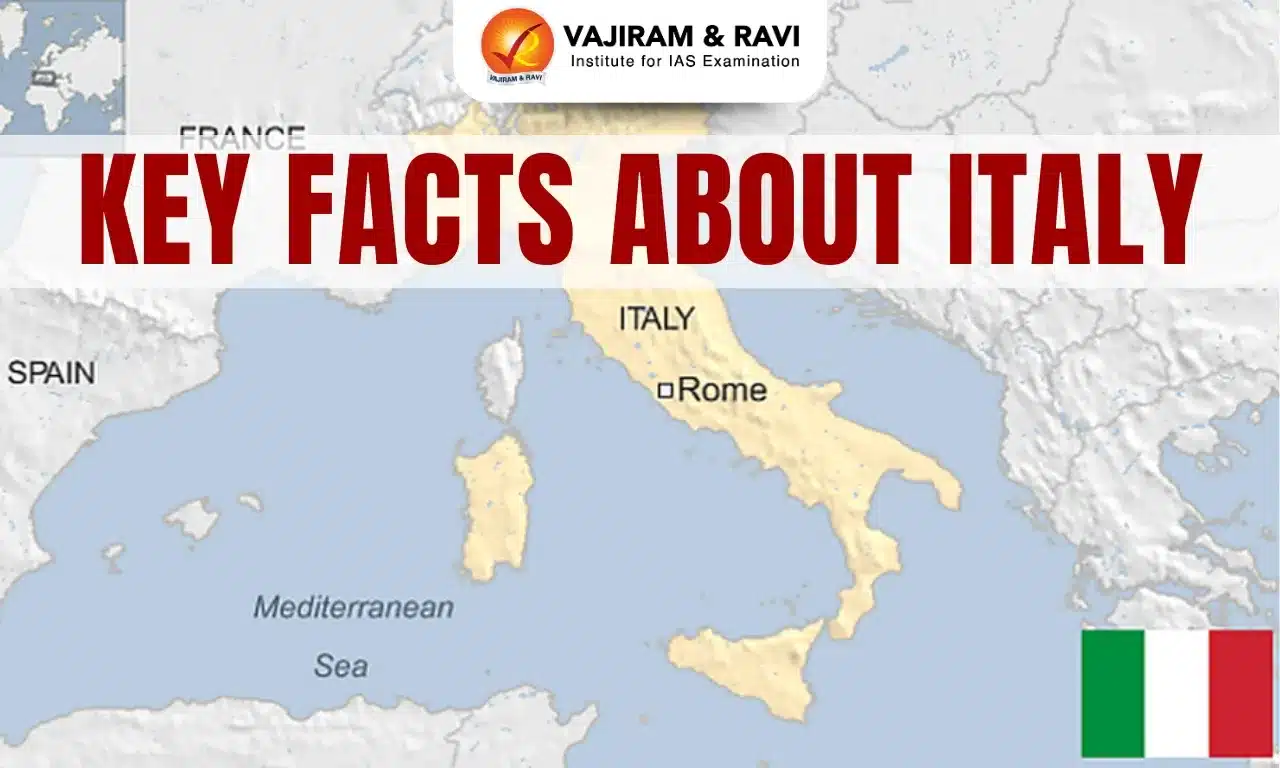
  • Location: It is located in South-central Europe on the Apennine Peninsula.
  • Bordering Countries: It shares its border with Switzerland and Austria in the north, Slovenia in the northeast and France in the northwest.  
  • Vatican City and San Marino are the two enclaved sovereign states within Italy.
  • Its southern boundary extends into the Mediterranean Sea.
  • Maritime boundaries: Italian Peninsula is bordered by the Adriatic Sea in the east, the Sea of Sicily in the south, the Ionian Sea in the southeast, the Ligurian Sea, and the Tyrrhenian Sea in the southwest.
  •  Capital City: Rome

Geographical Features of  Italy

  • Terrain: It is mostly rugged and mountainous and has some plains, coastal lowlands.
  • Major Rivers: Po (It is Italy's longest river) and Adige
  • Highest Point: Mont Blanc 
  • Natural Resources: Coal, antimony, mercury, zinc, potash, barite, asbestos, pumice, fluorspar, feldspar, pyrite (sulfur), natural gas and crude oil reserves.
  • Italy is volcanic in origin, and a few of its many volcanoes are active, including Sicily's Mt. Etna, Stromboli in the Aeolian Islands.

Source: PIB

Italy FAQs

Q1: What is the capital of Italy?

Ans: Rome

Q2: Which mountain range runs along the eastern coast of Italy?

Ans: Apennines

Western Tragopan

Western Tragopan

Western Tragopan Latest News

India’s western tragopan population is steadied by captive breeding but human disturbance and habitat fragmentation continue to endanger its future.

About Western Tragopan

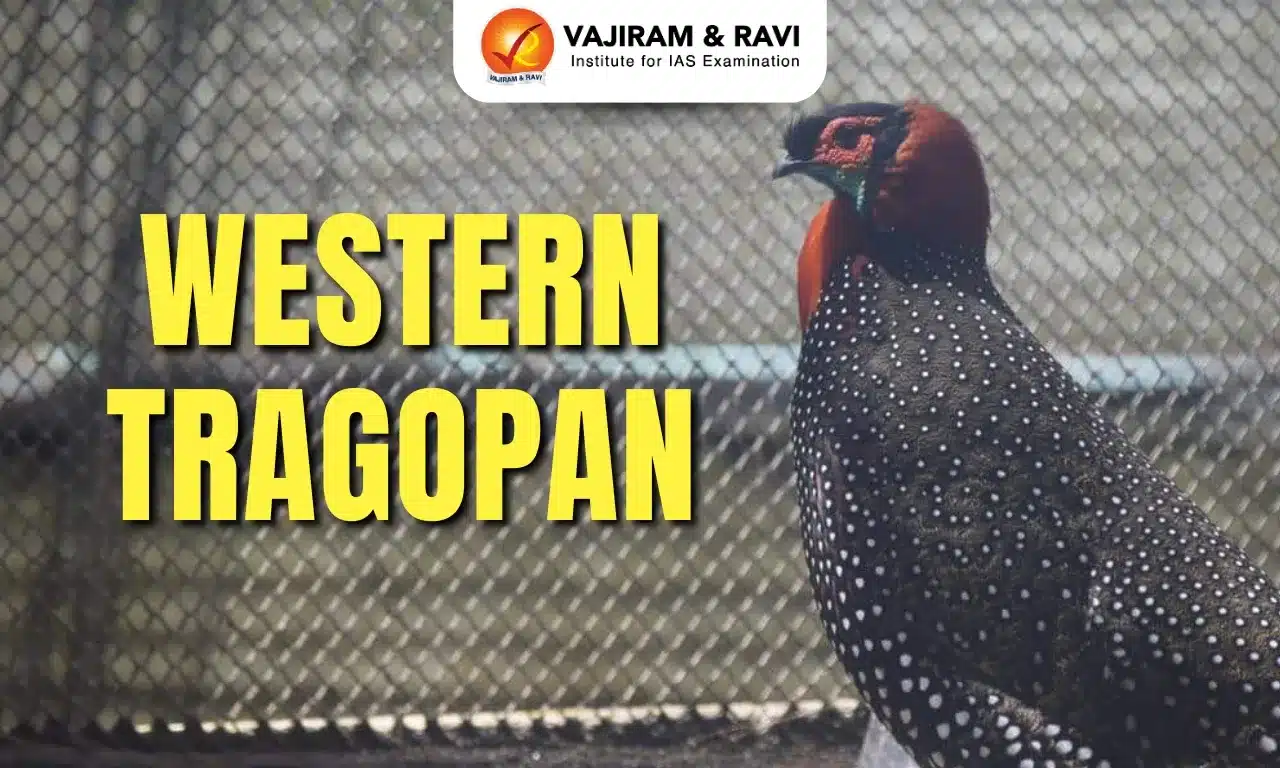
  • It is also known as the western horned tragopan, is amongst the rarest of all living pheasants.
  • Due to its beautiful plumage and large size, this bird is locally known as ‘jujurana’ or ‘king of birds’
  • It is one of the rarest and most stunning pheasant species in the world.
  • These birds are shy and ground-dwelling.
  • They are usually active during dawn and dusk, moving quietly through dense undergrowth.
  • It is the state bird of Himachal Pradesh.
  • Distribution: It is endemic to the northwest Himalaya, within a narrow range from Hazara in north Pakistan through Jammu and Kashmir and Himachal Pradesh, to the western part of Garhwal.
    • The upper part of Great Himalayan National Park’s (GHNP) forest zone holds the world’s largest known population of western tragopan.
  • Habitat: It prefers a habitat of ringal (dwarf) bamboo beneath dense forest.
  • Diet: It feeds mostly on leaves, shoots and seeds, but also consumes insects and other invertebrates.
  • Breeding:  It breeds during May to June, laying 3–5 eggs in concealed nests on the forest floor.
  • Threats: Habitat loss, hunting pressure and anthropogenic disturbances which includes livestock grazing, minor forest produce collection like medicinal herbs etc.
  • Conservation status: IUCN: Vulnerable.

Source: TH

Western Tragopan FAQs

Q1: What is the Western Tragopan also known as?

Ans: Jujurana

Q2: What is the habitat of Western Tragopan?

Ans: Western Himalayas

Agentic AI

Agentic AI

Agentic AI Latest News

Satya Nadella, Chairman and CEO of Microsoft, recently observed that India is witnessing strong momentum in the deployment of AI and agentic AI applications.

About Agentic AI

  • Agentic AI is an advanced form of artificial intelligence focused on autonomous decision-making and action. 
  • It consists of AI agentsmachine learning models that mimic human decision-making to solve problems in real time.
  • Unlike traditional AI, which primarily responds to commands or analyzes data, agentic AI can set goals, plan, and execute tasks with minimal human intervention.
  • "Agentic" indicates agency — the ability of these systems to act independently, but in a goal-driven manner.
  • At its core, this technology is built on several key components:
    • Perception: Agentic AI starts by gathering information from its surroundings and different sources, such as sensors, databases, and user interfaces. 
    • Reasoning: Using a large language model (LLM), agentic AI analyzes the gathered data to understand the context, identify relevant information, and formulate potential solutions. 
    • Planning: The AI then uses the information it gathered to develop a plan. This involves setting goals, breaking them down into smaller steps, and figuring out the best way to achieve them.
    • Action: Based on its plan, the AI takes action. This could involve performing tasks, making decisions, or interacting with other systems.
    • Reflection: After taking action, the AI learns from the results. It evaluates whether its actions were successful and uses this feedback to adjust its plans and actions in the future. 
  • Agentic AI builds on generative AI (GenAI) techniques by using large language models (LLMs) to function in dynamic environments. 
  • While generative models focus on creating content based on learned patterns, agentic AI extends this capability by applying generative outputs toward specific goals. 
  • For example, a generative AI model like OpenAI’s ChatGPT might produce text, images, or code, but an agentic AI system can use that generated content to complete complex tasks autonomously by calling external tools.

Source: TH

Agentic AI FAQs

Q1: What is Agentic AI?

Ans: It is an advanced form of artificial intelligence focused on autonomous decision-making and action.

Q2: What distinguishes Agentic AI from traditional AI?

Ans: Ability to act independently and pursue goals.

Q3: What makes Agentic AI capable of functioning in dynamic environments?

Ans: Use of large language model (LLM) -based generative abilities combined with autonomous planning

Champions of the Earth Award

Champions of the Earth Award

Champions of the Earth Award Latest News

Recently, the Additional Chief Secretary of the Department of Environment, Climate Change and Forests of Tamil Nadu, Ms Supriya Sahu, has won the UN Environment Programme’s 2025 Champions of the Earth Award. 

About Champions of the Earth Award

  • It was established in 2005 and awarded by the United Nations Environment Programme (UNEP).
  • It is the UN’s highest environmental honour, recognises trailblazers at the forefront of efforts to protect people and the planet.
  • Every year, UNEP honours individuals and organizations working on innovative and sustainable solutions to address the triple planetary crisis of climate change, nature and biodiversity loss, and pollution and waste

Champions of the Earth are Celebrated in Four Categories

  • Policy leadership: Public sector officials leading global or national action for the environment. They shape dialogue, lead commitments and act for the good of the planet.
  • Inspiration and action: Leaders taking bold steps to inspire positive change to protect our world. They lead by example, challenge behavior and inspire millions.
  • Entrepreneurial vision: Visionaries challenging the status quo to build a cleaner future. They build systems, create new technology and spearhead a groundbreaking vision. 
  • Science and innovation: Trailblazers pushing the boundaries of technology for profound environmental benefit. 

Source: News On Air

Champions of the Earth Award FAQs

Q1: What is the Champions of the Earth Award?

Ans: A UN award for environmental protection

Q2: Who established the Champions of the Earth Award?

Ans: United Nations Environment Programme (UNEP)

Sanchar Mitra Scheme

Sanchar Mitra Scheme

Sanchar Mitra Scheme Latest News

In a written reply to a question in the Lok Sabha recently, the Minister of State for Communications and Rural Development said that 222 institutions are currently participating in the Sanchar Mitra Scheme.

About Sanchar Mitra Scheme

  • It is a youth-oriented initiative by the Department of Telecommunications (DoT), Ministry of Communications.
  • It is aimed at harnessing the energy and potential of young students to spread awareness about safe digital behaviour.
  • Under this scheme, student volunteers, named as Sanchar Mitra, will raise public awareness about mobile safety, telecom fraud prevention, and government digital initiatives. 
  • They will conduct outreach in communities, schools, and public spaces to educate citizens on responsible and secure use of telecom services.
  • This scheme is open to students from those technical institutes that have active telecom, electronics, computers, cybersecurity, or similar programs and have agreed to participate in the scheme.
  • Sanchar Mitras will receive necessary training from experts and from the National Communications Academy-Technology (NCA-T). 
    • The Sanchar Mitras will receive various training on subjects like cybersecurity, emerging technologies in the telecom sector, telecom policies and regulations, etc. 
  • The scheme offers top performers,
    • access, on a best-effort basis, to research and development (R&D) projects and telecom start-ups;
    • involvement in policy and standards work;
    • participation in field surveys and DoT initiatives;
    • exposure to national conferences and events. 
  • Recognition and incentives will be coordinated through DoT units, leveraging existing resources and partnerships.
  • The scheme has been implemented across all states/UTs through the licensed service area (LSA) field offices of DoT.

Source: PIB

Sanchar Mitra Scheme FAQs

Q1: Which ministry implements the Sanchar Mitra Scheme?

Ans: Ministry of Communications

Q2: What is the primary aim of the Sanchar Mitra Scheme?

Ans: Encouraging youth to spread awareness about safe digital behaviour.

Q3: Who are designated as “Sanchar Mitras” under the scheme?

Ans: Student volunteers

Q4: Students from which institutions can participate in the Sanchar Mitra Scheme?

Ans: Technical institutes with telecom, electronics, computers, cybersecurity or similar programmes.

Q5: Which organisation provides training support to Sanchar Mitras?

Ans: National Communications Academy-Technology (NCA-T)

PM Vishwakarma Scheme

PM Vishwakarma Scheme

PM Vishwakarma Scheme Latest News

Recently, the National Steering Committee (NSC) for the PM Vishwakarma scheme approved several proposals and policy measures to improve loan sanctions and disbursements under this scheme.

About PM Vishwakarma Scheme

  • It is a central sector scheme launched by the Ministry of Micro, Small, and Medium Enterprises.
  • It aims to strengthen and nurture the Guru-Shishya parampara, or family-based practice of traditional skills by artisans and craftspeople working with their hands and tools. 
  • It offers services like market linkage support, skill training, and incentives for digital transactions to artisans and craftspeople engaged in specified trades.
  • Time period: Five years (FY 2023-24 to FY 2027-28). 
  • Eligibility & coverage
    • It is available for rural and urban artisans and craftsmen across India.
    • It covers 18 traditional crafts such as Boat Maker; Armourer; Blacksmith; Hammer and Tool Kit Maker; etc.
    • Aged 18+, engaged in traditional trade, no similar loans in the past 5 years.

Key Features of PM Vishwakarma Scheme

  • Recognition: Recognition of artisans and craftspeople through PM Vishwakarma certificate and ID card.
  • Skill Upgradation: Basic Training of 5-7 days and Advanced Training of 15 days or more, with a stipend of Rs. 500 per day;
  • Toolkit Incentive: A toolkit incentive of upto Rs. 15,000 in the form of e-vouchers at the beginning of Basic Skill Training.
  • Credit Support: Collateral free ‘Enterprise Development Loans’ of upto Rs. 3 lakh in two tranches of Rs. 1 lakh and Rs. 2 lakh at a concessional rate of interest fixed at 5%
  • Coverage: Five lakh families will be covered in the first year and 30 lakh families over five years

Source: PIB

PM Vishwakarma Scheme FAQs

Q1: What is the primary objective of PM Vishwakarma Scheme?

Ans: To support traditional artisans and craftspeople

Q2: Who is eligible for PM Vishwakarma Scheme?

Ans: Artisans and craftspeople above 18 years

Enquire Now