Hainan Island

Hainan Island

Hainan Island Latest News

China recently split off Hainan Island, with an economy comparable to a mid-ranked country, from the mainland for customs processing, part of a bid to join a major trans-Pacific trade deal and establish a new Hong Kong-style commercial hub.

About Hainan Island

  • It is a tropical island at the southernmost of China.
  • It is situated in the northeastern part of the Beibu Gulf, across the Qiongzhou Strait from mainland China.
  • It’s known as the “Hawaii of China,”.
  • It has a land area of ​​35,400 sq.km. It is the largest island administered by the People's Republic of China.
  • It has a population of about 10 million. 
  • Its provincial capital is Haikou, known as the "Coconut City".
  • It was geologically connected with the southern Chinese mainland until a rift through the Hainan Strait opened sometime during the Miocene and Pliocene epochs (about 23 to 2.6 million years ago). 
  • The island is approximately oval in shape and measures about 260 km from east to west and 210 km from north to south at its widest point.
  • Hainan is a regional center connecting Northeast Asia and Southeast Asia and is a maritime gateway between the Indian Ocean and the Pacific Ocean.
  • It’s also China’s largest free-trade port and host of the Boao Forum, an annual meeting of political and business leaders dubbed “Asia’s Davos.”

Source: CNBC

Hainan Island FAQs

Q1: Hainan Island is part of which country?

Ans: China

Q2: Hainan Island lies across which strait from mainland China?

Ans: Qiongzhou Strait

Q3: Which city is the provincial capital of Hainan Island?

Ans: Haikou

Q4: Hainan forms a maritime gateway between which two oceans?

Ans: Indian Ocean and Pacific Ocean

National Scheduled Caste and Scheduled Tribe Hub (NSSH) Scheme

National Scheduled Caste and Scheduled Tribe Hub (NSSH) Scheme

National Scheduled Caste and Scheduled Tribe Hub (NSSH) Scheme Latest News

The Ministry of Micro, Small and Medium Enterprises (MSME) has intensified efforts to promote entrepreneurship among SC and ST communities through the National Scheduled Caste and Scheduled Tribe Hub (NSSH) Scheme.

About National Scheduled Caste and Scheduled Tribe Hub (NSSH) Scheme

  • It is one of the flagship schemes of the Ministry of Micro, Small & Medium Enterprises.
  • It is implemented by the National Small Industries Corporation Ltd. (NSIC).
  • NSSH is aimed at capacity enhancement of SC/ST entrepreneurs and promoting "entrepreneurship culture" amongst the SC/ST population.
  • The Scheme empowers the SC/ST population to participate in the public procurement process and fulfill the mandated target of 4% procurement from SC/ST enterprises under the Public Procurement Policy by the Ministries, Departments, and CPSEs (Central Public Sector Enterprises). 
  • The initiative provides financial assistance and facilitates access to credit for SC/ST entrepreneurs. 
  • It collaborates with financial institutions, banks, and non-banking financial companies (NBFCs) to ensure that entrepreneurs from these communities have access to affordable and timely financial resources for their business ventures.
  • It also focuses on skill development and capacity building of SC/ST entrepreneurs.

Source: PV

National Scheduled Caste and Scheduled Tribe Hub (NSSH) Scheme FAQs

Q1: The National Scheduled Caste and Scheduled Tribe Hub (NSSH) is implemented by which organization?

Ans: National Small Industries Corporation (NSIC)

Q2: National Scheduled Caste and Scheduled Tribe Hub (NSSH) Scheme is a flagship scheme under which Ministry?

Ans: Ministry of Micro, Small & Medium Enterprises

Q3: What is the main objective of the National Scheduled Caste and Scheduled Tribe Hub (NSSH) Scheme?

Ans: Enhancing capacity and promoting entrepreneurship among SC/ST communities.

Q4: Under the Public Procurement Policy, what is the mandated procurement target from SC/ST-owned enterprises?

Ans: 4%

Antariksh Prayogshala (Space Labs)

Antariksh Prayogshala (Space Labs)

Antariksh Prayogshala (Space Labs) Latest News

The Indian National Space Promotion and Authorisation Centre (IN-SPACe) recently rolled out a Request for Proposal (RfP) to establish Antariksh Prayogshala (Space Labs) at select academic institutions across India.

About Antariksh Prayogshala (Space Labs)

  • It is an initiative of the Indian National Space Promotion and Authorisation Centre (IN-SPACe).
  • It is a first-of-its-kind initiative aimed at creating state-of-the-art space laboratories within Indian academic institutions. 
  • These labs will provide hands-on training to students pursuing space tech courses in academic institutes spread across the country. 
  • This initiative is intended to enable meaningful industry–academia collaboration and support India’s long-term vision of becoming a leading global space economy.
  • Under the scheme, up to seven academic institutions will be selected in a phased manner from different zones across the country. 
  • To ensure balanced regional representation, one lab is proposed in each zone. 
  • These labs will also be available to Non-Governmental Entities (NGEs) for utilization in that zone. 
  • IN-SPACe will provide financial support of up to 75 percent of the total project cost, with a cap of ₹5 crore per institution, to be released on a milestone-linked basis.
  • The selection process will be carried out in two stages. 
    • Institutions will first be screened based on eligibility criteria.
    • Shortlisted applicants will then be evaluated and ranked by an Empowered Committee (EC), following which final selections will be made on a zone-wise basis.

Key Facts about IN-SPACe

  • It is a single-window, independent, nodal agency that functions as an autonomous agency in the Department of Space (DOS). 
  • It is formed following the Space sector reforms to enable and facilitate the participation of private players.
  • IN-SPACe is responsible to promote, enable, authorize and supervise various space activities of non-governmental entities  (NGEs), including 
    • Building launch vehicles & satellites and providing space-based services; 
    • Sharing space infrastructure and premises under the control of DOS/ISRO.
    • Establishing new space infrastructure and facilities.
  • The agency acts as an interface between ISRO and NGEs and assesses how to utilize India's space resources better and increase space-based activities. 
  • It also assesses the needs and demands of private players, including educational and research institutions, and explores ways to accommodate these requirements in consultation with ISRO.

Source: TH

Antariksh Prayogshala (Space Labs) FAQs

Q1: Antariksh Prayogshala is an initiative of which organisation?

Ans: IN-SPACe

Q2: What is the primary objective of the Antariksh Prayogshala initiative?

Ans: Creating space labs within academic institutions.

Q3: What is the maximum financial support offered by IN-SPACe to each selected institution under the Antariksh Prayogshala initiative?

Ans: ₹5 crore

Q4: What percentage of the total project cost will IN-SPACe fund under Antariksh Prayogshala?

Ans: 75%

TIDE 2.0 Scheme

TIDE 2.0 Scheme

TIDE 2.0 Scheme Latest News

Recently, the Union Minister for Electronics and Information Technology informed the Rajya Sabha about the TIDE 2.0 Scheme.

About TIDE 2.0 Scheme

  • The “Technology Incubation and Development of Entrepreneurs 2.0 (TIDE 2.0)” Scheme was launched in the year 2019.
  • It promotes technology-based entrepreneurship by providing financial & technical support to incubators engaged in supporting ICT startups primarily engaged in using emerging technologies such as IoT, AI, Block-chain, Robotics etc. 

Features of TIDE 2.0 Scheme

  • It is implemented through empowering 51 incubators in India and handholding close to 2000 tech start-ups over a period of 5 years.
  • These selected incubators are located in the Institutes of Higher Learning and premier R&D organizations across the country.
    • These incubators provide startups with requisite expertise, industry linkages and ecosystem partnerships etc.
  • Under TIDE 2.0, Centres of Excellence in Intellectual Property Rights (CoE-IP) are also established to encourage or support Startups/SMEs/academia/inventors in the Electronics and IT domain.
    • These CoE provide various IP related services, awareness creation and training.
    • It complements other Government initiatives such as GENESIS, SAMRIDH, Startup India and sector-specific innovation programmes.

Source: PIB

TIDE 2.0 Scheme FAQs

Q1: Which ministry launched the TIDE 2.0 Scheme?

Ans: Ministry of Electronics and Information Technology (MeitY)

Q2: What is the primary objective of TIDE 2.0 Scheme?

Ans: To support tech entrepreneurship through financial and technical support.

Jiyo Parsi Scheme

Jiyo Parsi Scheme

Jiyo Parsi Scheme Latest News

According to a recent report submitted by the International Institute for Population Sciences (IIPS), the Jiyo Parsi Scheme has been largely successful in reaching its intended population.

About Jiyo Parsi Scheme

  • It is a unique Central Sector Scheme implemented by the Ministry of Minority Affairs for arresting the population decline of the Parsi Community. 
  • The scheme was launched in 2013-14. 
  • The objective of the scheme is to reverse the declining trend of the Parsi population by adopting a scientific protocol and structured interventions, stabilize their population, and to increase the population of Parsis in India.
  • The scheme has three components:
    • Medical Component: to provide financial assistance for medical treatment under standard medical protocol.
    • Health of the Community: To motivate Parsi Couples to have more children, financial assistance would be available to couples to take care of their dependent elderly family members and children.
    • Advocacy: 
      • Enhancing support for Parsi couples with infertility and family-related concerns involves counseling sessions and outreach programmes i.e., seminars, medical camps, publicity brochures, advocacy films, etc. 
      • The utilization of social media networks for publicity to effectively reach eligible Parsi couples, ensuring access to the benefits of the scheme.
  • The Scheme will be implemented through the State Governments with the assistance of respective Parsi Institutions. 
  • Eligible Parsi couples would be provided financial assistance under the various components of the schemes through Direct Benefit Transfer (DBT) mode.
  • The State Governments would get the necessary verification, including biometric authentication of all beneficiaries done.

Source: PIB

Jiyo Parsi Scheme FAQs

Q1: Jiyo Parsi Scheme is implemented by which ministry?

Ans: Ministry of Minority Affairs

Q2: What is the primary objective of the Jiyo Parsi Scheme?

Ans: Reverse the declining population of the Parsi community

Q3: What does the Medical Component of the Jiyo Parsi Scheme provide?

Ans: Financial assistance for medical treatment under standard medical protocols.

Q4: In which year was the Jiyo Parsi Scheme launched?

Ans: The scheme was launched in 2013-14.

Erivan Anomalous Blue

Erivan Anomalous Blue

Erivan Anomalous Blue Latest News

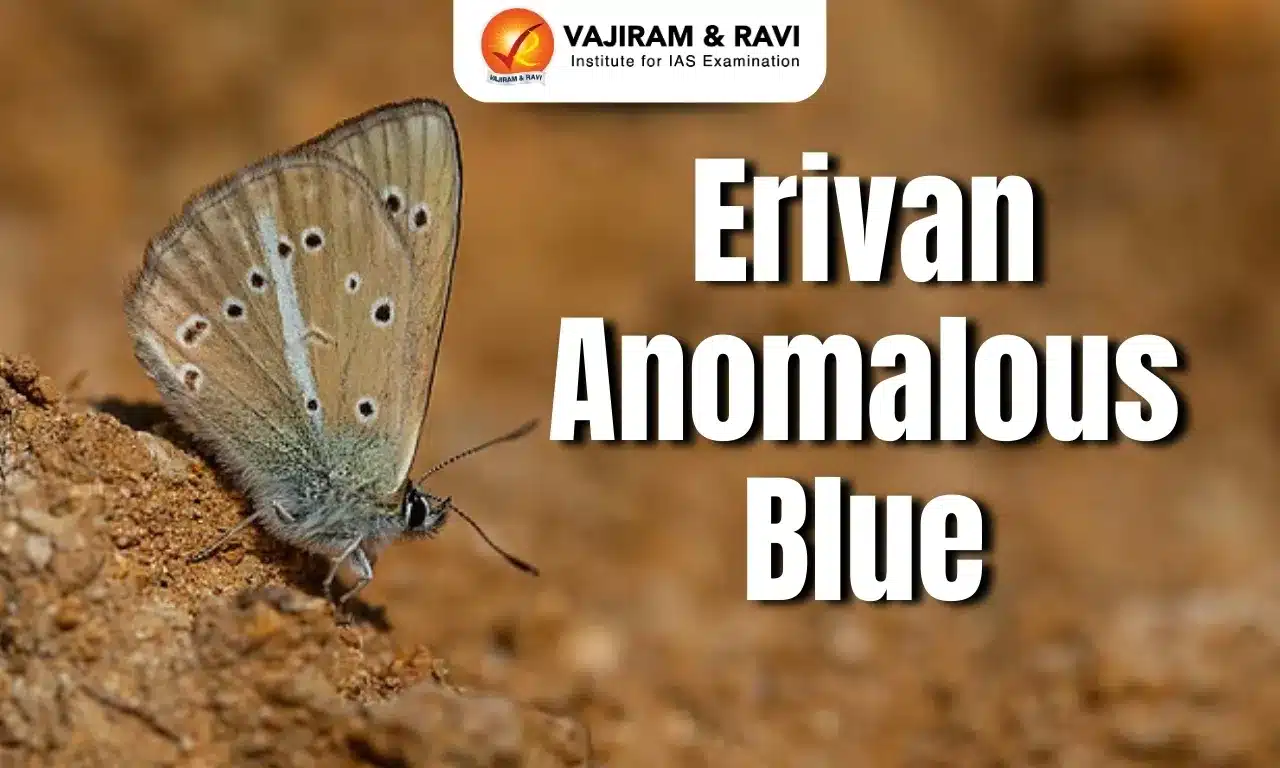
Recently, Armenia has unveiled the logo for the 17th Conference of the Parties (COP17) to the Convention on Biological Diversity which includes Erivan Anomalous Blue at its centre.

About Erivan Anomalous Blue

  • The Polyommatus eriwanens, also known as Erivan Anomalous Blue, is a blue butterfly.
  •  It is found only in and around Yerevan (Armenia).
  • The Erivan Anomalous Blue gives one generation per year.
  • These butterfly species are active from mid-June till mid-July, depending on elevation.
  • Habitat
    • The species inhabits calcareous grasslands in Armenia but the host plant of the species is still not known. 
    • The species is endemic to Southern Transcaucasia.
    • It is found at the elevation range from 1200 to 2200 m.
    • Conservation Status: The species is not included in the Global and European Red Lists.

What is the Convention on Biological Diversity?

  • It is the most comprehensive binding international agreement in the field of nature conservation and the sustainable use of natural resources.
  • History: It was opened for signing at the UN Conference on Environment and Development in Rio de Janeiro in 1992. 
  • It currently has 196 contracting parties.
  • Governance: The CBD’s governing body is the Conference of the Parties (COP).
  • This ultimate authority of all governments (or Parties) that have ratified the treaty meets every two years to review progress, set priorities, and commit to work plans.
  • Secretariat: Montreal, Canada.

Objectives of Convention on Biological Diversity

  • Conservation of biological diversity
  • Sustainable use of biological diversity
  • Fair and equitable sharing of the benefits arising out of the utilisation of genetic resources

Source: DTE

Erivan Anomalous Blue FAQs

Q1: What is the habitat of Erivan Anomalous Blue?

Ans: Calcareous grasslands in Armenia

Q2: Why is Erivan Anomalous Blue significant?

Ans: It's an indicator species reflecting ecosystem health.

Indian Coast Guard (ICG) Ship Amulya

Indian Coast Guard (ICG) Ship Amulya

Indian Coast Guard (ICG) Ship Amulya Latest News

Recently, the Indian Coast Guard (ICG) Ship ‘Amulya’ was commissioned in Goa.

About Indian Coast Guard (ICG) Ship Amulya

  • It is the third in the series of eight new-generation Adamya-class Fast Patrol Vessels.
  • It has more than 60% indigenous components and designed and built by the Goa Shipyard Limited.
  • It integrates modern design philosophy focused on efficiency, endurance, and rapid response capability.
  • It will be based at Paradip, Odisha, operating under the administrative and operational control of the Commander, Coast Guard Region (North East). 
  • Functions: It will undertake functions like surveillance, interdiction, Search & Rescue, anti-smuggling operations, and pollution response.

Features of Indian Coast Guard (ICG) Ship Amulya

  • Propulsion: It is powered by two 3000 KW advanced diesel engines.
  • Speed: The ship delivers a top speed of 27 knots and an operational endurance of 1,500 nautical miles.
  • Armaments: It is fitted with indigenous state-of-the-art weapons/systems, offering superior manoeuvrability, operational flexibility and enhanced performance at sea.

Source: PIB

Indian Coast Guard (ICG) Ship Amulya FAQs

Q1: What is the class of ICG Ship Amulya?

Ans: Adamya-class

Q2: Where is ICG Ship Amulya based?

Ans: Paradip, Odisha

Bureau of Port Security

Bureau of Port Security

Bureau of Port Security Latest News

Recently, the union Home Minister convened a meeting for the constitution of a dedicated body, the Bureau of Port Security (BoPS), for the security of vessels and port facilities.

About Bureau of Port Security

  • It shall be constituted as a statutory body under the provisions of Section 13 of the Merchant Shipping Act, 2025.
  • It is headed by a Director General, shall function under the aegis of the Ministry of Ports, Shipping and Waterways (MoPSW)
    • He /she shall be responsible for regulatory and oversight functions relating to the security of ships and port facilities.
    • It is being modelled on the lines of the Bureau of Civil Aviation Security (BCAS).
    • The BoPS shall be headed by an IPS officer (Pay Level-15).
    • During the transition period of one year, the Director General of Shipping (DGS/DGMA) shall function as the Director General, BoPS.
  • Functions Bureau of Port Security
    • It ensures timely analysis, collection and exchange of security-related information, with a special focus on cyber security, including a dedicated division to safeguard port IT infrastructure from digital threats.
  • The Central Industrial Security Force (CISF) has been designated as a Recognised Security Organisation (RSO) for port facilities with responsibility for undertaking security assessments and preparation of security plans for ports.

Source: PIB

Bureau of Port Security FAQs

Q1: What is the primary objective of the Bureau of Port Security?

Ans: To ensure port security and safety

Q2: Under which ministry does the Bureau of Port Security function?

Ans: Ministry of Ports, Shipping and Waterways

Doppler Weather Radar

Doppler Weather Radar

Doppler Weather Radar Latest News

Recently, the Minister of State for Earth Science informed that there are currently 47 Doppler weather radars (DWRs) across the country to survey weather patterns and forecast.

About Doppler Weather Radar

  • A Doppler radar is a specialized radar that uses the Doppler effect to produce velocity data about objects at a distance.
  • These radar systems can provide information regarding the movement of targets as well as their position.

Working of Doppler weather Radars

  • In radars, a beam of energy, called radio waves, is emitted from an antenna.
  • When this beam strikes an object in the atmosphere, the energy scatters in all directions, with some reflecting directly back to the radar.
  • The larger the object deflecting the beam, the greater is the amount of energy that the radar receives in return.
  • Observing the time required for the beam to be transmitted and returned to the radar allows weather forecasting departments to “see” raindrops in the atmosphere, and measure their distance from the radar.
  • Types of weather Radar Bands: Varying frequencies like S-band, C-band and X-band — are commonly used by the IMD in India.

Applications of  Doppler weather Radars 

  • It is used to track the movement of weather systems and cloud bands, and gauge rainfall over its coverage area of about 500 km.
  • An X-band radar is used to detect thunderstorms and lightning, whereas a C-band radar helps in cyclone tracking.

Source: IE

Doppler Weather Radar FAQs

Q1: What is the primary function of Doppler Weather Radar?

Ans: To detect and track weather systems

Q2: Which band is most commonly used for Doppler Weather Radar?

Ans: S-band

Bura Chapori Wildlife Sanctuary

Bura Chapori Wildlife Sanctuary

Bura Chapori Wildlife Sanctuary Latest News

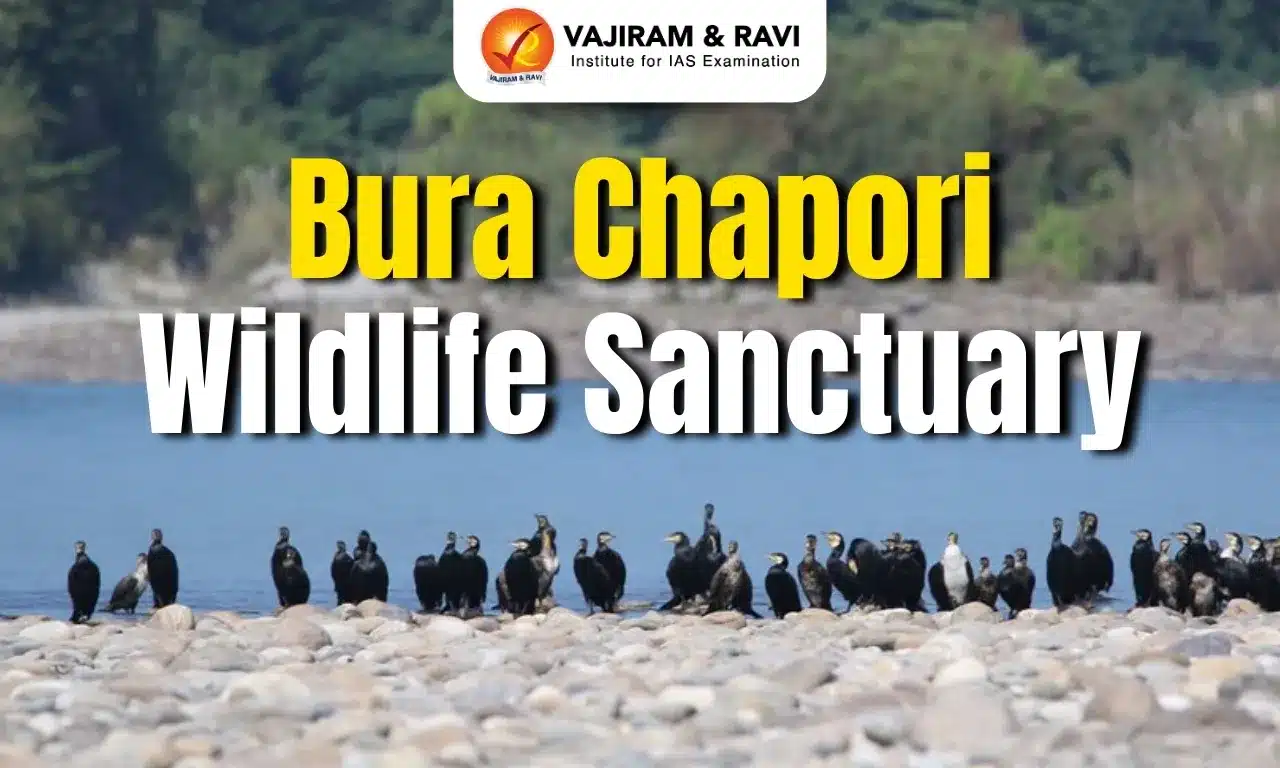
A team of government officials recently visited the encroached areas of land earmarked for compensatory afforestation at Bura Chapori Wildlife Sanctuary.

About Bura Chapori Wildlife Sanctuary

  • It is located on the southern bank of the river Brahmaputra in the Sonitpur district, Assam
  • It covers an area of 44.06 sq. km.
  • It is located on the north side of Laokhowa Wildlife Sanctuary and shares an integral transboundary landscape of the Laokhowa-Burachapori Wildlife Sanctuary ecosystem. 
  • Both the sanctuary was notified as a buffer zone of the Kaziranga Tiger Reserve in 2007.
  • Most of the low-lying areas of the sanctuary are vulnerable to flooding during summer. 
  • Flora
    • It is enveloped and adorned by wet alluvial grasslands, riparian, and semi-evergreen forests.
    • Most of the plant species found here are of great commercial and medical value.
  • Fauna:
    • It is a habitat of a wide range of wild animals, including tigers, elephants, wild buffalos, one-horned rhinoceros, hog deer, and wild boar.
    • The avian inhabitants feature species like the Bengal florican, black-necked stork, open-billed stork, white-eyed pochard, mallard, spotbill, large whistling teal, and numerous others.

Source: SA

Bura Chapori Wildlife Sanctuary FAQs

Q1: Bura Chapori Wildlife Sanctuary is located in which Indian state?

Ans: Assam

Q2: Bura Chapori Wildlife Sanctuary is situated along which river?

Ans: Brahmaputra

Q3: Bura Chapori Sanctuary shares a landscape with which other wildlife sanctuary?

Ans: Laokhowa Wildlife Sanctuary

Enquire Now