Suryastra Rocket System

Suryastra Rocket System

Suryastra Rocket System Latest News

Recently, the Indian Army has signed a ₹293 crore contract with private defence manufacturer NIBE Limited, in collaboration with Israel, for the supply of suryastra rocket launcher system. 

About Suryastra Rocket System

  • It is India’s first indigenous universal multi-calibre rocket launcher system.
  • Developed by: It is developed by Pune-based NIBE Limited in collaboration with Israel’s Elbit Systems. 

Key Features of Suryastra Rocket System

  • It is an advanced long-range rocket launcher system.
  • Range: It is capable of executing precision surface-to-surface striking targets at ranges of 150 and 300 kilometers. 
  • Multi-target Capability: It is designed to engage multiple targets simultaneously at varying ranges.
  • Precision: It achieves a high degree of accuracy with a circular error probable (CEP) of less than five metres during trials.
  • The same launcher is also capable of firing loitering munitions up to a range of 100 km.
  • Technology used: The system is based on Elbit Systems’ PULS (Precise & Universal Launching System) launcher technology.
  • It is equipped with a modern fire control system that integrates GPS, inertial navigation, and digital ballistic computation.
  • Its semi-automated reload and shoot-and-scoot capabilities reduce exposure to counter-battery fire.

Source: TH

Suryastra Rocket System FAQs

Q1: What is the range of Suryastra?

Ans: 150 km and 300 km

Q2: What is the precision of Suryastra?

Ans: Circular Error Probable (CEP) of 5 meters

Industrial Research and Development Promotion Program

Industrial Research and Development Promotion Program

Industrial Research and Development Promotion Program Latest News

Recently, the government announced relaxation for deep-tech startups to avail recognition under Department of Scientific and Industrial Research’s (DSIR) Industrial Research and Development Promotion Program.

About Industrial Research and Development Promotion Program

  • It is a research and Development programme of the Department of Scientific and Industrial Research, Govt. of India.
  • Focus Area: Engineering Science, Environment Science, Natural and Applied sciences, Agricultural, Medical and Social sciences
  • Funding Agency: Department of Scientific and Industrial Research (DSIR), Govt. of India
  • Eligibility Criteria 
    • The applicant should be a company registered under the Companies Act, 1956 or 2013.
    • The company shall be eligible for consideration only after the completion of three financial years after formation.
    • The applicant should have a regular source of income at least during the last two years.
    •  The companies seeking recognition for their in-house R&D units should be engaged in manufacture or production.
    • The R&D unit(s) should be located in non -residential areas.

Key Facts about the Department of Scientific and Industrial Research

  • It was established in 1985.
  • Nodal Ministry: It functions under the Ministry of Science and Technology.
  • Mandate: It has a mandate to carry out the activities relating to indigenous technology promotion, development, utilization and transfer.
  • Functions of Department of Scientific and Industrial Research
    • It focuses on the promotion, development, deployment, and transfer of indigenous technologies.
    • It actively collaborates with industry, academic institutions, research organizations, and government agencies to nurture a robust, innovation-led ecosystem.

Source: PIB

Industrial Research and Development Promotion Program FAQs

Q1: What is the primary objective of the Industrial Research and Development Promotion Program (IRDPP)?

Ans: To support industrial research and development

Q2: Which department is responsible for implementing the IRDPP?

Ans: Department of Scientific and Industrial Research (DSIR)

Popocatépetl Volcano

Popocatépetl Volcano

Popocatépetl Volcano Latest News

Recently, a team of scientists obtained the first 3D images from inside Mexico's Popocatépetl volcano.

About Popocatépetl Volcano

  • Popocatépetl means "Smoking Mountain” in the Aztec Nahuatl language.
  • Location: It is located in central Mexico roughly 45 miles (72 kilometers) southeast of Mexico City. 
  • It is on the border of the states of México and Puebla.
  • The volcano lies on the Trans-Mexican Volcanic Belt, which is the result of the small Cocos Plate subducting beneath the North American Plate.
  • It is one of Mexico's most active volcanoes, with recorded eruptions since 1519.
  • Elevation: It is a steep-sided stratovolcano that rises to an elevation of 5452 m (17,883 ft) above sea level. 
  • Popocatépetl is one of the most dangerous volcanoes in the Ring of Fire.

What is Stratovolcano?

  • It is a tall, steep, and cone-shaped type of volcano.
  • They are typically found above subduction zones, and they are often part of large volcanically active regions, such as the Ring of Fire that frames much of the Pacific Ocean.
  • They comprise the largest percentage (~60%) of the Earth’s individual volcanoes.
    • These more viscous lavas allow gas pressures to build up to high levels. Therefore, these volcanoes often suffer explosive eruptions. 
  • They are usually about half-half lava and pyroclastic material, and the layering of these products gives them their other common name of composite volcanoes.
  • At the peak, stratovolcanoes usually have a small crater.

Source: TH

Popocatépetl Volcano FAQs

Q1: Where is Popocatépetl Volcano located?

Ans: Mexico

Q2: What is another name for a Strato Volcano?

Ans: Composite Volcano

C-Reactive Protein (CRP)

C-Reactive Protein (CRP)

C-Reactive Protein (CRP) Latest News

Accumulating evidence over the past two decades demonstrates that a biomarker called C-reactive protein – which signals the presence of low-grade inflammation – is a better predictor of risk for heart disease than cholesterol.

About C-Reactive Protein (CRP)

  • It is a protein made by the liver.
  • The level of CRP increases when there's inflammation in the body. 
    • Inflammation is your body's way of protecting your tissues and helping them heal from an injury, infection, or other disease.
  • A CRP test measures the level of CRP in your blood. 
  • By measuring the levels of CRP in your blood, a CRP test can tell your health care provider how much inflammation you have in your body. 
  • High CRP levels may mean you have an acute or chronic health condition, such as:
    • Infections from bacteria or viruses.
    • Inflammatory bowel disease, disorders of the intestines that include Crohn's disease and ulcerative colitis.
    • Autoimmune disorders, such as lupus, rheumatoid arthritis, and vasculitis.
    • Lung diseases, such as asthma.
  • Smoking and exposure to environmental toxins such as polluted air and hazardous waste can also cause high CRP levels.

Source: LS

C-Reactive Protein (CRP) FAQs

Q1: What is C-reactive protein (CRP)?

Ans: It is a protein made by the liver.

Q2: When do C-reactive protein (CRP) levels increase in the body?

Ans: CRP levels increase when there is inflammation in the body.

Q3: What can a C-reactive protein (CRP) test tell a health care provider?

Ans: It can indicate how much inflammation is present in the body.

Q4: What does high C-reactive protein (CRP) levels indicate?

Ans: High CRP levels may indicate either an acute or chronic health condition.

Socotra Island

Socotra Island

Socotra Island Latest News

Hundreds of tourists are stuck on the Yemeni island of Socotra after flights were grounded over clashes on the mainland.

About Socotra Island

  • It is an island in the Indian Ocean about 340 km southeast of Yemen, to which it belongs. 
  • The largest of several islands extending eastward from the Horn of Africa, Socotra has an area of about 3,600 sq.km.
  • The Hajhir Mountains occupy Socotra’s interior, whereas narrow coastal plains lie in the north and a broader plain in the south. 
  • To the southwest and west are the smaller islands of Samḥah and Darzah, called al-Ikhwān (“the Brothers”), and ʿAbd al-Kūrī, all of which also belong to Yemen. 
  • The island has a total population of around 70,000 people who speak their Socotri language. 
  • Apart from the main town of Hadibo, there exists little infrastructure on the island.
  • It broke off from the Arabian Peninsula some 80 million years ago and is often called the "Galápagos of the Indian Ocean." 
  • Socotra is a treasure trove of endemic flora and fauna, meaning they are found nowhere else on Earth. 
  • For example: 37% of Socotra’s 825 plant species, 90% of its reptile species,  and 95% of its land snail species do not occur anywhere else in the world.
  • In 2008, Socotra was recognised as a UNESCO World Heritage Site.

Source: ET

Socotra Island FAQs

Q1: Where is Socotra Island located?

Ans: It is located in the Indian Ocean about 340 km southeast of Yemen.

Q2: To which country does Socotra Island belong?

Ans: Socotra belongs to Yemen.

Q3: Which mountain range occupies the interior of Socotra?

Ans: The Hajhir Mountains occupy the interior of Socotra.

Q4: What nickname is given to Socotra due to its unique biodiversity?

Ans: It is called the “Galápagos of the Indian Ocean.”

Q5: Why is Socotra considered a biodiversity hotspot?

Ans: Because it has high levels of endemic flora and fauna found nowhere else on Earth.

Calamaria Mizoramensis

Calamaria Mizoramensis

Calamaria Mizoramensis Latest News

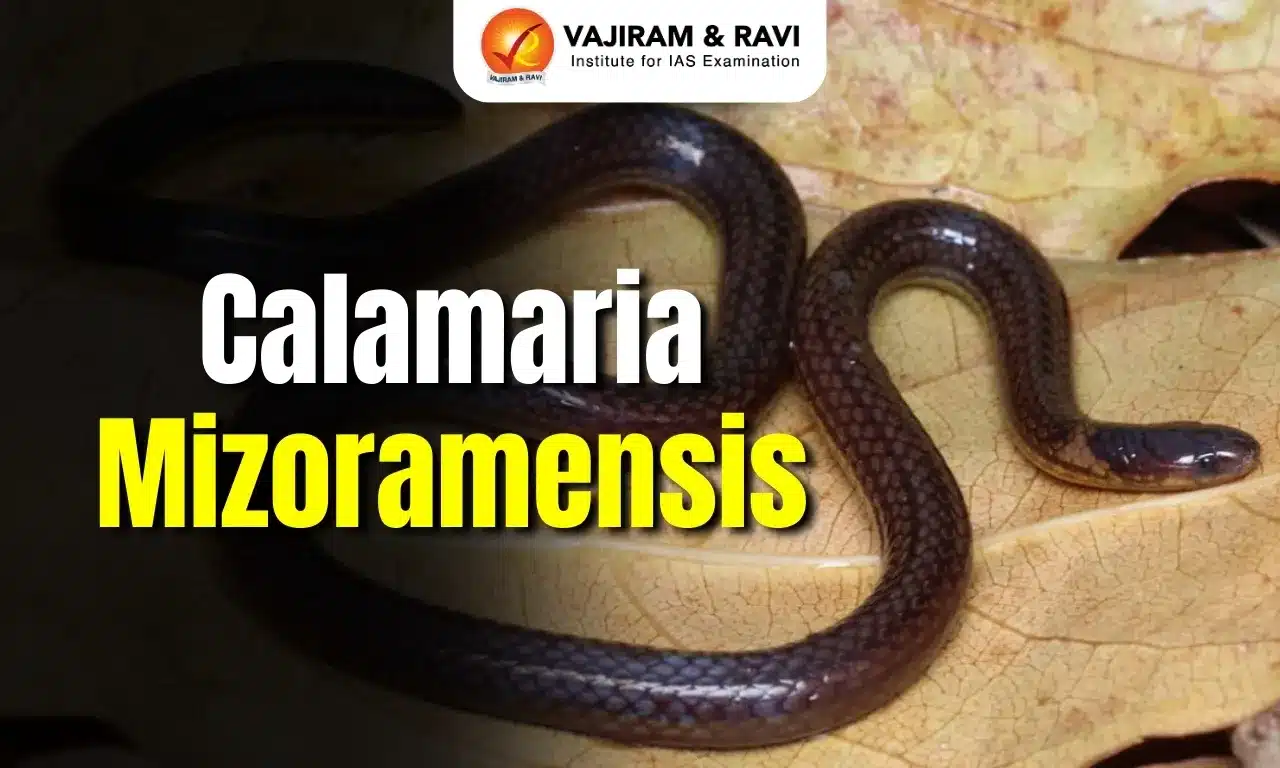
A new species of reed snake was recently found in Mizoram, which the researchers named after the state where it was found, calling it Calamaria Mizoramensis.

About Calamaria Mizoramensis

  • It is a new species of non-venomous reed snake.
  • It was discovered in Mizoram.
  • The new species is nocturnal and semi-fossorial, inhabiting humid, forested hill environments.
  • Habitats of C. Mizoramensis have been recorded at elevations ranging from 670 to 1,295 metres above sea level, including locations close to human settlements.
  • The new species is small with a dark brown to blackish body with faint stripes and a yellow underside.
  • Its occurrence in other parts of India remains unverified, but it is likely to be present in adjoining states such as Manipur, Nagaland, and Assam.

Key Facts about Reed Snakes

  • They are small, slender, non-venomous snakes.
  • They belong to the genus Calamaria.
  • Family: Colubridae
  • They are found in southern and southeastern Asia. 
  • Mostly found in:
    • Moist forests
    • Leaf litter
    • Under logs, stones, and soil
  • They are fossorial/semi-fossorial – spend most of their time underground or hidden in leaf litter.
  • Typically brown, reddish, or blackish in color.
  • They eat small, soft-bodied invertebrates.

Source: HT

Calamaria Mizoramensis FAQs

Q1: What is Calamaria mizoramensis?

Ans: It is a new species of non-venomous reed snake.

Q2: Where was Calamaria mizoramensis discovered?

Ans: It was discovered in Mizoram.

Q3: Is Calamaria mizoramensis nocturnal?

Ans: Yes, it is a nocturnal species.

Q4: In what type of environment does Calamaria mizoramensis live?

Ans: It inhabits humid, forested hill environments.

Q5: What are the key physical features of Calamaria mizoramensis?

Ans: It is small, with a dark brown to blackish body with faint stripes and a yellow underside.

Dnyanganga Wildlife Sanctuary

Dnyanganga Wildlife Sanctuary

Dnyanganga Wildlife Sanctuary Latest News

A tiger cub identified as PKT7CP1, rescued three years ago, has been recently sent to Dnyanganga Wildlife Sanctuary in Maharashtra's Buldhana district for rewilding.

About Dnyanganga Wildlife Sanctuary

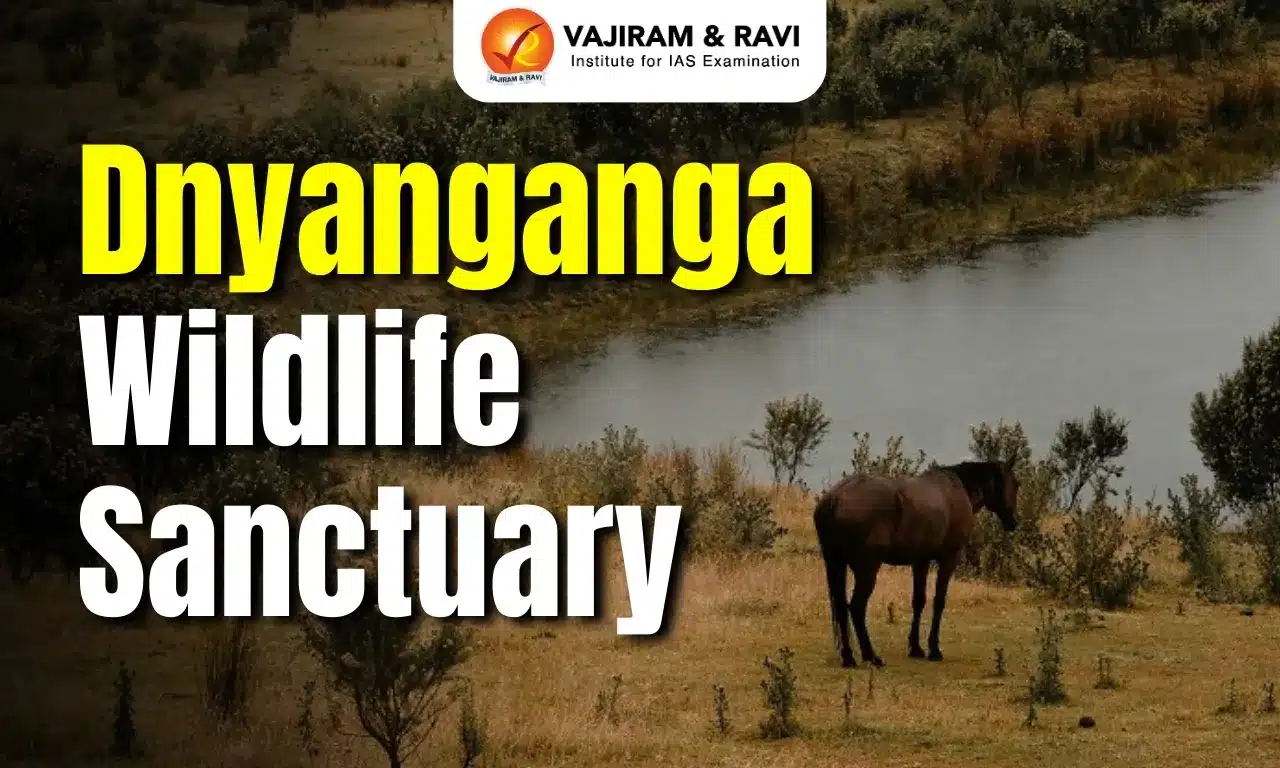
  • It is located in the Buldhana district of Maharashtra, near the Dnyanganga River. 
  • It is part of the Melghat Tiger Reserve.
  • Spanning around 205 sq.km., the sanctuary features two lakes.
  • Thе sanctuary is bordеrеd by thе scеnic hills of thе Wеstеrn Ghats, which is a UNESCO World Hеritagе Sitе.
  • The terrain is undulating, interspersed with hillocks having gentle slopes.
  • It has a very extreme climate; the winters are very cold, whereas the summers are very hot. 
  • Flora: The forest area is Southern tropical dry deciduous forest, consisting mainly of Teak and Anjan.
  • Fauna
    • The sanctuary is home to diverse wildlife, including leopards, sloth bears, barking deer, blue bulls (nilgai), spotted deer, hyenas, jungle cats, jackals, and occasionally tigers.
    • Over 150 bird species also inhabit the area.

Source: DEVD

Dnyanganga Wildlife Sanctuary FAQs

Q1: Where is Dnyanganga Wildlife Sanctuary located?

Ans: It is located in the Buldhana district of Maharashtra, near the Dnyanganga River.

Q2: Is Dnyanganga Wildlife Sanctuary part of the Melghat Tiger Reserve?

Ans: Yes, it is part of the Melghat Tiger Reserve.

Q3: What is the total area of Dnyanganga Wildlife Sanctuary?

Ans: It spans around 205 sq.km.

Q4: What type of terrain is found in Dnyanganga Wildlife Sanctuary?

Ans: The terrain is undulating and interspersed with hillocks having gentle slopes.

Q5: What type of forest characterizes Dnyanganga Wildlife Sanctuary?

Ans: It consists of Southern tropical dry deciduous forest.

Rice Crop

Rice Crop

Rice Crop Latest News

Recently, the Union Agriculture Minister said India’s rice production has reached 150.18 million tonnes, compared to China’s 145.28 million tonnes.

About Rice Crop

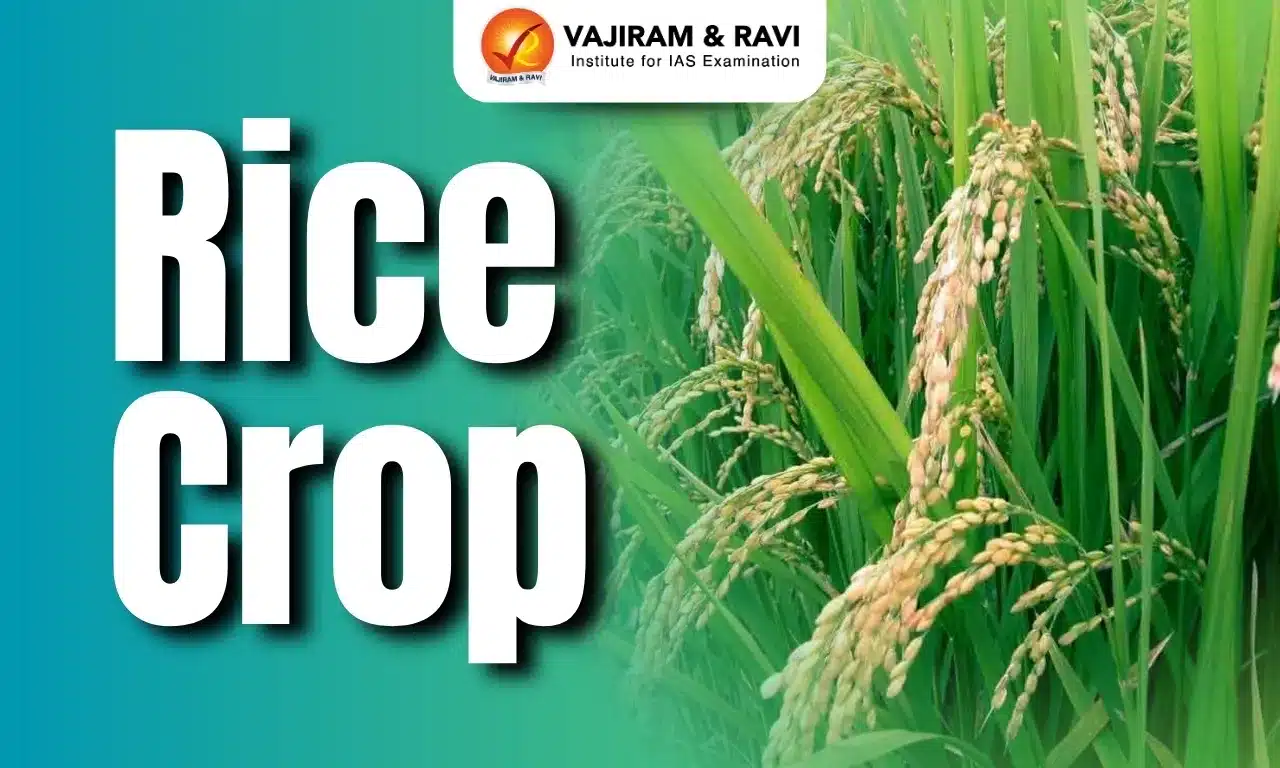
  • Rice is a tropical crop and the staple food for the majority of the Indian population.
  • Growing Season: It is primarily a Kharif crop, grown during the southwest monsoon season (June to October) but it can also be cultivated in Rabi and summer seasons under assured irrigation.

Required Climatic Conditions for Rice Crop

  • Rice is grown under varying conditions in India from 8°N to 30°N latitude and from sea level to about 2,500 metre altitude. 
  • The average annual rainfall required for rice is 150 cm.
  • Temperature: Between 25°C and 35°C.
  • Soil: It can be grown on a variety of soils including silts, loams and gravels and can tolerate acidic as well as alkaline soils.
  • The crop requires standing water (10-12 cm deep) during most of its growing season.
  • Major Rice Producing states: It is most commonly cultivated in states such as West Bengal, Uttar Pradesh, Punjab, Andhra Pradesh, Tamil Nadu, Bihar, Odisha, and Assam.
  • Nutrition: It has a higher nutritional value and is rich in Vitamins A, B, and calcium.

Source: News On Air

Rice Crop FAQs

Q1: Which is a major rice-producing state in India?

Ans: West Bengal

Q2: What is the primary season for rice cultivation in India?

Ans: Kharif

OPEC+

OPEC+

OPEC+ Latest News

Recently, the Organization of the Petroleum Exporting Countries (OPEC)+ has agreed in principle to maintain steady oil output despite rising political tensions among key members and widening geopolitical uncertainty. 

About OPEC+

  • It is the alliance of major oil-exporting nations. 
  • It is an extension of the Organization of the Petroleum Exporting Countries formed in 2016.
  • It consists of 22 oil-exporting countries which meet regularly to decide how much crude oil to sell on the world market.
  • Members of OPEC+: It comprises 12 OPEC countries plus Azerbaijan, Bahrain, Brunei, Kazakhstan, Russia, Mexico, Malaysia, South Sudan, Sudan, and Oman.
  • These nations aim to work together on adjusting crude oil production to bring stability to the oil market.

Key Facts about Organization of the Petroleum Exporting Countries

  • It is a permanent intergovernmental organization of oil-exporting countries.
  • It was established in 1960 by the five founding members Iran, Iraq, Kuwait, Saudi Arabia, and Venezuela. 
  • Currently, it has 12 members, including Algeria, Congo, Equatorial Guinea, Gabon, Libya, Nigeria, and the United Arab Emirates.
  • Angola withdrew its membership effective 1 January 2024.
  • Headquarters: Vienna, Austria.

Source: News on Air

OPEC+ FAQs

Q1: When was OPEC+ formed?

Ans: 2016

Q2: What is the primary goal of OPEC+?

Ans: To stabilize global oil prices

Justice Mission 2025

Justice Mission 2025

Justice Mission 2025 Latest News

China's military moved army, naval, air force, and artillery units around ​Taiwan recently for its "Justice Mission 2025" drills.

About Justice Mission 2025

  • It is a large-scale inter-service military exercise by China around Taiwan.
  • It involves coordinated ground, air, navy, and missile units. 
  • The activities focussed on "sea-air combat readiness patrol, joint seizure of comprehensive superiority, blockade on key ports and areas, as well as all-dimensional deterrence outside the island chain.
  • The drills aim to test joint combat capabilities and serve as a warning against "Taiwan independence" and external interference, asserting China's sovereignty over the island.
  • Beijing claims Taiwan as part of its sovereign territory and has refused to rule out using military action to seize the island democracy.
  • The exercise follows large-scale arms sales to Taiwan valued at more than USD 10 billion by the United States, Taiwan's main security backer.

Source: HBL

Justice Mission 2025 FAQs

Q1: What is Justice Mission 2025?

Ans: It is a large-scale inter-service military exercise by China around Taiwan.

Q2: What is the main objective of Justice Mission 2025?

Ans: The drills aim to test joint combat capabilities and warn against “Taiwan independence” and external interference.

Q3: What claim does China assert through Justice Mission 2025 exercise?

Ans: China asserts its sovereignty over Taiwan.

Enquire Now