Apparel Export Promotion Council (AEPC)

Apparel Export Promotion Council (AEPC)

Apparel Export Promotion Council (AEPC) Latest News

A Sakthivel has been recently appointed as the chairman of the Apparel Export Promotion Council (AEPC), marking his fifth term at the helm of the organization.

About Apparel Export Promotion Council (AEPC)

  • It was established in 1978 under the provisions of the Foreign Trade (Development and Regulation) Act of 1992. 
  • It is the official body of apparel exporters in India.
  • It operates under the aegis of the Ministry of Textiles, Government of India. 
  • Its primary objective is to promote and support the export of Indian garments and textiles to the global market. 
  • AEPC is the most significant body representing apparel exporters in India and works towards improving the competitiveness of the Indian apparel sector.
  • It acts as a bridge between the government, Indian apparel exporters, and international customers.
  • It comprises various stakeholders, including:
    • Central Government representatives
    • Exporters
    • Industry Associations
    • Government Bodies
  • AEPC's decision-making process involves inputs from these sectors to make informed decisions for the development of the industry. 
  • Its governing body is led by an elected chairman, supported by regional and sectoral committees, along with professionals and experts in the field of textile and apparel export.
  • Functions:
    • Promoting Apparel Exports: Facilitates the export of Indian-made garments worldwide.
    • Market Research & Development: Conducts research to understand global trends, market demands, and opportunities.
    • Organizing Trade Fairs: AEPC organizes national and international trade fairs to showcase Indian apparel.
    • Policy Advocacy: Acts as a liaison between the government and exporters to address issues in the export sector.
    • Skill Development: Provides training programs and workshops for improving the skills of the workforce in the apparel sector.
    • Certification and Standards: Works to ensure that apparel exports meet international quality standards and certifications.
    • Data Collection: Gathers and disseminates data on market trends, industry reports, and export statistics.
  • It also organizes the India International Garment Fair twice a year that allows more than 300 exhibitors to display their products and unique apparel.
  • It has its headquarters in Gurgaon, Haryana.

Source: DEVD

Apparel Export Promotion Council (AEPC) FAQs

Q1: When was the Apparel Export Promotion Council (AEPC) established?

Ans: It was established in 1978.

Q2: Under which Act was Apparel Export Promotion Council (AEPC) set up?

Ans: Under the Foreign Trade (Development and Regulation) Act, 1992.

Q3: Under which ministry does Apparel Export Promotion Council (AEPC) operate?

Ans: It operates under the Ministry of Textiles, Government of India.

Q4: What is the primary objective of Apparel Export Promotion Council (AEPC)?

Ans: To promote and support the export of Indian garments and textiles.

Q5: Where is Apparel Export Promotion Council (AEPC) headquartered?

Ans: In Gurgaon, Haryana.

Melghat Tiger Reserve

Melghat Tiger Reserve

Melghat Tiger Reserve Latest News

Recently, the Bombay Natural History Society (BNHS) has released 15 critically endangered Indian vultures at the Melghat Tiger Reserve in Maharashtra.

About Melghat Tiger Reserve

  • Location: It is situated  in the state of Maharashtra.
  • It is located on the southern offshoot of the Satpura Hill Range in Central India, called Gavilgarh Hill. 
  • It was the first tiger reserve in Maharashtra.
  • The name ‘Melghat’ means the confluence of various ‘ghats’ or valleys, as is typical from the landscape of this tiger reserve.
  • Vegetation: The forest is tropical dry deciduous in nature, dominated by teak.
  • Rivers: The reserve is a catchment area for five major rivers: the Khandu, Khapra, Sipna, Gadga, and Dolar, all of which are tributaries of the river Tapti.
  • Boundaries: The Tapti River and the Gawilgadh ridge of the Satpura Range form the boundaries of the reserve.
  • Tribes: The Korkus are the largest tribal community in Melghat. Other communities include the Gawli community, the Gond tribe,
  • Flora: Some of the common species are teak, Lagerstroemia Parviflora, Terminalia Tomentosa, Ougeinia Oojeinensis, Emblica Officinalis, Bamboo, etc.
  • Fauna: Sloth Bear, Indian Gaur, Sambar deer, Leopard, Nilgais, dhole, hyena, jungle cat, langur, etc. 
    • It is considered a stronghold of the critically endangered forest owlet.

Source: TP

Melghat Tiger Reserve FAQs

Q1: Where is Melghat Tiger Reserve located?

Ans: Maharashtra

Q2: What is the primary vegetation type in Melghat Tiger Reserve?

Ans: Tropical dry deciduous forest

W Ursae Majoris Star

W Ursae Majoris Star

W Ursae Majoris Star Latest News

Astronomers from Aryabhatta Research Institute of Observational Sciences used data from Devasthal Fast Optical Telescope and NASA’s TESS space telescope to create detailed light curves of the W Ursae Majoris (W UMa) star.

About W Ursae Majoris Star

  • It is also known as a low mass contact binary, is a type of eclipsing binary variable star. 
  • They share a single outer atmosphere and they orbit around each other.
  • W UMa stars are easily recognized by their light curves with near equal minima and continuous light variation.
  • Their variability ranges from a few tenths to slightly over a magnitude. The periods are typically short and range between 0.25 days to around 1.0 days.
  • Origin: The traditional theory explaining the origin of contact binaries is that W UMa systems form from detached binaries of comparable periods through orbital decay by angular momentum loss.
  • The idea of the contact binary seems to have been first introduced by Kuiper (1941).
  • Significance W Ursae Majoris Star Study: They assist in precise determinations of fundamental stellar parameters such as masses, radii, and temperatures, crucial for testing theories about how stars evolve over time.

Key Findings about W Ursae Majoris Star

  • It was found that stars share their outer layers, their orbits shift slightly over time, as if tugging and pulling on one another
  • Some stars appear lopsided—brighter on one side than the other.
  • It is found that there is an uneven brightness point at dark magnetic star spots similar to star spots.
  • These spots rotate in and out of view, creating bumps in the light curves.  
  • This also suggests the stars have strong magnetic activity.
  • Scientists also found specific light signals (called H-alpha and H-beta) that clearly show activity in the star’s outer layer, which is linked to magnetic events like star spots and stellar flares.

Source: PIB

W Ursae Majoris Star FAQs

Q1: What type of star system is W Ursae Majoris?

Ans: Eclipsing binary star

Q2: In which constellation is W Ursae Majoris located?

Ans: Ursa Major

SHINE Scheme

SHINE Scheme

SHINE Scheme Latest News

Recently, at the 79th Bureau of Indian Standards Foundation Day union ministers launched the SHINE scheme in New Delhi. 

About SHINE Scheme

  • The Standards Help Inform & Nurture Empowered Women (SHINE) is a new scheme of the Bureau of Indian Standards.
  • It places women at the center of India’s quality journey.
  • Through structured training, grassroots partnerships with NGOs and SHGs, and practical, locally delivered programmes,
  • It empowers women with knowledge that protects families and strengthens livelihoods.
  • Through this BIS spreads awareness about standards, safety, and quality within households, self-help groups, and communities.

Key Facts about Bureau of Indian Standards

  • It is the National Standard Body of India established under the BIS Act 2016.
  • Objective: It was established for the harmonious development of the activities of standardization, marking, and quality certification of goods and for matters connected therewith or incidental thereto.
  • It is the successor of the Indian Standards Institution (ISI), which was created in 1947 to ensure quality control and competitive efficiency in the rapid industrialization era.
  • BIS represents India in International Organization for Standardization (ISO) and International Electrotechnical Commission (IEC).
  • Nodal Ministry: It is functioning under the administrative control of the Ministry of Consumer Affairs, Food and Public Distribution.
  • Headquarter: It is headquartered in New Delhi and maintains regional and branch offices throughout the country.

Source: PIB

SHINE Scheme FAQs

Q1: What is the primary objective of the SHINE Scheme?

Ans: It is aimed at empowering women through education and awareness about quality standards.

Q2: What is the symbol used by BIS for certification?

Ans: ISI Mark

Biomaterials

Biomaterials

Biomaterials Latest News

As countries look to shift to cleaner processes to manufacture consumer products, be it plastics or textiles, biomaterials will become the new frontier of materials engineering.

About Biomaterials

  • They are materials of natural, synthetic, or hybrid origin designed to interact safely and compatibly with different systems such as the human body and the environment. 
  • They are derived wholly or partly from biological sources or engineered using biological processes that are designed to replace or interact with conventional materials. 
  • They are increasingly used across sectors such as packaging, textiles, construction, and healthcare. 
  • Biomaterials are central to modern biomedicine and bioengineering, and their design is informed by application-specific demands and trade-offs.
  • The modern field of biomaterials combines physics, chemistry, medicine, and biology, as well as materials science and tissue engineering. 
  • Metals, plastics, ceramics, glass, cells, and living tissue are currently used to create biomaterials.
  • Biomaterials can be broadly categorised into three types: 
    • Drop-in biomaterials, which are chemically identical to petroleum-based materials and can be used in existing manufacturing systems (such as bio-PET); 
    • Drop-out biomaterials, which are chemically different and require new processing or end-of-life systems (such as polylactic acid or PLA); 
    • Novel biomaterials, which offer new properties not found in conventional materials, such as self-healing materials, bioactive implants, and advanced composites.

Source: TH

Biomaterials FAQs

Q1: What are biomaterials?

Ans: Biomaterials are materials of natural, synthetic, or hybrid origin designed to interact safely and compatibly with the human body or the environment.

Q2: Why are biomaterials used in many sectors?

Ans: Because they offer safe, sustainable alternatives to conventional materials.

Q3: What materials are used to create biomaterials?

Ans: Metals, plastics, ceramics, glass, cells, and living tissue are currently used to create biomaterials.

Q4: What are novel biomaterials?

Ans: Biomaterials which offer new properties not found in conventional materials.

Katydids

Katydids

Katydids Latest News

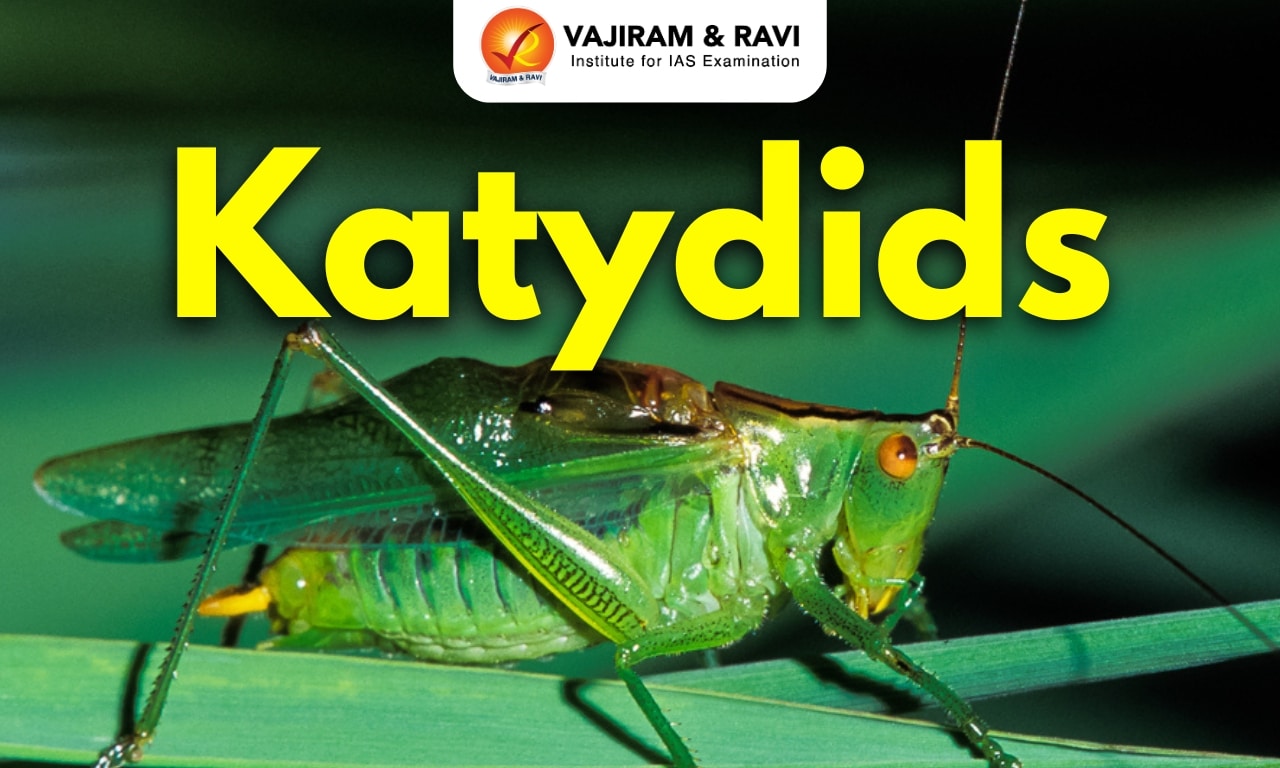
Researchers recently identified three previously unknown species of meadow katydids, or long-horned grasshoppers, named Conocephalus usmanii, Conocephalus nagariensis, and Conocephalus ganderbali, in Jammu and Kashmir.

About Katydids

  • Found on every continent except Antarctica, Katydids are a family of primarily nocturnal insects. 
  • There are more than 8,000 known species of Katydid, all of which belong to the family Tettigoniidae. 
  • Grasshoppers, locusts, crickets, and katydids belong to a group of insects known as orthopterans (meaning 'straight wings').
  • They closely resemble grasshoppers and used to go by the name long-horned grasshoppers. 
  • However, in reality, they are more closely related to crickets, hence their other common name, the bush cricket.

Katydids Features

  • Katydids vary greatly in size depending on the species. That said, most range between 0.2 inches to 5.1 inches long.
  • The body generally resembles that of grasshoppers, but katydids have long, threadlike antennae instead of the grasshoppers’ short antennae. 
  • While most Katydids appear bright green or mimic the appearance of leaves, they come in a variety of colors, ranging from pink to yellow. 
  • Like grasshoppers and crickets, katydids make noise by rubbing body parts together — in their case, by moving a leg against a wing and producing a sound that resembles their name. 
  • They are famous for their ability to blend into their surroundings. 
  • Katydids have feet with four segments. 
  • The lifespan of a katydid is about a year.
  • They are mostly herbivores, feeding on leaves, flowers, and fruit, but some eat small insects.

Key Facts about Meadow Katydids

  • The meadow katydids are a group of about 20 species of slender, small-to medium-sized katydids found in grassy meadows near lakes and ponds.
  • Genus: Orchelimum
  • When disturbed, they enter the water, cling to underwater plants, and can remain submerged for several minutes. 
  • Abundant and widespread, meadow katydids have large orange eyes and a body that is brown on top and green on the bottom. 
  • They produce a song, consisting of clicks and buzzes, during the day or at night.

Conocephalus Nagariensis

  • Found in the Budgam district, it is distinguished by its spindle-shaped appendages (cerci) and a stridulatory file containing exactly 34 teeth. 
  • It is dedicated to Dr. Rajendra Nagar, a researcher credited with discovering several other species of katydids across the country, and bears his name.

Conocephalus Ganderbali

  • Discovered in the Ganderbal region, it is notably small and slender.
  • It has a musical file of only 28 teeth and a unique V-shaped incision on its underbelly. 
  • Its name is derived from the Ganderbal district in Kashmir, the specific locality where the researchers first collected the specimens.

Conocephalus Usmanii

  • It features a flat, elongated plate on its abdomen and a musical file with 36 teeth. 
  • It was named in honour of Professor Mohd Kamil Usmani, a scholar who has made significant contributions to the study of Orthoptera (the group of insects including grasshoppers and katydids) in India.

Source: RM

Katydids FAQs

Q1: What are Katydids?

Ans: They are a family of primarily nocturnal insects.

Q2: How many species of katydids are known?

Ans: There are over 8,000 known species.

Q3: To which insect group do grasshoppers, locusts, crickets, and katydids belong?

Ans: They all belong to Orthoptera.

Q4: What is another common name for katydids?

Ans: They are also called bush crickets.

Q5: What colors can katydids appear in?

Ans: Mostly green, but also pink, yellow, and other colors.

Sagar Island

Sagar Island

Sagar Island Latest News

The West Bengal Chief Minister recently laid the foundation stone of a 5-km-long bridge over the river Muriganga to connect Sagar Island with the mainland.

About Sagar Island

  • Sagar Island, also known as Gangasagar or Sagardwip, is located in the Ganges delta, in West Bengal.
  • It is about 100 km south of Kolkata. 
  • It is part of the South 24 Parganas district. It consists of 43 villages. 
  • It lies at the mouth of the Hooghly River (a major distributary of the Ganges), an arm of which separates it from the mainland to the east. 
  • Although Sagar Island is a part of Sundarbans, it does not have any tiger habitation or mangrove forests or small river tributaries as is characteristic of the overall Sundarban delta. 
  • Situated at a point where the Ganges River system meets the Bay of Bengal, the island is held to be particularly sacred and is a noted Hindu pilgrimage center.
    • Thousands of pilgrims make their way to Sagardwip every year in mid-January to take a holy dip in the river during the Ganga Sagar Fair. 
    • The Ganga Sagar Fair is the second most attended fair in the world, after the popular Kumbh Mela.
    • The Kapil Muni temple on the island is a popular pilgrim centre.

Source: TH

Sagar Island FAQs

Q1: What is another name for Sagar Island?

Ans: It is also known as Gangasagar or Sagardwip.

Q2: Where is Sagar Island located?

Ans: It is located in the Ganges delta in West Bengal.

Q3: Is Sagar Island part of the Sundarbans?

Ans: Yes, it is part of the Sundarbans.

Q4: When do pilgrims visit Sagar Island for a holy dip?

Ans: Every mid-January during the Ganga Sagar Fair.

Q5: What is the famous temple located on Sagar Island?

Ans: The Kapil Muni Temple.

Wangchu Hydroelectric Project

Wangchhu Hydroelectric Project

Wangchhu Hydroelectric Project Latest News

The Adani Group recently commenced the 570 MW Wangchhu Hydro Electricity Project in Bhutan.

About Wangchhu Hydro Electricity Project

  • It is a 570 MW run-of-river hydropower project being built on the Wangchu River/basin in Chukha District, Bhutan. 
    • The Wangchu River (also called Raidāk River in India) is a significant tributary of the Brahmaputra River.
  • It is being developed by Wangchhu Hydroelectric Power Limited (WHPL), a joint venture company formed by India’s Adani Power Limited (APL) and Bhutan’s state-owned Druk Green Power Corporation Ltd (DGPC) following a shareholders’ agreement signed in September 2025.
    • DGPC holds a controlling 51% stake in the venture, with Adani Power owning the remaining 49%. 
  • This project will involve an investment of ₹6,000 crore.  It will be implemented on a build, own, operate, and transfer (BOOT) basis.
  • The facility will function as a peaking run-of-river plant, helping Bhutan manage seasonal fluctuations in hydropower generation.
  • The facility will feature four turbines, each rated at 142.5 MW, producing roughly 2,478.93 GWh annually.
  • The Wangchu Project will meet Bhutan’s electricity demand during winters. Power generated in the summer season will be exported to India.

Source: TOI

Wangchhu Hydro Electricity Project FAQs

Q1: What is the capacity of the Wangchhu Hydro Electricity Project?

Ans: It is a 570 MW run-of-river project.

Q2: Where is the Wangchhu project located?

Ans: In the Wangchu River basin, Chukha District, Bhutan.

Q3: The Wangchu River is a tributary of which major river?

Ans: It is a tributary of the Brahmaputra River.

Mpemba Effect

Mpemba Effect

Mpemba Effect Latest News

Recently, researchers from Jawaharlal Nehru Centre for Advanced Scientific Research have used supercomputers to develop the first simulation of ice formation proving the Mpemba effect of water. 

About Mpemba Effect

  • Mpemba effect is a paradoxical phenomenon in which a hot liquid can cool or freeze faster than a cold liquid under certain conditions. 
  • The effect described by Aristotle, in his book Meterologica.
  • It is named after Tanzanian student Erasto Mpemba, who brought attention to this counterintuitive phenomenon in 1969, making for curious observations.

Possible Explanations

  • Micro bubbles: One cause, scientists have posited, is micro bubbles left suspended in water that has been heated by boiling.
  • These cavities promote convection and transfer heat faster as the water cools.
  • Evaporation: as warmer water evaporates more, it also takes away some heat (evaporation is inherently endothermic, which is how sweat cools your skin).
    • Both convection and accelerated heat transfer are enhanced in warmer water because such water is less dense.
  • Presence of frost in cold water: Frost is an insulator and could slow the loss of heat.
  • Scientists have also considered whether compounds in water like calcium carbonate could be precipitated by boiling, and then dissolve, thus increasing the water’s freezing point.

Recent Findings related to Mpemba Effect

  • The researchers also found that the Mpemba effect is not unique to water.
  • The simulation demonstrates that similar behaviour can occur during fluid-to-solid phase transitions in other materials

Source: PIB

Mpemba Effect FAQs

Q1: Who popularized the Mpemba Effect in 1969?

Ans: Erasto Mpemba

Q2: What is the Mpemba Effect?

Ans: A phenomenon where hot water freezes faster than cold water

Key Facts about Iran

Key Facts about Iran

Iran Latest News

Recently, India has issued an advisory urging its nationals to avoid any non-essential travel to Iran until further notice amid the ongoing protests. 

About Iran

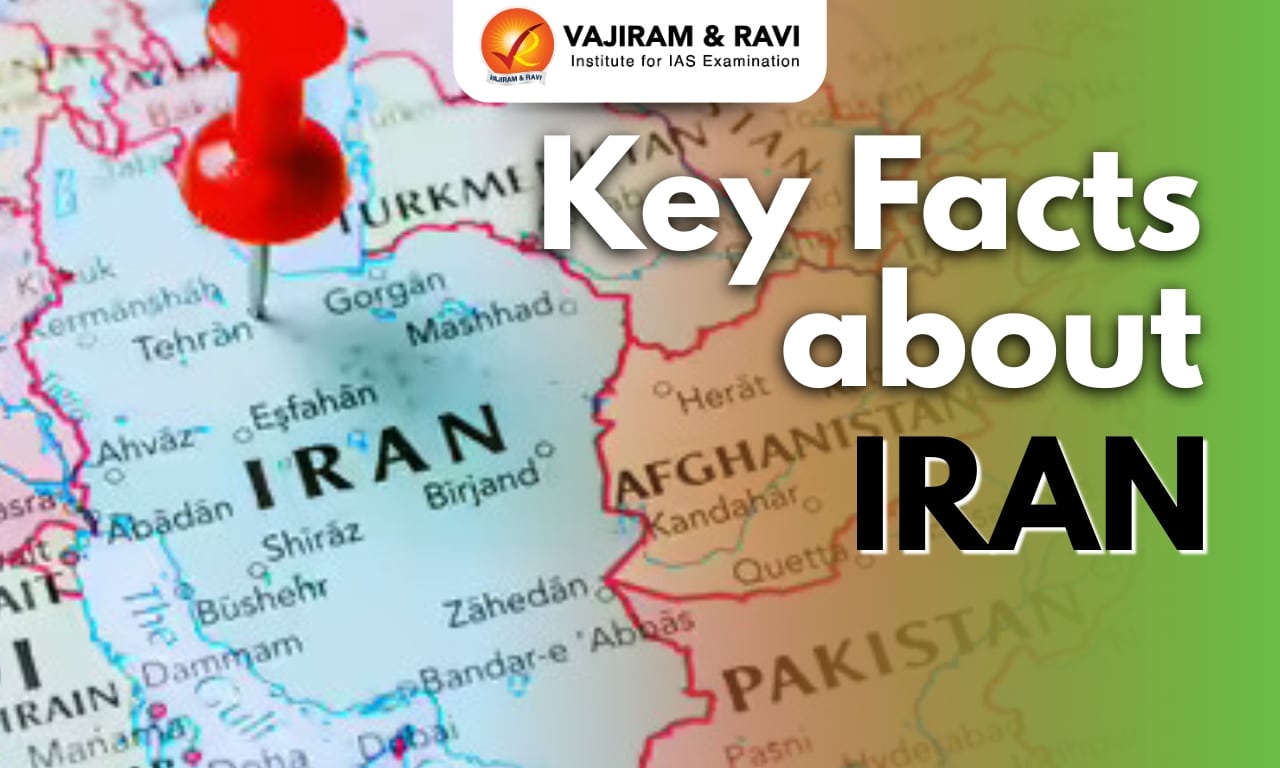
  • Location: It is a prominent country located in West Asia.
  • Bordering Countries: It shares land boundaries with Armenia, Azerbaijan, and Turkmenistan to the north, Afghanistan and Pakistan to the east, Iraq to the west, and Turkey to the northwest.
  • Maritime Boundaries: It is bordered by major water bodies, namely the Caspian Sea to the north, and the Persian Gulf and the Gulf of Oman to the south.
  • Capital City: Tehran
  • It is a member country of SCO, OPEC and BRICS.

Geographical Features of Iran

  • Terrain: Its terrain is predominantly marked by the Iranian Plateau, characterised by vast deserts like the Dasht-e Kavir and Dasht-e Lut.
  • Mountain Range: It has important mountain ranges such as the Zagros Mountains in the west and the Alborz Mountains in the north.
  • Highest Peak: Mount Damavand, located in the Alborz Mountain Range, is the highest peak in Iran.
  • Climate: Iran’s climate varies from arid and semi-arid conditions to subtropical regions, especially along the Caspian coast.
  • Major Rivers:  Karun, Dez, Karkheh, and Diyala rivers, essential for irrigation and agriculture.
  • Natural Resources: It is rich in oil and natural gas, along with coal, chromium, copper, iron ore, lead, manganese, zinc, and sulphur.

Source: ET

Iran FAQ's

Q1: Which mountain range runs along the border between Iran and Iraq?

Ans: Zagros Mountains

Q2: Iran is a significant producer of which natural resource?

Ans: Oil

Enquire Now