Sports Authority of India (SAI)

Sports Authority of India (SAI)

Sports Authority of India (SAI) Latest News

The Sports Authority of India (SAI) recently launched a four-day Sports Sciences Workshop for combat sports coaches at its Sports Science Division in New Delhi.

About Sports Authority of India (SAI)

  • It is the apex national sports body of India, established by the Ministry of Youth Affairs and Sports, Government of India.
  • It was set up in 1984 to carry forward the legacy of the IXth Asian Games held in New Delhi in 1982 under the Department of Sports.
  • It is a registered society fully funded by the Government of India.
  • SAl has been entrusted with the twin objectives of promoting sports and achieving sporting excellence at the national and international level.
  • SAI’s primary efforts include widespread talent scouting and training of selected individuals by providing vital inputs like coaching, infrastructure, equipment support, sports kits, competitive exposure, etc.
  • SAI has played a significant role in shaping India’s sports development by providing training to elite athletes and at the same time operating a number of schemes for the identification and development of young talent. 
  • The schemes are being implemented through various regional centres and training centres of SAI spread throughout the country. 
  • SAI implements the following Sports Promotional Schemes across the country to identify talented sportspersons in various age groups and nurture them to excel at the national and international levels:
    • National Centres of Excellence (NCOE)
    • SAI Training Centre (STC)
    • Extension Centre of STC
    • National Sports Talent Contest (NSTC)
  • In addition to that, a number of academic programmes in physical education and sports are also offered by SAI. 
  • SAI is also entrusted with the responsibility of maintaining and utilizing, on behalf of the Ministry of Youth Affairs & Sports, the following stadiums in Delhi, which were constructed/renovated for the IXth Asian Games.
    • Jawaharlal Nehru Sports Stadium
    • Indira Gandhi Sports Complex
    • Major Dhyan Chand National Stadium
    • Dr. Syama Prasad Mookherjee Swimming Pool Complex
    • Dr. Karni Singh Shooting Ranges

Source: PIB

Sports Authority of India (SAI) FAQs

Q1: What is the Sports Authority of India (SAI)?

Ans: It is the apex national sports body of India.

Q2: Under which ministry was the Sports Authority of India established?

Ans: The Ministry of Youth Affairs and Sports, Government of India.

Q3: When was the Sports Authority of India set up?

Ans: It was set up in 1984 to carry forward the legacy of the IXth Asian Games held in New Delhi in 1982.

Q4: How is the Sports Authority of India funded?

Ans: It is fully funded by the Government of India.

Q5: What are the primary efforts undertaken by Sports Authority of India to develop sportspersons?

Ans: Talent scouting and training with support such as coaching, infrastructure, equipment, sports kits, and competitive exposure.

Bio-Bitumen

Bio-Bitumen

Bio-Bitumen Latest News

Recently, the union Minister of State for Science and Technology said that India has entered an era of "Clean, Green Highways" following the successful technology transfer of "Bio-Bitumen via Pyrolysis: From Farm Residue to Roads".

About Bio-Bitumen

  • Bio bitumen is manufactured using renewable organic materials, such as plant-based oils, agricultural waste, or biomass.
  • These materials undergo a special processing method to create a high-quality binder that is similar to traditional bitumen.
  • It is an alternative to petroleum-based bitumen that lowers both carbon emissions and import dependency,
  • Bio-bitumen production involves multiple steps, depending on the source material used. 
  • Significance of Bio-bitumen: Its production results in significantly lower carbon emissions, making it ideal for eco-friendly projects.

Key Processes of Bio-bitumen production 

  • Biomass Collection & Processing:  Raw materials such as plant-based oils, lignin, or algae are collected and pre-processed.
  • Pyrolysis & Bio-Oil Extraction: Thermal decomposition of biomass at controlled temperatures produces bio-oil, which serves as a precursor for bio bitumen.
  • Refining & Modification: Bio-oil undergoes refining and polymer modification to enhance its viscosity, thermal stability, and adhesive properties
  • Blending & Finalization: In some cases, bio bitumen is blended with conventional bitumen to improve performance characteristics while maintaining sustainability benefits.

Key Facts about Bio-Bitumen via Pyrolysis Technology

  • It is an indigenous innovation developed by CSIR‑Central Road Research Institute (CSIR-CRRI) New Delhi and CSIR‑Indian Institute of Petroleum Dehradun (CSIR-IIP)".
  • It involves the collection of post-harvest rice straw, its palletisation, and conversion into bio-oil through pyrolysis, which is then blended with conventional bitumen.
  • Extensive laboratory tests have shown that 20–30 per cent of conventional bitumen can be safely replaced without compromising performance. 

Source: DD News

Bio-Bitumen FAQs

Q1: What is Bio-Bitumen primarily used for?

Ans: Construction and road paving

Q2: How is Bio-Bitumen typically produced?

Ans: From biomass like vegetable oils or waste materials

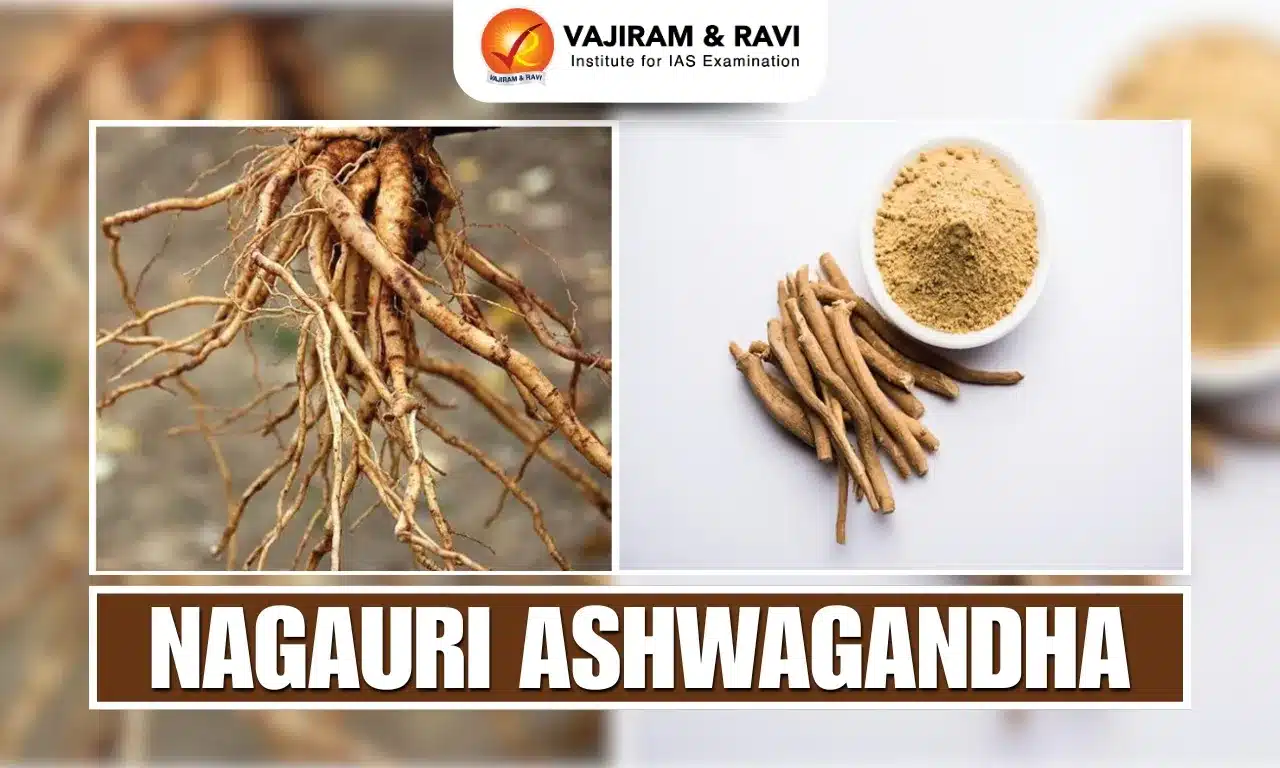
Nagauri Ashwagandha

Nagauri Ashwagandha

Nagauri Ashwagandha Latest News

Recently, the Centre has officially granted a Geographical Indication (GI) tag to 'Nagauri Ashwagandha'. 

About Nagauri Ashwagandha

  • It is mainly grown in the Nagaur district of Rajasthan.
  • Nagaur's dry climate and sandy soil are ideally suited for Ashwagandha cultivation.
  • It has longer, thicker roots rich in medicinal compounds, particularly alkaloids.
  • Its berries are known for their dark, bright red colour, which is considered a clear indicator of superior quality.
  • It has brittle and starchy roots. The ‘Nagori Ashwagandha’ is the supreme among all Ashwagandha varieties in arid regions.

Key Facts about Ashwagandha

  • Ashwagandha (Withania somnifera) is an important ancient plant.
  • Other names: Indian ginseng or Indian winter cherry

Required Climatic Condition for Ashwagandha

  • It grows in dry and sub-tropical regions.
  • Soil: It grows well in sandy loam or light red soil having pH 7.5 to 8.0 with good drainage. 
  • Climate: It is grown as a late rainy season (kharif) crop
  • Rain: The semi-tropical areas receiving 500 to 750 mm rainfall are suitable for its cultivation as a rainfed crop. 
  • Temperature: It can tolerate a temperature range of 20 to 38 degree Celsius.
  • Major Ashwagandha Producing states: Madhya Pradesh, Rajasthan, Punjab, Haryana, Uttar Pradesh, Gujarat, Maharashtra and Madhya Pradesh are the of the country. 

Benefits of Ashwagandha

  • It has been in use as a medicinal plant for thousands of years, especially in traditional Ayurvedic medicine.
  • It is often called an adaptogen, meaning it helps the body adapt to stressors and restore balance.
  • Its other benefits are reducing inflammation, increasing energy, alleviating anxiety, ease pain, and improving sleep.
  • Different parts of the ashwagandha plant, such as the root, leaves, and berries, may have different concentrations of bioactive compounds.

Source: ETV

Nagauri Ashwagandha FAQs

Q1: What is Nagauri Ashwagandha primarily known for?

Ans: Its medicinal properties

Q2: Where is Nagauri Ashwagandha mainly cultivated?

Ans: Rajasthan

National Quality Assurance Standards

National Quality Assurance Standards

National Quality Assurance Standards Latest News

Recently, a total of 50,373 public health facilities across all States and Union Territories have been certified under the National Quality Assurance Standards (NQAS).

About National Quality Assurance Standards

  • It is a comprehensive quality framework established by the Ministry of Health and Family Welfare (MoHFW).
  • It is aimed at ensuring and enhancing the quality of healthcare services provided at public health facilities.
  • The NQAS began in 2015 with just 10 certified healthcare facilities.
  • It was initially focusing on District Hospitals to ensure safe, patient-centric, and quality-assured services.
  • NQAS are currently available for District Hospitals, Sub-District Hospitals, Community Health Centres, Ayushman Arogya Mandir–PHCs, AAM–UPHCs, and AAM–Sub Health Centres.
  • Purpose: These standards are primarily meant for providers to assess their own quality for improvement through pre-defined standards and to bring up their facilities for certification. 
  • These are broadly arranged under 8 "Areas of Concern" namely;
    • Service Provision, Patient Rights, Inputs, Support Services, Clinical Care, Infection Control, Quality Management and Outcome

Source: PIB

National Quality Assurance Standards FAQs

Q1: What is the primary objective of NQAS?

Ans: To ensure quality healthcare services in public facilities

Q2: Which ministry is associated with NQAS implementation?

Ans: Ministry of Health and Family Welfare

Dust Experiment (DEX)

Dust Experiment (DEX)

Dust Experiment (DEX) Latest News

Recently, the Indian Space Research Organisation confirmed through its first-ever Dust Experiment (DEX) that an interplanetary dust particle enters Earth’s atmosphere approximately every 1,000 seconds.

About Dust Experiment (DEX)

  • It is the first Indian-made instrument to hunt for these high speed Interplanetary Dust Particles (IDPs). 
  • It is the first-of-its-kind instrument designed to detect such high-transient particles.
  • It is developed by the Physical Research Laboratory, Ahmedabad.
  • It was flown on PSLV Orbital Experimental Module (POEM) of the PSLV-C58 XPoSat Mission on January 1, 2024.

Features of Dust Experiment (DEX)

  • It is a compact instrument tuned to hear impacts, capturing vital data.
  • At the core of the experiment lies a 3-kilogram dust detector based on the cutting-edge hypervelocity principle designed to capture high-speed space dust impacts with only 4.5 W power consumption.
  • It rocketed to an altitude of 350Km.
  • DEX is a blueprint of the detector which can study the cosmic dust particle at any planet having an atmosphere or no atmosphere.

Significance of the Dust Experiment (DEX)

  • Its data redefines our understanding of the universe and charts the path for safe human deep-space missions.
  • Understanding and collecting data on interplanetary dust in Earth’s atmosphere will also be valuable for planning Gaganyaan missions.

What are Interplanetary Dust Particles (IDPs)? 

  • Interplanetary dust refers to micrometer-scale particles originating from the solar system. 
  • These are microscopic shrapnel from comets and asteroids that form our atmosphere's mysterious "meteor layer", and show up as “shooting stars” at night. 
  • These can be analyzed to gain insights into their origins, formation mechanisms, and the processes that occurred in early solar and presolar environments.

 Source: IE

Dust Experiment (DEX) FAQs

Q1: What is cosmic dust composed of?

Ans: Small solid particles in space, including silicates and carbon compounds

Q2: Where is cosmic dust commonly found?

Ans: In interstellar space, galaxies, and planetary systems

PSLV-C62 Mission

PSLV-C62 Mission

PSLV-C62 Mission Latest News

ISRO’s PSLV-C62 rocket is set to lift off from the first launchpad at Sriharikota, marking India’s first space launch of 2026.

About PSLV-C62 Mission

  • It is a multi-payload mission of the Indian Space Research Organisation (ISRO) that will carry one primary satellite and 18 secondary payloads into space.
  • It is ISRO’s first space launch of 2026.
  • It is scheduled to lift off from Sriharikota.
  • The mission's primary payload is the earth observation satellite EOS-N1 (codenamed ‘Anvesha’), an hyperspectral imaging satellite developed primarily for the Defence Research and Development Organisation (DRDO) for strategic purposes.
    • Unlike conventional imaging satellites, hyperspectral satellites can “see” the Earth in hundreds of wavelengths, allowing them to identify materials and objects with far greater precision.
    • This capability makes EOS-N1 a high-value asset for national security, border surveillance and strategic monitoring. 
    • At the same time, the satellite will also be used for civilian applications such as agriculture planning, urban mapping, mineral detection, and environmental monitoring.
  • PSLV-C62 will also carry Europe's Kestrel Initial Demonstrator (KID), an experimental mission involving a small re-entry capsule developed in collaboration with a Spanish startup. 
    • The capsule is expected to re-enter Earth’s atmosphere and splash down in the South Pacific Ocean.
  • Additionally, 17 commercial payloads from startups and research institutions across India, Mauritius, Luxembourg, the UAE, Singapore, Europe, and the United States are manifested for the PSLV-C62 Mission.
  • Several Indian startups and academic institutions are also flying their satellites. 
    • These include OrbitAID Aerospace’s AayulSAT, CV Raman Global University’s CGUSAT-1, Dhruva Space’s DA-1, Space Kidz India’s SR-2, Assam Don Bosco University’s Lachit-1, Akshath Aerospace’s Solaras-S4, and Dayanand Sagar University’s DSAT-1.
  • Bengaluru-based OrbitAID Aerospace’s AayulSAT stands out as a historic first. 
    • It is India’s maiden on-orbit satellite refuelling payload. 
    • The mission aims to demonstrate technologies that could extend the operational life of satellites by enabling in-orbit servicing and refuelling.
    • Such capabilities are seen as crucial for tackling space debris and improving sustainability in Earth’s increasingly crowded orbital environment.

Source: MC

PSLV-C62 Mission FAQs

Q1: What is the PSLV-C62 Mission?

Ans: It is a multi-payload mission of ISRO carrying one primary satellite and 18 secondary payloads.

Q2: What is the primary payload of the PSLV-C62 Mission?

Ans: The Earth observation satellite EOS-N1 (codenamed Anvesha).

Q3: For which organisation was EOS-N1 primarily developed?

Ans: The Defence Research and Development Organisation (DRDO).

Q4: Which European experimental payload is carried onboard PSLV-C62?

Ans: Kestrel Initial Demonstrator (KID).

Tadoba-Andhari Tiger Reserve

Tadoba-Andhari Tiger Reserve

Tadoba Andhari Tiger Reserve Latest News

The Tadoba Andhari Tiger Reserve (TATR) recently undertook a sterilisation and vaccination program to deal with the growing menace of stray dogs.

About Tadoba Andhari Tiger Reserve 

  • It is located in the Chandrapur district in Maharashtra.
  • It is the largest and oldest tiger reserve in Maharashtra. 
  • It covers an area of 1,727 sq.km. 
  • Established in 1955, the reserve consists of Tadoba National Park and Andhari Wildlife Sanctuary.
  • The word ‘Tadoba’ is derived from the name of the God “Tadoba” or “Taru,” which is praised by local tribal people of this region, and “Andhari” is derived from the name of the Andhari River that flows in this area.
  • It has corridor linkages with Nagzira-Navegaon and Pench Tiger Reserves within the State.
  • It has a hilly topography with an average elevation of 200–350 metres.
  • Drainage: There are two lakes and one waterway in the reserve: Tadoba Lake, Kolsa Lake, and the Tadoba River.
  • Vegetation: Biogeographically, the reserve falls in the Central plateau province of the Deccan peninsula, with tropical dry deciduous forests and a typical Central Indian faunal assemblage.
  • Flora: It is blessed with thick forests covered with teak trees and other vegetation such as crocodile bark, salai, tendu, karaya gum, and mahua madhuca.
  • Fauna
    • Apart from tigers, the reserve is home to Indian leopards, sloth bears, Indian gaur (bison), wild dogs (dholes), striped hyenas, marsh crocodiles, sambar deer, chital (spotted deer), barking deer, and four-horned antelopes (chousingha).
    • It is also a birdwatcher’s paradise, with over 250 species of birds, including crested serpent eagles, grey-headed fish eagles, paradise flycatchers, and hornbills.

Source: WEEK

Tadoba Andhari Tiger Reserve Latest News FAQs

Q1: Where is Tadoba Andhari Tiger Reserve (TATR) located?

Ans: Chandrapur district of Maharashtra.

Q2: Which is the largest and oldest tiger reserve in Maharashtra?

Ans: Tadoba Andhari Tiger Reserve (TATR)

Q3: Which two protected areas together form Tadoba Andhari Tiger Reserve?

Ans: Tadoba National Park and Andhari Wildlife Sanctuary.

Q4: Which water bodies are part of the drainage system of Tadoba Andhari Tiger Reserve?

Ans: Tadoba Lake, Kolsa Lake, and the Tadoba River.

Q5: What type of forest vegetation is found in Tadoba Andhari Tiger Reserve?

Ans: Tropical dry deciduous forests.

Thanthai Periyar Wildlife Sanctuary

Thanthai Periyar Wildlife Sanctuary

Thanthai Periyar Wildlife Sanctuary Latest News

Recently, the first phase of the All-India Tiger Estimation-2026 (AITE-26) commenced in the Thanthai Periyar Wildlife Sanctuary. 

About Thanthai Periyar Wildlife Sanctuary

  • Location: It is located in Bargur Hills in Erode District of Tamil Nadu.
  • It is located between the Sathyamangalam Tiger Reserve of Tamil Nadu and the Male Mahadeshwara Wildlife Sanctuary and the Cauvery Wildlife Sanctuary of Karnataka.
  • It is one of the tiger corridors identified by the National Tiger Conservation Authority.
  • The region is also part of the Nilgiris Elephant Reserve.
  • These forests occupy a prominent position in the Eastern Ghats as they merge with the Western Ghat at the Nilgiris.
  • Rivers: It is the catchment of the Palar River that drains into the Cauvery River.
  • Fauna: It is home to a healthy population of large herbivores including elephants and the Indian Gaur.

Key Facts about All-India Tiger Estimation

  • It is conducted once every four years
  • Purpose: To assess the status of the tiger population in the country.
  • Past Estimations: Five cycles have already been conducted in 2006, 2010, 2014, 2018, and 2022.

Source: TH

Thanthai Periyar Wildlife Sanctuary FAQs

Q1: Where is the Thanthai Periyar Wildlife Sanctuary located?

Ans: Tamil Nadu

Q2: What is the primary significance of Thanthai Periyar Wildlife Sanctuary?

Ans: It's a critical corridor for elephant and tiger movement

Bigha

Bigha

Bigha Latest News

The Assam government recently completed an eviction drive to clear alleged encroachment from around 6,200 bighas (nearly 830 hectares) of land in Burhachapori Wildlife Sanctuary, affecting 710 families.

About Bigha

  • It is a traditional unit of land measurement commonly used in India, Bangladesh, and Nepal. 
  • It is generally used for the measurement of agricultural land, although it may also be used for residential plots. 
  • Historical Context:
    • The origins of Bigha trace back to ancient South Asian practices. 
    • It originated from the Sanskrit term ‘vigraha,’ which translates to division. 
    • Before the introduction of modern units like the acre or hectare, landowners and farmers relied on Bigha to calculate land for cultivation, taxation, and trade. 
    • Over time, it became deeply rooted in the cultural and economic fabric of these regions.
  • Popular in states where farming is common, Bigha is used by farmers when measuring plots and negotiating land prices.
  • This unit is most commonly used in the following Indian states: Assam, Bihar, Gujarat, Haryana, Himachal Pradesh, Jharkhand, Madhya Pradesh, Punjab, Rajasthan, Uttarakhand, Uttar Pradesh, and West Bengal.
  • The exact measurement of bigha differs from state to state
    • For instance, in West Bengal and Assam, one bigha equals about 14,400 sq.ft., while in Punjab, it measures approximately 9,070 sq.ft. 
  • There is no national standard for the size of a bigha, and it is typically smaller than an acre, which is 43,560 sq.ft. or 4,047 sq.m.
  • Bigha has several subunits in different places; some common ones are:
    • Katha
    • Biswa
    • Nalli
  • Bigha in Bangladesh and Nepal:
    • Bangladesh: Standardized under British rule at 14,400 sq.ft (1,340 sq.m.).
    • Nepal: A bigha equals about 6,772.63 sq.m., with local variations.

Key Facts about Burhachapori Wildlife Sanctuary

  • It is located on the southern bank of the river Brahmaputra in the Sonitpur district, Assam
  • It is located on the north side of Laokhowa Wildlife Sanctuary and shares an integral transboundary landscape of the Laokhowa-Burachapori Wildlife Sanctuary ecosystem. 
  • Both the sanctuary was notified as a buffer zone of the Kaziranga Tiger Reserve in 2007.
  • Most of the low-lying areas of the sanctuary are vulnerable to flooding during summer. 
  • Flora: It is enveloped and adorned by wet alluvial grasslands, riparian forests, and semi-evergreen forests.
  • Fauna:
    • It is a habitat of a wide range of wild animals, including tigers, elephants, wild buffalos, one-horned rhinoceros, hog deer, and wild boar.
    • The avian inhabitants feature species like the Bengal florican, black-necked stork, open-billed stork, white-eyed pochard, mallard, spotbill, large whistling teal, and numerous others.

Source: PRINT

Bigha FAQs

Q1: What is Bigha?

Ans: Bigha is a traditional unit of land measurement commonly used in India, Bangladesh, and Nepal.

Q2: For what type of land is Bigha generally used?

Ans: It is mainly used to measure agricultural land, and sometimes residential plots.

Q3: In which Indian states is Bigha most commonly used?

Ans: Assam, Bihar, Gujarat, Haryana, Himachal Pradesh, Jharkhand, Madhya Pradesh, Punjab, Rajasthan, Uttarakhand, Uttar Pradesh, and West Bengal.

Q4: Does Bigha have a uniform measurement across India?

Ans: No, the measurement of Bigha varies from state to state.

Open Network for Digital Commerce (ONDC)

Open Network for Digital Commerce (ONDC)

Open Network for Digital Commerce (ONDC) Latest News

The Archaeological Survey of India (ASI) recently enabled online ticket booking for "over 170 centrally protected monuments and museums" on the Open Network for Digital Commerce (ONDC), seeking to expand digital access.

About Open Network for Digital Commerce (ONDC)

  • It is a transformative initiative by the Department for Promotion of Industry and Internal Trade (DPIIT), Ministry of Commerce, Government of India, aimed at democratizing digital commerce. 
  • Launched in April 2022, ONDC aims at promoting open networks for all aspects of the exchange of goods and services over digital or electronic networks. 
  • ONDC represents a step toward digital commerce democratization, shifting it from a platform-centric model—where a few e-commerce giants dominate the market—to an open, interoperable platform where buyers and sellers can interact regardless of the platforms they’re using. 
  • ONDC is based on open-sourced methodology, using open specifications and open network protocols independent of any specific e-commerce platform. 
  • It envisions creating a level playing field for sellers, buyers, and service providers across India, particularly small and medium enterprises (MSMEs). 
  • The ONDC initiative has several key objectives:
    • Democratization of Commerce: Break the dominance of large e-commerce platforms by enabling interoperability across networks.
    • Inclusivity: Empower small businesses, retailers, and local artisans to access the digital marketplace.
    • Cost Efficiency: Lower the cost of customer acquisition and transaction processing for sellers.
    • Market Expansion: Bridge regional and linguistic gaps, bringing untapped markets into the fold of digital commerce.
    • Customer Empowerment: Increase options for buyers by providing access to a broader array of sellers.
  • It will enable local commerce across segments, such as mobility, grocery, food order and delivery, hotel booking and travel, among others, to be discovered and engaged by any network-enabled application.
  • It comprises buyer-side apps where consumers can place orders, seller-side apps that onboard merchants and display their listings, and logistics platforms that handle deliveries.
  • Benefits:
    • It offers small retailers an opportunity to provide their services, and goods to buyers across the country through an e-commerce system.
    • ONDC enables merchants to save their data to build credit history and reach consumers.
    • It is expected to digitise the entire value chain, promote inclusion of suppliers, derive efficiencies in logistics, and enhance value for consumers.
    • ONDC protocols would standardize operations like cataloguing, inventory management, order management, and order fulfilment.

Source: ET

Open Network for Digital Commerce (ONDC) FAQs

Q1: What is the Open Network for Digital Commerce (ONDC)?

Ans: It is an initiative by the Department for Promotion of Industry and Internal Trade (DPIIT) to democratize digital commerce in India.

Q2: When was Open Network for Digital Commerce (ONDC) launched?

Ans: In April 2022.

Q3: What is the primary aim of Open Network for Digital Commerce (ONDC)?

Ans: To promote open networks for the exchange of goods and services over digital platforms.

Q4: How does Open Network for Digital Commerce (ONDC) differ from traditional e-commerce models?

Ans: It shifts from a platform-centric model to an open, interoperable network.

Enquire Now