Key Facts about Barbados

Key Facts about Barbados

Barbados Latest News

Recently, the Prime Minister of India congratulated Barbados Mia Amor Mottley on securing a historic third consecutive electoral victory.

About Barbados

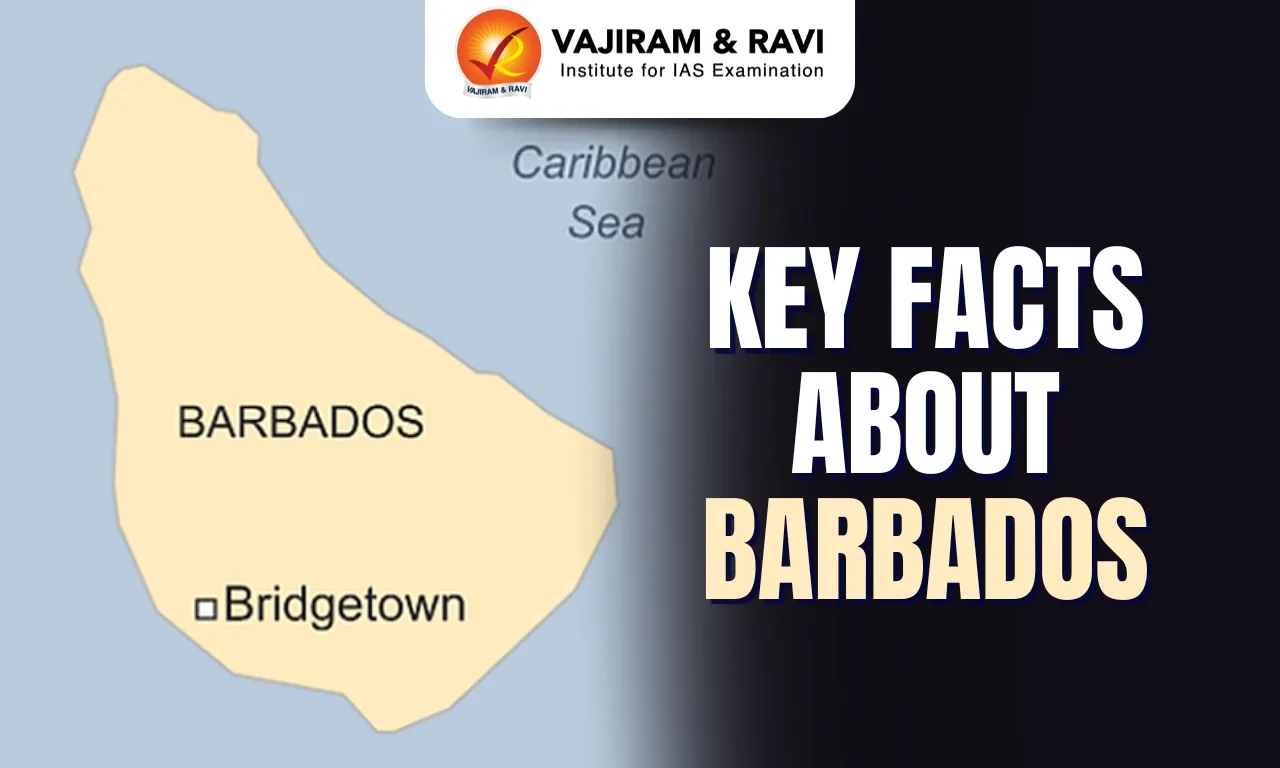
  • Location: It is an island country located in the south eastern Caribbean region of North America.
  • It lies to the east of St. Lucia, St. Vincent and the Grenadines; to the southeast of Martinique; to the northeast of Trinidad and Tobago.
  • It is the easternmost island in the Caribbean.
  • Water Bodies: Barbados is surrounded by the Atlantic Ocean.
  • It is part of the Caribbean Community (CARICOM) which was established in 1973.
  • Capital City: Bridgetown
  • Independence: Barbados became independent on November 30, 1966.

Geographical Features of Barbados

  • Terrain: The terrain of Barbados is gentle sloping, terraced plains separated by rolling hills.
  • Climate: Its climate is classified as a tropical monsoon. It experiences both the wet and dry seasons.
  • Highest Point: The highest point on the island is Mount Hillaby which measures 340 meters above sea level.
  • Natural Resources: Barbados's chief natural resources are petroleum, fish, and natural gas. 

Source: DD News

Barbados FAQs

Q1: Where is Barbados located?

Ans: Caribbean Sea

Q2: What is the capital of Barbados?

Ans: Bridgetown

Tetrataenium Paikadae

Tetrataenium Paikadae

Tetrataenium Paikadae Latest News

A team of researchers recently discovered a new plant species named Tetrataenium paikadae in the high-altitude grasslands of Idukki district of the Western Ghats.

About Tetrataenium Paikadae

  • It is a new plant species.
  • It was discovered in the high-altitude grasslands of the Western Ghats in the Idukki district, Kerala.
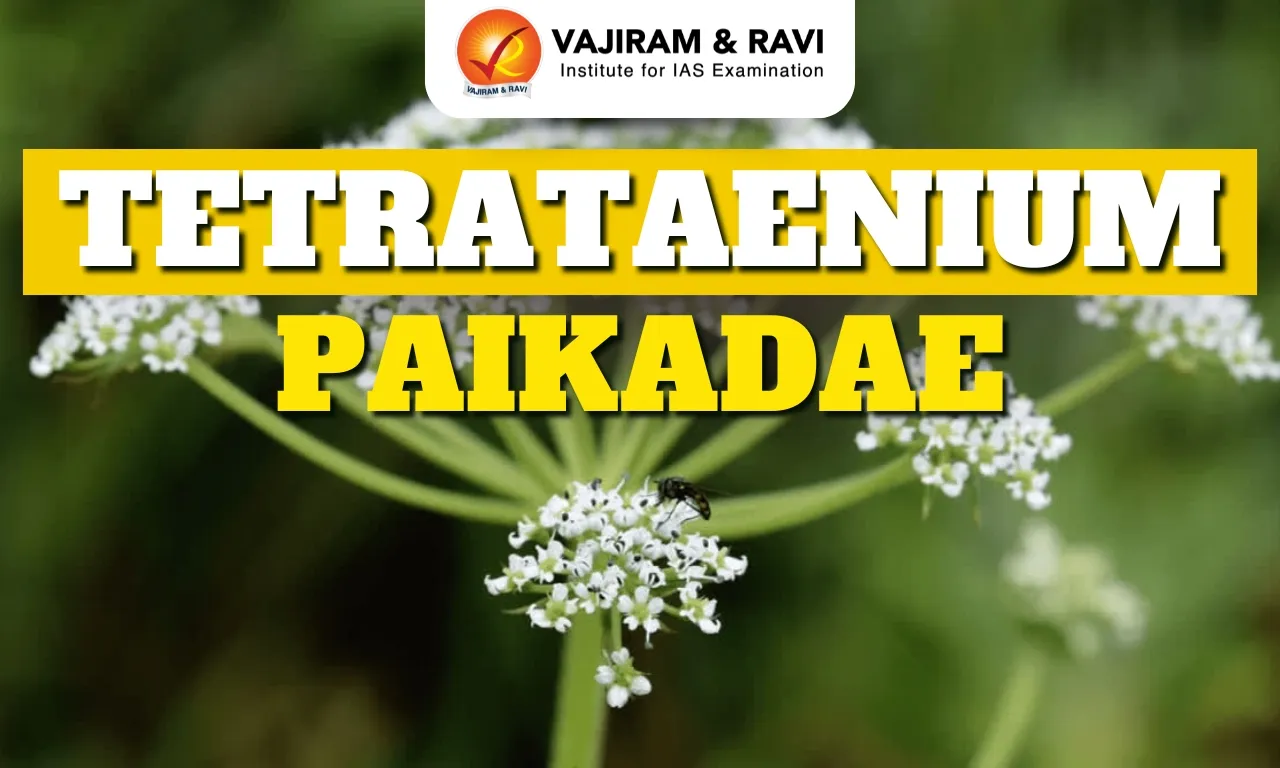
  • It was identified inside Eravikulam National Park and belongs to the Apiaceae family, which includes commonly known plants such as carrot and coriander.
  • The newly discovered species thrives in moist, marshy grasslands at elevations ranging between 1,000 and 2,500 metres above sea level. 
  • The plant grows to a height of 30 to 80 centimetres, and it has densely stiff-haired stems, ovate leaves, and clusters of small white flowers.
  • It typically flowers between July and September, while fruiting occurs from October to November. 
  • Researchers distinguished Tetrataenium paikadae from closely related species based on the number and structural arrangement of oil tubes present in its fruits.

Source: ETVB

Tetrataenium Paikadae FAQs

Q1: What is Tetrataenium paikadae?

Ans: It is a newly discovered plant species.

Q2: Where was Tetrataenium paikadae discovered?

Ans: It was discovered in the high-altitude grasslands of the Western Ghats in the Idukki district of Kerala.

Q3: To which plant family does Tetrataenium paikadae belong?

Ans: It belongs to the Apiaceae family.

Q4: In what type of habitat does Tetrataenium paikadae thrive?

Ans: It thrives in moist, marshy grasslands.

Chennakeshava Temple

Chennakeshava Temple

Chennakeshava Temple Latest News

The Prime Minister’s new office complex, Seva Teerth has been built in the Indian architectural tradition inspired by the features of the 12th-century Chennakeshava Temple.

About Chennakeshava Temple

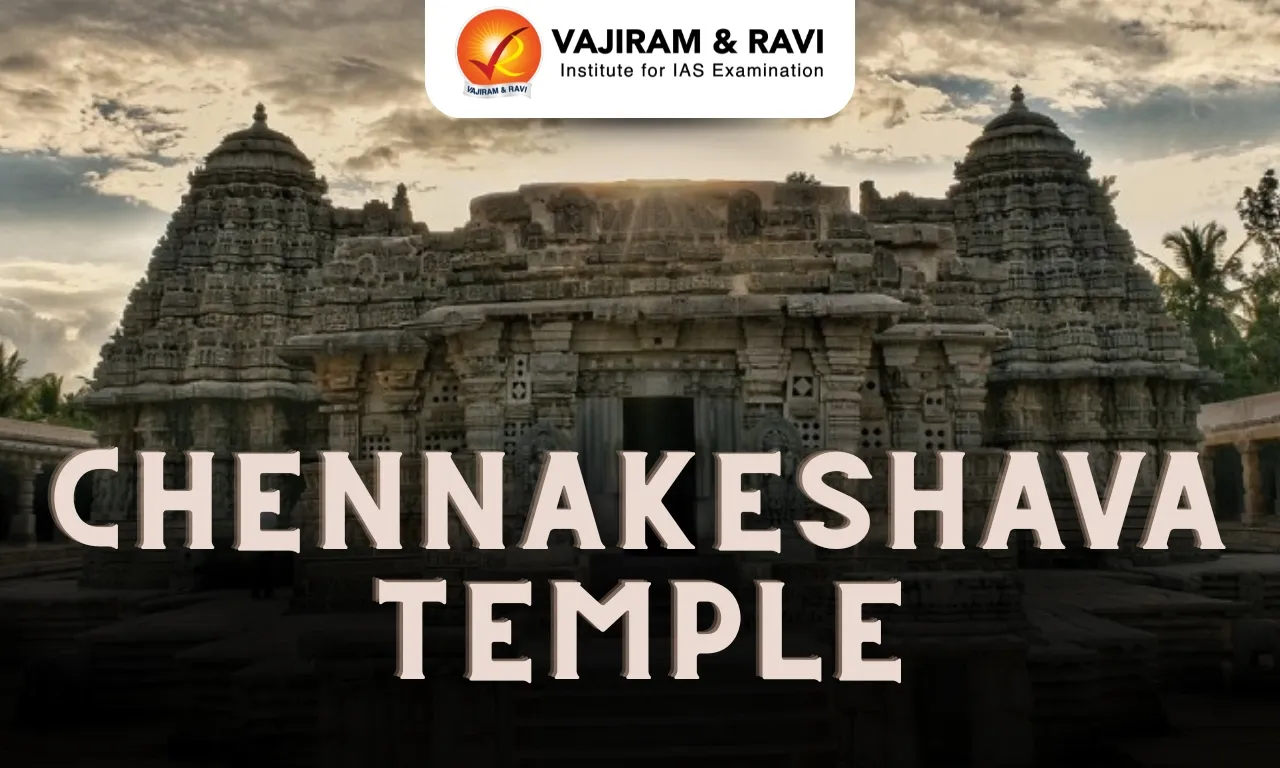
  • The Chennakeshava Temple, also referred to as the Keshava, or Vijayanarayana Temple of Belur, is a 12th-century temple in Karnataka.
  • It is a Hindu temple dedicated to Lord Vishnu. 
  • It was commissioned by King Vishnuvardhana in 1117 CE (after a major military victory in 1116 CE over the Cholas in the great battle of Talakkad), on the banks of the Yagachi River in Belur, also known as Velapura. 
  • The temple was built over three generations and took 103 years to complete.
  • The temple is listed as a UNESCO World Heritage Site.

Chennakeshava Temple Architecture

  • It is a stunning example of Hoysala architecture.
  • The Hoysalas used soft soapstone for their structures, as they were found suitable for intricate carvings. 
  • Enclosed by a Prakara with a Gopura built in the Vijayanagar style, the temple stands on a platform, or Jagati, and looks like a huge casket.
  • The outer walls of the temple are adorned with intricate carvings, which depict various gods, goddesses, and mythical creatures.
  • There are more than 80 Madanika sculptures in the temple, dancing, hunting, standing under canopies of trees, and so on. 
  • One of the unique features of the Chennakeshava Temple is the stepped well, which is located in the temple complex.

Source: TI

Chennakeshava Temple FAQs

Q1: What is the Chennakeshava Temple also known as?

Ans: It is also known as the Keshava Temple or Vijayanarayana Temple of Belur.

Q2: Where is the Chennakeshava Temple located?

Ans: It is located in Belur (also known as Velapura) in Karnataka.

Q3: In which century was the Chennakeshava Temple built?

Ans: It was built in the 12th century.

Q4: Who commissioned the Chennakeshava Temple?

Ans: It was commissioned by King Vishnuvardhana.

Q5: In which year was the temple commissioned?

Ans: It was commissioned in 1117 CE.

Combined Maritime Forces

Combined Maritime Forces

Combined Maritime Forces Latest News

Recently, the Indian Navy has assumed command of Combined Task Force (CTF) 154, a key multinational training task force under the Combined Maritime Forces (CMF).

About Combined Maritime Forces

  • It is a multinational maritime partnership that upholds the International Rules Based Order (IRBO) by countering illicit non-state actors on the high seas.
  • It promotes security, stability and prosperity across approximately 3.2 million square miles of international waters, which encompass some of the world’s most important shipping lanes.
  • Mandate: Its main focus areas are counter-narcotics, counter-smuggling, suppressing piracy, encouraging regional cooperation, and engaging with regional and other partners to strengthen relevant capabilities and improve overall security and stability, and promote a safe maritime environment free from illicit non-state actors.
  • CMF has five Combined Task Forces
    • CTF 150 (Maritime Security Operations outside the Arabian Gulf)
    • CTF 151 (Counter-Piracy)
    • CTF 152 (Maritime Security Operations inside the Arabian Gulf)
    • CTF 153 (Red Sea Maritime Security)
    • CTF 154 (Maritime Security Training)
  • Member Countries: It comprises 47 nations including India.
  • The 47 nations that comprise CMF are not bound by either a fixed political or military mandate. 

Source: PIB

Combined Maritime Forces FAQs

Q1: What is the primary objective of the Combined Maritime Forces (CMF)?

Ans: To counter maritime threats and ensure security

Q2: Where is the headquarters of the Combined Maritime Forces located?

Ans: Bahrain

Lead Bank Scheme (LBS)

Lead Bank Scheme (LBS)

Lead Bank Scheme (LBS) Latest News

The Reserve Bank of India (RBI) recently issued the draft circular on the revised guidelines for the Lead Bank Scheme (LBS) for public comments.

About Lead Bank Scheme (LBS)

  • On the recommendations of the Nariman committee, the LBS was introduced by the Reserve Bank of India in December 1969.
  • Aim: Coordinating the activities of banks and other developmental agencies in order to achieve the objective of enhancing the flow of bank finance to the priority sector and other sectors and to promote banks' role in the overall development of the rural sector
  • For coordinating the activities in the district, a particular bank is assigned ‘Lead Bank’ responsibility of the district. 
  • The Lead Bank is expected to assume a leadership role for coordinating the efforts of the credit institutions and the Government. 
  • For the preparation of District Credit Plans and monitoring their implementation, a Lead bank Officer (LBO), now designated as Lead District Manager was appointed in 1979.

Source: TH

Lead Bank Scheme (LBS) FAQs

Q1: On whose recommendation was the Lead Bank Scheme introduced?

Ans: It was introduced on the recommendations of the Nariman Committee.

Q2: In which year was the Lead Bank Scheme introduced?

Ans: It was introduced in December 1969.

Q3: What is the main objective of the Lead Bank Scheme?

Ans: Its main objective is to enhance the flow of bank finance to the priority sector and promote the development of the rural sector.

Q4: What role does the Lead Bank play in a district?

Ans: The Lead Bank assumes a leadership role in coordinating the efforts of credit institutions and the Government.

Rajaji Tiger Reserve

Rajaji Tiger Reserve

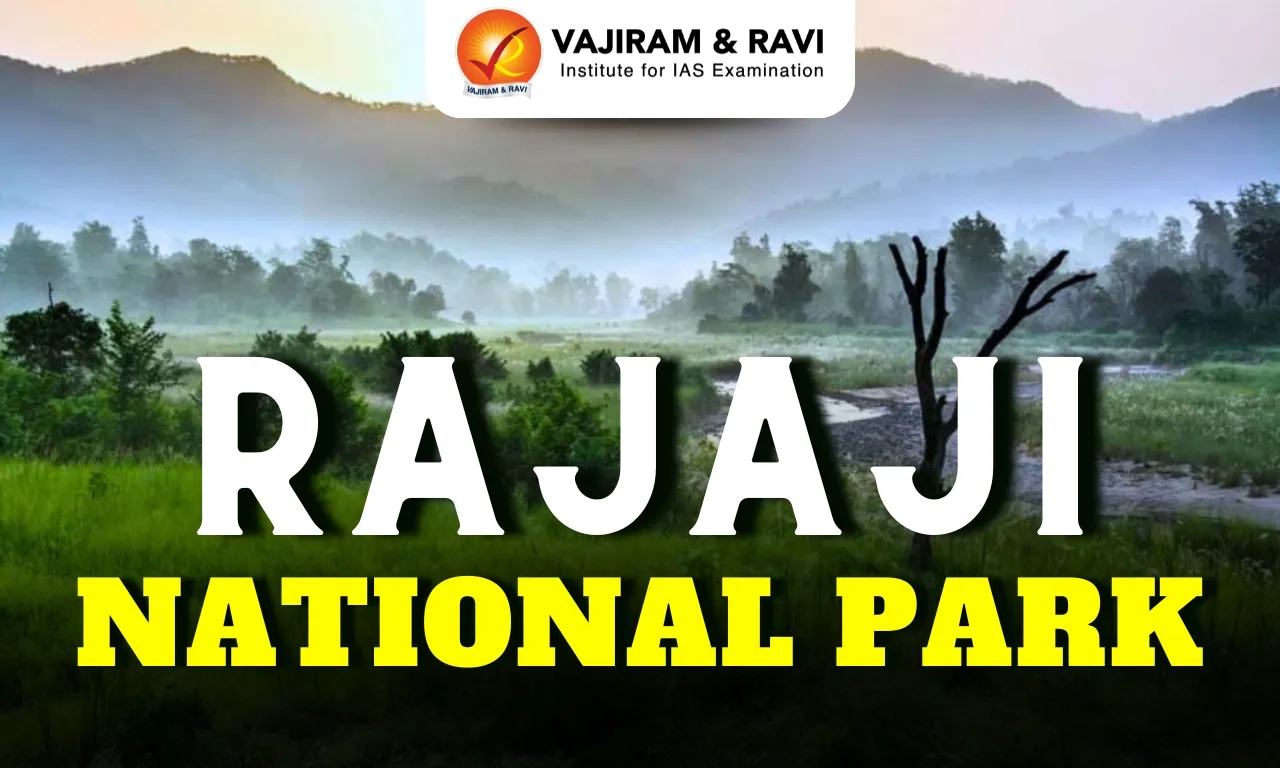
Rajaji National Park Latest News

The Supreme Court gave the nod for construction of a road cutting through Rajaji National Park on the condition that no commercial vehicles shall ply on it.

About Rajaji National Park

  • Location: It is located in the state of Uttarakhand.
  • It was established by merging three wildlife sanctuaries- Rajaji, Motichur and Chilla. 
  • It is named after C. Rajagopalachari, a prominent freedom fighter, fondly known as “Rajaji”. 
  • It is nestled between the Shivalik ranges and the Indo-Gangetic plains.
  • Rivers: River Ganga bifurcates the Park into two parts.
  • Vegetation: Forests of Rajaji include the Moist Shivalik Sal Forest, Moist Mixed Deciduous Forest, Northern Dry Mixed Deciduous and Khair-Sissoo forests in the Southern Slopes,
  • Flora: Sal tree, Anogeissus latilolia, Albizzia procera, A. lebbek, Boehmeria rugulosa, Lannea coromandelica, Terminalia bellerica, Mallotus philippensis, Wendlandia heynii, Bombax ceiba, etc.
  • Fauna: It is home to Asian Elephant, Tiger, leopard, Himalayan Black bear, sloth bear, Civet, Marten, Jackal, Hyena etc.

Source: HT

Rajaji National Park FAQs

Q1: Where is Rajaji National Park located?

Ans: Uttarakhand

Q2: Which river flows through Rajaji National Park?

Ans: Ganga River

Bhadra Tiger Reserve

Bhadra Tiger Reserve

Bhadra Tiger Reserve Latest News

A black panther and a leopard were recently spotted drinking water side by side, creating a rare and unforgettable moment in the wild.

About Bhadra Tiger Reserve

  • It is located in the Western Ghats of Karnataka, spreading over the Chikmagalur and Shimoga districts.
  • It boasts of a substantial tiger population, and as such, the sanctuary was declared the 25th Project Tiger reserve of India in 1998.
  • The reserve is unique, as it is nestled within several hill ranges. The habitat has a good population of elephants and is also an Elephant Reserve.
  • The reserve is shaped in the form of a saucer, having mostly undulating terrain with valleys and steep hillocks. 
  • It is well drained by the river Bhadra and its tributaries.
  • Vegetation: It has dry-deciduous, moist-deciduous, shola, and semi-evergreen patches.
  • Flora: Teak, Rosewood, Mathi, Honne, Nandi and many medicinal plants, etc. 
  • Fauna
    • Tiger, Leopard, Leopard cat, Dholes, Indian Civet, ungulates like Gaur, Sambar, and Barking Deer are common. 
    • Birdlife in the reserve is abundant, and around 250 species of avifauna have been identified.

Source: NDTV

Bhadra Tiger Reserve FAQs

Q1: Where is Bhadra Tiger Reserve located?

Ans: It is located in the Western Ghats of Karnataka, spread over the Chikmagalur and Shimoga districts.

Q2: Which river drains the Bhadra Tiger Reserve?

Ans: It is well drained by the Bhadra River and its tributaries.

Q3: What types of vegetation are found in Bhadra Tiger Reserve?

Ans: Dry-deciduous, moist-deciduous, shola, and semi-evergreen patches are found here.

Enquire Now