Traditional Knowledge Digital Library

Traditional Knowledge Digital Library

Traditional Knowledge Digital Library Latest News

Recently, the National Institute of Industrial Property (INPI), Brazil and the Council of Scientific and Industrial Research (CSIR), India have entered into a cooperation arrangement on access to the Traditional Knowledge Digital Library.

About Traditional Knowledge Digital Library

  • It is a unique initiative, established in 2001 by the Government of India through collaboration between CSIR and the Ministry of AYUSH.
  • Objective: Its primary objective is to prevent the erroneous grant of patents on Indian traditional knowledge and to safeguard the country’s knowledge heritage from misappropriation.

Features of Traditional Knowledge Digital Library

  • It currently contains information on over 5.2 lakh formulations and practices drawn from Indian systems of medicine such as Ayurveda, Unani, Siddha and Sowa Rigpa, as well as Yoga, sourced from authoritative traditional texts.
  • Under this, knowledge from multiple languages and disciplines is translated, structured and linked with modern scientific and technical terminology.
  • Languages: The database is available in five international languages—English, German, French, Japanese and Spanish.
  • To this platform, access is provided to patent offices through Non-Disclosure Agreements.
  • With the inclusion of INPI, Brazil, the number of patent offices worldwide with access to the TKDL rises to eighteen.
  • The TKDL is widely regarded as a global benchmark for the defensive protection of traditional knowledge.

Source: PIB

Traditional Knowledge Digital Library FAQs

Q1: What is the primary goal of TKDL?

Ans: Protect India's traditional knowledge

Q2: TKDL is a collaboration between?

Ans: CSIR and Ministry of AYUSH
Contarinia icardiflores

Contarinia icardiflores

Contarinia icardiflores Latest News

Scientists from the ICAR-Directorate of Floricultural Research (ICAR-DFR), Pune, recently discovered a new species of blossom midge, Contarinia icardiflores sp. nov.

About Contarinia icardiflores

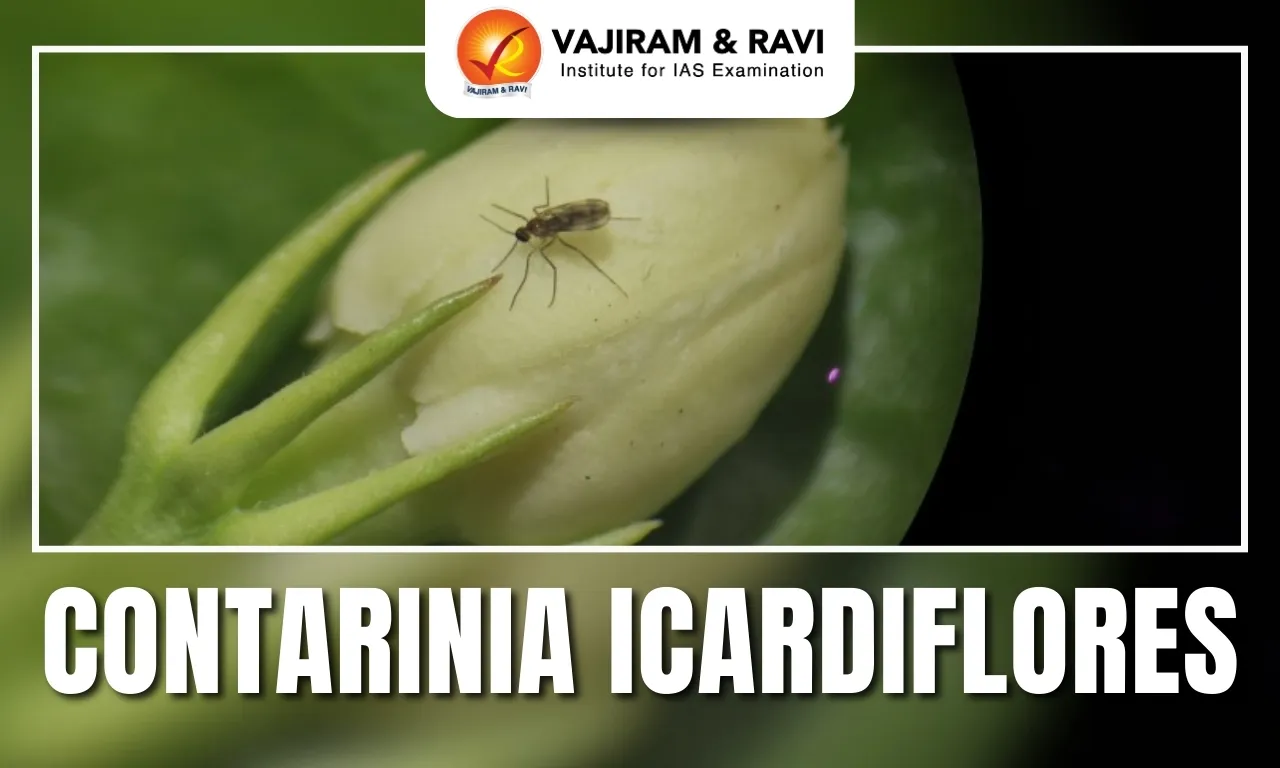
  • It is a new species of blossom midge.
    • Blossom midges of the genus Contarinia are small insects known to be serious pests of ornamental and food crops worldwide.
    • The larvae feed inside flower buds or blossoms, often causing severe yield loss in agricultural and horticultural crops.
  • C. icardiflores has been named in honour of ICAR-DFR, acknowledging the institute’s contributions to floriculture research.
  • It was found causing significant economic losses in jasmine cultivation, especially in some parts of Maharashtra, Tamil Nadu, Andhra Pradesh, and Karnataka.
  • The pest ― about 1.5 to 2 mm in size - completes its life cycle in 16 to 21.
  • Although C. icardiflores closely resembles C. maculipennis — the only other midge known to attack jasmine — it is genetically distinct.
  • The findings provide essential biological insights and lay the groundwork for developing targeted and eco-friendly pest management strategies for jasmine farmers in the country.

Source: ICAR

Contarinia icardiflores FAQs

Q1: What is Contarinia icardiflores?

Ans: It is a newly identified species of blossom midge that affects jasmine crops.

Q2: In whose honour has Contarinia icardiflores been named?

Ans: It has been named in honour of ICAR-Directorate of Floricultural Research.

Q3: What is the duration of the life cycle of Contarinia icardiflores?

Ans: Approximately 16 to 21 days.

Tetrodotoxin (TTX)

Tetrodotoxin

Tetrodotoxin Latest News

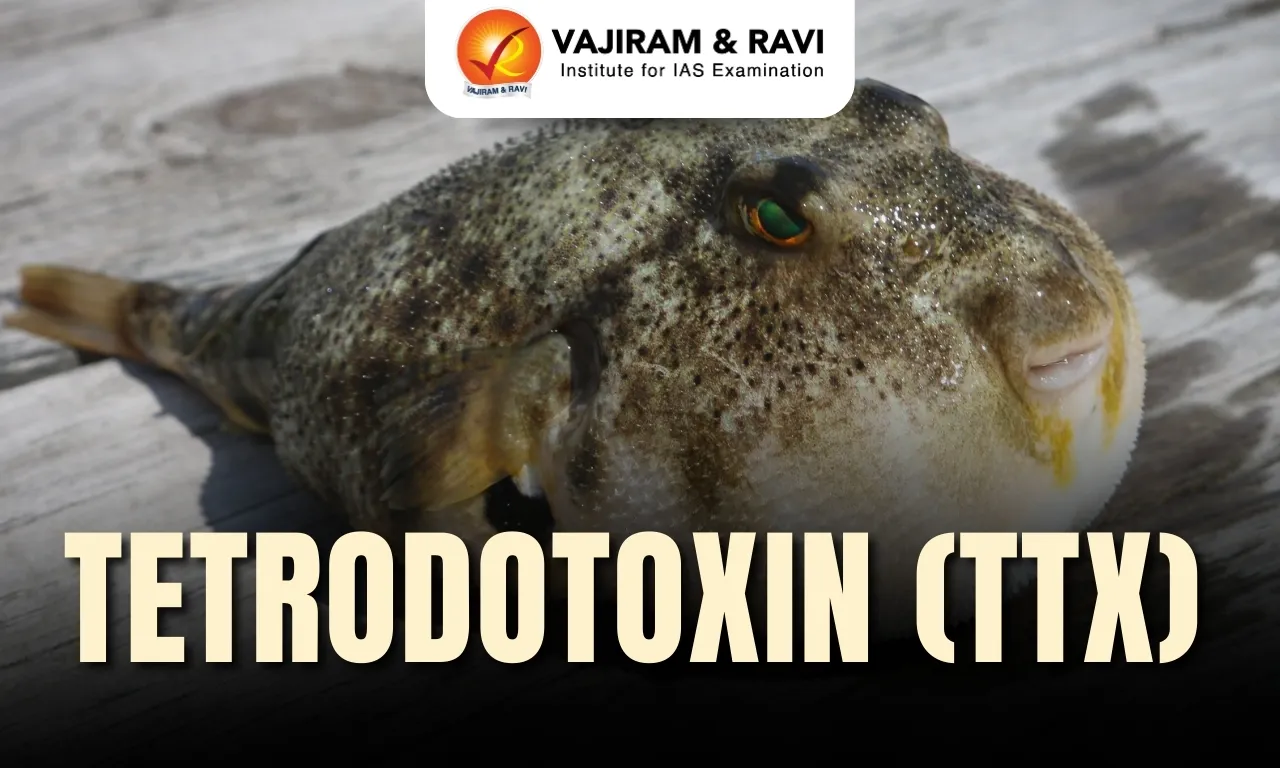
Food safety authorities and doctors suspect that the severe illness in people who consumed seafood at a restaurant in Vizhinjam, Kerala, was caused by contamination with a highly potent marine neurotoxin, likely tetrodotoxin (TTX).

About Tetrodotoxin

  • It is an extremely potent marine neurotoxin.
  • It is a crystalline, weakly basic, colorless organic substance. It darkens above 220° C.
  • Chemical Formula: C11H17N3O8. 
  • It naturally occurs in the skin, intestine, and liver of some fish in the family Tetraodontidae. 
  • Examples include puffer fish, porcupine fish, ocean sunfish, and some species of newts and salamanders.
  • Human poisonings occur when the flesh and/or organs of the fish are improperly prepared and eaten. 
  • TTX interferes with the transmission of signals from nerves to muscles and causes an increasing paralysis of the muscles of the body. 
  • Its toxicity is more than 1000 times greater than sodium cyanide.
  • TTX poisoning can be fatal.
  • It has no known antidote. Treatment is mainly supportive.

Source: TH

Tetrodotoxin FAQ's

Q1: What is Tetrodotoxin (TTX)?

Ans: It is an extremely potent marine neurotoxin.

Q2: What are the physical characteristics of Tetrodotoxin?

Ans: It is a crystalline, weakly basic, colorless organic substance that darkens above 220°C.

Q3: In which family of fish is Tetrodotoxin commonly found?

Ans: It is found in fish belonging to the family Tetraodontidae.

Q4: How does Tetrodotoxin affect the human body?

Ans: It blocks nerve signal transmission, leading to progressive muscle paralysis.

Q5: Is there a specific antidote for Tetrodotoxin poisoning?

Ans: No, there is no known antidote.

Lunar New Year

Lunar New Year

Lunar New Year Latest News

Moscow recently marked the Lunar New Year with vibrant celebrations featuring panda-themed events, cultural performances and festive displays highlighting Chinese traditions.

About Lunar New Year

  • It marks the beginning of a new year in the lunisolar calendar, which was developed in ancient China.
  • Often known in the West as Chinese New Year, the Lunar New Year occurs on the first new moon of the lunar calendar. 
    • Lunar calendars consist of 12 months, each month corresponding roughly to one cycle of the moon.
    • Because 12 lunar cycles do not fill a whole year an extra month is added periodically to Lunar calendars to stay close to the solar year.
  • Since the lunar calendar is based on the cycles of the moon, the date of Lunar New Year is different each year. 
  • However, it is usually in January or February. In 2026 it was on 17 February. 
  • Commonly known as the Spring Festival in China, Lunar New Year is a fifteen-day celebration marked by many traditions. 
  • It is the most important holiday of the year for China
  • It is also celebrated widely in Taiwan and across Southeast Asia in countries with large Chinese populations, such as Singapore, the Philippines, and Malaysia. 
  • In Korea, the Lunar New Year is called Seollal; in Vietnam, Tet; and in Tibet, Losar.
  • Each year is symbolised by one of the 12 animals of the Chinese zodiac.
    • The zodiacs and their orders are Rat, Ox, Tiger, Rabbit, Dragon, Snake, Horse, Goat, Monkey, Rooster, Dog, and Pig.

Source: WION

Lunar New Year FAQs

Q1: What does the Lunar New Year mark?

Ans: It marks the beginning of a new year in the lunisolar calendar developed in ancient China.

Q2: Why does the date of Lunar New Year change every year?

Ans: Because it is based on the cycles of the moon.

Q3: In which months does the Lunar New Year usually fall?

Ans: It usually falls in January or February.

Q4: What is the Lunar New Year commonly called in China?

Ans: It is known as the Spring Festival.

Lake Baikal

Lake Baikal

Lake Baikal Latest News

In a tragic incident, seven bodies have been recently recovered from Lake Baikal in Siberia after a tour bus carrying eight Chinese tourists broke through the ice and plunged into the water.

About Lake Baikal

  • It is located in the southern part of eastern Siberia, south-central Russia, near the border with Mongolia.
  • It is the oldest existing freshwater lake on Earth (20 million–25 million years old). 
  • It covers about 31,722 sq.km., making it the world’s largest freshwater lake. 
  • It has a length of 636 km and an average width of 48 km. 
  • It is also the world’s deepest lake, with a maximum depth of 1,642 meters below the water surface. 
  • Below the lake’s bottom lie sediments of about 7 kilometers, making it the Earth’s deepest continental rift, with a rift floor of 8-11 kilometers. 
  • It is also the world’s largest freshwater lake by volume. It contains roughly 20 percent of the world’s surface fresh water. 
  • There are 45 islands and islets in Lake Baikal, of which Olkhon is the largest island.
  • Up to 330 rivers drain into Lake Baikal, of which Barguzini, Selenga, Upper Angara, Sarma, and Turka are the major ones. 
  • However, the lake has only one outlet, the Angara River.
  • Baikal’s climate is much milder than that of the surrounding territory. The lake surface freezes in January and thaws in May or June.
  • It is also home to the Buryat people, who follow the Tibetan Buddhist religion and reside on the eastern side of the lake, rearing goats, camels, cattle, and sheep.
  • The lake was declared a UNESCO World Heritage Site in 1996. 
  • Known as the 'Galapagos of Russia', its age and isolation have produced one of the world's richest and most unusual freshwater faunas.

Source: N18

Lake Baikal FAQs

Q1: Where is Lake Baikal located?

Ans: It is located in southern eastern Siberia in Russia, near the border with Mongolia.

Q2: Why is Lake Baikal considered the oldest freshwater lake in the world?

Ans: Because it is estimated to be about 20–25 million years old.

Q3: What is the surface area of Lake Baikal?

Ans: It covers about 31,722 sq.km., making it the world’s largest freshwater lake.

Q4: Why is Lake Baikal significant in terms of freshwater volume?

Ans: It contains about 20% of the world’s surface freshwater, making it the largest freshwater lake by volume.

Fishing Cat

Fishing Cat

Fishing Cat Latest News

Recently, the first scientific assessment of the fishing cat (Prionailurus viverrinus) has established Kaziranga National Park and Tiger Reserve as a stronghold of the small feline species.

About Fishing Cat

  • It is a stocky and powerfully built medium-sized wild cat species.
  • Habitat
  • It is found in a variety of wetland habitats, mangrove forests, swamps, marshes.
  • The species is adapted to both fresh and saltwater habitats, and is able to tolerate a wide range of weather conditions, from tropical rain forests to temperate regions.
  • Distribution
  • It is native to South and Southeast Asia.
  • It inhabits the peninsular region of India, Sri Lanka, Malaysia, Thailand, Java, and Pakistan.
  • In India, fishing cats are mainly found in the mangrove forests of the Sundarbans, on the foothills of the Himalayas along the Ganga and Brahmaputra river valleys, and in the Western Ghats.

Features of Fishing Cat 

  • Fishing cats are powerfully built with short limbs and a stocky body. 
  • They have a long head and a short tail that is roughly one-third the length of their body. 
  • Their fur is coarse and brownish gray in color with distinctive dark markings.
  • The fishing cat is an adept swimmer and enters water frequently to prey on fish, as its name suggests. It is known to even dive to catch fish.
  • They show strong sexual dimorphism. Males are considerably larger. 
  • They are nocturnal. 

Conservation Status of Fishing Cat 

  • IUCN Red List: Vulnerable
  • Wildlife Protection Act of 1972: Schedule I

Source: TH

Fishing Cat FAQs

Q1: What is the scientific name of Fishing Cat?

Ans: Prionailurus viverrinus

Q2: Where is Fishing Cat primarily found?

Ans: Wetlands of India and Southeast Asia

International Mother Language Day 2026

International Mother Language Day 2026

International Mother Language Day Latest News

On International Mother Language Day (21 February), UNESCO reaffirms the importance of promoting and supporting Indigenous Peoples in using their mother tongue, in line with the framework of the International Decade of Indigenous Languages (2022-2032).

About International Mother Language Day

  • It is observed every year on February 21 to promote linguistic and cultural diversity across the world. 
  • The day highlights the importance of preserving mother languages and encouraging multilingual education for inclusive and sustainable societies.
  • With over 40% of the world's 6,000 to 7,000 languages vulnerable, the day reinforces the global commitment to safeguarding languages that are at risk of disappearing.
  • History
    • The day commemorates the 1952 Bengali Language Movement in Bangladesh, where students protested for recognition of their mother tongue. 
    • Their sacrifice led to global recognition of linguistic rights and diversity.
    • The day was first proposed by Bangladesh.
    • In 1999, UNESCO declared February 21 as International Mother Language Day, and it has been observed worldwide since 2000.
  • Theme for 2026: This year’s theme, “Youth voices on multilingual education,” emphasises the crucial role young people play in preserving and promoting linguistic diversity.

Source: UNESCO

International Mother Language Day FAQs

Q1: When is International Mother Language Day observed?

Ans: It is observed every year on 21 February.

Q2: What is the main objective of International Mother Language Day?

Ans: To promote linguistic and cultural diversity and multilingual education.

Q3: Which country proposed the observance of International Mother Language Day?

Ans: Bangladesh.

Q4: Which organization declared February 21 as International Mother Language Day in 1999?

Ans: UNESCO

Q5: What is the theme for International Mother Language Day 2026?

Ans: “Youth voices on multilingual education.”

Key Facts about Cuba

Cuba

Cuba Latest News

Cuban security advisers and doctors are withdrawing from Venezuela due to mounting U.S. pressure.

About Cuba

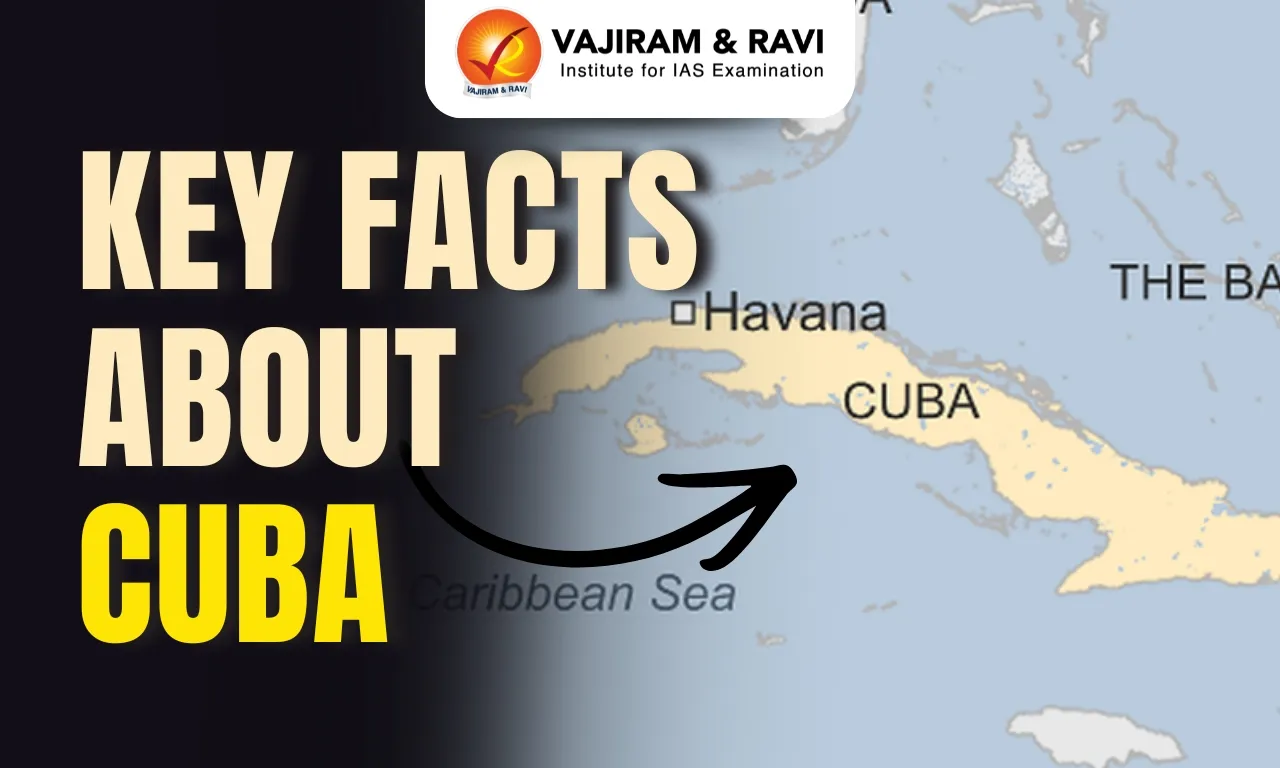
  • Location: It is the largest island country located in the north western Caribbean at the confluence of the Atlantic Ocean, Caribbean Sea and the Gulf of Mexico.
  • Cuba shares its maritime borders with the US, Haiti, Honduras, The Bahamas, Jamaica and Mexico.
  • Water bodies: It is surrounded by the Atlantic Ocean, Cayman Trench, Gulf of Mexico, Straits of Florida and the Caribbean Sea.
  • Capital City: Havana

Geographical Features of Cuba

  • Topography:  It is relatively flat, gradually transitioning into hills.
  • Climate: In Cuba, the climate is tropical, with a dry and relatively cool season from late November to mid-April, and a rainy and muggy season from late April to early November.
  • Mountain ranges: Sierra Maestra.
  • River: The country’s longest river is the Cauto.
  • Lakes and Reservoirs: Laguna de Leche and man-made Zaza Reservoir
  • Natural Resources: Cuba has plenty of natural resources such as nickel, cobalt, petroleum, arable land, forests.

Source: Devd

Cuba FAQs

Q1: What is the capital of Cuba?

Ans: Havana

Q2: What is the currency of Cuba?

Ans: Cuban Peso

Lenacapavir

Lenacapavir

Lenacapavir Latest News

Recently, Zimbabwe has begun rolling out lenacapavir, a long-acting injectable HIV prevention medicine.

About Lenacapavir

  • It is the new long-acting injectable HIV-prevention drug.
  • It is the first twice-yearly injectable pre-exposure prophylaxis (PrEP) for HIV, offering a highly effective, long-acting alternative to daily oral pills.
  • PrEP is a medication that can reduce the risk of HIV infection for individuals who are HIV-negative but are at risk of contracting the virus.
  • The results of two key studies have shown that it helps prevent 99.9 per cent of all HIV transmission.
  • It is developed by Gilead Sciences and marketed under the brand name Yeztugo.

How does Lenacapavir work?

  • Lenacapavir is a capsid inhibitor, a class of drugs that blocks the protein shell (capsid) the HIV virus needs to replicate.
  • Unlike oral PrEP pills that must be taken daily, lenacapavir is administered as an injection once every six months, providing a discreet and highly effective method of prevention.

Source: DTE

Lenacapavir FAQs

Q1: What is Lenacapavir used for?

Ans: Treatment and prevention of HIV

Q2: What is the mechanism of action of Lenacapavir?

Ans: Targets HIV-1 capsid protein

PM Surya Ghar: Muft Bijli Yojana

PM Surya Ghar_ Muft Bijli Yojana

PM Surya Ghar: Muft Bijli Yojana Latest News

Recently, the Union minister said that installation of rooftop solar power systems has crossed 30 lakh households since February 2024 under the central government's PM Surya Ghar: Muft Bijli Yojana.

About PM Surya Ghar: Muft Bijli Yojana

  • It was launched in 2024 with an aim to provide free electricity to households in India.
  • Under the scheme, households will be provided with a subsidy to install solar panels on their roofs.
  • Subsidy: The scheme provides for a subsidy of 60% of the solar unit cost for systems up to 2 kW capacity and 40 percent of additional system cost for systems between 2 to 3 kW capacity. 
  • The subsidy has been capped at 3 kW capacity.
  • Another component of the scheme is the development of Model Solar Village in each district of the country.
    • Under the component Incentives to Local Bodies, the scheme has provision of providing an incentive at Rs 1,000 per rooftop solar installation in the respective jurisdiction of the Urban Local Bodies (ULBs) and Panchayat Raj Institutions (PRIs) at the Gram Panchayat level.
  • Implementing agency: It is implemented by a National programme Implementation Agency (NPIA) at the National level and by the State Implementation Agencies (SIAs) at the state level. 
    • Under the scheme, DISCOMs are designated as State Implementation Agencies (SIAs) responsible for facilitating various measures, including net meter availability, timely inspection, and commissioning of installations. 
    • DISCOMs will receive incentives based on their achievement in the installation of additional grid-connected rooftop solar capacity beyond a baseline level.

Eligibility Criteria for PM Surya Ghar Muft Bijli Yojana

  • The household must be an Indian citizen.
  • The household must own a house with a roof that is suitable for installing solar panels.
  • The household must have a valid electricity connection.
  • The household must not have availed any other subsidy for solar panels.

Source: THBL

PM Surya Ghar: Muft Bijli Yojana FAQs

Q1: What is the primary goal of PM Surya Ghar: Muft Bijli Yojana?

Ans: Provide free electricity to households

Q2: Who is eligible for PM Surya Ghar: Muft Bijli Yojana?

Ans: Indian citizens with a valid electricity connection

Enquire Now