Agray- Anti Submarine Warfare Shallow Water Craft

Agray- Anti Submarine Warfare Shallow Water Craft

Agray- Anti Submarine Warfare Shallow Water Craft Latest News

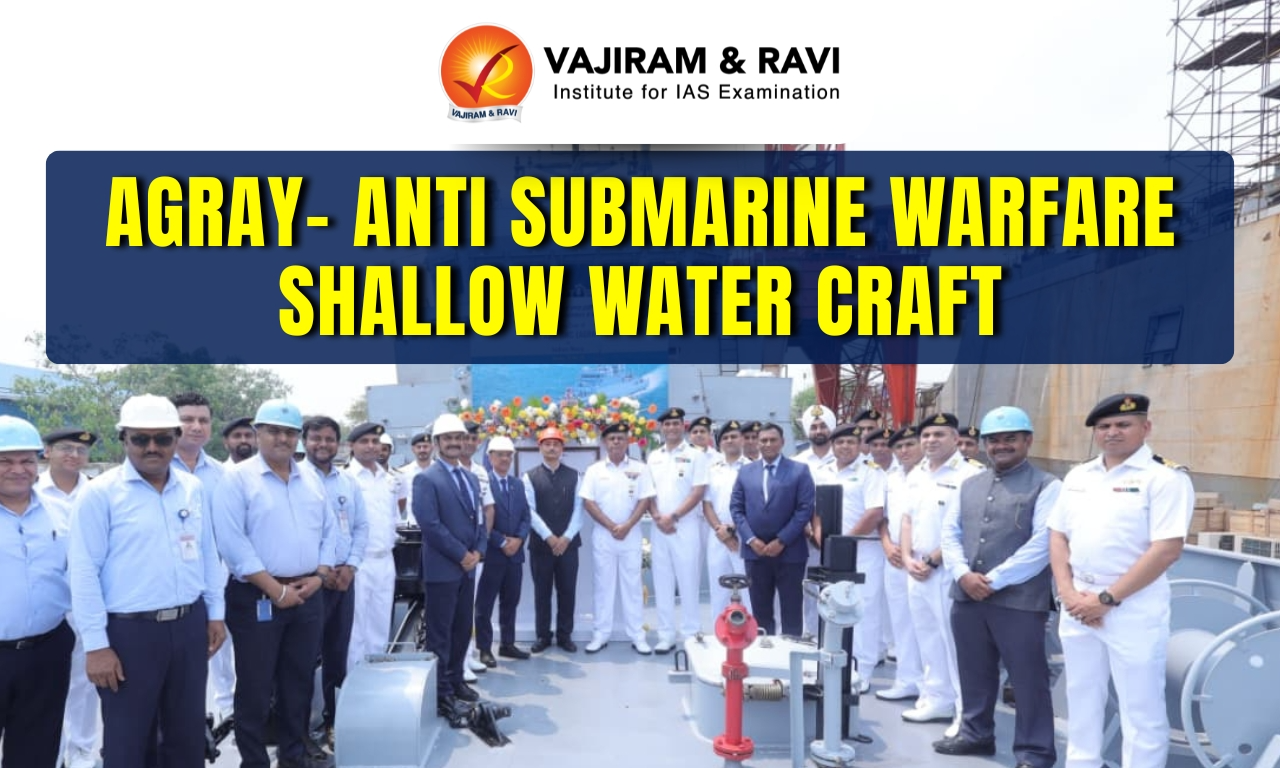
Recently, the Agray - anti-submarine warfare shallow water craft was delivered to the Indian Navy.

About Agray- Anti Submarine Warfare Shallow Water Craft

  • It is the fourth of eight Anti-Submarine Warfare Shallow Water Craft.
  • It is indigenously designed and built by Garden Reach Shipbuilders and Engineers (GRSE), Kolkata.
  • It is a reincarnation of the erstwhile INS Agray, the fourth of the 1241 PE Class of Patrol Vessels, decommissioned in 2017.
  • The ASW SWCs have been designed and constructed by GRSE in compliance with the classification standards of the Indian Register of Shipping (IRS).

Features of Agray- Anti Submarine Warfare Shallow Water Craft

  • Propulsion: Waterjet propulsion—the largest Indian naval warships to use this technology
  • Armaments
    • It is the largest Indian Naval warship propelled by waterjets.
    • It is equipped with state-of-the-art Lightweight Torpedoes, Indigenous Rocket Launchers and shallow water SONAR, enabling effective detection.
  • Sensors: Advanced shallow water SONAR systems
  • Significance: The induction of the ship will further augment the Indian Navy’s anti-submarine and mine-warfare capabilities, as well as coastal surveillance.

Source: PIB

Agray- Anti submarine warfare shallow water craft FAQs

Q1: What is the primary role of the Agray-class ASW craft?

Ans: Anti-submarine warfare

Q2: What is the propulsion system used in ASW SWC?

Ans: Waterjet propulsion

Bhavasagara Referral Centre

Bhavasagara Referral Centre

Bhavasagara Referral Centre Latest News

Recently, the Ministry of Environment, Forest and Climate Change (MoEFCC) has officially designated the Center for Marine Living Resources & Ecology's “Bhavasagara” Referral Centre as a National Repository for Deep-Sea Fauna.

About Bhavasagara Referral Centre

  • It is designated as a National Repository for Deep-Sea Fauna.
  • It was conferred under the provisions of the Biological Diversity Act, 2002.
  • It establishes the Centre as a critical national facility for the preservation, study, and documentation of India's vast deep-sea biological heritage.
  • It currently serves as a vital scientific hub, housing an extensive collection of over 3,500 taxonomically identified and geo-referenced voucher specimens.
  • The collection spans a diverse range of marine life, from invertebrates—including cnidarians, annelids, molluscs, arthropods, and echinoderms—to vertebrates such as elasmobranchs and teleostean fishes.
  • Under the Biological Diversity Act, the Repository is authorized to:
    • Maintain Secure Custody: Preserve representative biological samples as voucher specimens along with critical associated data, such as DNA sequences, for future scientific reference.
    • Hold Type Specimens: Act as the official custodian for any new deep-sea species discovered within Indian waters.
    • Capacity Building: Foster expertise in deep-sea taxonomy, aligning with the goals of the UN Decade of Ocean Science for Sustainable Development (2021–2030).

Source: PIB

Bhavasagara Referral Centre FAQs

Q1: What is the Bhavasagara Referral Centre designated as?

Ans: National Repository for Deep-Sea Fauna

Q2: Under which act is the Bhavasagara Referral Centre recognized?

Ans: Biological Diversity Act, 2002

20 Cities Towards Zero Waste Initiative

20 Cities Towards Zero Waste Initiative

20 Cities Towards Zero Waste Initiative Latest News

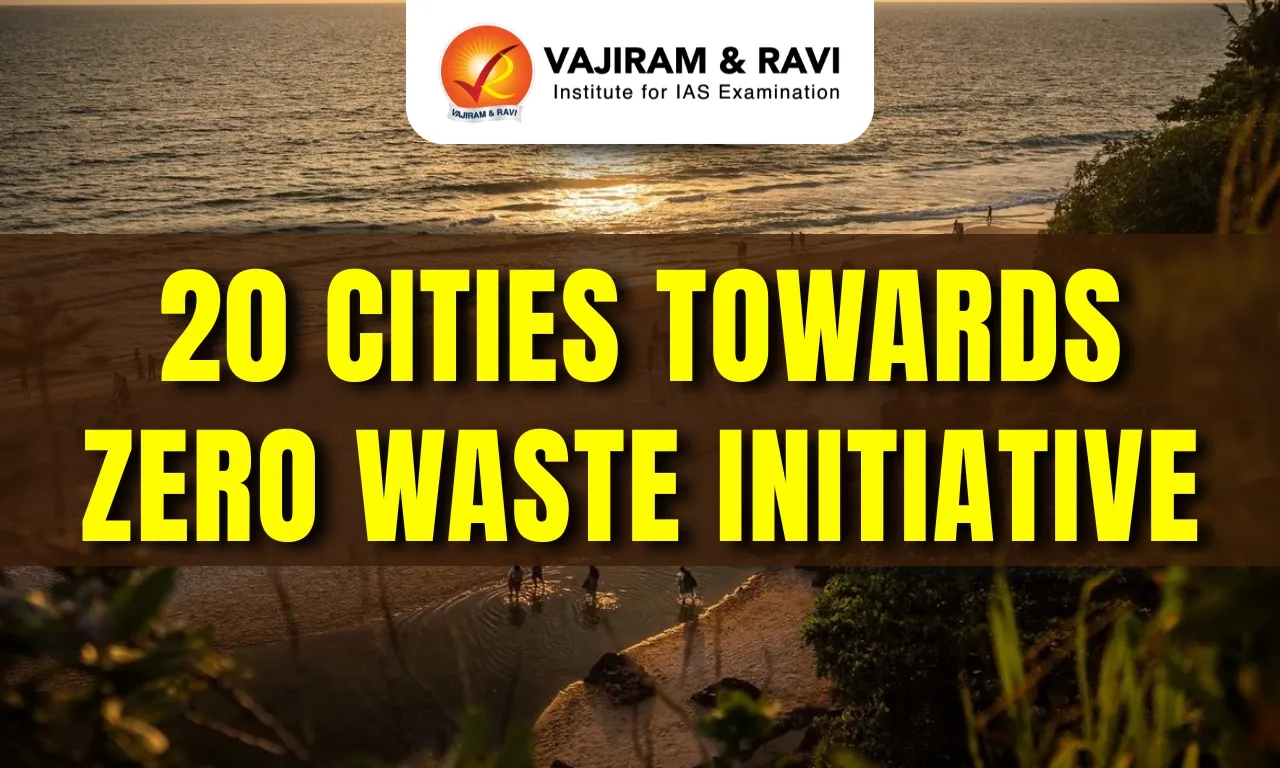
Recently, Varkala has been named in the inaugural 20 Cities Towards Zero Waste initiative.

About 20 Cities Towards Zero Waste Initiative

  • It is an initiative led by the UN Secretary-General’s Advisory Board on Zero Waste, with support from UN-Habitat and the UN Environment Programme (UNEP).
  • It highlights cities demonstrating ambitious and innovative approaches to reducing waste, advancing circular economy solutions, and building more sustainable, resilient, and inclusive urban systems.
  • It aims to
    • Recognize city leadership and innovation
    • Promote exchange of good practices and lessons learned
    • Inspire other cities to accelerate their transition toward zero waste
    • Support implementation of circular economy approaches at the local level

Key Facts about United Nations Environment Programme

  • It is the leading global authority on the environment.
  • It was founded in 1972 after a UN General Assembly resolution.
  • Mandate: It was conceived to monitor the state of the environment and coordinate responses to the world’s greatest environmental challenges. 
  • Headquarters: Nairobi, Kenya.
  • Functions
    • It develops and supports global environmental treaties, such as the CBD, CITES, and Minamata Convention.
    • Hosts secretariats of major environmental conventions and supports the negotiation of new environmental agreements.
    • It publishes authoritative research and assessments, including the Global Environment Outlook and Emissions Gap Report.
    • It supports developing countries with environmental capacity building, funding, and technical assistance.

Source: UNEP

20 Cities Towards Zero Waste Initiative FAQs

Q1: Which Indian city is part of the UN's '20 Cities Towards Zero Waste' initiative?

Ans: Varkala

Q2: What is the primary goal of the 'Cities Towards Zero Waste' initiative?

Ans: To achieve zero waste and promote circular economy

Convention on the Conservation of Migratory Species

Convention on the Conservation of Migratory Species

Convention on the Conservation of Migratory Species Latest News

Recently, at 15th Conference of Parties (COP15) to the Convention on the Conservation of Migratory Species of Wild Animals (CMS) forty new species were added to the protected list category.

About Convention on the Conservation of Migratory Species

  • It is also known as the Bonn Convention, is an environmental treaty under the aegis of the United Nations Environment Programme. 
  • It provides a global platform for the conservation and sustainable use of migratory animals and their habitats. 
  • It was signed in Bonn, Germany, on 23 June 1979.
  • It is the only global and UN-based intergovernmental organisation established exclusively for the conservation and management of terrestrial, aquatic and avian migratory species throughout their range.
  • The parties to the convention acknowledge the importance of conserving migratory species, and the need to pay special attention to species whose conservation status is unfavourable.
  • Activities by CMS Parties may range from legally binding treaties (called Agreements) to less formal instruments, such as Memoranda of Understanding.
  • The Conference of Parties (COP) is the decision-making organ of this convention. 
  • It has two Appendices. 
    • Appendix I lists endangered migratory species and includes prohibitions regarding the take of these species.
    • Appendix II lists species that have an ‘unfavourable conservation status’ (as per the conditions set out in the Convention) and encourages range states to draft range-wide agreements for conservation and management o

Convention on the Conservation of Migratory Species FAQs

Q1: What is the primary objective of the Convention on the Conservation of Migratory Species (CMS)?

Ans: To conserve migratory species throughout their range

Q2: When was the Convention on the Conservation of Migratory Species (CMS) signed?

Ans: 1979

PM e-Drive Scheme

PM e-Drive Scheme

PM e-Drive Scheme Latest News

Recently, the Ministry of Heavy Industries has extended subsidies for electric two-wheelers till 31 July 2026, and for electric rikshaw and electric carts till 31 March 2028 under the PM E- DRIVE scheme.

About PM e-Drive Scheme

  • The PM E-DRIVE (Electric Drive Revolution in Innovative Vehicle Enhancement) scheme is a flagship initiative launched in October 2024.
  • It came into effect from October 1, 2024.
  • Its primary aim is to accelerate the adoption of electric vehicles (EVs), establish charging infrastructure, and build a robust EV manufacturing ecosystem in the country.
  • The key objective is to speed up the transition to EVs by offering upfront incentives for EV purchases and encouraging the development of charging infrastructure. 
  • The PM E-DRIVE scheme to be implemented through the following key components:
    • Subsidies: Demand incentives to be provided for electric vehicles such as e-2 wheelers (e-2W), e-3 wheelers (e-3W), e-ambulances, e-trucks, and other emerging categories of EVs.
    • Grants for creation of capital assets: Funding to be provided for the acquisition of electric buses (e-buses), the establishment of a comprehensive network of charging stations, and the upgrading testing facilities of the Ministry of Heavy Industries (MHI).
    • Administration of the Scheme including IEC (Information, Education & Communication) activities and fee for project management agency (PMA).
  • Under this, states are encouraged to offer additional fiscal and non-fiscal incentives, such as road tax waivers, reduced toll and parking fees, and permit exemptions, to further promote EV adoption. 
  • The scheme will be overseen by an inter-ministerial body, the Project Implementation and Sanctioning Committee (PISC), chaired by the Secretary of Heavy Industries. 
    • The PISC will be responsible for monitoring progress and ensuring the scheme’s successful rollout.
    • It will also have the authority to address any challenges, including revising incentives, increasing the number of e-buses, and approving guidelines for testing agencies.
  • To qualify for the PM E-DRIVE incentives, vehicles must be registered as “Motor Vehicles” under the Central Motor Vehicle Rules (CMVR) and equipped with advanced battery technology.

Source: LM

PM e-Drive Scheme FAQs

Q1: What is the primary objective of the PM e-Drive Scheme?

Ans: To accelerate the adoption of electric vehicles

Q2: Which vehicles are eligible for subsidy under the PM E-Drive Scheme?

Ans: Electric two-wheelers and three-wheelers and Electric ambulances and trucks

Navegaon-Nagzira Tiger Reserve

Navegaon-Nagzira Tiger Reserve

Navegaon-Nagzira Tiger Reserve Latest News

The Navegaon Nagzira Tiger Reserve (NNTR) in Maharashtra’s Gondia will get control of the buffer notified area in its vicinity from April 1.

About Navegaon-Nagzira Tiger Reserve

  • Location: It is located in the state of Maharashtra.
  • It is located in the heart of the central Indian Tiger Landscape, which contributes almost 1/6 of the total tiger population of the country.
    • It was declared a tiger reserve in 2013; it is the fifth tiger reserve in Maharashtra.
  • It comprises the notified areas of Nawegaon National Park, Nawegaon Wildlife Sanctuary, Nagzira Wildlife Sanctuary, New Nagzira Wildlife Sanctuary, and Koka Wildlife Sanctuary.
  • It has linkages with Kanha, Pench, and Tadoba Tiger Reserves.
  • Topography: The topography is undulating, and the highest point, viz. ‘Zenda Pahad’, is around 702 m above Mean Sea Level.
  • Vegetation: Southern Tropical Dry Deciduous
  • Flora: There are 364 species of plants, and the major trees are: Terminalia tomentosa, Lagerstroemia parviflora, Anogeisus lotifolia, Pterocarpus marsupium, Diospyrus melanoxylon, Ougeinia oogenesis, etc.
  • Fauna: The major wild animals are: Tiger, Panther, Small Indian Civet, Palm Civet, Wolf, Jackal, Wild Dog, Sloth Bear, Ratel, Common Giant Flying Squirrel, Gaur, Sambar, Chital, Four Horned Antelope, Mouse Deer, and Pangolin.

Source: TP

Navegaon-Nagzira Tiger Reserve FAQs

Q1: When was Navegaon-Nagzira Tiger Reserve notified as a Tiger Reserve?

Ans: 2013

Q2: What is the primary objective of Navegaon-Nagzira Tiger Reserve?

Ans: To conserve tigers and other wildlife

Electronics Components Manufacturing Scheme

Electronics Components Manufacturing Scheme

Electronics Component Manufacturing Scheme Latest News

Recently, the government approved the 29 applications under the fourth tranche of the Electronics Component Manufacturing Scheme.

About Electronics Component Manufacturing Scheme

  • It is the first dedicated production-linked incentive (PLI) scheme to promote the manufacturing of select passive electronic components, including resistors, capacitors, speakers, microphones, special ceramics, relays, switches, and connectors. 
  • Objective: To develop a robust component manufacturing ecosystem by attracting investments (global / domestic) across the value chain by integrating its domestic electronic industry with the Global Value Chains (GVCs).
  • The scheme will offer three incentive structures
    • Turnover-linked incentive (based on revenue)
    • Capex-linked incentive (for investments in plants & machinery)
    • Hybrid incentive model (a combination of both)
  • Incentives for incremental investments and turnover range from 1–10% depending on the year and the component.
  • Employment generation will be a mandatory requirement for all applicants, including both component manufacturers and capital equipment producers.
  • Tenure: This scheme has a tenure of six years, with a one-year gestation period.
  • The scheme focuses particularly on passive electronic components. In contrast, active components fall under the purview of the India Semiconductor Mission (ISM).
  • Significance: This scheme is set to benefit a number of industries, such as automobiles, consumer electronics, and electronics.

Source: PIB

Electronics Component Manufacturing Scheme FAQs

Q1: What is the primary objective of the Electronics Component Manufacturing Scheme?

Ans: To promote electronics manufacturing in India

Q2: Under which scheme has the Electronics Component Manufacturing Scheme been launched?

Ans: PLI Scheme

Jan Samarth Portal

Jan Samarth Portal

Jan Samarth Portal Latest News

Recently, over 41 lakh applications amounting to ₹1,06,306 Crores processed through Jan Samarth portal.

About Jan Samarth Portal

  • It was launched on 6th June 2022.
  • It was conceptualized with the twin objectives;
    • Increasing the reach of the Government sponsored schemes.
    • Streamlining the credit delivery process for all the stakeholders, through a multitude of credit linked Government schemes.
  • The portal facilitates ease of access to all beneficiaries, financial institutions, Central/State Government Agencies, and Nodal Agencies.

Features of the Jan Samarth Portal

  • It is a digital marketplace with front-end user interface for beneficiaries, integrated with a wide range of centralized data sources. 
  • It eases the loan application and disbursement process as the applicant can upload his application and the rule engine for approval of the applications is inbuilt.
  • Applicants can apply for a loan on the portal which is available on a 24/7 basis.
  • It provides a single-window facility for 15 Credit-linked Central Government Schemes application submissions and 254 Member Lending Institutions (including all Public Sector Banks) to choose from.
  • The portal will check eligibility, give in-principle sanction and send the application to the selected Bank branch.
  • It will also keep the beneficiaries updated at each stage of the journey, without necessitating multiple physical visits to bank branches.
  • It is available in 8 different languages catering to the credit needs of a diverse range of beneficiaries. 
  • It has a dedicated grievance redressal channel for both beneficiaries and Banks.

Source: PIB

Jan Samarth Portal FAQs

Q1: What is the primary objective of the Jan Samarth Portal?

Ans: To provide a single platform for credit-linked government schemes

Q2: What is the benefit of using the Jan Samarth Portal?

Ans: Single platform for multiple schemes

Kariba Dam

Kariba Dam

Kariba Dam Latest News

A 500MW Floating Solar Plant being designed by Green Hybrid Power in partnership with the Intensive Energy User Group is to be installed at Kariba Dam in Zimbabwe. 

About Kariba Dam

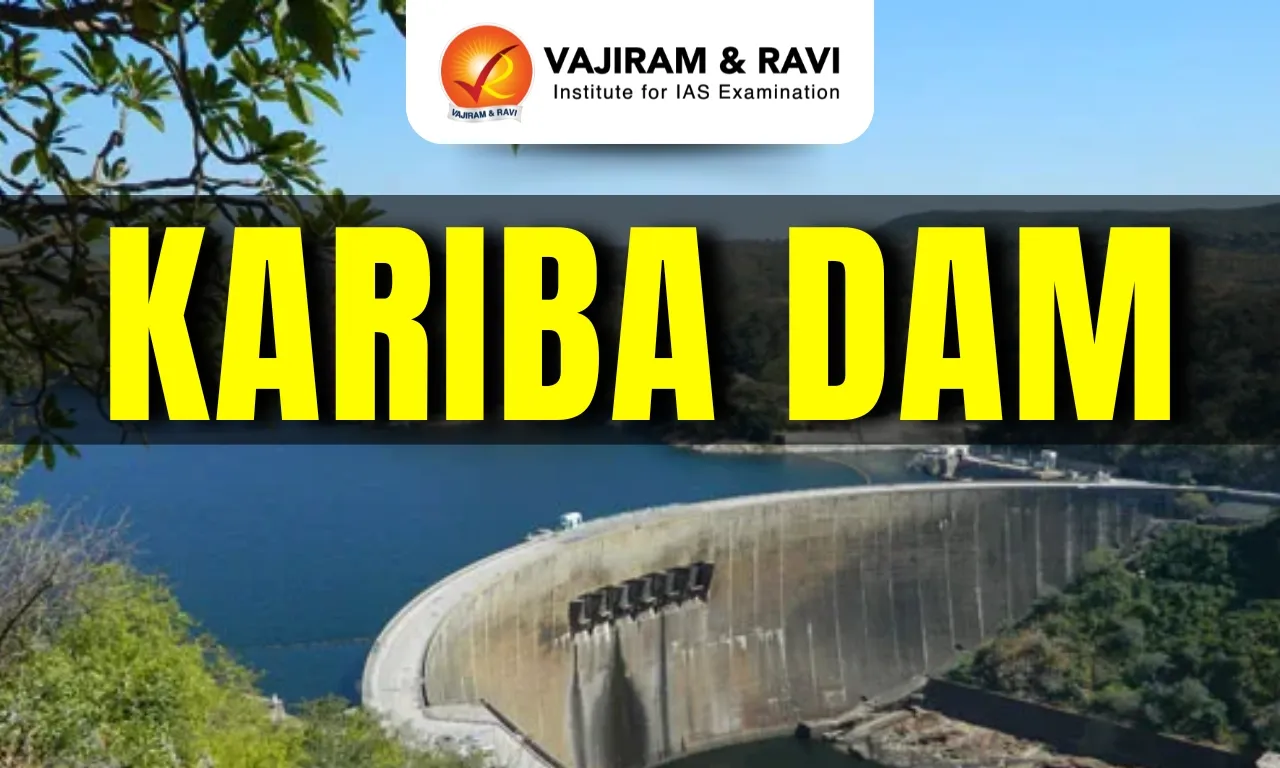
  • Location: It is a concrete arch dam across the Zambezi River at Kariba Gorge,
  • It is on the border between Zambia and Zimbabwe.
  • The construction of the dam was completed in 1959.
  • The 128-metre-high double-curvature concrete arch dam provides critical electricity to both countries. 
  • It had created the world’s largest human-made lake by volume, Lake Kariba.

Key Facts about Zambezi River

  • It is Africa’s 4th longest river and the continent’s longest east-flowing stream.
  • Course
    • It starts off in Angola’s southern highlands, at the source of a river called the Lungwebungu.
    • It flows for about 3,421 kilometers through Angola, Zambia, Namibia, Botswana, Zimbabwe, and Mozambique before emptying into the Indian Ocean.
  • Waterfalls: Victoria Falls and Chavuma Falls are on this river.
  • Dams: The Cohara Bassa and Kariba Dams, two of Africa’s major hydroelectric power sources, are located along the Zambezi’s course.
  • Tributaries: The main tributaries of the Zambezi River include the Shire, Kafue, Luangwa, Kabompo, and Cuando (Kwando) rivers.

Source: DTE

Kariba Dam FAQs

Q1: On which river is the Kariba Dam built?

Ans: Zambezi River

Q2: What is the primary purpose of the Kariba Dam?

Ans: Hydroelectric power generation

INS Dunagiri

INS Dunagiri

INS Dunagiri Latest News

Recently, INS Dunagiri was delivered to the Indian Navy.

About INS Dunagiri

  • It is the fifth ship of Nilgiri Class (Project 17A).
  • It was designed by Warship Design Bureau (WDB).
  • It was built at Garden Reach Shipbuilding and Engineers Ltd (GRSE).
  • It is the fifth P17A ship getting delivered to the Indian Navy.
  • It is a reincarnation of the erstwhile INS Dunagiri, a Leander-class frigate, that was part of the Indian Navy.

Features of INS Dunagiri

  • Propulsion: These ships are configured with Combined Diesel or Gas (CODOG) propulsion plants.
    • Comprising a diesel engine and a gas turbine that drive a Controllable Pitch Propeller (CPP) on each shaft, and state-of-the-art Integrated Platform Management System (IPMS)
  • Armaments: It comprises BrahMos SSM, MFSTAR and MRSAM complex, 76mm SRGM, and a combination of 30 mm and 12.7 mm close-in weapon system, along with rocket and torpedoes for anti- submarine warfare.

Source: PIB

INS Dunagiri FAQs

Q1: What is the name of the peak after which INS Dunagiri is named?

Ans: Dunagiri peak

Q2: What is the class of INS Dunagiri?

Ans: Nilgiri-class frigate

Enquire Now