Pradhan Mantri Gram Sadak Yojana

Pradhan Mantri Gram Sadak Yojana

Pradhan Mantri Gram Sadak Yojana Latest News

Recently, the Union Cabinet has given its approval for the continuation of Pradhan Mantri Gram Sadak Yojana-III (PMGSY-III) beyond March 2025 upto March 2028. 

About Pradhan Mantri Gram Sadak Yojana

  • It is a flagship rural development programme of the Government of India, launched on 25th December, 2000.
  • Objectives: Providing all-weather road connectivity to unconnected habitations in rural areas by way of a single all-weather road, to the eligible unconnected habitations of designated population size
  • Eligibility Criteria of PMGSY Scheme
    • The eligibility criteria under the PMGSY scheme were primarily based on population size and connectivity status.
    • In plain areas, habitations with a population of 500 or more were eligible, provided they were unconnected.
    • For regions in North-Eastern states, Himalayan states, and Himalayan Union Territories, the threshold was reduced to a population of 250 or more, as per the 2001 Census.
  • The Pradhan Mantri Gram Sadak Yojana is implemented by the following agencies 
    • State Governments / UT Administrations will designate Executing Agencies to implement the programme.
    • At the District level, the programme will be planned, coordinated, and implemented through Programme Implementation Units (PIUs).
    • PIUs will be manned by competent technical personnel.
    • State Governments will establish suitable linkages with District Rural Development Agencies (DRDAs).
    • Funds will be released to DRDAs
  • Nodal Ministry: Ministry of Rural Development

Source: PIB

Pradhan Mantri Gram Sadak Yojana FAQs

Q1: What is the main objective of PMGSY?

Ans: Provide all-weather road connectivity to unconnected rural habitations

Q2: PMGSY is a scheme of which ministry?

Ans: Ministry of Rural Development
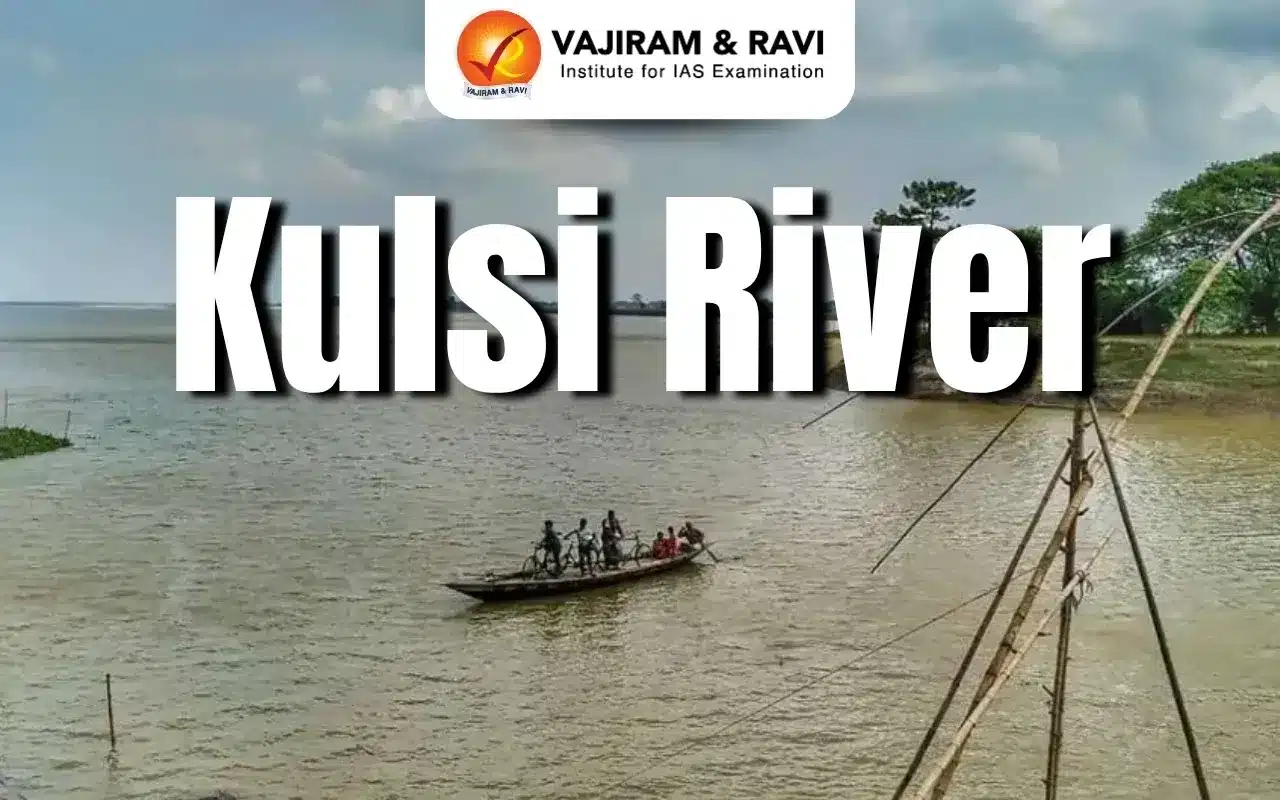
Kulsi River

Kulsi River

Kulsi River Latest News

A proposed hydropower project on the Kulsi River is facing opposition from local residents.

About Kulsi River

  • It is a south-bank tributary of the Brahmaputra River.
  • Course
    • It is composed of three rivers, namely Khri, Krishniya, and Umsiri, all of which originate from the West Khasi hill ranges of Meghalaya from an elevation of over 1800 metres and flow north. 
    • The river is known as Khri in the upper catchments, and after being joined by two other tributaries, namely Krishniya and Umsiri, within the Khasi hills in Meghalaya, it flows northwest and enters Assam at Ukium.
    • After that it flows north up to Kulsi village through the plains of the Kamrup District of Assam. 
    • Finally, it outflows into the Brahmaputra near Nagarbera. 
  • The total length of Kulsi is about 220 km, out of which 100 km is in Meghalaya and the rest, 120 km, is in Assam.
  • It is considered one of the last refuges of the endangered Gangetic dolphin (Platanista gangetica gangetica) in Assam.

Source: ETVB


Kulsi River FAQs

Q1: Kulsi River is a tributary of which river?

Ans: It is a south-bank tributary of the Brahmaputra River.

Q2: From which hills do the source streams of the Kulsi River originate?

Ans: West Khasi hill ranges of Meghalaya

Q3: What are the three rivers that form the Kulsi River?

Ans: Khri, Krishniya, and Umsiri.

Q4: What is the total length of the Kulsi River?

Ans: The total length of Kulsi is about 220 km, out of which 100 km is in Meghalaya and the rest, 120 km, is in Assam.

National Mineral Exploration and Development Trust

National Mineral Exploration and Development Trust

National Mineral Exploration and Development Trust Latest News

Recently, in its 23rd report on the National Mineral Exploration and Development Trust (NMEDT), the Standing Committee on Coal, Mines and Steel said offshore exploration presents a “significant opportunity” to harness largely untapped seabed minerals. 

About National Mineral Exploration and Development Trust

  • It is set up by the Central Government for the purposes of regional and detailed exploration of minerals using the funds accrued to it and in such manner as prescribed by the Central Government.
  • It was established under the Mines and Minerals (Development & Regulation) Amendment Act, 2015, (MMRDA)
  • Structure: It has a two-tier structure.
    • Apex Body: It is the Governing Body, chaired by the Minister of Mines. It holds the overall control of the Trust.
    • Executive Committee: It is chaired by the Secretary, Ministry of Mines, administers and manages its activities.
  • Funding: To implement mandated activities an NMET Fund has been established
    • The NMET Fund receives money from holders of mining lease or a prospecting license-cum-mining lease, an amount equivalent to two percent of royalty paid in terms of the Second Schedule of the MMDR Act.

Functions of NMET

  • Funding special studies and projects designed to identify, explore, extract, beneficiate and refine deep-seated or concealed mineral deposits;
  • Undertaking studies for mineral development, sustainable mining, adoption of advanced scientific and technological practices and mineral extraction metallurgy;
  • Detailed and regional exploration for strategic and critical minerals
  • Facilitating a national core repository for encouraging research in earth sciences and for evaluation of the mineral prospects

Source: BS

National Mineral Exploration and Development Trust FAQs

Q1: NMET was established under which Act?

Ans: MMDR Act, 1957

Q2: Who chairs the Governing Body of NMET?

Ans: Union Minister of Mines

Amchang Wildlife Sanctuary

Amchang Wildlife Sanctuary

Amchang Wildlife Sanctuary Latest News

The Gauhati High Court recently directed the Assam govt to respond to a petition alleging that the forest department floated an e-tender for felling trees in Amchang Wildlife Sanctuary without obtaining mandatory forest clearance from the central govt.

About Amchang Wildlife Sanctuary

  • It is located in the eastern fringe of Guwahati city in Assam.
  • The sanctuary was formed by merging three reserve forest areas: South Amchang Reserve Forest, Amchang Reserve Forest, and Khanapara Reserve Forest.
  • It stretches from the Brahmaputra River in the north to the hilly forests of Meghalaya in the south, forming a continuous forest belt through Meghalaya’s Maradakdola Reserve Forests.
  • Vegetation: Khasi Hill Sal Forests, East Himalayan Mixed Deciduous Forest, Eastern Alluvial Secondary Semi-evergreen Forests, and East Himalayan Sal Forests.
  • Flora: The forest is dominated by teak, white iris, axle wood, terminalia, wild java plum, elephant rope tree, beechwood, bitter champa, black dammer tree, cluster fig, and arjun trees.
  • Fauna
    • Among the mammals found here are Asian elephants, leopards, fishing cat, Asian palm civet, tadpole, different species of monkeys, gaur or Indian bison, sambar, barking deer, porcupines, mongooses, wild pigs, rabbit, flying squirrel, and otter. 
    • It shelters both resident and migratory birds such a jungle fowl, doves, egrets, teals, partridges, woodpeckers, hornbills, kingfishers, bulbuls, and many others.
    • Tree yellow butterflies (gancana harina) are also found at the Amchang wildlife sanctuary. These butterflies are indigenous to Thailand, Malaysia, Singapore, and Northeast India.

Source: MSN


Amchang Wildlife Sanctuary FAQs

Q1: Where is Amchang Wildlife Sanctuary located?

Ans: On the eastern fringe of Guwahati city in Assam.

Q2: Which major river lies to the north of Amchang Wildlife Sanctuary?

Ans: The Brahmaputra River

Q3: Which tree species dominate the flora of Amchang Wildlife Sanctuary?

Ans: Teak, arjun, terminalia, and wild java plum.

Fructose

What is Fructose

Fructose Latest News

A recent study presents fructose as a significant biological driver of conditions such as obesity, metabolic syndrome, and related chronic illnesses, challenging conventional understandings of dietary sugars.

About Fructose

  • It is a member of a group of carbohydrates known as simple sugars, or monosaccharides. 
  • It is one of the three most common natural monosaccharides. (The other two are glucose and galactose.) 
  • Chemical Formula: C₆H₁₂O₆ (same as glucose but with a different structure).
  • Fructose is the most water-soluble monosaccharide.
  • It is commonly known as fruit sugar. Fructose naturally occurs in fruits, vegetables, honey, sugar cane, and sugar beets. 
  • Fructose is significantly sweeter than glucose, making it ideal for use in beverages, desserts, and snacks.
  • Fructose and glucose combine to form the disaccharide sucrose, which we know as common sugar/table sugar.
  • However, fructose needs to be converted into glucose by the liver before it can be used by the body.
  • Unlike other sugars, fructose does not require insulin to be absorbed and therefore has a low impact on blood glucose levels.
  • When the digestive system doesn't absorb fructose properly, it can cause stomach pain, bloating, diarrhea and gas. This is known as fructose intolerance.

Source: OLI


Fructose FAQs

Q1: What is Fructose?

Ans: It is a simple sugar (monosaccharide).

Q2: Is fructose sweeter than glucose?

Ans: Yes.

Q3: What is formed when fructose combines with glucose?

Ans: Sucrose (table sugar).

Q4: Where is fructose converted into glucose in the body?

Ans: In the liver.

Q5: What are the symptoms of fructose intolerance?

Ans: Stomach pain, bloating, diarrhea, and gas.

Dung Beetle

Dung Beetle

Dung Beetle Latest News

Scientists have discovered that dung beetles roll in remarkably straight lines—even in complete darkness by using the band of light created by our galaxy, the Milky Way.

About Dung Beetle

  • The Dung Beetle, scientifically known as the Scarabaeidae family within the Animal Kingdom’s order Coleoptera.
  • Appearance
    • They are robust, compact insects known for their hard, protective exoskeletons and strong, clawed legs adapted for digging and rolling dung.
    • They vary in color, with some species displaying dull, black or brown hues, while others exhibit metallic shades of blue, green, or copper.
  • Distribution: Dung beetles are found worldwide, on every continent except Antarctica.
  • Habitat: They live in habitats that range from desert to forest.
  • They feed on the feces of large herbivores during both their larval and adult stages. 
  • Dung beetles span three main lifestyles: rollers (ball-makers), tunnelers (bury beneath), and dwellers (live in the pat).
  • Several dung beetles navigate using celestial cues; some use the Milky Way as an orientation reference during straight-line rolling.
  • Many scarabs have fan-like (lamellate) antennae that open to sample odors-useful for locating fresh dung fast.
  • Ecological Role: They play major ecological roles in nutrient cycling, soil aeration, seed dispersal, and parasite/flies suppression.

Source: IE


Dung Beetle FAQs

Q1: Dung beetles belong to which insect family?

Ans: Scarabaeidae

Q2: What is the main ecological role of dung beetles?

Ans: Decomposition of animal dung & nutrient cycling

Bharat Maritime Insurance Pool

Bharat Maritime Insurance Pool

Bharat Maritime Insurance Pool Latest News

Recently, the union government took a decisive step to shield its seaborne trade from global disruptions with the creation of the Bharat Maritime Insurance Pool (BMI Pool).

About Bharat Maritime Insurance Pool

  • It is a new domestic maritime insurance scheme designed to safeguard the country's shipping and trade interests during periods of global instability.
  • It is a Centre-backed mechanism designed to ensure uninterrupted and affordable maritime insurance coverage.
  • It is backed by a sovereign guarantee of Rs 12,980 crore.
  • The BMI Pool will provide insurance support to Indian-flagged vessels, Indian-controlled ships, and vessels carrying cargo to or from India, including those passing through volatile maritime routes.
  • It will cover a wide range of risks, including hull and machinery, cargo, protection and indemnity, and war risk insurance.
  • The BMI Pool will initially run for 10 years, with the possibility of a five-year extension.
  • Significance: It is expected to strengthen India’s self-reliance in marine insurance, build domestic expertise in underwriting and claims management, and ensure continuity of coverage in case of global disruptions or sanctions. 

Source: FE

Bharat Maritime Insurance Pool FAQs

Q1: What is the sovereign guarantee amount for BMI Pool?

Ans: ₹12,980 crore

Q2: BMI Pool is approved for how many years initially?

Ans: 10 years, extendable by 5 more years

Dalma Wildlife Sanctuary

Dalma Wildlife Sanctuary

Dalma Wildlife Sanctuary Latest News

Recently, a herd of 38 elephant have returned to the Dalma Wildlife Sanctuary after nearly three years.

About Dalma Wildlife Sanctuary

  • Location: It is located in the state of Jharkhand.
  • It is situated around the Dalma Hills on the Chottanagpur Plateau.
  • The Sanctuary gets its name from the “Dalma mai” a local goddess who is revered and worshipped by the local people and the people of adjoining villages of Dalma. 
  • Terrain: The terrain here is hilly and rocky, with dense forests and grasslands. 
  • River: The entire forest of Dalma Sanctuary falls in the catchment of the Subarnarekha River.
  • It features two prominent waterfalls, Sitaguldi and Dassam.
  • Vegetation: The forests of Dalma come under the category “Dry peninsular Sal” and “Northern dry mixed deciduous Forest“.
  • Flora: Medicinal plants like Ananatmula, Satawari, Sarpgandha, etc. are abundant in the sanctuary. 
  • Various types of trees, climbers, herbs, shrubs, and orchids are found here. 
  • Fauna:  Besides elephants, the sanctuary has a considerable population of other wildlife like barking deer, wild boar, giant squirrel, porcupine, pangolin, sloth bear, etc.

Source: AM

Dalma Wildlife Sanctuary FAQs

Q1: What type of forest found in Dalma WLS?

Ans: Dry Peninsular Sal & Northern Dry Mixed Deciduous

Q2: Dalma Wildlife Sanctuary is famous for which animal?

Ans: Indian Elephant

Glutathione

What is Glutathione

Glutathione Latest News

Researchers recently discovered glutathione's key part in maintaining the smooth operations of a protein-producing hub in the cell called the endoplasmic reticulum (ER).

About Glutathione

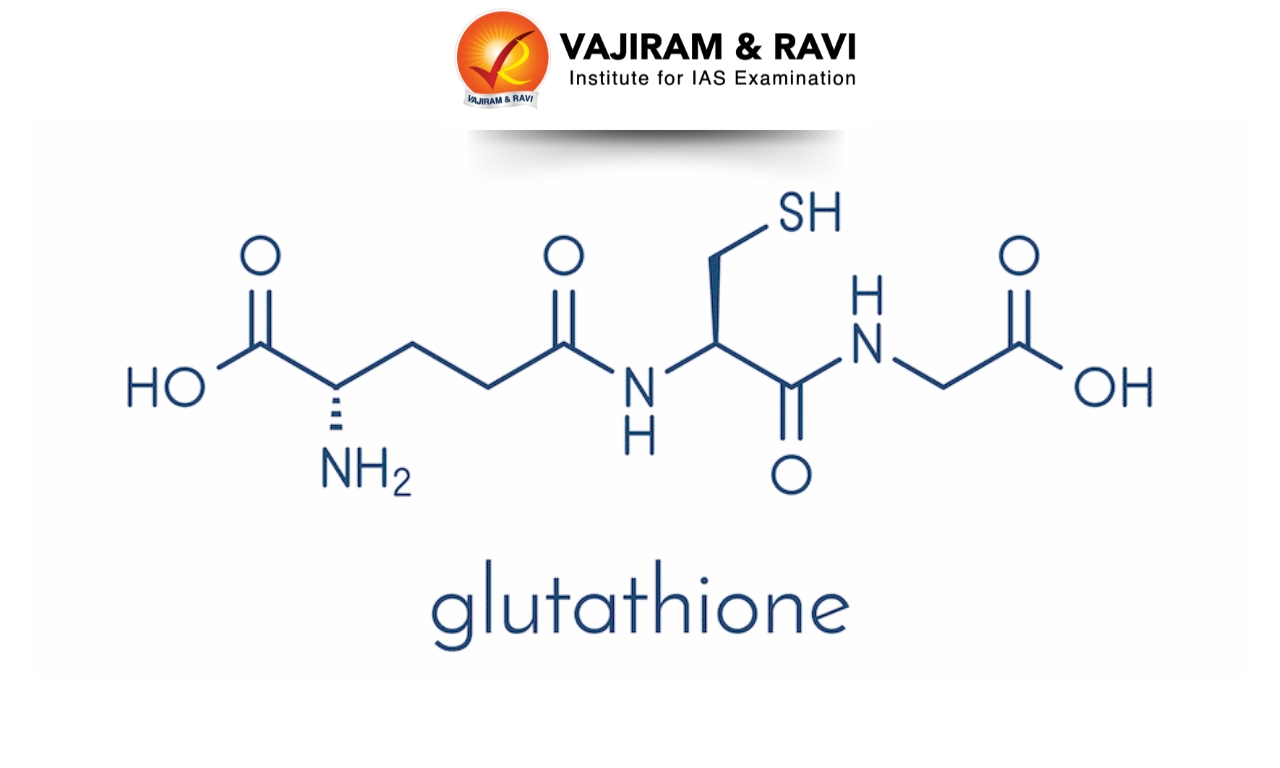
  • Glutathione is an antioxidant produced in the body through enzymatic reactions.
  • It is a tripeptide consisting of three amino acids (glutamate, cysteine, and glycine) and is naturally produced in the liver.
  • These amino acids that make up glutathione are non-essential amino acids that our body can produce on its own when needed. 
  • In addition to being produced naturally by the body, glutathione can be given intravenously, topically, or as an inhalant. It’s also available as an oral supplement in capsule and liquid form.
  • Some of the most abundant food sources of glutathione include cabbage, Brussels sprouts, garlic, onions, broccoli, and cauliflower. 
  • Benefits:
    • Glutathione is often called the “master antioxidant” because of its crucial role in protecting and detoxifying cells.
    • It is involved in tissue building and repair, making chemicals and proteins needed in the body, and in immune system function. 
    • It also can play a role in treating certain genetic conditions.
  • Glutathione levels in the body may be reduced by a number of factors, including poor nutrition, environmental toxins, and stress. Its levels also typically decline with age.

Source: PHYS


Glutathione FAQs

Q1: What is Glutathione?

Ans: It is an antioxidant produced in the body.

Q2: How is glutathione produced in the body?

Ans: Through enzymatic reactions.

Q3: Which three amino acids make up glutathione?

Ans: Glutamate, cysteine, and glycine.

Q4: Where is glutathione mainly produced in the body?

Ans: In the liver.

Q5: What role does glutathione play in the body?

Ans: Tissue building, repair, and immune function.

New Species of Jumping Spiders

New Species of Jumping Spiders

Jumping Spiders Latest News

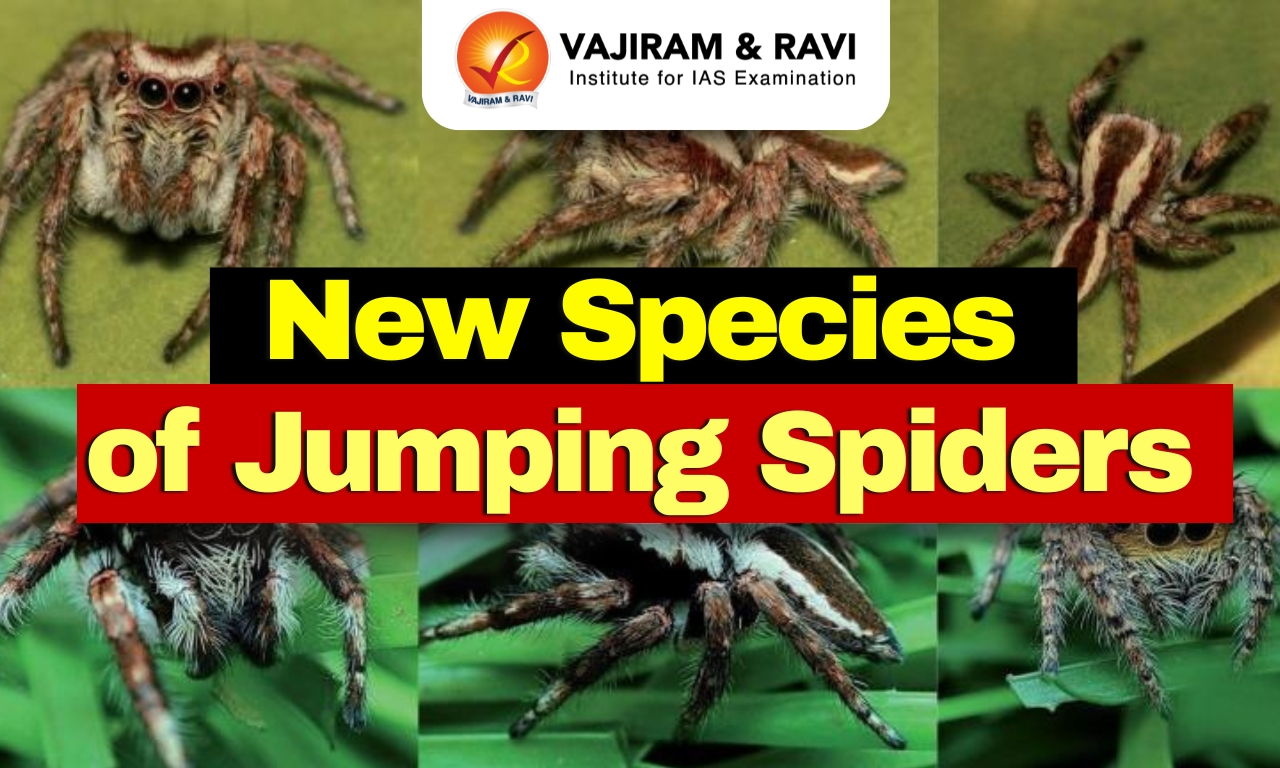
A team of scientists recently discovered two new species of jumping spiders named Mogrus shushka and Mogrus pune, thriving in the country's drylands and urban green spaces.

About Mogrus shushka and Mogrus pune

  • These are two newly discovered arachnids belonging to the genus Mogrus,  a group of medium-sized jumping spiders typically found in the arid regions of Africa, Europe, and Asia.
  • Mogrus shushka:
    • It was identified in Desert National Park, Rajasthan, a region better known for its sand dunes and iconic desert wildlife. 
    • Derived from the Sanskrit word shushka for 'dry,' the name reflects the extreme, arid conditions in which the spider thrives. 
    • It is highly adapted to intense heat, low humidity, and sandy terrain, conditions that define the Thar desert.
    • Males of M. shushka stand out from their closest relative, M. cognatus, by having a distinct triangular-shaped bump on their mating appendage, rather than a thumb-shaped one. 
    • The females feature a deep, semi-circular depression on their underside with short, closely spaced internal ducts. 
  • Mogrus pune:
    • It was discovered in the Alfa Laval Biodiversity Park in Maharashtra. It was named after the city of Pune.
    • Male M. pune can be easily distinguished by a heart-shaped bump on its reproductive organ and uniquely curved structures, while the female possesses a distinctively wide and membranous central depression.

Source: RM


Jumping Spiders FAQs

Q1: What are Mogrus shushka and Mogrus pune?

Ans: They are newly discovered species of jumping spiders.

Q2: Where was Mogrus shushka discovered?

Ans: It was identified in Desert National Park, Rajasthan.

Q3: Where was Mogrus pune discovered?

Ans: It was discovered in the Alfa Laval Biodiversity Park in Maharashtra.

Q4: What is a distinguishing feature of male Mogrus pune?

Ans: A heart-shaped bump on its reproductive organ.

Enquire Now