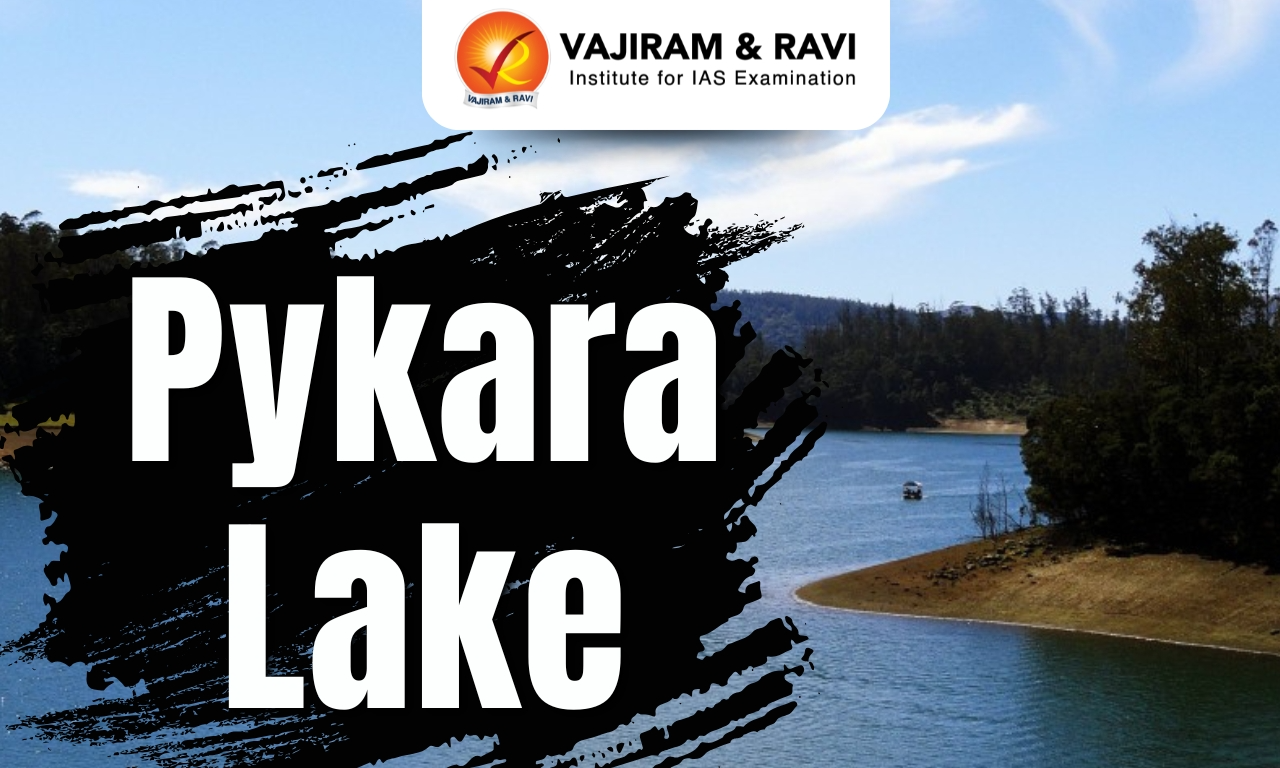
Pykara Lake

Pykara Lake

Pykara Lake Latest News

The Madras High Court has refused to lift the temporary stay on operating boating services for tourists on Pykara Lake in the Nilgiris district, Tamil Nadu.

About Pykara Lake

  • It is situated at a distance of about 20 km from Ooty, in the Nilgiri district of Tamil Nadu.
  • It is formed as a result of the construction of the Pykara Dam over the Pykara River.
    • The Pykara River, which originates from the Mukurthi peak, is the largest river in the district and is revered by the Todas, an Adivasi community, who consider it to be sacred. 
  • The dam also has a powerhouse, which is one of the oldest power plants in South India and is generating about 60 megawatts of electricity.
  • A few hundred meters north of the lake, the river tumbles down the rocks to form the famous Pykara Falls.
    • Pykara Falls consists of two cascades that fall from a height of about 55 meters and 61 meters, respectively. 
  • The lake is surrounded by the thick forest of Mukurthi National Park (MNP). As part of the Western Ghats, it MNP has been a UNESCO World Heritage Site since 1st July 2012.

Source: NIE

Pykara Lake FAQs

Q1: Where is Pykara Lake located?

Ans: It is situated at a distance of about 20 km from Ooty, in the Nilgiri district of Tamil Nadu.

Q2: Pykara Lake is formed due to the construction of which structure?

Ans: It is formed as a result of the construction of the Pykara Dam over the Pykara River.

Q3: The Pykara River originates from which peak?

Ans: Mukurthi Peak

Q4: Which community considers the Pykara River sacred?

Ans: Todas

Q5: Pykara Lake is surrounded by which national park?

Ans: Mukurthi National Park

Atlas Drone Swarm System

Atlas Drone Swarm System

Atlas Drone Swarm System Latest News

Recently, the Chinese People’s Liberation Army (PLA) unveiled its new Atlas drone swarm system (atelasi).

About Atlas Drone Swarm System

  • It is a mobile battlefield platform designed to deploy and coordinate large numbers of drones from a single command point. 
  • The system is manufactured by China Electronic Technology Group Corporation (CETC), a state-owned defence electronics conglomerate working closely with the Chinese People’s Liberation Army (PLA).
  • Mounted on vehicles, the system is intended to launch up to 96 drones in a coordinated swarm, with control consolidated under one operator. 
  • Built around a Swarm-2 combat vehicle, a command unit, and a support vehicle, Atlas is designed for reconnaissance, electronic disruption, and coordinated strikes.

Atlas Drone Swarm System Features

  • The Swarm-2 platform can carry and launch up to 48 fixed-wing drones, while a single command vehicle can control up to 96 drones simultaneously in a coordinated swarm.
  • The three-seconds launch sequencing between drones allows the full deployment of 96 drones within roughly 300 seconds for reconnaissance or attack missions. 
  • The system enables flexible grouping of drones into different operational formations, including coordinated defensive structures and precision strike patterns.
  • Each drone within the Atlas system can carry different payloads. The drones can reportedly be equipped with electro-optical reconnaissance payloads, strike munitions, and relay communications packages, allowing the swarm to be configured for surveillance, attack support, battlefield sensing, and communications extension.
  • The system is designed for swarm-level coordination, where drones can adapt formations and execute tasks collectively while retaining individual autonomy.

Source: IE

Atlas Drone Swarm System FAQs

Q1: What is the Atlas Drone Swarm System?

Ans: A mobile battlefield platform for deploying drone swarms

Q2: The Atlas Drone Swarm System is associated with which country?

Ans: China

Q3: How many drones can the Atlas Drone Swarm System launch in a coordinated swarm?

Ans: 96

Q4: The Atlas Drone Swarm System is built around which combat vehicle?

Ans: Swarm-2 platform

Q5: What is the launch interval between drones in the Atlas system?

Ans: 3 seconds

Cerium–Magnesium Changesite

Cerium–Magnesium Changesite

Cerium–Magnesium Changesite Latest News

China recently announced the discovery of a new mineral from the Moon named Cerium-Magnesium Changesite, marking a significant addition to the growing catalogue of extraterrestrial materials and offering fresh insights into lunar geology.

About Cerium–Magnesium Changesite

  • It is a newly discovered lunar mineral.
  • It is the 11th known lunar mineral.
  • The mineral was discovered in a lunar meteorite dubbed Pakepake 005, the first of its kind to have fallen within China.
    • It is a single spherical meteorite weighing 44 grams, with a dark molten outer shell.
  • The new mineral is colourless, transparent and brittle.
  • It is extremely small, with grain sizes ranging from about 3 to 25 micrometres, and most particles measuring under 10 micrometres.
  • Despite its tiny size, it holds significant scientific value due to its unique chemical and structural properties.
  • One of the most striking features is its fluorescent behaviour, meaning it emits light under certain conditions. 
  • This property could have practical applications in advanced technologies, particularly in the development of next-generation LED materials.
  • The mineral’s composition, especially its rare earth element ratios, along with its magnesium and iron content, offers valuable clues about the processes that shaped the Moon’s surface and interior.
  • Variations in its crystal structure could help researchers better understand how lunar minerals form and evolve under extreme conditions.

Source: IT

Cerium–Magnesium Changesite FAQs

Q1: What is Cerium–Magnesium Changesite?

Ans: A newly discovered lunar mineral.

Q2: What is the appearance of Cerium–Magnesium Changesite?

Ans: Colourless, transparent, and brittle

Q3: What special property does Cerium–Magnesium Changesite exhibit?

Ans: One of the most striking features is its fluorescent behaviour, meaning it emits light under certain conditions.

Q4: Why is Cerium–Magnesium Changesite scientifically important?

Ans: It provides clues about the Moon’s surface and interior.

Credit Guarantee Fund Trust for Micro and Small Enterprises

Credit Guarantee Fund Trust for Micro and Small Enterprises

Credit Guarantee Fund Trust for Micro and Small Enterprises Latest News

Recently, the Credit Guarantee Fund Trust for Micro and Small Enterprises (CGTMSE) organised the Global Symposium on Credit Guarantees.

About Credit Guarantee Fund Trust for Micro and Small Enterprises

  • It was established in the year 2000.
  • Objective: To catalyze the flow of institutional credit to Micro & Small Enterprises (MSEs). 
  • It was jointly set up by the Ministry of Micro, Small & Medium Enterprises Government of India, and Small Industries Development Bank of India (SIDBI).
  • Funding: The corpus of CGTMSE is being contributed by the Government of India and SIDBI in the ratio of 4:1.
  • Eligible Lending Institutions
    • Scheduled commercial banks (Public Sector Banks/Private Sector Banks/Foreign Banks) and select Regional Rural Banks
    • National Small Industries Corporation Ltd. (NSIC), North Eastern Development Finance Corporation Ltd. (NEDFi), SIDBI, selected Small Finance banks, and NBFCs have also been made eligible institutions.
  • The CGTMSE offers guaranteed coverage (75-85%) for loans to strengthen credit delivery. 

Source: PIB

Credit Guarantee Fund Trust for Micro and Small Enterprises FAQs

Q1: CGTMSE was set up by which entities?

Ans: Government of India & SIDBI

Q2: What is the main objective of CGTMSE?

Ans: Provide collateral-free credit guarantee to Member Lending Institutions for loans to MSEs

Sea Slugs

Sea slugs

Sea Slugs Latest News

A rare sea slug, Discodorid cebuensis, has been recorded in India for the first time after being spotted recently at Haji Ali, Mumbai.

About Sea Slugs

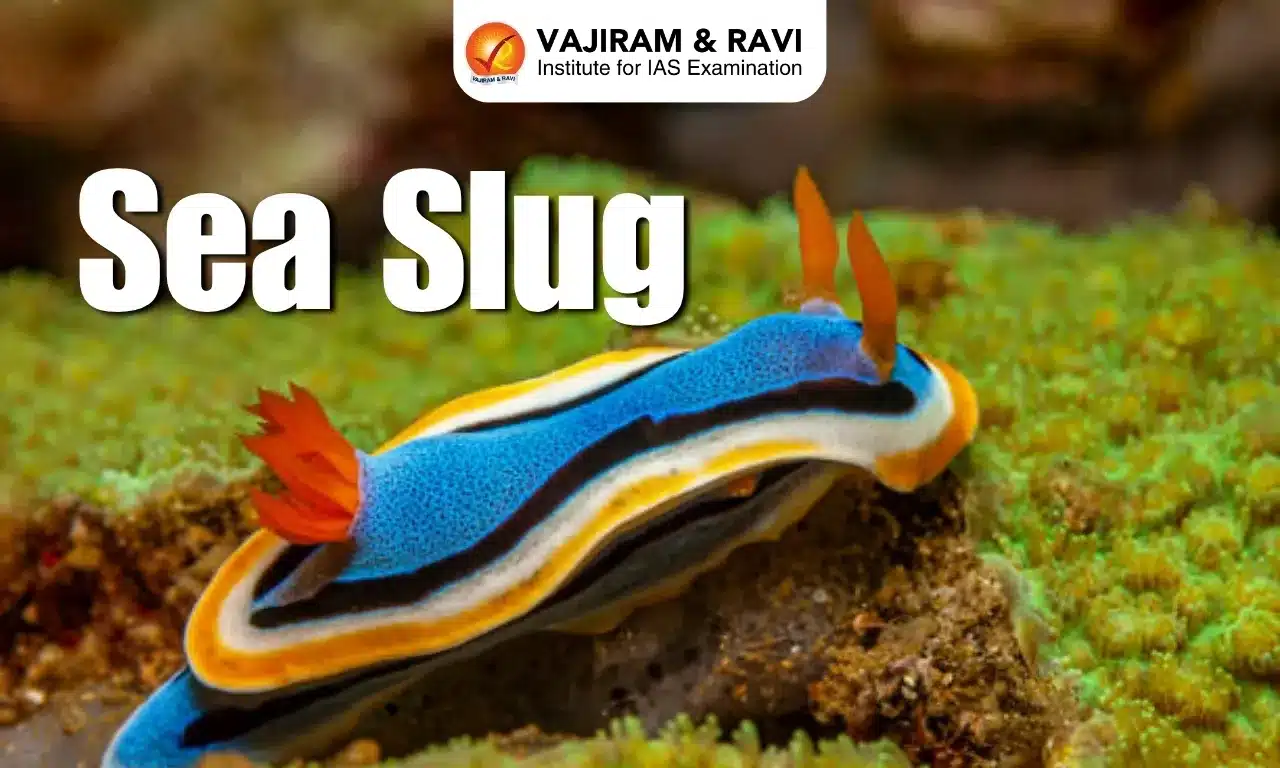
  • Sea slugs, sometimes called ocean slugs, water slugs, or nudibranchs, are soft-bodied marine molluscs found in all the world’s oceans, from shallows to the deep sea. 
  • They are a type of gastropod, a large group of mollusks that includes both marine and land species such as snails and slugs. 
  • They have no shells, quills, or mantle cavities.
  • They look like naked snails, i.e., without shells.  
  • These slow-moving grazers consume algae, sponges, and other small invertebrates, showcasing a range of feeding habits.
  • They are usually found in coral reefs, and their presence is a significant indicator of a strong coral ecosystem.
  • Sea slugs are renowned for their vibrant colours and intricate patterns, which often serve as warning signals to predators due to their toxicity. 
  • They get their toxicity from the creatures they eat, and some sea slugs can even keep the stinging cells of jellyfish inside their bodies.
  • On their heads, nudibranchs have tentacles that serve as important sensory organs, helping them detect chemicals and movement in the water.
  • When the sea slug eats, it absorbs and displays its prey’s pigment—the substance that gives the prey its color.
  • Beyond their striking appearance, sea slugs possess other intriguing traits. 
    • Some can photosynthesise, producing their own food with sunlight. 
    • Others regenerate lost limbs, and a few can steal genes from their prey and incorporate them into their DNA.
  • Most sea slugs are active throughout the day, but some species are also nocturnal.

Source: MD

Sea Slugs FAQs

Q1: What are sea slugs?

Ans: Sea slugs are soft-bodied marine molluscs.

Q2: Where are sea slugs found?

Ans: They are found in all the world’s oceans, from shallows to the deep sea.

Q3: Do sea slugs have shells?

Ans: No

Q4: Sea slugs are commonly found in which ecosystem?

Ans: Coral reefs

Q5: How do sea slugs acquire toxicity?

Ans: From the creatures they eat.

Nasha Mukt Bharat Abhiyaan

Nasha Mukt Bharat Abhiyaan

Nasha Mukt Bharat Abhiyaan Latest News

The Ministry of Social Justice & Empowerment set to launch the upgraded Nasha Mukt Bharat Abhiyaan (NMBA) App 2.0 to strengthen the monitoring under the framework of the National Action Plan for Drug Demand Reduction (NAPDDR).

About Nasha Mukt Bharat Abhiyaan

  • It was launched on 15th August 2020 by the Ministry of Social Justice & Empowerment.
  • It was initially launched in 272 identified most vulnerable districts and now it has been extended to all districts of the country with effect from 15th August 2023.
  • Objective: It intends to reach out to the masses and spread awareness about substance abuse through various activities like:
    • Awareness generation programmes
    • Focus on higher educational Institution, university campuses and schools
    • Reaching out into the Community and identifying dependent population,
    • Focus on counselling & treatment facilities in hospitals & rehabilitation centres
    • Capacity building programmes for a service providers
  • Target group: Special emphasis is laid on the participation of stakeholders such as women, children, educational institutions, civil society organizations etc. who may be directly or indirectly affected by substance use

Key Features of NMBA App 2.0

  • It is now accessible to citizens with features of undertaking e-Pledge, access to IEC material, helpline support and deaddiction centre details.
  • Dedicated Access for Grant-in-Aid Institutions (GIAs): GIAs will now be onboarded onto the platform with role-based access, enabling real-time reporting and monitoring of activities at the deaddiction facilities.
  • Real time status of Anudan (Grant) for GIA institutions: It incorporates Anudan status of all GIAs accessible to DoSJE, States / UTs and GIAs,
  • Nearest De-addiction Centre: It Allows users to identify the nearest de-addiction centre, enabling quicker referral and improved access to treatment services.

Source: PIB

Nasha Mukt Bharat Abhiyaan FAQs

Q1: Which component was added to NMBA in 2024?

Ans: Waste Pickers – for welfare of sewer & septic tank workers and waste pickers

Q2: Which organization is the national implementing agency for NMBA?

Ans: NSKFDC – National Safai Karamcharis Finance & Development Corporation

Diphtheria

Diphtheria

Diphtheria Latest News

After decades of being largely under control, diphtheria — a serious but vaccine-preventable disease — is making an unexpected return in parts of Australia.

About Diphtheria

  • It is a highly contagious bacterial infection that can attack the upper respiratory tract and less often the skin.
  • It is caused by strains of bacteria called Corynebacterium diphtheriae that make a toxin. 
  • The bacterium usually multiplies on or near the surface of the throat or skin.
  • There are two main types of diphtheria:
  • Classical respiratory diphtheria: It may affect your nose, throat, tonsils, or larynx (voice box). It’s the most common type.
  • Skin (cutaneous) diphtheria: It causes a skin rash, sores, or blisters. They can appear anywhere on your body. Cutaneous diphtheria is more common in tropical climates. Overall, it’s rare.

Diphtheria Transmission

  • It can spread from person to person, usually through respiratory droplets, like from coughing or sneezing. 
  • People can also get sick from touching infected open sores or ulcers in case of cutaneous diphtheria.
  • Some people may not develop disease manifestations but can still transmit the bacteria to others.

Diphtheria Symptoms

  • Symptoms of respiratory diphtheria can include:
    • Throat pain
    • Weakness or fatigue
    • Mild fever
    • Swollen lymph nodes in your neck
    • A thick, greyish coating on the back of your throat
    • Problems breathing and/or swallowing
  • Symptoms of skin diphtheria can include:
    • Painful open sore or ulcer
    • Rash with scales or peeling skin
    • Swelling and discoloration near the sore or rash
  • Diphtheria can lead to complications, like:
    • Airway blockage, which can cause suffocation
    • Heart muscle damage and heart failure
    • Nerve damage
    • Kidney failure
    • These complications can result in death.

Diphtheria Treatment

  • Neutralization of unbound toxin with Diphtheria Antitoxin (DAT).
  • Antibiotics to prevent further bacterial growth;
  • Monitoring and supportive care to prevent and treat complications, e.g. airway obstruction, myocarditis.
  • Although diphtheria can be treated with medications, in advanced stages, the bacterial infection can damage the heart, kidneys and nervous system.
  • It is a vaccine-preventable disease, but multiple doses and booster doses are needed to produce and sustain immunity.
  • For unvaccinated individuals, without proper treatment, diphtheria can be fatal in around 30% of cases, with young children at higher risk of dying.

Source: IE

Diphtheria FAQs

Q1: What type of disease is diphtheria?

Ans: Bacterial infection

Q2: Which bacterium causes diphtheria?

Ans: Corynebacterium diphtheriae

Q3: Which is the most common type of diphtheria?

Ans: Respiratory diphtheria.

Q4: How does diphtheria commonly spread?

Ans: Through respiratory droplets.

Q5: Is diphtheria a vaccine-preventable disease?

Ans: Yes, diphtheria is a vaccine-preventable disease.

Project DANTAK

Project DANTAK

Project DANTAK Latest News

Recently, Project DANTAK of the Border Roads Organisation (BRO) celebrated its 66th Raising Day , at Thimphu, Bhutan.

About Project DANTAK

  • It is an overseas project of the Border Roads Organisation (BRO) under the Ministry of Defence of India.
  • Background: It was established on 24 April 1961 as a result of an agreement between Jigme Dorji Wangchuck, the third king of Bhutan and then Prime Minister of India Jawahar Lal Nehru.
  • It is primarily focused on developing infrastructure and providing connectivity in remote areas of Bhutan.
  • Achievements
    • It was tasked to construct the pioneering motorable roads in Bhutan.
    • Under this Project, over 1,500 km of road has been constructed, including the strategically vital East–West Highway connecting Trashigang to Thimphu. 
    • Some other notable projects include the construction of Paro Airport, Yonphula Airfield, Thimphu – Trashigang Highway, Telecommunication & Hydro Power Infrastructure, Sherubtse College, Kanglung and India House Estate.

What is the Border Road Organisation?

  • It is a road construction executive force in India that provides support to the Indian Armed Forces.
  • BRO was entirely brought under the Ministry of Defence in 2015.
  • Establishment: It was formed on 7 May 1960 to secure India’s borders and develop infrastructure in remote areas of the north and northeastern states of the country.
  • It develops and maintains road networks in India’s border areas and friendly neighboring
  • Motto: Shramena Sarvam Sadhyam (everything is achievable through hard work).

Source: PIB

Project DANTAK FAQs

Q1: Where is the headquarters of Project DANTAK located?

Ans: Simtokha, Thimphu

Q2: Project DANTAK is an overseas project of which organization?

Ans: Border Roads Organisation (BRO) under Ministry of Defence

Enquire Now