Oxyserphus narendrani

Oxyserphus narendrani

Oxyserphus narendrani Latest News

Researchers discovered the tiny insect in Dibru-Saikhowa National Park and named it Oxyserphus narendrani.

About Oxyserphus narendrani

  • It is a new species of parasitic wasp discovered in Dibru-Saikhowa National Park Assam.
  • The members of the Oxyserphus genus are incredibly rare in insect collections globally and are typically only found in high-altitude areas.
  • Features
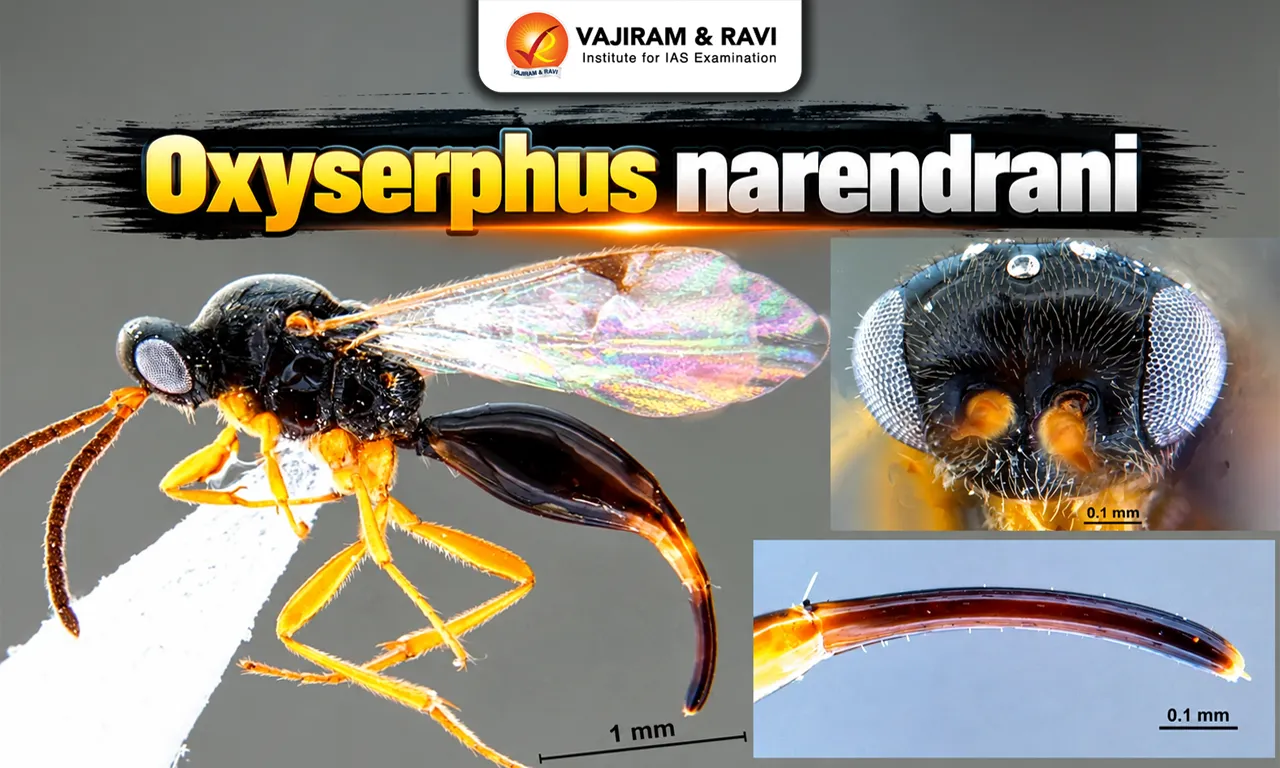
    • It has a black head, a brownish-black body, and striking yellow legs.
    • It has a unique single horizontal groove on the side of its thorax.
    • It has a much shorter egg-laying reproductive structure, known as an ovipositor sheath, and a uniquely shaped wing spot.

Key Facts about Dibru-Saikhowa National Park

  • Location: It is located in the Dibrugarh and Tinsukia districts of Assam.
  • It was originally created to help conserve the habitat of the rare white-winged wood duck.
  • Rivers: The park is bounded by the Brahmaputra and Lohit Rivers in the north and Dibru River in the south.
  • Vegetation: It mainly consists of moist mixed semi-evergreen forests, moist mixed deciduous forests, canebrakes and grasslands. It is the largest salix swamp forest in north-eastern India.
  • Climate: It has a tropical monsoon climate with a hot and wet summer and cool and usually dry winter. 
  • Flora: It mainly consists of Hollong, Nahor, Simul, Sissoo, Khair, and Jamun are commonly found.
  • Fauna: Asian Elephant, Wild Water Buffalo, Leopard, Clouded Leopard, Fishing Cat, Jungle Cat, Hog Deer, Sambar Deer, and Barking Deer are commonly found.

Source: RM

Oxyserphus narendrani FAQs

Q1: What is Oxyserphus narendrani?

Ans: It is a new species of parasitic wasp.

Q2: Where was Oxyserphus narendrani discovered?

Ans: Dibru-Saikhowa National Park Assam
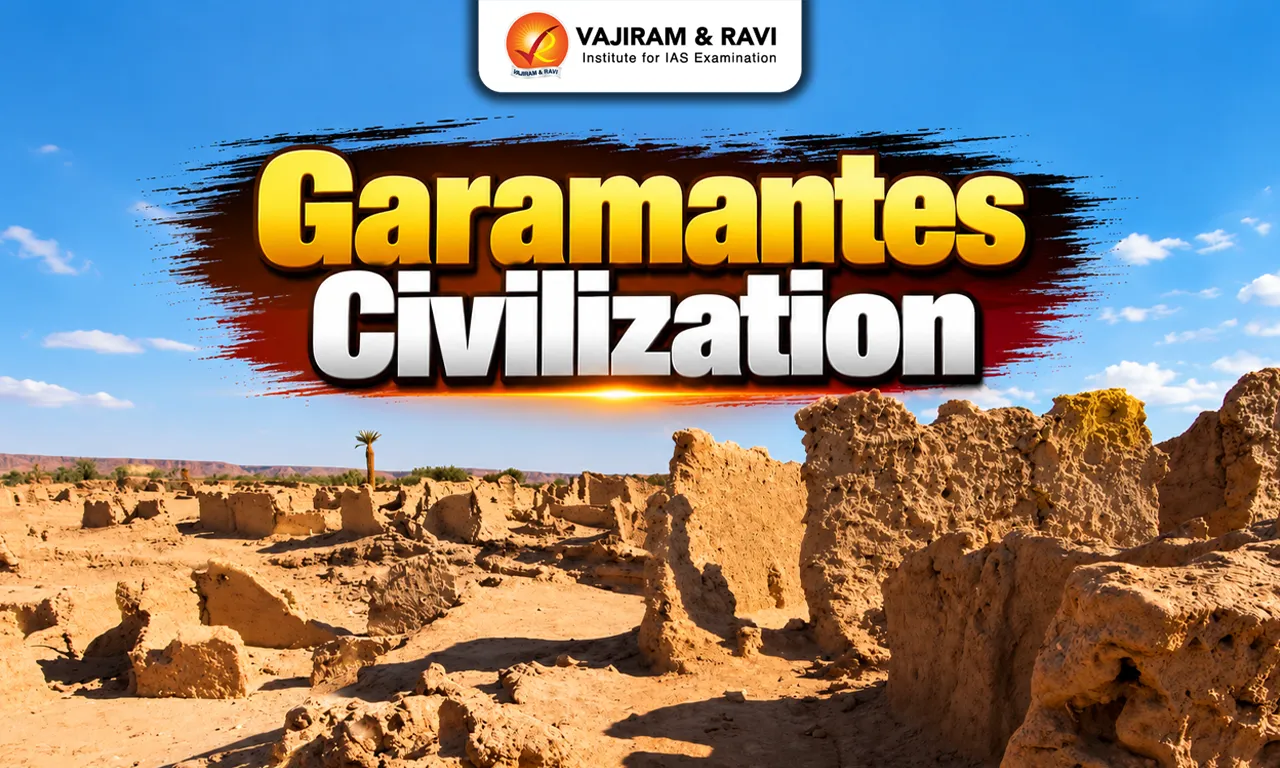
Garamantes Civilization

Garamantes Civilization

Garamantes Civilization Latest News

A recent study using satellite imagery and aerial photographs has revealed previously undocumented fortified farms, walled villages and fortified towns in Libya’s Fezzan region, providing new evidence of the Garamantes civilization and its extensive settlement network.

About Garamantes Civilization

  • They were an ancient civilization that thrived in the Sahara Desert from approximately 500 BCE to 200 CE, primarily centered in the Fazzan region of southwest Libya. 
  • They established significant urban centers, including their capital, Germa, as well as Zinchera and Saniat Gebril, alongside numerous other settlements. 
  • Contrary to historical depictions of them as nomadic, archaeological findings suggest that the Garamantes were an advanced society skilled in constructing extensive underground irrigation systems known as foggara, which allowed them to access groundwater for agriculture in an arid environment. 
  • This ingenuity enabled them to cultivate crops such as cereals, grapes, olives, and dates, supporting a population that may have reached 50,000 at its peak.
  • The origins of the Garamantes remain debated among scholars, with theories ranging from Berber ancestry to connections with Neolithic peoples. 
  • Their civilization engaged in trade with nearby Mediterranean regions, exchanging goods like salt, gold, ivory, and slaves, and transitioned from military conflict to becoming important trading partners with the Roman Empire. 
  • However, environmental changes, particularly falling water levels, led to the decline of the Garamantes by the sixth century CE, resulting in the eventual abandonment of their urban centers. 
  • The legacy of the Garamantes is marked by their innovative adaptation to a challenging landscape and their role in shaping the cultural and historical landscape of ancient North Africa.

News: TOI

Garamantes Civilization FAQs

Q1: Who were the Garamantes?

Ans: The Garamantes were an ancient civilization that flourished in the Sahara Desert, primarily in the Fezzan region of southwestern Libya.

Q2: When did the Garamantes civilization approximately flourish?

Ans: It flourished approximately from 500 BCE to 200 CE.

Q3: What was the capital of the Garamantes civilization?

Ans: Germa was the capital of the Garamantes.

Q4: What were the underground irrigation systems developed by the Garamantes called?

Ans: They were called foggara or foggaras.

Q5: What was the primary purpose of the Garamantes' foggara irrigation systems?

Ans: They were used to access groundwater for agriculture in the arid Sahara.

International Mobile Equipment Identity Number

International Mobile Equipment Identity Number

International Mobile Equipment Identity Number Latest News

India’s active wireless mobile subscriber base reached 1,204.01 million in July 2026 and it brings new security challenges i.e the misuse of the International Mobile Equipment Identity (IMEI) number or IMEI tampering.

About International Mobile Equipment Identity Number

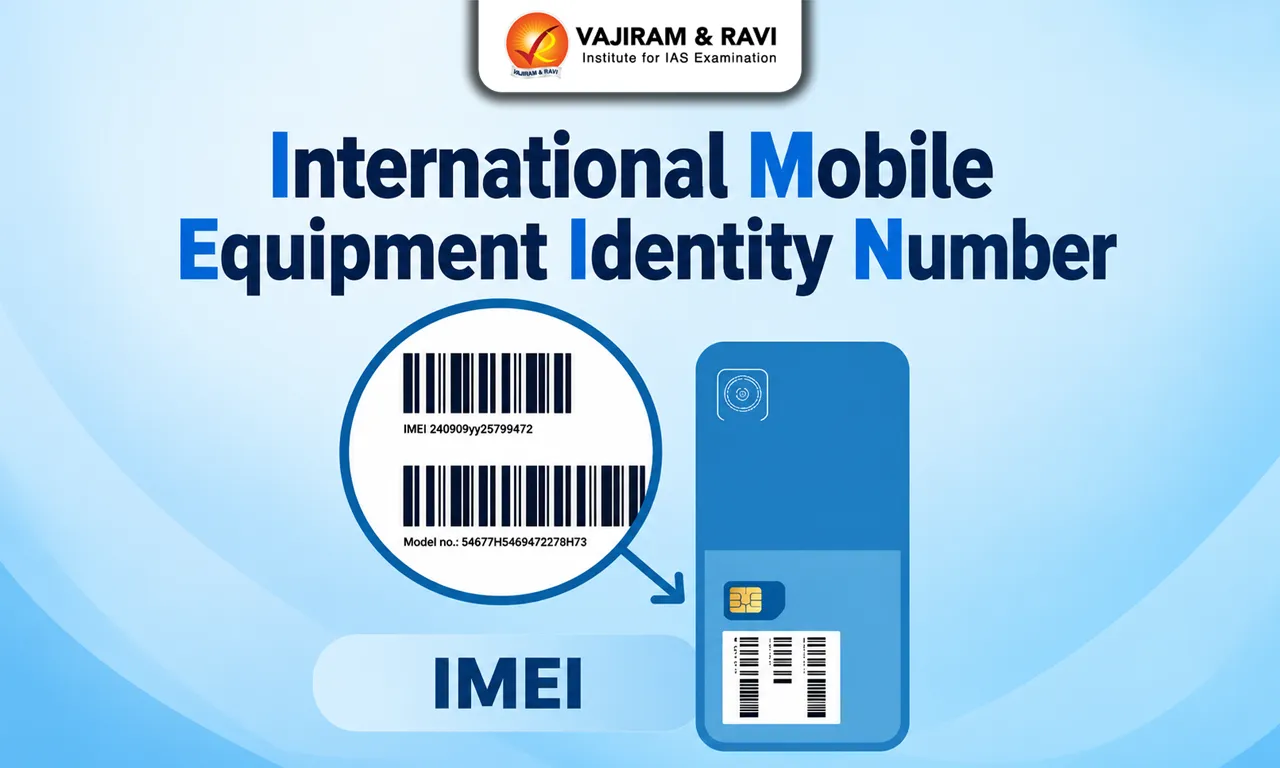
  • It is a unique 15-digit number that identifies a mobile device on a telecom network.
  • The first eight digits of an IMEI form the Type Allocation Code (TAC), which identifies the device model or type.
  • Allocation of IMEI numbers: The Global System for Mobile Communications Association (GSMA) oversees the global allocation of TAC.
  • GSMA allocate TACs to manufacturers and brand owners. Manufacturers then assign unique IMEIs to individual devices.
  • A dual-SIM phone generally has two IMEI numbers, one for each SIM slot.
  • Identification: Users can dial *#06# on their mobile device to display its IMEI number.

India's IMEI Ecosystem

  • Manufacturers: They must register the IMEI numbers of all applicable telecom devices manufactured in India with the Government before their first sale, testing, research or other use. 
    • Registration is carried out through the Device Setu–Indian Counterfeited Device Restriction (ICDR) portal. 
  • Importers: They must register IMEI numbers on Indian Counterfeited Device Restriction (ICDR) portal with the Central Government before importing applicable telecom equipment into India.
  • Resellers and retailers: They also must ensure that telecom devices offered for sale have valid and untampered IMEI numbers.
  • Brand owners: They must ensure that devices sold under their brands comply with applicable IMEI registration and cybersecurity requirements.

India’s Legal Framework to Protect the Telecommunication Ecosystem

  • The Telecommunications Act, 2023: It provides stringent action against tampering with telecommunication identifiers, including the IMEI number of mobile handsets and other telecommunication devices.
    • Section 42(3)(c) prohibits tampering with telecommunication identifiers. 
    • Section 42(3)(e) prohibits obtaining Subscriber Identity Modules (SIMs) or telecommunication identifiers through fraud, cheating or impersonation.
    • Violations may attract imprisonment for up to three years, a fine of up to ₹50 lakh, or both. Such offences are cognizable and non-bailable under Section 42(7) of the Act.
    • Under Section 42(6), persons who abet or promote the commission of such offences are also liable to the same punishment.

Source: PIB

International Mobile Equipment Identity Number FAQs

Q1: What is International Mobile Equipment Identity Number ?

Ans: It is a unique 15-digit number that identifies a mobile device on a telecom network.

Q2: Who allocates Type Allocation Code?

Ans: Global System for Mobile Communications Association

Great Cormorant

Great Cormorant

Great Cormorant Latest News

A Hyderabad-born Canadian birder spotted a rare leucistic Great Cormorant at Ameenpur Lake near BHEL recently.

About Great Cormorant

  • It is a large waterbird and a member of the cormorant family of seabirds.
  • Scientific Name: Phalacrocorax carbo 

Great Cormorant Habitat and Distribution

  • They are probably the most widespread member of the cormorant family with a range that includes North America, Europe, Africa, China, India, Southeast Asia, New Zealand, Papua New Guinea and Australia.  
  • Well adapted to aquatic environments, they live in the shallow waters along marine shorelines but may inhabit lakes and rivers.  

Great Cormorant Features

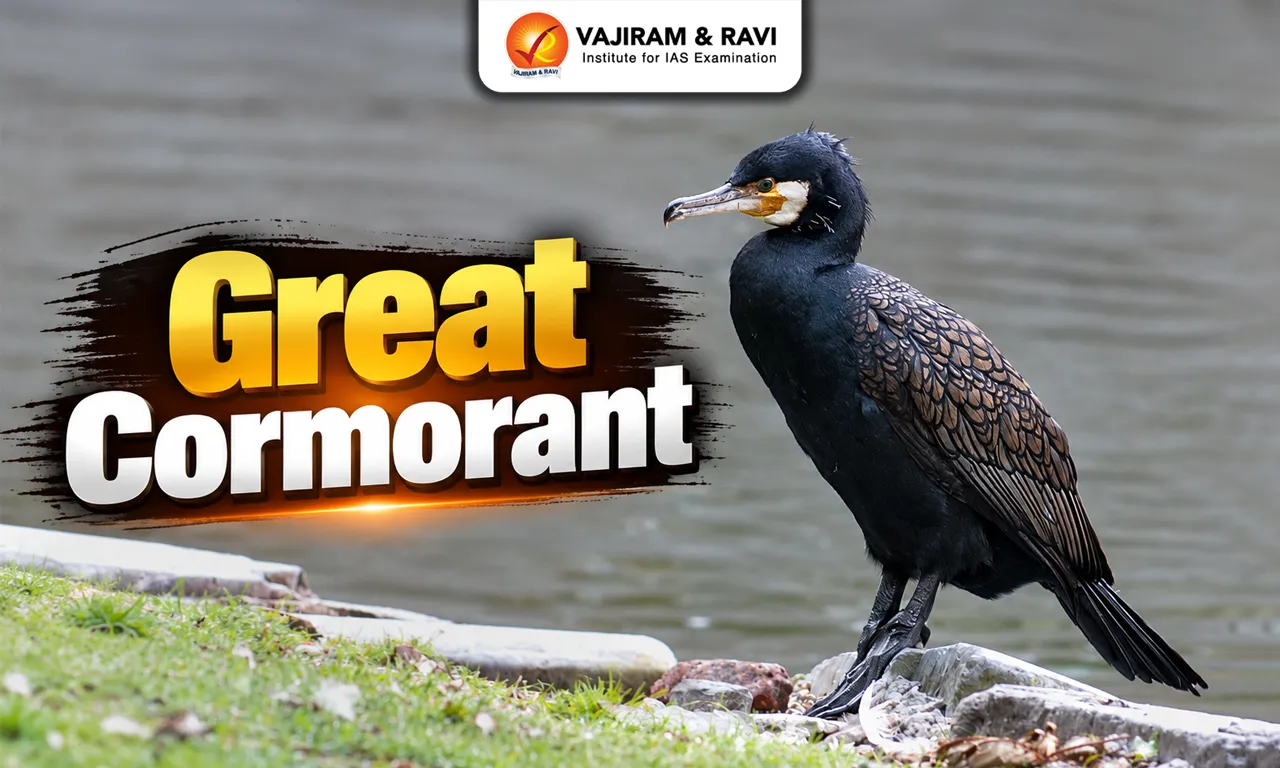
  • It is the largest member of the cormorant family, reaching 35-40 inches in length with a wingspan of over five feet. 
  • Males are typically larger and heavier than females. 
  • They have dark, glossy plumage, very long necks, long, hooked bills and webbed feet. 
  • They have a longish tail and a yellow throat patch. Adults have white thigh patches in the breeding season. 
  • Their powerful bills are greyish with white patches around its base. 
  • They employ their powerful webbed feet for efficient swimming and diving to catch a variety of prey, including fish, crabs, and, in some areas, frogs or ducklings. 
  • Notably, the Great Cormorant has a unique fishing partnership with Asian fishermen, who train them to catch fish while preventing them from swallowing their catch using rings around their necks. 
  • Like other cormorants, their plumage has limited waterproofing. The birds spread their wings to dry when they leave the water after diving.  
  • These birds typically nest in small colonies, sometimes expanding to over 2,000 pairs.

Great Cormorant Conservation Status

It is classified as 'Least Concern' under the IUCN Red List.

News: TT

Great Cormorant FAQs

Q1: What is the Great Cormorant?

Ans: The Great Cormorant is a large waterbird belonging to the cormorant family.

Q2: Where is the Great Cormorant distributed?

Ans: It has a very wide distribution covering North America, Europe, Africa, China, India, Southeast Asia, New Zealand, Papua New Guinea and Australia.

Q3: What type of plumage does the Great Cormorant have?

Ans: It has dark, glossy plumage.

Q4: What are the major physical features of the Great Cormorant?

Ans: It has a long neck, long hooked bill, webbed feet, longish tail and yellow throat patch.

Q5: What is the conservation status of the Great Cormorant according to the IUCN Red List?

Ans: Least Concern (LC).

Emi Koussi Volcano

Emi Koussi Volcano

Emi Koussi Volcano Latest News

A 2024 astronaut photo captured an unusual salt patch shining like snow on top of northern Chad's imposing Emi Koussi volcano, which is covered with ancient lava, hidden vents and shadowy waterways.

About Emi Koussi Volcano

  • It is a large shield volcano located in the central Sahara in the north of the Republic of Chad. 
  • It lies at the southeast end of the Tibesti Mountains. 
  • At 3,415 meters above sea level, it is not only the highest mountain in Chad but also the highest in the Sahara. 
  • Its crater is 19 kilometers wide and 1,219 meters deep. 
  • Two nested calderas cap the volcano, the outer one being about 12 by 15 km in size. 
  • Within it on the southeast side is a smaller caldera, about 2–3 km wide and 350 m deep. 
  • Numerous lava domes, cinder cones, maars, and lava flows are found both within the calderas and along the outer flanks of the shield. 
  • Nested within the main caldera is a smaller crater that contains white salts of a dry lake at its lowest point. 
  • The smaller crater is surrounded by a region of darker rocks—a geologically young dome of lava studded with several small circular volcanic vents. 
  • The dark volcanic rocks of the volcano provide a sharp contrast to the underlying tan and light brown sandstone exposed to the west, south, and east. 
  • Emi Koussi is extinct, and it is not known when it last erupted. 

What is a Maar?

  • A maar is a broad, low-relief volcanic crater caused by an explosion which occurs when groundwater comes into contact with hot lava or magma. 
  • A maar characteristically fills with water to form a relatively shallow crater lake.

News: LS

Emi Koussi Volcano FAQs

Q1: What type of volcano is Emi Koussi Volcano?

Ans: It is a large shield volcano.

Q2: Where is the Emi Koussi Volcano located?

Ans: It is located in the central Sahara in the north of the Republic of Chad.

Q3: What is the geographical significance of Emi Koussi?

Ans: It is the highest mountain in Chad and the highest point in the Sahara.

Q4: What is the volcanic status of Emi Koussi?

Ans: Emi Koussi is considered extinct.

Lord Howe Island

Lord Howe Island

Lord Howe Island Latest News

A 16-year study from Lord Howe Island found record levels of plastic ingestion in fledgling sable shearwaters.

About Lord Howe Island

  • It is a crescent-shaped, volcanic island.
  • Location:  It is located about 650 kilometres off Australia's east coast in the Tasman Sea.
  • Discovered By: The Island was discovered in 1788 and named for Admiral Lord Howe by Lieutenant Henry Lidgbird Ball of the British navy.
  • Geographical Features
    • Peaks: The island has two peaks (Mounts Gower and Lidgbird), each rising above 2,500 feet (760 metres) at its southern end. 
    • It has the most southerly coral reef in the world.
  • Flora and Fauna
    • About 47% of the island's vascular plants are endemic, including the famous Kentia Palm (Howea forsteriana).
    • It has endemic species like the Lord Howe Island Phasmid which is considered the world’s largest stick insect, and the flightless Lord Howe Woodhen (Gallirallis sylvestris).
    • It hosts the world’s largest known population of sable shearwaters, with an estimated 22,000 breeding pairs.
  • The Lord Howe Island Group is a UNESCO World Heritage Site that boasts countless unique plants and animals, many of which are endemic to the region. 

Source: DTE

Lord Howe Island FAQs

Q1: Where is Lord Howe Island located?

Ans: It is located about 650 kilometres off Australia's east coast in the Tasman Sea.

Q2: Who discovered the Lord Howe Island?

Ans: Admiral Lord Howe

Exercise Tarang Shakti

Exercise Tarang Shakti

Exercise Tarang Shakti 2026 Latest News

The Indian Air Force (IAF) will host the second edition of its largest-ever multinational air exercise, Tarang Shakti-26 in Jodhpur. 

About Exercise Tarang Shakti 2026

  • It is the multinational air exercise to be conducted in Jodhpur.
    • The maiden edition of the exercise took place in August-September 2024 in two phases.
  • Participating Countries: Eight friendly foreign countries such as Australia, Bangladesh, France, Germany, Greece, Sri Lanka, UAE and USA will participate with air assets, while 32 nations will be attending as observers. 
  • It is aimed at enhancing interoperability among participating air forces, while providing a platform for exchanging operational experience and showcasing India’s air combat capabilities.
  • The exercise will see the participation of advanced combat aircraft, including the U.S. Air Force’s F-35, the French Rafale, the UAE’s F-16 and a Bangladeshi C-130J.
    • The IAF will field a range of its frontline platforms, including the Rafale, Mirage-2000, Jaguar, Tejas, MiG-29 and Su-30MKI.

Source: IE

Exercise Tarang Shakti 2026 FAQs

Q1: What is Exercise Tarang Shakti 2026?

Ans: It is the multinational air exercise to be conducted in Jodhpur.

Q2: Which countries are participating in Exercise Tarang Shakti 2026?

Ans: Australia, Bangladesh, France, Germany, Greece, Sri Lanka, UAE and USA

National Single Window System

National Single Window System

National Single Window System Latest News

The National Single Window System marks a significant step towards creating a transparent, and technology-driven regulatory ecosystem. 

About National Single Window System

  • It serves as a digital platform that guides investors in identifying and applying for the approvals required for their businesses.
  • It is a digital platform that guides investors in identifying the approvals required for their businesses. 
  • It was launched in September 2021.
  • It is implemented by the Department for Promotion of Industry and Internal Trade (DPIIT), Ministry of Commerce & Industry.
  • It integrates approvals offered by Central Ministries, State Governments, and regulatory authorities on a common digital platform.   

Key Functionalities of NSWS

  • Know Your Approvals: It is the Know Your Approvals (KYA) module, a tool that identifies the approvals applicable to a business based on its proposed activities.
  • The portal hosts applications for approvals from 32 Central Ministries/ Departments and 34 State Governments and Union Territories. This helps investors navigate regulatory requirements for business.
  • Common Registration Form: It captures information through a single interface and enables reuse of information across applications.
  • Access to State Single Window Systems: It offers seamless access through a dedicated State Registration Form, ensuring integration with State-level approval mechanisms.
  • Applicant Dashboard: It includes an applicant dashboard for submitting applications, monitoring their status, and responding to departmental queries.
  • A centralized Document Repository enables one-time upload and reuse of documents across multiple approvals, reducing duplication of submissions.
  • E-Communication Module: It facilitates online exchange of queries and clarifications between applicants and the concerned Ministries and State Governments.

Significance of National Single Window System

  • It simplifies the approval process by enabling one-time submission of information and documents.
  • It helps reduce compliance and approval timelines. The platform also enhances transparency through real-time application tracking and online communication with regulatory authorities.
  • NSWS minimizes duplication of information across departments and improves coordination among government agencies through an integrated digital ecosystem.

 Source: PIB

National Single Window System FAQs

Q1: What is National Single Window System?

Ans: It is a digital platform that guides investors in identifying the approvals required for their businesses.

Q2: Who implements the National Single Window System?

Ans: It is implemented by the Department for Promotion of Industry and Internal Trade (DPIIT), Ministry of Commerce & Industry.

Koel River

Koel River

Koel River Latest News

Four teenagers recently drowned in the Koel River in Jharkhand's Palamu district while immersing materials used for Karma Puja.

About Koel River

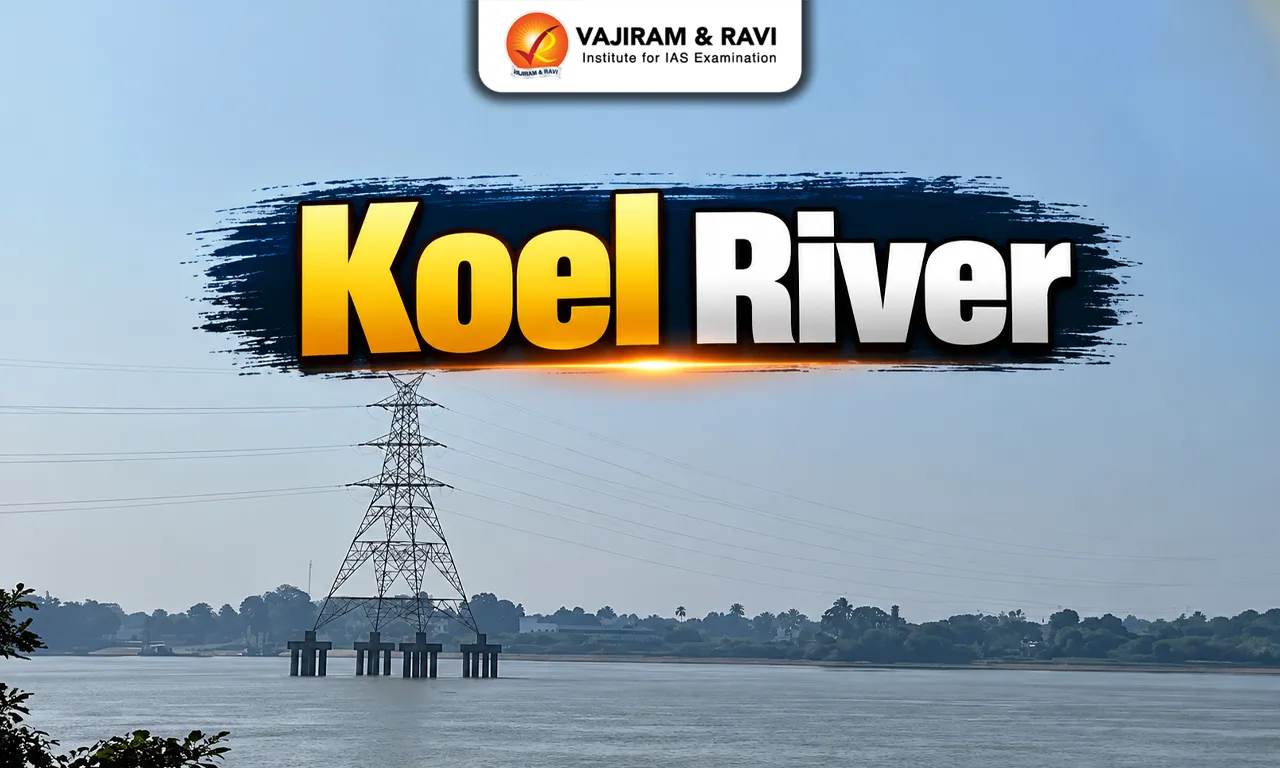
  • It is an important river flowing through the states of Jharkhand and Odisha. 
  • Course:
    • It originates from the Palamau Tiger Reserve, Jharkhand, and flows in the western part of Palamu District. 
    • The river is believed to be fed by three streams of Jharkhand, namely South Karo, North Karo and Koina. 
    • The river divides into two:
      • North Koel River: It is tapped near Kutku for irrigation reasons and finally joins with the Son River (a principal southern tributary of the Ganges). 
      • South Koel River: It joins the Sankh River near Rourkela in Odisha to form the Brahmani River. 
  • Flowing through the hilly terrain of Jharkhand and Odisha, the Koel River is part of the larger Damodar Valley region, known for its mineral-rich landscape.
  • It is prone to seasonal flooding, particularly during the monsoon months.
  • Hydropower Potential: The North Koel Dam, also known as the Mandal Dam, was constructed on the North Koel River in Jharkhand, intended to generate hydroelectric power and supply irrigation water.

News: ETVB

Koel River FAQs

Q1: Which states does the Koel River flow through?

Ans: The Koel River flows through Jharkhand and Odisha.

Q2: Where does the Koel River originate?

Ans: It originates from the Palamau Tiger Reserve in Jharkhand.

Q3: Which major river does the North Koel River eventually join?

Ans: The North Koel eventually joins the Son River, a major southern tributary of the Ganges.

Central Drugs Standard Control Organization

Central Drugs Standard Control Organization

Central Drugs Standard Control Organisation Latest News

The Central Drugs Standard Control Organisation recently called for rational, safe and responsible use of non-steroidal anti-inflammatory drugs, used commonly to relieve pain and inflammation, and antibiotics.

About Central Drugs Standard Control Organisation 

  • It is the National Regulatory Authority (NRA) of India for pharmaceuticals, medical devices, and cosmetics.
  • It is responsible for discharging functions assigned to the Central Government under the Drugs and Cosmetics Act 1940 and Rules 1945.  
  • Its primary responsibility is to ensure the safety, efficacy, and quality of drugs, medical devices, and diagnostic kits.
  • The organization plays a pivotal role in the regulation and supervision of drug development, manufacturing, distribution, and marketing in India. 
  • Nodal Ministry: It works under the Directorate General of Health Services, Ministry of Health & Family Welfare, Government of India.
  • Headed By: The Drugs Controller General of India (DCGI) is the head of the CDSCO.
  • Headquarters: New Delhi  
  • Under the Drugs and Cosmetics Act, CDSCO is responsible for,
    • Approval of new drugs; Conduct of clinical trials; Laying down the standards for drugs; Control over the quality of imported drugs in the country; Coordination of the activities of State Drug Control Organizations;
    • CDSCO, along with state regulators, is jointly responsible for the grant of licenses for certain specialized categories of critical drugs such as blood and blood products, I. V. Fluids, Vaccine, and Sera.
    • It is also responsible for overseeing the import, manufacture, sale, and distribution of medical devices in the country. 
    • The CDSCO ensures that medical devices comply with safety, quality, and efficacy standards.

News: NIE

Central Drugs Standard Control Organisation FAQs

Q1: What is the Central Drugs Standard Control Organisation (CDSCO)?

Ans: CDSCO is the National Regulatory Authority (NRA) of India for pharmaceuticals, medical devices and cosmetics.

Q2: What is the primary responsibility of Central Drugs Standard Control Organisation (CDSCO)?

Ans: Its primary responsibility is to ensure the safety, efficacy and quality of drugs, medical devices and diagnostic kits.

Q3: Under which ministry does Central Drugs Standard Control Organisation (CDSCO) function?

Ans: CDSCO functions under the Ministry of Health & Family Welfare through the Directorate General of Health Services (DGHS).

Q4: Who heads the Central Drugs Standard Control Organisation (CDSCO)?

Ans: The Drugs Controller General of India (DCGI) heads CDSCO.

Enquire Now