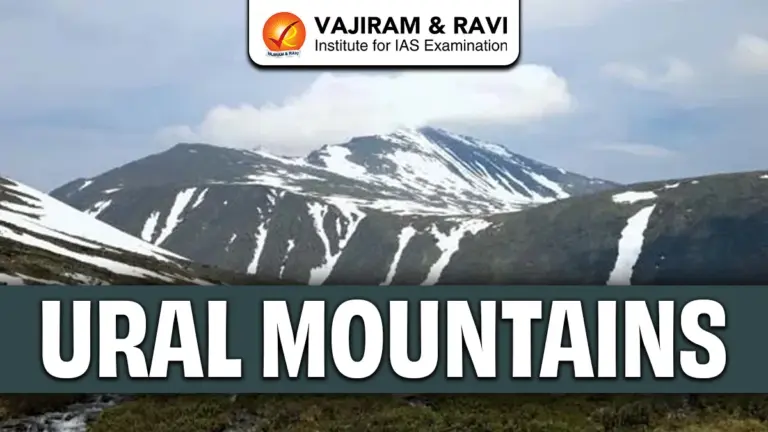
The Ural Mountains are one of the oldest mountain ranges on Earth, extending about 2,500 kilometres from the Arctic Ocean coast. They form the traditional geographical boundary between Europe and Asia. Since the 18th century, the Urals have played a central role in Russia’s economic development due to vast deposits of metal ores, coal, gold, platinum and semi precious stones, making the region a major metallurgical hub.
Ural Mountains
The Ural Mountains stretch across Eurasia through western Russia and slightly into Kazakhstan, separating European Russia from Siberia. They pass through the Ural geographical region and overlap with the Ural Federal District and Ural economic region. The range continues northward through Vaygach Island and the Novaya Zemlya archipelago into the Arctic Ocean.
Ural Mountains Features
The Ural Mountains display ancient geological structure, moderate heights, rich mineral resources and strong economic and continental boundary significance.
- Location: The Ural Mountains are located in western Russia and extend into northwestern Kazakhstan.
- Geological Age: Formed around 250-300 million years ago during the Uralian orogeny, they are among the world’s oldest preserved mountain ranges without major post orogenic collapse.
- Height: Average elevations range between 1,000 and 1,300 metres, with Mount Narodnaya reaching 1,894 metres, identified as the highest peak in 1927.
- Rivers: The Ural Mountains act as an important watershed, giving rise to major rivers such as the Ural, Kama, Pechora, Tobol and Iset, which drain into the Caspian Sea and Arctic Ocean basins.
- Peaks: The range has rounded and eroded peaks due to great geological age, with Mount Narodnaya (1,894 m), Mount Karpinsky and Mount Telposiz as notable high points.
- Divisions: The range is divided into Polar, Nether-Polar, Northern, Central and Southern Urals, each showing distinct relief, climate and geological characteristics.
- Mineral: The Urals contain about 48 economically valuable minerals, including iron ore, copper, nickel, chromite, bauxite, gold, platinum and precious gemstones.
- Industrial Importance: Since the 18th century, the region has supported Russia’s metallurgy and heavy industries, with major centres like Yekaterinburg, Chelyabinsk and Magnitogorsk.
- Climatic Influence: The north-south alignment affects climate patterns, with western slopes receiving 150-300 mm more rainfall annually than the eastern slopes.
- Transport Corridor: Historic routes like Babinov Road and modern railways, including parts of the Trans Siberian Railway, cross the Urals linking Europe and Asia.
- Economic Regions: The mountains overlap with the Ural economic region, one of Russia’s largest industrial zones due to dense mineral and energy resources.
Also Read: Altai Mountains






Ural Mountains Biodiversity
The flora and fauna of the Ural Mountains ranges from Arctic tundra to forests and steppes, which are shaped by latitude, altitude and continental climatic conditions.
Flora
- Tundra Vegetation: In Polar Urals, vegetation includes mosses, lichens, dwarf birch, cloudberry and blueberry due to low temperatures and shallow soils.
- Taiga Forests: Northern Urals are dominated by Siberian spruce, fir, pine, larch and Siberian cedar, forming dense boreal forest ecosystems.
- Mixed Forests: Southern Urals host mixed forests with conifers and broadleaf species like oak, maple, elm and linden, showing highest plant diversity.
- Tree Line Variation: Tree line lies at 250-400 metres in Polar Urals, rising to nearly 1,000 metres in Central and Southern Urals.
- Steppe Grasslands: Southern and south-eastern slopes support meadow and rocky steppes with grasses such as Bromus inermis and mountain clovers.
- Karst Forest Zones: Western slopes with limestone geology support forests interspersed with caves, sinkholes and underground streams.
- World Heritage Forests: Virgin Komi Forests in the Northern Urals are recognised as a UNESCO World Heritage Site for pristine boreal ecosystems.
Also Read: Mount Kosciuszko
Fauna
- Northern Species: Polar Urals host Arctic fox, lemmings, reindeer, snowy owl and ptarmigan adapted to tundra environments.
- Fur Animals: Northern Urals contain valuable fur species like sable, ermine, marten and Siberian weasel.
- Steppe Fauna: Southern Urals are home to hares, hamsters, susliks, jerboa and birds of prey like buzzards and kestrels.
- Bird Diversity: Birdlife includes capercaillie, black grouse, hazel grouse, nutcracker, Siberian jay and migratory waterfowl.
- Reptiles and Amphibians: Common viper, grass snake and lizards occur mainly in Central and Southern Urals due to milder climate.
- Aquatic Life: Rivers and lakes support fish such as grayling, salmon, whitefish, nelma and trout, especially in northern basins.
- Human Impact: Industrialisation reduced wildlife near cities, leading to creation of nature reserves like Ilmen, Pechora-Ilych and Bashkir reserves.
- Protected Areas: Nine major strict nature reserves conserve forests, wetlands and mountain ecosystems across different Ural sections.
- Ecological Balance: Despite industrial pressure, large forest cover helps regulate river flow and maintain biodiversity stability.

 Last updated on March, 2026
→ UPSC Final Result 2025 is now out.
→ UPSC has released UPSC Toppers List 2025 with the Civil Services final result on its official website.
→ Anuj Agnihotri secured AIR 1 in the UPSC Civil Services Examination 2025.
→ UPSC Marksheet 2025 is now out.
→ UPSC Notification 2026 & UPSC IFoS Notification 2026 is now out on the official website at upsconline.nic.in.
→ UPSC Calendar 2026 has been released.
→ Check out the latest UPSC Syllabus 2026 here.
→ UPSC Prelims 2026 will be conducted on 24th May, 2026 & UPSC Mains 2026 will be conducted on 21st August 2026.
→ The UPSC Selection Process is of 3 stages-Prelims, Mains and Interview.
→ Prepare effectively with Vajiram & Ravi’s UPSC Prelims Test Series 2026 featuring full-length mock tests, detailed solutions, and performance analysis.
→ Enroll in Vajiram & Ravi’s UPSC Mains Test Series 2026 for structured answer writing practice, expert evaluation, and exam-oriented feedback.
→ Join Vajiram & Ravi’s Best UPSC Mentorship Program for personalized guidance, strategy planning, and one-to-one support from experienced mentors.
→ Shakti Dubey secures AIR 1 in UPSC CSE Exam 2024.
→ Also check Best UPSC Coaching in India
Ural Mountains FAQs
Q1. In which Continent are the Ural Mountains Located?+
Q2. Why are the Ural Mountains important geographically?+
Q3. What is the highest peak of the Ural Mountains?+
Q4. How old are the Ural Mountains?+
Q5. What natural resources are found in the Ural Mountains?+
Tags: ural mountains