Urban Malaria Latest News
- India’s Malaria Elimination Technical Report, 2025 has flagged urban malaria driven by the invasive mosquito Anopheles stephensi as a growing national concern.
- It could threaten India’s target of eliminating malaria by 2030, with an interim goal of zero indigenous cases by 2027, aligned with World Health Organisation strategy.
Urban Malaria A New Challenge
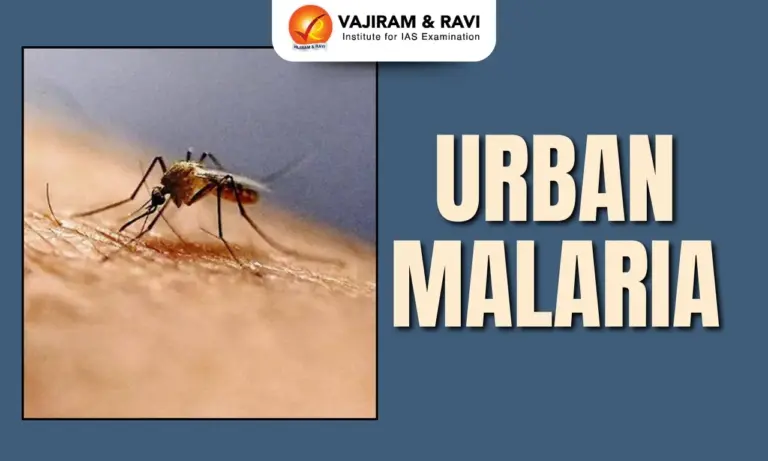
- The spread of Anopheles stephensi in cities such as Delhi marks a shift from traditional rural malaria transmission.
- The species thrives in urban environments, breeding in artificial containers like overhead tanks, tyres, and construction sites.
- It efficiently transmits Plasmodium falciparum and P. vivax, complicating malaria control efforts.





Why Anopheles Stephensi Is a Serious Threat
- Recognised globally as an invasive vector.
- Adapted to high population density, informal settlements, and fragmented urban healthcare systems.
- Requires city-specific vector control and surveillance strategies, unlike conventional rural-focused approaches.
Persistent High-Burden Pockets
- India has entered the pre-elimination phase, but malaria is now concentrated in specific pockets rather than widespread.
- High-burden districts persist in Odisha, Tripura, and Mizoram.
- Cross-border transmission from Myanmar and Bangladesh continues to affect northeastern border districts.
Key Drivers of Continued Transmission
- Asymptomatic infections, making detection difficult.
- Difficult terrain and remote tribal and forest areas.
- Population mobility and migration.
- Occupational exposure and uneven access to health services.
India’s Progress So Far
- Malaria cases reduced from 11.7 lakh (2015) to ~2.27 lakh (2024).
- Deaths declined by 78% over the same period.
- Active surveillance intensified in tribal, forest, border, and migrant-population settings.
Health System Gaps Identified
- Inconsistent reporting by the private sector.
- Limited entomological capacity.
- Drug and insecticide resistance.
- Operational gaps in remote tribal regions.
- Occasional shortages of diagnostics and treatment supplies.
Priority Actions and Research Areas
- Strengthen surveillance systems and vector monitoring.
- Improve supply-chain reliability for diagnostics and medicines.
- Focus operational research on:
- Asymptomatic malaria infections
- Ecology and control of Anopheles stephensi
- Drug and insecticide resistance
- Optimisation of P. vivax treatment regimens
Strategic Frameworks Guiding Elimination
- India’s success rests on a clear policy roadmap:
- National Framework for Malaria Elimination (NFME), 2016: Target of zero indigenous cases by 2027.
- National Strategic Plan for Malaria Elimination (2023–2027): Focus on enhanced surveillance, “test–treat–track” strategy, and real-time monitoring through the Integrated Health Information Platform (IHIP).
Vector Control and Urban Malaria Management
- Integrated Vector Management (IVM) has been central, including:
- Indoor Residual Spraying (IRS)
- Long-Lasting Insecticidal Nets (LLINs)
- Special attention has been given to controlling the invasive Anopheles stephensi mosquito, strengthening urban malaria control.
Strengthening Diagnostics, Health Systems, and Communities
- Establishment of National Reference Laboratories under the National Centre of Vector Borne Diseases Control (NCVBDC).
- District-specific action plans for tribal, forested, and high-endemic areas.
- Integration of malaria services into Ayushman Bharat, with Community Health Officers and Ayushman Arogya Mandirs delivering care at the grassroots level.
Capacity Building, Research, and Partnerships
- Over 850 health professionals trained in 2024 through national refresher programmes.
- Research on insecticide resistance and drug efficacy guiding evidence-based interventions.
- Intensified Malaria Elimination Project–3 (IMEP-3) covering 159 districts in 12 states, focusing on vulnerable populations, Long-Lasting Insecticidal Nets (LLINs) distribution, entomological studies, and surveillance.
The Road Ahead 2030 Malaria-Free India
- India remains committed to achieving zero indigenous malaria cases by 2027 and elimination by 2030, with safeguards against re-establishment.
- By combining strong policy frameworks, scientific interventions, community participation, and sustained funding, India is emerging as a global benchmark in malaria elimination.

 Last updated on March, 2026
→ UPSC Final Result 2025 is now out.
→ UPSC has released UPSC Toppers List 2025 with the Civil Services final result on its official website.
→ Anuj Agnihotri secured AIR 1 in the UPSC Civil Services Examination 2025.
→ UPSC Marksheet 2025 is now out.
→ UPSC Notification 2026 & UPSC IFoS Notification 2026 is now out on the official website at upsconline.nic.in.
→ UPSC Calendar 2026 has been released.
→ Check out the latest UPSC Syllabus 2026 here.
→ UPSC Prelims 2026 will be conducted on 24th May, 2026 & UPSC Mains 2026 will be conducted on 21st August 2026.
→ The UPSC Selection Process is of 3 stages-Prelims, Mains and Interview.
→ Prepare effectively with Vajiram & Ravi’s UPSC Prelims Test Series 2026 featuring full-length mock tests, detailed solutions, and performance analysis.
→ Enroll in Vajiram & Ravi’s UPSC Mains Test Series 2026 for structured answer writing practice, expert evaluation, and exam-oriented feedback.
→ Join Vajiram & Ravi’s Best UPSC Mentorship Program for personalized guidance, strategy planning, and one-to-one support from experienced mentors.
→ Shakti Dubey secures AIR 1 in UPSC CSE Exam 2024.
→ Also check Best UPSC Coaching in India
Urban Malaria FAQs
Q1. Why is urban malaria in India a growing concern?+
Q2. What makes Anopheles stephensi a dangerous mosquito?+
Q3. Which regions remain malaria hotspots in India?+
Q4. How much progress has India made in malaria reduction?+
Q5. What strategies is India using to achieve malaria elimination?+
Tags: mains articles upsc current affairs upsc mains current affairs Urban malaria