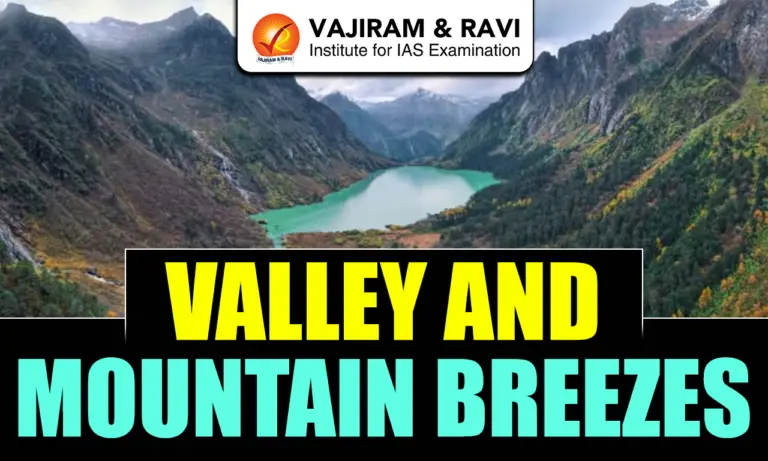
Valley and Mountain Breezes are localized wind systems that develop in hilly regions due to daily heating and cooling differences between mountain slopes and valley floors. These winds occur in a regular diurnal cycle, reversing direction between day and night. Meteorologists classify them as anabatic and katabatic winds because their movement is controlled by temperature driven pressure variations along slopes.
Valley Breeze
A Valley Breeze is a daytime wind that moves upward from the valley floor toward mountain slopes due to differential solar heating. During sunny conditions, mountain slopes heat faster than valley bottoms, creating low pressure along slopes. Warm air rises upslope through convection, generating gentle winds that travel upward along the valley sides.
Also Read: Mountain Ranges in India
Mountain Breeze
A Mountain Breeze is a nighttime wind that flows downward from mountain slopes into the valley. After sunset, rapid radiation cooling makes mountain air colder and denser than valley air. This heavy air moves downhill under gravity and spreads across the valley floor, forming a cool drainage wind.
Also Read: Indus Valley Civilization





Valley and Mountain Breezes Features
Valley and Mountain Breezes represent daily reversing wind systems in mountainous regions driven by temperature contrasts and pressure differences.
- Diurnal Wind Cycle: These winds operate within a 24 hour cycle. Valley Breezes dominate during daylight while Mountain Breezes develop after sunset when cooling reverses pressure gradients.
- Wind Process:
- Anabatic: Valley Breezes are classified as anabatic winds. Warm, less dense air formed on heated slopes rises upward, moving from the valley toward higher mountain elevations.
- Katabatic: Mountain Breezes represent katabatic winds. Cold, dense air formed by nighttime cooling flows downslope due to gravity toward the valley floor.
- Daytime Heating Mechanism: On clear sunny days, mountain slopes absorb more solar radiation than valley bottoms. This uneven heating produces localized low pressure along slopes.
- Night-time Radiation Cooling: After sunset, mountain surfaces lose heat quickly through terrestrial radiation. Cooling occurs faster on slopes than on the valley floor.
- Pressure Distribution: During daytime, pressure becomes lower on mountain slopes and relatively higher in valleys. At night, slopes develop higher pressure while valleys remain comparatively warmer.
- Impact on Local Temperature: Campers and travelers in mountainous regions often experience warm afternoons followed by sudden cold winds after sunset due to Mountain Breeze development.
- Influence on Cloud Formation: Rising warm air along slopes during Valley Breezes can transport moisture upward, sometimes forming clouds near upper mountain regions.
- Wind Direction: Valley Breeze moves upward from valley to mountain slopes, while Mountain Breeze flows downward from mountain ridges to valley floors.
- Density Variation: Warm air in Valley Breezes has lower density and rises easily, whereas Mountain Breeze air is colder, denser and remains close to the ground.

 Last updated on March, 2026
→ UPSC Final Result 2025 is now out.
→ UPSC has released UPSC Toppers List 2025 with the Civil Services final result on its official website.
→ Anuj Agnihotri secured AIR 1 in the UPSC Civil Services Examination 2025.
→ UPSC Marksheet 2025 is now out.
→ UPSC Notification 2026 & UPSC IFoS Notification 2026 is now out on the official website at upsconline.nic.in.
→ UPSC Calendar 2026 has been released.
→ Check out the latest UPSC Syllabus 2026 here.
→ UPSC Prelims 2026 will be conducted on 24th May, 2026 & UPSC Mains 2026 will be conducted on 21st August 2026.
→ The UPSC Selection Process is of 3 stages-Prelims, Mains and Interview.
→ Prepare effectively with Vajiram & Ravi’s UPSC Prelims Test Series 2026 featuring full-length mock tests, detailed solutions, and performance analysis.
→ Enroll in Vajiram & Ravi’s UPSC Mains Test Series 2026 for structured answer writing practice, expert evaluation, and exam-oriented feedback.
→ Join Vajiram & Ravi’s Best UPSC Mentorship Program for personalized guidance, strategy planning, and one-to-one support from experienced mentors.
→ Shakti Dubey secures AIR 1 in UPSC CSE Exam 2024.
→ Also check Best UPSC Coaching in India
Valley and Mountain Breezes FAQs
Q1. What are Valley and Mountain Breezes? +
Q2. When does a Valley Breeze occur? +
Q3. When does a Mountain Breeze occur? +
Q4. What causes Valley and Mountain Breezes? +
Q5. What are Anabatic and Katabatic Winds? +
Tags: geography valley and mountain breezes