VB–G RAM G Bill Latest News
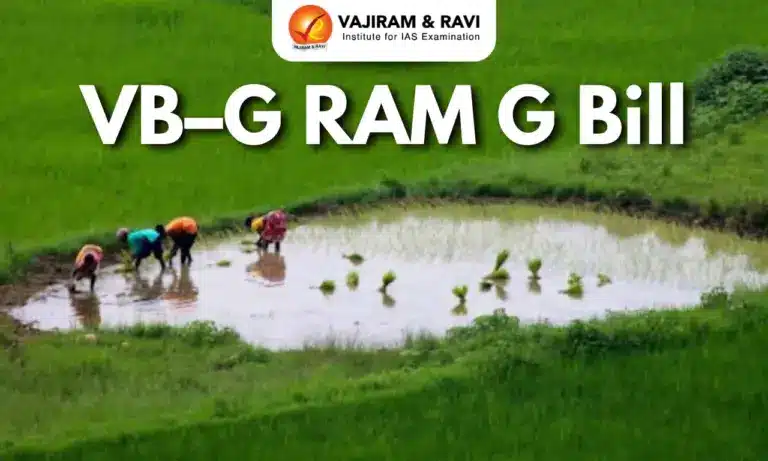
- The Viksit Bharat–Guarantee for Rozgar and Ajeevika Mission (Gramin) – VB-G Ram G- Bill, 2025 proposes a sweeping overhaul of India’s two-decade-old rural employment system by replacing MGNREGA, 2005.
- While positioned as a modernised framework for rural jobs and livelihoods, critics contend that the Bill could significantly increase the financial and administrative burden on state governments, raising concerns over its feasibility and federal implications.
Key Changes Proposed by the VB–G RAM G Bill
- The Viksit Bharat–Guarantee for Rozgar and Ajeevika Mission (Gramin) Bill, 2025 proposes a fundamental restructuring of India’s rural employment guarantee by replacing the MGNREGA, 2005.
- The following are the five most consequential statutory changes, with relevant sections and clauses.
Expansion of Guaranteed Employment Days – [Section 3(1), VB–G RAM G Bill | Section 3(1), MGNREG Act]
- The Bill guarantees 125 days of wage employment per rural household per financial year, up from “not less than 100 days” under MGNREGA.
- Under MGNREGA, 100 days became a de facto ceiling due to NREGA software constraints, despite legal flexibility.
- Existing provisions under Section 3(4) of MGNREGA allowed:
- Additional 50 days in drought or disaster-notified areas.
- 150 days for certain Scheduled Tribe households in forest areas.
- VB–G RAM G makes 125 days the standard statutory entitlement, rather than an exception triggered by special circumstances.
Change in Centre–State Funding Pattern – [Section 22(2), VB–G RAM G Bill]
- A major departure from MGNREGA, where the Centre paid 100% of unskilled wage costs.
- Proposed cost-sharing under VB–G RAM G:
- 90:10 (Centre:State) for Northeastern States, Himalayan States, and UTs with legislature (Uttarakhand, Himachal Pradesh, J&K).
- 60:40 for all other States and UTs with legislature.
- 100% Central funding for UTs without legislature.
- This shifts direct wage liability to States, substantially increasing their fiscal responsibility.
- Under MGNREGA, States were primarily responsible only for:
- Unemployment allowance
- ¼ of material costs
- State-level administrative expenses
Normative Allocation Replaces Labour Budget – Sections 4(5) & 4(6), VB–G RAM G Bill
- Section 4(5): Central Government shall determine State-wise normative allocation for each financial year based on prescribed objective parameters.
- Normative allocation is a system where a central authority sets fixed, principled limits (norms) for funding or resource distribution to states/regions, shifting from demand-driven models.
- Section 4(6): Any expenditure beyond this allocation shall be borne by the State Government.
- “Normative allocation” is defined as the Central fund allocation to a State.
- This replaces the Labour Budget mechanism under MGNREGA, where:
- States submitted annual work plans and labour budgets by January 31.
- Funding was demand-driven and open-ended.
- Effectively converts a rights-based, demand-led scheme into a budget-capped, supply-driven programme.
Statutory Pause During Peak Agricultural Seasons – Section 6(1) & Section 6(2), VB–G RAM G Bill
- Section 6(1): No work shall be commenced or executed during notified peak agricultural seasons.
- Section 6(2): States must notify, in advance, a period aggregating to 60 days per financial year covering sowing and harvesting.
- Notifications may vary by:
- Districts
- Blocks
- Gram Panchayats
- Agro-climatic zones and local cropping patterns
- All planning and execution authorities are legally bound to ensure works occur only outside these periods.
- While addressing farm labour shortages, this reduces the effective window to realise the 125-day guarantee.
Viksit Gram Panchayat Plans & National Infrastructure Stack – Schedule I, VB–G RAM G Bill
- All works must originate from Viksit Gram Panchayat Plans, consolidated upward:
- Gram Panchayat → Block → District → State
- These are aggregated into the Viksit Bharat National Rural Infrastructure Stack, aligned with national priorities.
- The Stack covers four thematic domains:
- Water security (water-related works)
- Core rural infrastructure
- Livelihood-related infrastructure
- Extreme weather mitigation works
- Plans will be integrated with the PM Gati Shakti National Master Plan, enabling spatial optimisation and inter-departmental convergence.





Rationale Behind the Proposed Overhaul of MGNREGA
- The government argues that an overhaul was necessary as MGNREGA, enacted in 2005, no longer reflects current rural realities.
- With declining poverty levels and expanded digital access, the scheme has continued to face structural issues such as misuse of funds, weak monitoring, and creation of low-quality assets.
- In FY 2024–25, misappropriation amounted to ₹193.67 crore, while only 7.61% of households completed the full 100 days of work.
- The proposed VB–G RAM G framework seeks to replace this fragmented approach with a more focused, accountable, and technology-driven rural employment system.
Expected Impact of VB–G RAM G on the Rural Economy
- The government argues that the new law will strengthen rural employment, incomes, and infrastructure.
- By prioritising water-related works, rural roads, markets, and climate-resilient assets, the scheme aims to raise agricultural productivity and reduce distress migration.
- Digitised planning, payments, and monitoring are expected to improve efficiency, transparency, and delivery.
What It Means for Farmers
- Farmers are expected to benefit in multiple ways:
- Improved labour availability during peak sowing and harvesting, as States can pause public works for up to 60 days.
- Lower wage inflation during critical agricultural seasons.
- Better water and irrigation infrastructure, enhancing farm resilience.
- Improved rural connectivity and storage facilities, reducing post-harvest losses.
Gains for Rural Workers
- For workers, the government highlights:
- 25% increase in guaranteed employment days (125 days instead of 100).
- Digital wage payments and Aadhaar-based verification, reducing delays and wage theft.
- Mandatory unemployment allowance if work is not provided.
- Creation of durable community assets such as roads and water systems.
- Predictable job availability through panchayat-led planning.
Stronger Accountability and Monitoring
- To address past weaknesses, the Bill introduces robust accountability mechanisms:
- AI-based fraud detection systems
- GPS and mobile-based monitoring of works
- Weekly public disclosures of scheme data
- Twice-yearly social audits at the gram panchayat level
- Central and State-level steering committees for oversight

 Last updated on March, 2026
→ UPSC Final Result 2025 is now out.
→ UPSC has released UPSC Toppers List 2025 with the Civil Services final result on its official website.
→ Anuj Agnihotri secured AIR 1 in the UPSC Civil Services Examination 2025.
→ UPSC Marksheet 2025 is now out.
→ UPSC Notification 2026 & UPSC IFoS Notification 2026 is now out on the official website at upsconline.nic.in.
→ UPSC Calendar 2026 has been released.
→ Check out the latest UPSC Syllabus 2026 here.
→ UPSC Prelims 2026 will be conducted on 24th May, 2026 & UPSC Mains 2026 will be conducted on 21st August 2026.
→ The UPSC Selection Process is of 3 stages-Prelims, Mains and Interview.
→ Prepare effectively with Vajiram & Ravi’s UPSC Prelims Test Series 2026 featuring full-length mock tests, detailed solutions, and performance analysis.
→ Enroll in Vajiram & Ravi’s UPSC Mains Test Series 2026 for structured answer writing practice, expert evaluation, and exam-oriented feedback.
→ Join Vajiram & Ravi’s Best UPSC Mentorship Program for personalized guidance, strategy planning, and one-to-one support from experienced mentors.
→ Shakti Dubey secures AIR 1 in UPSC CSE Exam 2024.
→ Also check Best UPSC Coaching in India
VB–G RAM G Bill FAQs
Q1. What is the VB–G RAM G Bill, 2025?+
Q2. How does the Bill change employment guarantees?+
Q3. How does funding under VB–G RAM G differ from MGNREGA?+
Q4. What is the provision for pausing work during agricultural seasons?+
Q5. What accountability mechanisms are introduced?+
Tags: mains articles upsc current affairs upsc mains current affairs VB–G RAM G Bill