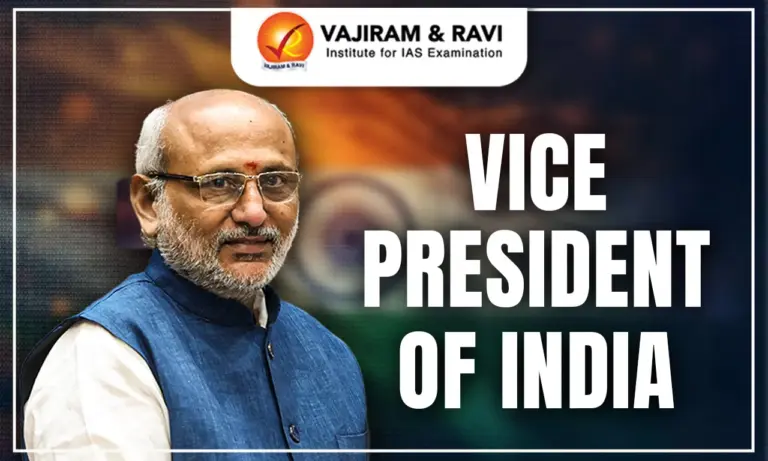
The Vice President of India hold the second-highest constitutional office after the President. As per Article 65 of the Indian Constitution, the Vice President is in charge during situations where the President is unable to fulfill their duties whether due to resignation, removal, death, impeachment, or incapacity. By default, the Vice Presidents of India also serves as the ex-officio Chairman of the Rajya Sabha, presiding over its sessions and ensuring the smooth conduct of proceedings. Since the role was established, 15 strong personalities have been Vice Presidents of India.
Vice Presidents of India
Unlike the President, the Vice Presidents of India are elected only by the members of both houses of Parliament, Lok Sabha and Rajya Sabha. State legislatures have no role in this election. C. P. Radhakrishnan serving as the 15th Vice President of India since September 9, 2025. The first to hold the position was Dr. Sarvepalli Radhakrishnan, who served from May 13, 1952, to May 12, 1957.
Mohammad Hamid Ansari remains the only Vice President to complete two full terms, serving from August 11, 2007, to August 11, 2017. He was succeeded by M. Venkaiah Naidu, who held the post under President Ram Nath Kovind until August 2022. The Vice Presidents of India serve a five-year term but continue in office until a successor is elected.
Current Vice President of India
C. P. Radhakrishnan has been elected as the 15th and Current Vice President of India. He secured a total of 452 votes, comfortably crossing the required majority mark of 391 votes, and won the contest by a margin of 152 votes.
The Vice President of India holds the second-highest constitutional office in the country. By virtue of this position, the Vice-President also serves as the ex-officio Chairman of the Rajya Sabha. The election to this office is conducted by an electoral college consisting of members from both Houses of Parliament. Unlike the presidential election, the State Legislatures have no role in this process.





List of Vice Presidents of India from 1952 to 2026
Dr. Sarvepalli Radhakrishnan was First Vice President of India, took oath at Rashtrapati Bhavan on May 13, 1952. Below is the complete List of Vice Presidents of India from 1952 to 2026:
| List of Vice Presidents of India from 1952 to 2026 | ||||
|---|---|---|---|---|
| S. No. | Vice-President | Tenure (From) | Tenure (To) | President(s) During Tenure |
| 1 | Dr. Sarvepalli Radhakrishnan | 13 May 1952 | 12 May 1962 | Dr. Rajendra Prasad |
| 2 | Dr. Zakir Hussain | 13 May 1962 | 12 May 1967 | Dr. Sarvepalli Radhakrishnan |
| 3 | Varahagiri Venkata Giri | 13 May 1967 | 20 July 1969 | Dr. Zakir Hussain |
| 4 | Gopal Swarup Pathak | 31 August 1969 | 30 August 1974 | V. V. Giri, Dr. Fakhruddin Ali Ahmed |
| 5 | Basappa Danappa Jatti | 31 August 1974 | 30 August 1979 | Dr. Fakhruddin Ali Ahmed, Neelam Sanjiva Reddy |
| 6 | Justice Muhammad Hidayatullah | 31 August 1979 | 30 August 1984 | Neelam Sanjiva Reddy, Giani Zail Singh |
| 7 | Ramaswamy Venkataraman | 31 August 1984 | 24 July 1987 | Giani Zail Singh |
| 8 | Shankar Dayal Sharma | 7 September 1987 | 24 July 1992 | Ramaswamy Venkataraman |
| 9 | Kocheril Raman Narayanan | 21 August 1992 | 24 July 1997 | Shankar Dayal Sharma |
| 10 | Krishan Kant | 21 August 1997 | 27 July 2002 | K. R. Narayanan, A. P. J. Abdul Kalam |
| 11 | Bhairon Singh Shekhawat | 19 August 2002 | 21 July 2007 | A. P. J. Abdul Kalam |
| 12 | Mohammad Hamid Ansari | 11 August 2007 | 10 August 2017 | Pratibha Patil, Pranab Mukherjee, Ram Nath Kovind |
| 13 | M. Venkaiah Naidu | 11 August 2017 | 11 August 2022 | Ram Nath Kovind |
| 14 | Jagdeep Dhankhar | 11 August 2022 | 21 July 2025 | Droupadi Murmu |
| 15 | C. P. Radhakrishnan | 09 September 2025 | Incumbent | Droupadi Murmu |
Vice Presidents of India Constitutional Provision
The Vice Presidents of India holds an important constitutional position, acting as the second-highest authority in the country and playing a key legislative and executive role. The provisions related to the office of the Vice Presidents of India are discussed in Articles 63 to 70 of the Indian Constitution. These articles outline the eligibility, method of election, tenure, powers, functions, and procedures in case of vacancies. The table below includes overview of Vice President of India Constitutional Provision:
| Vice President of India Constitutional Provision | |
| Article | Details |
|
Article 63 |
There will be an Indian Vice President |
|
Article 64 |
The Vice-President shall not hold any other paid post and shall serve as the Council of States’ de facto Chairman |
|
Article 65 |
When there are brief gaps in the office or when the president is not present, the vice president fills in for him or herself. |
|
Article 66 |
The members of an electoral college made up of representatives from both Houses of Parliament will choose the vice president. The Vice-President is not permitted to serve in either the House of Representatives or the House of the Legislature of any State. |
|
Article 67 |
From the time of his appointment, the Vice-tenure President’s in office must be for a period of five years. |
|
Article 68 |
Before the term’s expiration, a vote must be held to fill any vacancies caused by the vice president’s tenure coming to an end. Elections must be held as soon as possible to fill any vacancies left by the vice president’s death, resignation, or removal. |
|
Article 69 |
Each Vice President must take an oath or affirmation before the President, or a person he has nominated in that capacity. |
|
Article 70 |
President’s duties are discharged in other emergencies |
First Vice President of India
Dr. Sarvepalli Radhakrishnan was First Vice President of India. He was born on September 5, 1888, to Shri S. Veerasamiah. A renowned scholar and philosopher, Radhakrishnan held several academic honours, including an M.A., and multiple honorary degrees such as D.Litt., LL.D., D.C.L., and D.L. He was also a Fellow of the British Academy (F.B.A.) and the Royal Society of Literature (F.R.S.L.), and an Honorary Fellow at All Souls College, Oxford.
Vice Presidents of India Eligibility Criteria
To be eligible for the position of Vice President of India, a candidate must meet certain constitutional criteria. These qualifications ensure that the office is held by an individual with sufficient experience, integrity, and independence. Below are the key Vice Presidents of India Eligibility Criteria.
If elected while still a member of either House, he is considered to have vacated that seat from the day he takes office. Also, the Vice Presidents of India cannot hold any salaried position under the central, state, or local governments, or any public authority during the term.
- Must be a citizen of India.
- Must be at least 35 years old.
- Must not hold any office of profit under the central or state government, or any public or local authority.
Vice Presidents of India Tenure
The Vice Presidents of India assumes office on the date he begins his term, which lasts for five years. However, he can choose to resign before completing the term. Apart from resignation, there are several other situations where the office of the Vice President can become vacant:
- Completion of the five-year term
- Voluntary resignation
- Removal through a formal process
- Death while in office
- If the election is declared invalid by the Supreme Court
Vice Presidents of India Impeachment
Article 67(b) of the Indian Constitution deals with the removal of the Vice-President of India. It states that the Vice-President may be removed from office by a resolution of the Rajya Sabha (Council of States) passed by a majority of all its then members and agreed to by the Lok Sabha (House of the People). However, such a resolution cannot be moved unless at least 14 days’ notice has been given of the intention to move it.
Vice Presidents of India Powers and Functions
- Chairman of Rajya Sabha: The Vice Presidents of India serves as the ex-officio Chairman of the Rajya Sabha. In this role, his powers and functions are similar to those of the Speaker of the Lok Sabha.
- Acts as President: He is an Acting President if the President resigns, is removed, dies, or otherwise becomes unable to serve. However, he can hold the office for a maximum of six months until a new President is elected.
- Temporary Duties: The Vice President also performs the duties of the President during temporary absences due to illness, travel, or any other reason.
- Similarity to U.S. System: His role resembles that of the Vice President of the United States, who presides over the Senate (the upper house of Congress).
- Legal Continuity: If the Supreme Court later declares an election of Vice Presidents of India void, all decisions and actions made before that judgment remain valid and are not reversed.
Vice Presidents of India Important Facts
- The Vice Presidents of India is the ex-officio Chairman of the Rajya Sabha and presides over its sessions.
- The Vice President’s office may fall vacant due to:
- Resignation
- Removal
- Death
- Absence caused by illness or incapacity
- When the Vice President discharges the functions of the President, the Deputy Chairman of the Rajya Sabha takes over the Vice President’s duties in the House.
- Articles 63 to 71 of the Constitution discusses the Vice Presidents of India.
- The 11th Constitutional Amendment changed the method of election. Earlier, both Houses met in a joint sitting to elect the Vice President. Now, they vote separately.
- Parliament determines the salary of the Vice Presidents of India. The current monthly salary of the Rajya Sabha Chairman (ex-officio the Vice President of India) is ₹4 lakh.

 Last updated on March, 2026
→ UPSC Final Result 2025 is now out.
→ UPSC has released UPSC Toppers List 2025 with the Civil Services final result on its official website.
→ Anuj Agnihotri secured AIR 1 in the UPSC Civil Services Examination 2025.
→ UPSC Marksheet 2025 is now out.
→ UPSC Notification 2026 & UPSC IFoS Notification 2026 is now out on the official website at upsconline.nic.in.
→ UPSC Calendar 2026 has been released.
→ Check out the latest UPSC Syllabus 2026 here.
→ UPSC Prelims 2026 will be conducted on 24th May, 2026 & UPSC Mains 2026 will be conducted on 21st August 2026.
→ The UPSC Selection Process is of 3 stages-Prelims, Mains and Interview.
→ Prepare effectively with Vajiram & Ravi’s UPSC Prelims Test Series 2026 featuring full-length mock tests, detailed solutions, and performance analysis.
→ Enroll in Vajiram & Ravi’s UPSC Mains Test Series 2026 for structured answer writing practice, expert evaluation, and exam-oriented feedback.
→ Join Vajiram & Ravi’s Best UPSC Mentorship Program for personalized guidance, strategy planning, and one-to-one support from experienced mentors.
→ Shakti Dubey secures AIR 1 in UPSC CSE Exam 2024.
→ Also check Best UPSC Coaching in India
Vice President of India FAQs
Q1. How many vice presidents are there in India?+
Q2. Who is the 17th vice president of India?+
Q3. Who is the vice president of India now?+
Q4. What are the powers of the Vice President of India?+
Q5. Who was the first woman vice president of India?+
Tags: vice presidents of india