Vishwamitri River Latest News
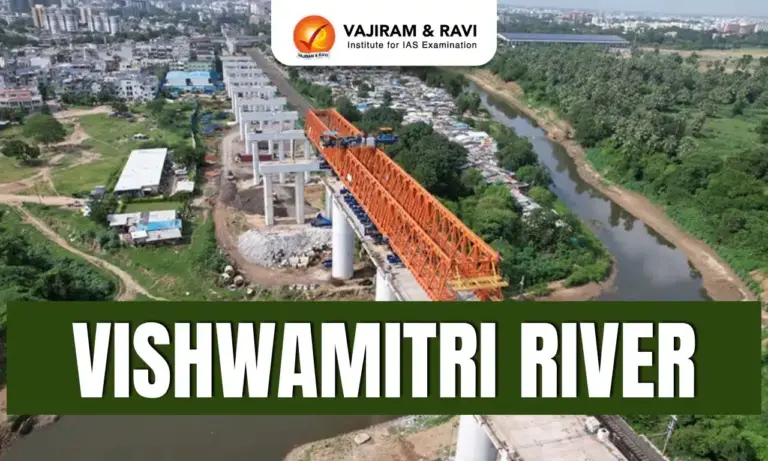
The Vishwamitri River passes through the city of Vadodara in Gujarat and is commonly known as India’s Crocodile River due to the presence of mugger crocodiles in and around the urban area.
About Vishwamitri River
- It is a small non-perennial river located in Gujarat.
- Course:
- It originates from the western and southern slopes of the Pavagadh hills in eastern Gujarat.
- The river flows westward, through Gujarat’s third-largest city, Vadodara, after which it meets the two tributaries of Dhadar and Jambuva before draining into the Arabian Sea via the Gulf of Khambhat.
- Total Length: 200 km
- The highly meandering, sinuous river has a unique ecosystem bearing a plethora of beautiful ravines right from its beginning till its end.
- Porcupines, the common Indian civet, the jungle cat, cobras, pythons, the checkered keelback, and the Bengal monitor are some of the species found in the ravines on the banks of this river.
- Vishwamitri is also where the protected and vulnerable species of the Indian crocodile (Crocodylus palustris), also known as the mugger, resides.
- A 2025 census recorded 442 mugger crocodiles within a 21-kilometre stretch flowing through Vadodara.
- Historically, the river has been central to Vadodara’s development, with human settlements along its banks dating back to 1000 B.C.






Key Facts about Mugger Crocodiles
- It is one of the 24 extant species of crocodilians found globally.
- The crocodile’s common name comes from magar, which translates loosely to “water monster” in the Hindi and Urdu languages.
- Distribution:
- The mugger’s geographic range extends from extreme southeastern Iran eastward to Bangladesh and from Nepal and northern India south to Sri Lanka.
- In India it is found in 15 Indian states, with the largest populations in the middle Ganges (Bihar-Jharkhand) and Chambal (Madhya Pradesh, Gujarat and Rajasthan) basins.
- Habitat:
- It is most commonly found in freshwater environments such as rivers, lakes, hill streams, and village ponds.
- It can live in fresh water and coastal saltwater lagoons.
- This species makes burrows on land in a wide variety of habitats.
- Features:
- The maximum length for this crocodile is 4-5 meters, and maximum weight is 700 kg.
- It has rough, thick scales covering the whole body with a muddy brown coloring. It has the widest snout among all crocodile species.
- The length of an adult crocodile’s tail is about 1.8 meters long.
- Conservation Status:
- IUCN Red List: Vulnerable
Source: IE

 Last updated on March, 2026
→ UPSC Final Result 2025 is now out.
→ UPSC has released UPSC Toppers List 2025 with the Civil Services final result on its official website.
→ Anuj Agnihotri secured AIR 1 in the UPSC Civil Services Examination 2025.
→ UPSC Marksheet 2025 is now out.
→ UPSC Notification 2026 & UPSC IFoS Notification 2026 is now out on the official website at upsconline.nic.in.
→ UPSC Calendar 2026 has been released.
→ Check out the latest UPSC Syllabus 2026 here.
→ UPSC Prelims 2026 will be conducted on 24th May, 2026 & UPSC Mains 2026 will be conducted on 21st August 2026.
→ The UPSC Selection Process is of 3 stages-Prelims, Mains and Interview.
→ Prepare effectively with Vajiram & Ravi’s UPSC Prelims Test Series 2026 featuring full-length mock tests, detailed solutions, and performance analysis.
→ Enroll in Vajiram & Ravi’s UPSC Mains Test Series 2026 for structured answer writing practice, expert evaluation, and exam-oriented feedback.
→ Join Vajiram & Ravi’s Best UPSC Mentorship Program for personalized guidance, strategy planning, and one-to-one support from experienced mentors.
→ Shakti Dubey secures AIR 1 in UPSC CSE Exam 2024.
→ Also check Best UPSC Coaching in India
Vishwamitri River FAQs
Q1. What is the Vishwamitri River?+
Q2. From where does the Vishwamitri River originate?+
Q3. Which major city does the Vishwamitri River flow through?+
Q4. Into which water body does the Vishwamitri River finally drain?+
Tags: prelims pointers upsc current affairs upsc prelims current affairs