Water Hyacinth Latest News
A thick blanket of water hyacinth covers the Mula river near Holkar Bridge, raising alarms among residents about the river’s deteriorating condition.
About Water Hyacinth
- It is a free-floating, aquatic plant in the pickerelweed family.
- Scientific Name: Eichhornia crassipes
- It is native to tropical regions of South America and is now present on all continents except Antarctica.
- It is one of the world’s most serious water weeds because of its aggressive, fast-growing nature.
- It can form dense mats that reduce the water quality, change water flows, and increase sediment.
- It crowds out native aquatic plants and animals, altering ecosystems, destroying habitats, and blocking irrigation systems.
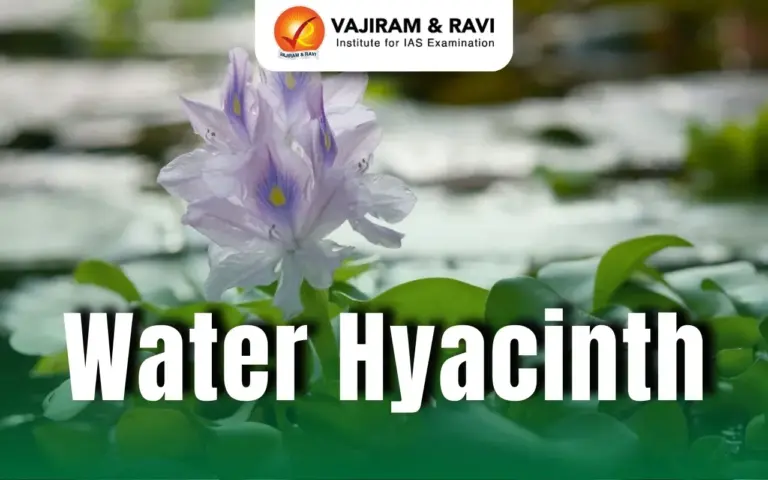
- It has thick, glossy green leaves and lavender to violet flowers with a yellow spot.
- It was introduced to India during the British colonial rule as an ornamental aquatic plant from South America.




Water Hyacinth Uses
- The plant has been used as a biofertilizer in some organic agriculture practices.
- The plant produces beautiful purple flowers that have high aesthetic value.
- It is rich in fibrous stems that can be processed into a wide array of handbags, interior decorative material, table mats, baskets, and other products.
- It has been reported that this plant is a good phytoremediation species, suggesting it has the ability to trap and remove toxic metabolites and harmful heavy metals from water.
Water Hyacinth FAQs
Q1. Why is water hyacinth harmful?
Ans. Water-hyacinth blocks waterways and limits boat traffic, recreation, flood control and wildlife use
Q2. Why is water hyacinth called the Terror of Bengal?
Ans. Water hyacinth is called the “Terror of Bengal” due to its highly invasive nature and the severe environmental and economic problems it causes in the region.
Q3. What is water hyacinth good for?
Ans. The water hyacinth collected can be used to feed animals, or processed to improve the soil, as compost or biochar.
Source: TOI

 Last updated on March, 2026
→ UPSC Final Result 2025 is now out.
→ UPSC has released UPSC Toppers List 2025 with the Civil Services final result on its official website.
→ Anuj Agnihotri secured AIR 1 in the UPSC Civil Services Examination 2025.
→ UPSC Marksheet 2025 is now out.
→ UPSC Notification 2026 & UPSC IFoS Notification 2026 is now out on the official website at upsconline.nic.in.
→ UPSC Calendar 2026 has been released.
→ Check out the latest UPSC Syllabus 2026 here.
→ UPSC Prelims 2026 will be conducted on 24th May, 2026 & UPSC Mains 2026 will be conducted on 21st August 2026.
→ The UPSC Selection Process is of 3 stages-Prelims, Mains and Interview.
→ Prepare effectively with Vajiram & Ravi’s UPSC Prelims Test Series 2026 featuring full-length mock tests, detailed solutions, and performance analysis.
→ Enroll in Vajiram & Ravi’s UPSC Mains Test Series 2026 for structured answer writing practice, expert evaluation, and exam-oriented feedback.
→ Join Vajiram & Ravi’s Best UPSC Mentorship Program for personalized guidance, strategy planning, and one-to-one support from experienced mentors.
→ Shakti Dubey secures AIR 1 in UPSC CSE Exam 2024.
→ Also check Best UPSC Coaching in India