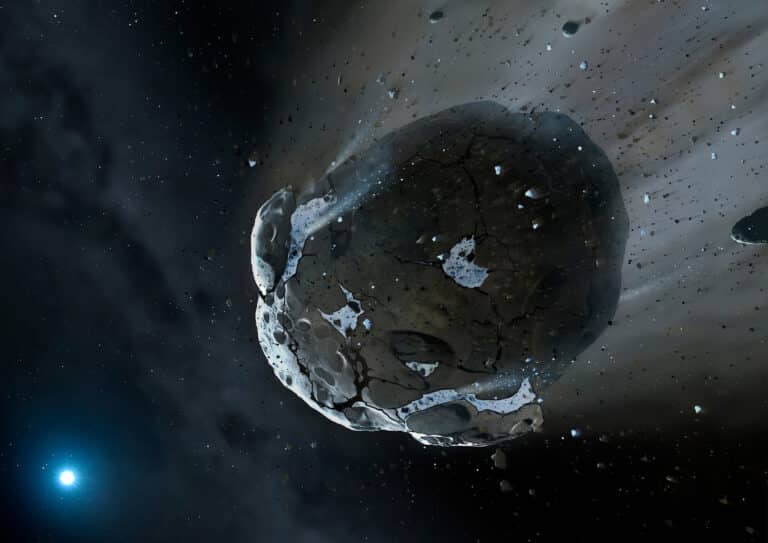
About 3200 Phaethon:
- It is classified as an asteroid – the first to be discovered via satellite.
- It was discovered on Oct. 11, 1983, using the Infrared Astronomical Satellite, and named after the Greek myth of Phaethon, son of the sun god Helios, due to its close approach to Sun.
- It is blue in colour, which is rare for an asteroid.
- It orbits the sun every 524 days (1.43 years), coming as close as 0.14 astronomical units (AU) and reaching as far as 2.40 AU from the sun.
- Its orbit is highly elliptical. It completes a rotation on its axis every 3.60 hours.
- Phaethon is about 6.3 kilometers in diameter, making it larger than 99% of asteroids.
- Phaethon’s orbit is 0.02 AU from Earth’s orbit at its closest point. This means that there is a wide berth between this asteroid and Earth at all times.
- Mystery:
- While Phaethon looked like an asteroid – it appeared to be the source of the annual Geminid meteor shower.
- In 2021, scientists suggested that some of this object’s comet-like behaviour might stem from sodium fizzing from its surface.
What is Geminid meteor shower?
- The Geminids meteor shower, which peaks during mid-December each year, is considered to be one of the best and most reliable annual meteor showers.
- During its peak, 120 Geminid meteors can be seen per hour under perfect conditions.
- Unlike a majority of the meteor showers we experience on Earth, the Geminids are the product of an asteroid.
- The reliable shower produces bright meteors associated with the asteroid Phaethon, a strange blue rock that acts like a comet.
What is an astronomical unit (AU)?
- An Astronomical Unit (AU) is the average distance between Earth and the Sun, which is about 93 million miles or 150 million kilometers.
- Astronomical units are usually used to measure distances within our Solar System.
Q1) What is an Asteroid?
Asteroids are small, rocky objects that orbit the Sun. Although asteroids orbit the Sun like planets, they are much smaller than planets.
Source: Solar flare-monitoring spacecraft reveals asteroid Phaethon’s comet-like behaviour






 Last updated on April, 2026
→ UPSC Final Result 2025 is now out.
→ UPSC has released UPSC Toppers List 2025 with the Civil Services final result on its official website.
→ Anuj Agnihotri secured AIR 1 in the UPSC Civil Services Examination 2025.
→ UPSC Marksheet 2025 is now out.
→ UPSC Notification 2026 & UPSC IFoS Notification 2026 is now out on the official website at upsconline.nic.in.
→ UPSC Calendar 2026 has been released.
→ Check out the latest UPSC Syllabus 2026 here.
→ UPSC Prelims 2026 will be conducted on 24th May, 2026 & UPSC Mains 2026 will be conducted on 21st August 2026.
→ The UPSC Selection Process is of 3 stages-Prelims, Mains and Interview.
→ Prepare effectively with Vajiram & Ravi’s UPSC Prelims Test Series 2026 featuring full-length mock tests, detailed solutions, and performance analysis.
→ Enroll in Vajiram & Ravi’s UPSC Mains Test Series 2026 for structured answer writing practice, expert evaluation, and exam-oriented feedback.
→ Join Vajiram & Ravi’s Best UPSC Mentorship Program for personalized guidance, strategy planning, and one-to-one support from experienced mentors.
→ Shakti Dubey secures AIR 1 in UPSC CSE Exam 2024.
→ Also check Best UPSC Coaching in India