What are Solar Flares?
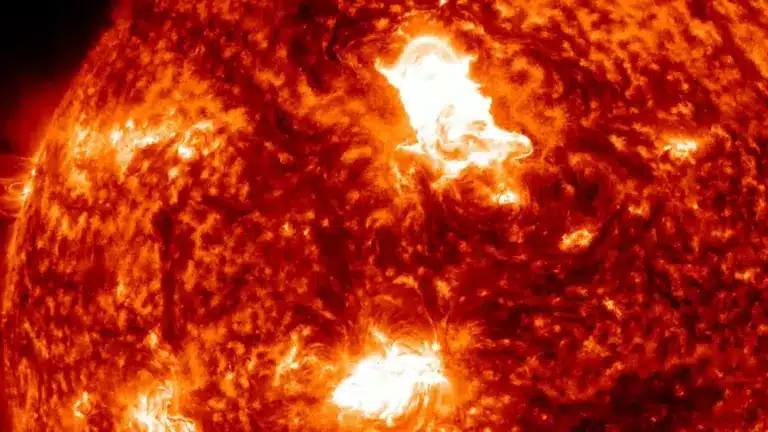
- A solar flare is an intense burst of radiation coming from the release of magnetic energy associated with sunspots.
- Flares are our solar system’s largest explosive events.
- They are seen as bright areas on the sun, and they can last from minutes to hours.
- In a matter of just a few minutes, they heat the material to many millions of degrees and produce a burst of radiation across the electromagnetic spectrum, including from radio waves to x-rays and gamma rays.
- Although solar flares can be visible in white light, they are often more readily noticed via their bright X-ray and ultraviolet emissions.
- Effect of Solar Flare on Earth:
- The intense radiation emitted during a solar flare can affect satellite communications, disrupt radio signals, and even pose a risk to astronauts in space.
- Additionally, the increased solar radiation can lead to geomagnetic storms, which may impact power grids and cause auroras (northern and southern lights) at lower latitudes.
About Sympathetic Solar Flare
- This type of solar outburst occurs when sunspots or filaments are invisibly linked by massive magnetic field loops that arch above the solar surface. When one flare detonates, the others follow in rapid succession.
- Sympathetic solar flares typically involve just two linked flares, ranging in intensity from minor outbursts to X-class flares, the most powerful class of solar flares.
- They are more likely to happen during or around the solar maximum, the most active phase of the Sun’s approximately 11-year solar cycle.
Q1: What are Geomagnetic Storms?
A geomagnetic storm is a major disturbance of Earth’s magnetosphere. These storms result from variations in the solar wind that produces significant changes in the currents, plasmas, and fields in Earth’s magnetosphere. The solar wind conditions that are effective for creating geomagnetic storms are sustained (for several hours) periods of the high-speed solar wind and a southward-directed solar wind magnetic field (opposite the direction of Earth’s field) at the dayside of the magnetosphere.
Source: Sun witnesses a massive explosion on April 23: How it will impact Earth






 Last updated on March, 2026
→ UPSC Final Result 2025 is now out.
→ UPSC has released UPSC Toppers List 2025 with the Civil Services final result on its official website.
→ Anuj Agnihotri secured AIR 1 in the UPSC Civil Services Examination 2025.
→ UPSC Marksheet 2025 is now out.
→ UPSC Notification 2026 & UPSC IFoS Notification 2026 is now out on the official website at upsconline.nic.in.
→ UPSC Calendar 2026 has been released.
→ Check out the latest UPSC Syllabus 2026 here.
→ UPSC Prelims 2026 will be conducted on 24th May, 2026 & UPSC Mains 2026 will be conducted on 21st August 2026.
→ The UPSC Selection Process is of 3 stages-Prelims, Mains and Interview.
→ Prepare effectively with Vajiram & Ravi’s UPSC Prelims Test Series 2026 featuring full-length mock tests, detailed solutions, and performance analysis.
→ Enroll in Vajiram & Ravi’s UPSC Mains Test Series 2026 for structured answer writing practice, expert evaluation, and exam-oriented feedback.
→ Join Vajiram & Ravi’s Best UPSC Mentorship Program for personalized guidance, strategy planning, and one-to-one support from experienced mentors.
→ Shakti Dubey secures AIR 1 in UPSC CSE Exam 2024.
→ Also check Best UPSC Coaching in India