About Borehole Geophysics Research Laboratory (BGRL):
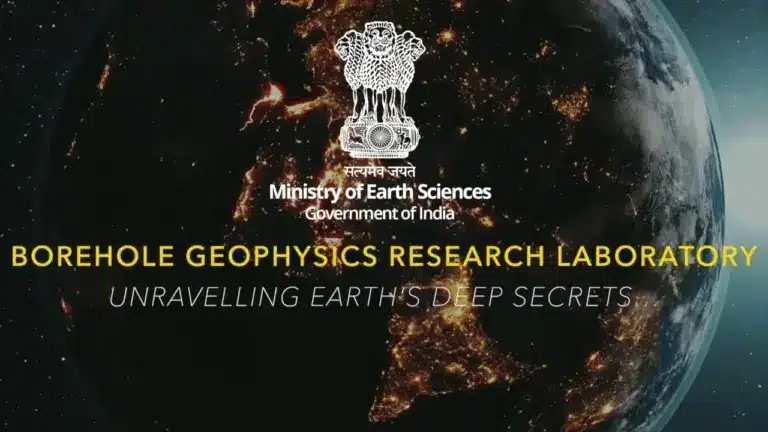
- The BGRL in Karad, Maharashtra, is a specialised institute under theMinistry of Earth Sciences mandated to execute India’s sole scientific deep-drilling programme.
- Under BGRL, the aim is to drill the earth’s crust to a depth of 6 km and conduct studies to help expand the understanding of reservoir-triggered earthquakes in the Koyna-Warna region of Maharashtra.
- This region has been experiencing frequent earthquakes since the Shivaji Sagar Lake, or the Koyna Dam, was impounded in 1962.
- BGRL’s 3-km-deep pilot borehole in Koyna is complete; the Ministry of Earth Sciences is committed to reaching a depth of 6 km.
- It employs a unique drilling strategy—a hybrid of mud rotary drilling and air hammering.
- Benefits of a deep-drilling mission:
- Scientifically drilled boreholes can be a hub of direct, unique in situ experiments and observations and monitor a region’s fault lines and seismic behaviour.
- They also provide exact and fundamental knowledge of the composition of the earth’s crust, structure, and processes, and help validate models based on surface studies.
- Thus, it can inform a range of societal problems related to geohazards and geo-resources.
- It can also help expand scientific know-how and technological innovation, especially in seismology (the study of earthquakes).
- It can also spur the development of tools and equipment for drilling, observation, data analysis, sensors, etc.
Q1: What is mud rotary drilling?
Mud rotary drilling is a method for wellbore excavation. It involves the use of a spinning drill bit aided by a semi-fluid mixture known as mud. Mud rotary drilling is adaptable for a wide range of trenchless construction situations, and is considered the most versatile and common of drilling methods.
Source: Why is India drilling a 6-km deep hole in Maharashtra?






 Last updated on April, 2026
→ UPSC Final Result 2025 is now out.
→ UPSC has released UPSC Toppers List 2025 with the Civil Services final result on its official website.
→ Anuj Agnihotri secured AIR 1 in the UPSC Civil Services Examination 2025.
→ UPSC Marksheet 2025 is now out.
→ UPSC Notification 2026 & UPSC IFoS Notification 2026 is now out on the official website at upsconline.nic.in.
→ UPSC Calendar 2026 has been released.
→ Check out the latest UPSC Syllabus 2026 here.
→ UPSC Prelims 2026 will be conducted on 24th May, 2026 & UPSC Mains 2026 will be conducted on 21st August 2026.
→ The UPSC Selection Process is of 3 stages-Prelims, Mains and Interview.
→ Prepare effectively with Vajiram & Ravi’s UPSC Prelims Test Series 2026 featuring full-length mock tests, detailed solutions, and performance analysis.
→ Enroll in Vajiram & Ravi’s UPSC Mains Test Series 2026 for structured answer writing practice, expert evaluation, and exam-oriented feedback.
→ Join Vajiram & Ravi’s Best UPSC Mentorship Program for personalized guidance, strategy planning, and one-to-one support from experienced mentors.
→ Shakti Dubey secures AIR 1 in UPSC CSE Exam 2024.
→ Also check Best UPSC Coaching in India