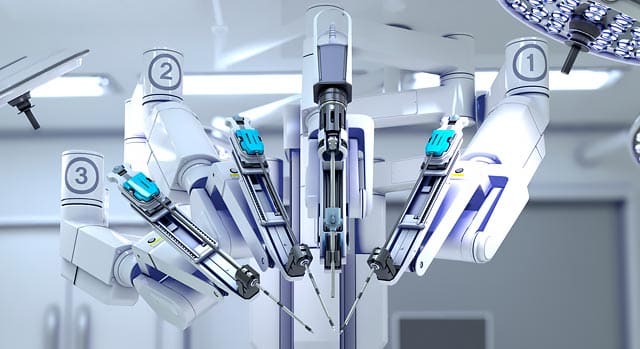
About Da Vinci Robotic Surgical System:
- It is a tool that helps surgeons perform a variety of surgeries including gynecological surgeries, urological, head and neck, thoracic, colorectal, cardiac and general surgeries.
- Because the da Vinci only uses small cuts, it’s less traumatic on your body, resulting in less pain, fewer complications and a shorter recovery time.
- It can be used in the field of colorectal surgeries, urology, oncology, gynaecology thoracic, cardiology, paediatric and gastro-intestinal surgeries, kidney transplants and in liver transplantation.
- The machine is made up of three different parts:
- The console/control center: The surgeon operates while seated at a console unit, using hand and foot controls and with a magnified, 3D, high-definition view.
- The patient cart: The cart holds surgical instruments and the camera.
- The vision cart: This cart has a video screen so that the healthcare providers in the room can see what’s happening during the surgery.
What is a Da Vinci surgery?
- A Da Vinci surgery is when your surgery is performed using the da Vinci Surgical System, a machine that uses four thin robotic arms.
- The robotic instruments have a wider range of motion than the human hand. Surgeons can use the surgical system for a variety of procedures.
What’s the difference between a da Vinci surgery and an open surgery?
- Use of the da Vinci system makes your surgery “minimally invasive” (smaller incisions).
- The procedure uses small cuts (less than or equal to 1 centimeter long), tiny surgical instruments, fewer stitches and a laparoscope (a telescope) which is a thin tube with a light and a camera lens.
- This is different than traditional surgeries that use larger, more invasive cuts through skin, tissues and muscles.
Q1) What is a Da Vinci surgery?
A Da Vinci surgery is when your surgery is performed using the da Vinci Surgical System, a machine that uses four thin robotic arms. The robotic instruments have a wider range of motion than the human hand. Surgeons can use the surgical system for a variety of procedures.





 Last updated on March, 2026
→ UPSC Final Result 2025 is now out.
→ UPSC has released UPSC Toppers List 2025 with the Civil Services final result on its official website.
→ Anuj Agnihotri secured AIR 1 in the UPSC Civil Services Examination 2025.
→ UPSC Marksheet 2025 is now out.
→ UPSC Notification 2026 & UPSC IFoS Notification 2026 is now out on the official website at upsconline.nic.in.
→ UPSC Calendar 2026 has been released.
→ Check out the latest UPSC Syllabus 2026 here.
→ UPSC Prelims 2026 will be conducted on 24th May, 2026 & UPSC Mains 2026 will be conducted on 21st August 2026.
→ The UPSC Selection Process is of 3 stages-Prelims, Mains and Interview.
→ Prepare effectively with Vajiram & Ravi’s UPSC Prelims Test Series 2026 featuring full-length mock tests, detailed solutions, and performance analysis.
→ Enroll in Vajiram & Ravi’s UPSC Mains Test Series 2026 for structured answer writing practice, expert evaluation, and exam-oriented feedback.
→ Join Vajiram & Ravi’s Best UPSC Mentorship Program for personalized guidance, strategy planning, and one-to-one support from experienced mentors.
→ Shakti Dubey secures AIR 1 in UPSC CSE Exam 2024.
→ Also check Best UPSC Coaching in India