About Garnet
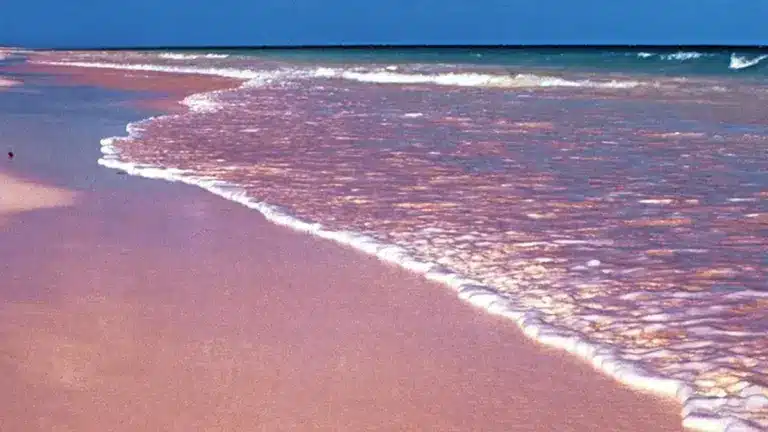
- It is rare in beach sand which is destroyed by prolonged exposure to the waves and currents of the ocean.
- It is a fairly common mineral, deep red in color. It crystallizes at high temperatures, usually where large mountain belts grind upwards out of colliding tectonic plates.
- These are opaque, transparent to translucent minerals that can be found as individual crystals, pebbles, or clumps of inter-grown crystals.
- There are six main types of garnet, all with slightly different chemical compositions. All kinds of garnet can form in the same place and sometimes garnets can be a combination of types e.g. pyrope-almadine or pyrope-spessartine.
- Formation:
- These are formed in metamorphic (schist, amphibolite, and eclogite) and igneous (some granites and peridotite) rocks.
- This mineral grows deep in Earth’s crust, in the same kind of conditions in which diamonds are formed.
- When sand contains an abundance of garnets, it usually contains epidote and magnetite as well.
- Australia produces almost half of the world’s garnets, with the rest mainly coming from India, USA, and China.
- Uses: It is used for manufacturing blasting media, abrasives, grinding wheels, mosaic cutting stones, decorative wall plasters, ceramics, polishing of picture tubes, glass polishing and antiskid surface for roads, air strips etc.
Q1: What are Critical Minerals?
A mineral is critical when the risk of supply shortage and associated impact on the economy is (relatively) higher than other raw materials. These minerals are essential for economic development and national security, and their lack of availability/ the concentration of extraction/ processing in a few geographical locations could potentially lead to supply chain vulnerabilities.
Source: The Hindu






 Last updated on March, 2026
→ UPSC Final Result 2025 is now out.
→ UPSC has released UPSC Toppers List 2025 with the Civil Services final result on its official website.
→ Anuj Agnihotri secured AIR 1 in the UPSC Civil Services Examination 2025.
→ UPSC Marksheet 2025 is now out.
→ UPSC Notification 2026 & UPSC IFoS Notification 2026 is now out on the official website at upsconline.nic.in.
→ UPSC Calendar 2026 has been released.
→ Check out the latest UPSC Syllabus 2026 here.
→ UPSC Prelims 2026 will be conducted on 24th May, 2026 & UPSC Mains 2026 will be conducted on 21st August 2026.
→ The UPSC Selection Process is of 3 stages-Prelims, Mains and Interview.
→ Prepare effectively with Vajiram & Ravi’s UPSC Prelims Test Series 2026 featuring full-length mock tests, detailed solutions, and performance analysis.
→ Enroll in Vajiram & Ravi’s UPSC Mains Test Series 2026 for structured answer writing practice, expert evaluation, and exam-oriented feedback.
→ Join Vajiram & Ravi’s Best UPSC Mentorship Program for personalized guidance, strategy planning, and one-to-one support from experienced mentors.
→ Shakti Dubey secures AIR 1 in UPSC CSE Exam 2024.
→ Also check Best UPSC Coaching in India