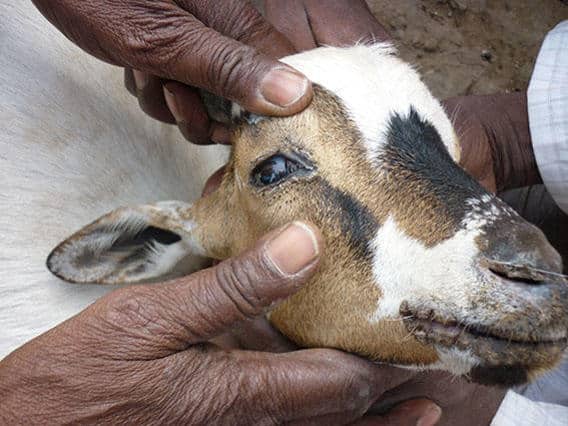
About is Peste Des Petits Ruminants (PPR):
- PPR is a highly contagious viral disease of sheep and goats with high mortality.
- It is caused by a virus of the family paramyxoviridae and genus morbillivirus. It is closely related to other members of the genus, including the rinderpest virus, measles virus, and canine distemper virus.
- Symptoms:
- PPRV causes disease with an array of clinical signs. It also causes immunosuppression, which makes affected animals more likely to pick up other infections.
- Clinical signs of PPR: Fever, Eye and nasal discharges, Sores in the mouth, Diarrhoea, Listlessness, Respiratory signs (coughing and pneumonia), Abortion and death, with case fatality rates as high as 90% (though more commonly around 20%).
- Transmission:
- PPR is mainly spread during close contact when a susceptible animal inhales the virus from infected animals’ coughing and sneezing.
- Transmission can also occur indirectly through contact with infected objects (fomites) such as feed troughs, bedding etc.
- Sources of PPRV include secretions from the eyes, nose, and mouth of infected animals, as well as their faeces.
- Once introduced, the virus can infect up to 90 percent of an animal herd, and the disease kills anywhere from 30 to 70 percent of infected animals.
- The PPR virus does not infect humans.
- Disease prevalence:
- PPR was first described in 1942 in Côte d’Ivoire. Since then the disease has spread to large regions in Africa, the Middle East and Asia.
- In India, the disease outbreaks have been reported in Himachal Pradesh, Andhra Pradesh, West Bengal, Telangana, Karnataka and Chhattisgarh.
- Currently, a global initiative driven by the Food and Agriculture Organization of the United Nations (FAO) and the World Organisation for Animal Health (OIE) exists to eradicate PPR by 2030.
Q1) What is immunosuppression?
The suppression of the body’s innate ability to ward off disease and infection is known as immunosuppression. This suppression may be the result of a disease that targets the immune system, such as the human immunodeficiency virus (HIV), or as a consequence of pharmaceutical agents used to fight certain conditions, like cancer.
Source: Explainer: Goat plague sends alarm bells ringing in Himachal Pradesh






 Last updated on March, 2026
→ UPSC Final Result 2025 is now out.
→ UPSC has released UPSC Toppers List 2025 with the Civil Services final result on its official website.
→ Anuj Agnihotri secured AIR 1 in the UPSC Civil Services Examination 2025.
→ UPSC Marksheet 2025 is now out.
→ UPSC Notification 2026 & UPSC IFoS Notification 2026 is now out on the official website at upsconline.nic.in.
→ UPSC Calendar 2026 has been released.
→ Check out the latest UPSC Syllabus 2026 here.
→ UPSC Prelims 2026 will be conducted on 24th May, 2026 & UPSC Mains 2026 will be conducted on 21st August 2026.
→ The UPSC Selection Process is of 3 stages-Prelims, Mains and Interview.
→ Prepare effectively with Vajiram & Ravi’s UPSC Prelims Test Series 2026 featuring full-length mock tests, detailed solutions, and performance analysis.
→ Enroll in Vajiram & Ravi’s UPSC Mains Test Series 2026 for structured answer writing practice, expert evaluation, and exam-oriented feedback.
→ Join Vajiram & Ravi’s Best UPSC Mentorship Program for personalized guidance, strategy planning, and one-to-one support from experienced mentors.
→ Shakti Dubey secures AIR 1 in UPSC CSE Exam 2024.
→ Also check Best UPSC Coaching in India