About GST Council:
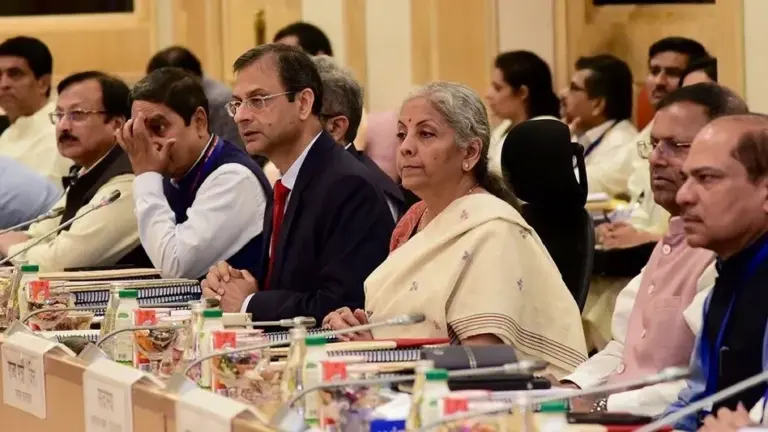
- It is a constitutional body responsible for making recommendations on issues related to the implementation of the Goods and Services Tax (GST) in India.
- Article 279A of the Indian Constitution gives power to the President of India to constitute a joint forum of the Centre and States called the GST Council, consisting of:
- Union Finance Minister as Chairperson
- The Union Minister of State, in-charge of Revenue of finance
- The Minister in-charge of finance or taxation, or any other Minister nominated by each State Government
- It is an apex committee to modify, reconcile, or make recommendations to the Union and the States on important issues related to GST, like the goods and services that may be subjected to or exempted from GST, model GST Laws, principles that govern Place of Supply, threshold limits, GST rates including the floor rates with bands, special rates for raising additional resources during natural calamities/disasters, special provisions for certain States, etc.
- Decisions in the GST Council are taken during its meetings.
- One half of the total number of members of the GST Council shall constitute the quorum at its meeting.
- Each decision of the council must be supported by a majority of not less than three-fourth of weighted votes of the members present and voting.
- The vote of the Central Government shall have a weightage of 1/3rd of the votes cast, and the votes of all the State Governments taken together shall have a weightage of 2/3rd of the total votes cast in that meeting.
- Secretariat:
- The Secretariat manages the GST Council.
- It is manned by officers taken on deputation from both the Central and State Governments.
- The entire cost of managing the Secretariat is borne by the Central Government.
- The Ex-officio Secretary to the GST Council is the Revenue Secretary of India.
- The office of the council is located in New Delhi.
What is the Goods and Services Tax (GST)?
- It is an indirect tax which has replaced many indirect taxes in India, such as excise duty, VAT, services tax, etc.
- The GST Act was passed in Parliament on 29th March 2017 and came into effect on 1st July, 2017.
- It is a single domestic indirect tax law for the entire country.
- It is a comprehensive, multi-stage, destination-based tax that is levied on the supply of goods and services, right from the manufacturer to the consumer.
- Under the GST regime, the tax is levied at every point of sale.
- In the case of intrastate sales, Central GST and State GST are charged.
- All the interstate sales are chargeable to the Integrated GST.
- Credits of input taxes paid at each stage will be available in the subsequent stage of value addition, which makes GST essentially a tax only on value addition at each stage.
- The final consumer will thus bear only the GST charged by the last dealer in the supply chain, with set-off benefits at all the previous stages.
- The GST is paid by consumers, but it is remitted to the government by the businesses selling the goods and services.
Q1: What is an Indirect Tax?
An indirect tax is collected by one entity in the supply chain, such as a manufacturer or retailer, and paid to the government; however, the tax is passed onto the consumer by the manufacturer or retailer as part of the purchase price of a good or service. The consumer is ultimately paying the tax by paying more for the product.






 Last updated on April, 2026
→ UPSC Final Result 2025 is now out.
→ UPSC has released UPSC Toppers List 2025 with the Civil Services final result on its official website.
→ Anuj Agnihotri secured AIR 1 in the UPSC Civil Services Examination 2025.
→ UPSC Marksheet 2025 is now out.
→ UPSC Notification 2026 & UPSC IFoS Notification 2026 is now out on the official website at upsconline.nic.in.
→ UPSC Calendar 2026 has been released.
→ Check out the latest UPSC Syllabus 2026 here.
→ UPSC Prelims 2026 will be conducted on 24th May, 2026 & UPSC Mains 2026 will be conducted on 21st August 2026.
→ The UPSC Selection Process is of 3 stages-Prelims, Mains and Interview.
→ Prepare effectively with Vajiram & Ravi’s UPSC Prelims Test Series 2026 featuring full-length mock tests, detailed solutions, and performance analysis.
→ Enroll in Vajiram & Ravi’s UPSC Mains Test Series 2026 for structured answer writing practice, expert evaluation, and exam-oriented feedback.
→ Join Vajiram & Ravi’s Best UPSC Mentorship Program for personalized guidance, strategy planning, and one-to-one support from experienced mentors.
→ Shakti Dubey secures AIR 1 in UPSC CSE Exam 2024.
→ Also check Best UPSC Coaching in India