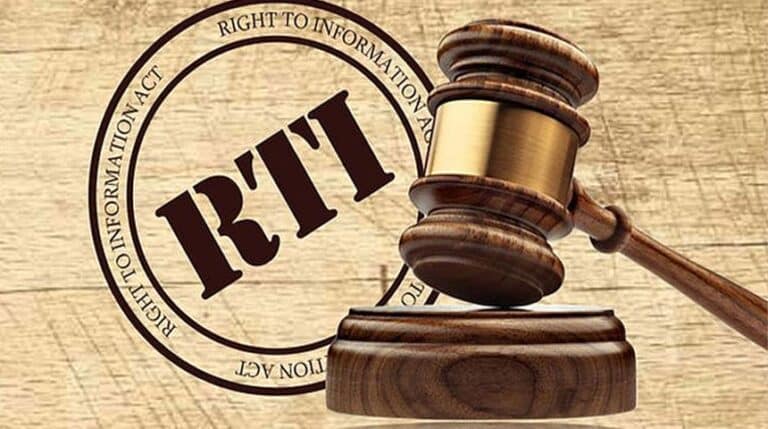
About Right to Information (RTI) Act, 2005:
- It is a law enacted by the Parliament of India “to provide for setting out the practical regime of right to information for citizens.
- The Right to Information is derived from our fundamental right of Expression under Article 19 of the Constitution of India.
- The Act applies to all States and Union Territories of India.
- Under the provisions of the Act, any citizen may request information from a “public authority” (a body of Government or “instrumentality of State”) by making an application in writing or through electronic means.
- The information seeker is not required to give reasons for seeking information.
- Time Period for Supply of Information:
- In the normal course, information to an applicant shall be supplied within 30 days from the receipt of the application by the public authority.
- If the information sought concerns the life or liberty of a person, it should be supplied within 48 hours.
- Public Information Officer (PIO): Every public authority shall designate some of its officers as PIOs. They are responsible for giving information to a person who seeks information under the RTI Act.
- The Act also requires every public authority to computerize their records for wide dissemination and to proactively publish certain categories of information so that the citizens need minimum recourse to request information formally.
- Exemptions:
- It also contains several exemptions which enable public authorities to deny requests for information. It ranges from the sovereignty and security of India to trade secrets.
- Section 24 of the act exempts certain security and intelligence organizations from the purview of the act except the information pertaining to the allegations of corruption and human rights violations.
Q1) What is the Central Information Commission?
The Central Information Commission has been constituted with effect from 12-10-2005 under the Right to Information Act, 2005. The jurisdiction of the Commission extends over all Central Public Authorities.The Commission has certain powers and functions mentioned in sections 18, 19, 20 and 25 of the RTI Act, 2005.The decisions of the Commission are final and binding.
Source: Set Up RTI Portal Within 3 Months”: Supreme Court To High Courts






 Last updated on March, 2026
→ UPSC Final Result 2025 is now out.
→ UPSC has released UPSC Toppers List 2025 with the Civil Services final result on its official website.
→ Anuj Agnihotri secured AIR 1 in the UPSC Civil Services Examination 2025.
→ UPSC Marksheet 2025 is now out.
→ UPSC Notification 2026 & UPSC IFoS Notification 2026 is now out on the official website at upsconline.nic.in.
→ UPSC Calendar 2026 has been released.
→ Check out the latest UPSC Syllabus 2026 here.
→ UPSC Prelims 2026 will be conducted on 24th May, 2026 & UPSC Mains 2026 will be conducted on 21st August 2026.
→ The UPSC Selection Process is of 3 stages-Prelims, Mains and Interview.
→ Prepare effectively with Vajiram & Ravi’s UPSC Prelims Test Series 2026 featuring full-length mock tests, detailed solutions, and performance analysis.
→ Enroll in Vajiram & Ravi’s UPSC Mains Test Series 2026 for structured answer writing practice, expert evaluation, and exam-oriented feedback.
→ Join Vajiram & Ravi’s Best UPSC Mentorship Program for personalized guidance, strategy planning, and one-to-one support from experienced mentors.
→ Shakti Dubey secures AIR 1 in UPSC CSE Exam 2024.
→ Also check Best UPSC Coaching in India