Air Pollution Latest News
- Every winter, Delhi sinks into its usual toxic smog, and India reaches for the same short-term fixes — cloud seeding, smog towers, water sprinkling, odd-even rules, and festival crackdowns.
- These highly visible measures create an impression of action but barely change actual air quality.
- Public discourse deteriorates just as fast: scientists are accused of weak solutions, politicians of lacking resolve, and administrators of copying Western models without local adaptation.
- While each criticism holds some truth, none captures the full systemic failure.
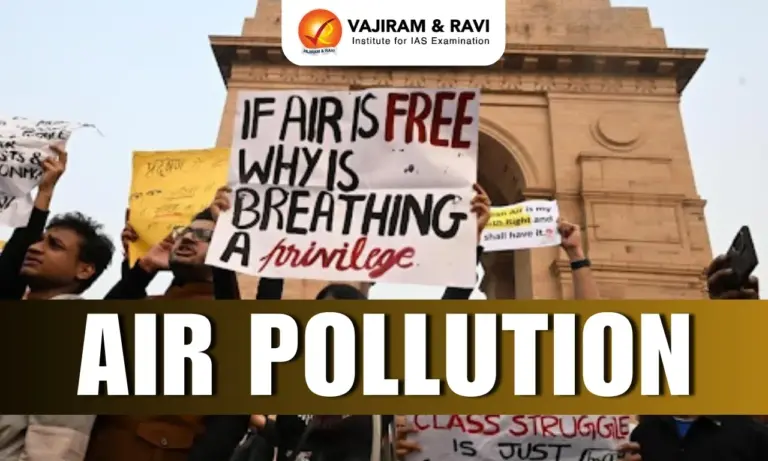
- This year, frustration spilled into small but peaceful public protests near India Gate.
- Around 50–60 people gathered on November 24, only to face heavy police presence, and five protesters were detained — reflecting both civic desperation and administrative defensiveness.
Fragmented Governance Fuels India’s Pollution Crisis
- India’s repeated reliance on short-term pollution fixes stems from a deeper structural flaw: air-quality management is fragmented across numerous agencies.
- Responsibilities are split among the Environment Ministry, CPCB, SPCBs, CAQM, DPCC, municipal bodies, and sectoral departments such as agriculture, transport, industry, and energy.
- With each institution overseeing only a slice of the problem, no agency has full authority or accountability for clean air.
Governance Constraints and Institutional Weaknesses
- Environmental powers are constitutionally shared, budgets and manpower vary widely, and judicial pressure prioritises quick actions over long-term planning.
- With many actors involved but none empowered to lead, sustained progress becomes difficult.
Short-Term Measures Dominate
- The dominance of quick fixes is also rooted in political incentives.
- High-visibility measures — cloud seeding, smog towers, anti-smog guns, odd-even rules — allow governments to show immediate action without challenging powerful polluting sectors like construction, transport, and agriculture.
- They cost little, fit easily into annual budgets, and avoid political backlash.
- These interventions respond to headlines rather than the science of pollution control, providing momentary relief while doing little to improve public health.
Political Optics Over Public Health
- Short-term measures help officials signal responsiveness during pollution spikes but fail to address structural issues such as waste burning, fuel quality, industrial emissions, and crop residue management.
- As a result, the air remains hazardous, and winter pollution keeps returning, exposing systemic gaps that require long-term, coordinated reform rather than symbolic actions.





Why India’s Pollution Policies Fail: The Intellectual and Western Traps
- India’s pollution strategies are often shaped by elite institutions, think tanks, and top scientific bodies.
- While analytically strong, these actors are frequently removed from the lived realities of municipal governance — understaffing, limited budgets, informal economies, and political constraints.
- As a result:
- Policies look good on paper but falter in execution.
- Strategies underestimate enforcement challenges and administrative gaps.
- Many remain pilots, unable to scale due to lack of institutional support.
- This trap prioritises what should work in theory over what can work in practice.
The Western Trap: Copying Global Models Without Local Adaptation
- India routinely imports “best practices” from Europe, East Asia, and the West, assuming they can function the same way here.
- However, India’s conditions differ sharply:
- High-density neighbourhoods
- Informal construction and transport sectors
- Weak regulatory credibility
- Limited institutional trust and administrative coordination
- When applied without contextual redesign, global models collapse under India’s resource constraints and socio-political complexities.
- The issue isn’t foreign ideas — it’s the lack of localisation.
Building India-Specific Clean-Air Solutions
- To overcome the intellectual and Western traps, India must adapt global ideas to its own administrative, political, and social realities.
- Even strong solutions need redesign to fit local constraints.
Need for Clear Leadership and Accountability
- India’s air-quality governance lacks clarity on:
- Who leads,
- Who coordinates, and
- Who is accountable across national, State, and municipal levels.
- A modern clean-air law with explicit mandates could streamline roles, reduce jurisdictional overlaps, and ensure steady implementation.
Strengthening Institutions Through Stable Systems
- Effective air-quality management requires:
- Multi-year funding to build staff and maintain equipment
- Public access to compliance data to build credibility
- Visible enforcement to ensure rules matter
- Consistency across election cycles, avoiding policy resets
- These foundation blocks enable long-term progress rather than episodic, crisis-driven interventions.
The Missing Link: Science Managers
- India needs a professional cadre of science managers who can:
- Understand both science and governance
- Translate expert knowledge into workable policies
- Help ministries navigate complex transitions
- Maintain coherence despite bureaucratic turnover
- Without them, India’s scientific tools and models remain disconnected from actual policymaking.
Aligning Ambition with Capacity
- India’s main gap is not ideas but alignment:
- Policies often assume levels of staffing, coordination and public compliance that vary widely across cities and States.
- Solutions must start from Indian constraints—informal economies, uneven urban capacity, budget limits, and diverse regional priorities.
- Policies should be implementation-first, built around what agencies can realistically enforce and what communities will accept.
Source: TH

 Last updated on March, 2026
→ UPSC Final Result 2025 is now out.
→ UPSC has released UPSC Toppers List 2025 with the Civil Services final result on its official website.
→ Anuj Agnihotri secured AIR 1 in the UPSC Civil Services Examination 2025.
→ UPSC Marksheet 2025 is now out.
→ UPSC Notification 2026 & UPSC IFoS Notification 2026 is now out on the official website at upsconline.nic.in.
→ UPSC Calendar 2026 has been released.
→ Check out the latest UPSC Syllabus 2026 here.
→ UPSC Prelims 2026 will be conducted on 24th May, 2026 & UPSC Mains 2026 will be conducted on 21st August 2026.
→ The UPSC Selection Process is of 3 stages-Prelims, Mains and Interview.
→ Prepare effectively with Vajiram & Ravi’s UPSC Prelims Test Series 2026 featuring full-length mock tests, detailed solutions, and performance analysis.
→ Enroll in Vajiram & Ravi’s UPSC Mains Test Series 2026 for structured answer writing practice, expert evaluation, and exam-oriented feedback.
→ Join Vajiram & Ravi’s Best UPSC Mentorship Program for personalized guidance, strategy planning, and one-to-one support from experienced mentors.
→ Shakti Dubey secures AIR 1 in UPSC CSE Exam 2024.
→ Also check Best UPSC Coaching in India
Air Pollution FAQs
Q1. Why does India rely on short-term pollution measures every winter?+
Q2. What structural flaw lies at the heart of India’s pollution crisis?+
Q3. What is the “intellectual trap” in India’s pollution policymaking?+
Q4. How does the “Western trap” affect India’s clean air strategies?+
Q5. What India-specific reforms are needed for lasting clean air?+
Tags: air pollution mains articles upsc current affairs upsc mains current affairs