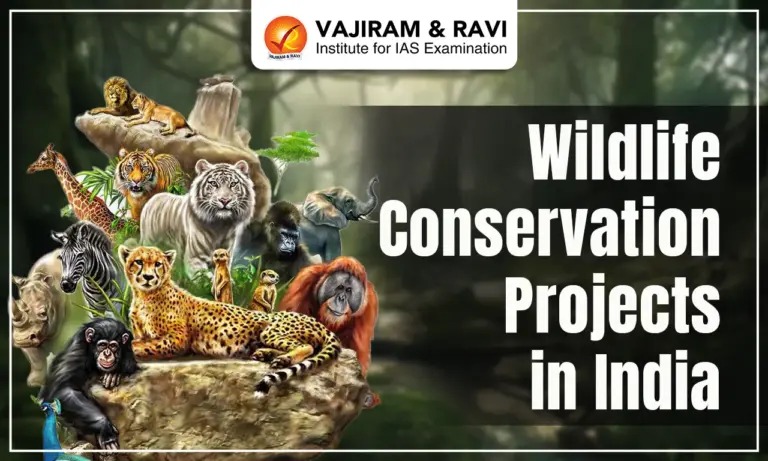
India, home to nearly 8% of global biodiversity, harbors over 103,258 animals (Zoological Survey of India, 2022) and 55,000 plant species (Botanical Survey of India. 2022). Rapid industrialization, deforestation, and poaching have endangered many species. To protect its ecological heritage, India launched various wildlife conservation projects under the Wildlife (Protection) Act, 1972. These projects aim to preserve critical habitats, ensure species survival, and maintain balance between human activity and biodiversity.
Wildlife Conservation Projects in India
Wildlife conservation projects in India focus on saving endangered species, restoring their natural habitats, and fostering human-wildlife coexistence. These projects are implemented by central and state agencies such as the National Tiger Conservation Authority (NTCA) and Project Elephant Division. As per the WWF Living Planet Report (2022), wildlife populations have globally declined by 69% since 1970, highlighting the urgent need for focused conservation efforts.
List of Wildlife Conservation Projects in India
India has launched several species-specific projects to protect its rich biodiversity and maintain ecological balance. These initiatives involve scientific monitoring, habitat restoration, and community participation. The following are the major wildlife conservation projects in India implemented by the MoEFCC and related authorities:
- Project Tiger
- Project Elephant
- Project Lion
- Project Snow Leopard
- Project Cheetah
- Project Hangul
- Project Crocodile
- Project Great Indian Bustard
- Indian Rhino Vision 2020
- Project Dolphin





Project Tiger
Launched in 1973 at Jim Corbett National Park, this project safeguards tigers and their habitats using a core-buffer strategy. It is managed by the National Tiger Conservation Authority (NTCA) under MoEFCC.
- Tiger Count: 1,411 (2006) → 3,167 (2022); over 75% of global population.
- Coverage: 53 Tiger Reserves covering 75,000 sq. km.
- Protection Status:
- IUCN: Endangered
- WPA: Schedule I
- CITES: Appendix I
Project Elephant
Started in 1992, this project conserves elephants and their migration corridors, aiming to minimize human-elephant conflict.
- Elephant Reserves: 33 across 14 states, covering 76,500 sq. km.
- Population: Around 29,964 (Census 2017).
- Key Measures:
- Radio-collaring for tracking
- Corridor restoration
- Welfare of captive elephants
- Protection Status:
- IUCN: Endangered
- WPA: Schedule I
- CITES: Appendix I
Project Lion
Initiated in 2020, Project Lion focuses on conserving the Asiatic Lion (Panthera leo persica), found exclusively in Gir National Park, Gujarat.
- Population Increase: 177 (1968) → 891 (2025).
- Key Measures:
- Habitat improvement
- Disease prevention
- Relocation to Kuno National Park, Madhya Pradesh (not executed completely)
- Protection Status:
- IUCN: Vulnerable
- WPA: Schedule I
Project Snow Leopard
Launched in 2009, this project protects snow leopards and their fragile high-altitude ecosystems across Jammu & Kashmir (including Ladakh), Himachal Pradesh, Uttarakhand, Sikkim, and Arunachal Pradesh.
- Population: Around 718 (SPAI 2023; WWF-India & MoEFCC).
- Focus Areas:
- Community-based conservation
- Livelihood diversification
- Camera-trap monitoring
- Protection Status:
- IUCN: Vulnerable
- WPA: Schedule I
- CITES: Appendix I
Project Cheetah
Started in 2022, this project aims to reintroduce cheetahs in India after 70 years of extinction.
- Implementation: MoEFCC & NTCA with Namibia and South Africa.
- Introduced Cheetahs: The first batch was 8 from Namibia (2022) and later 12 from South Africa (2023), totalling 20 in the initial stages in Kuno National Park.
- Objectives:
- Restore grassland ecosystems
- Establish self-sustaining populations
- Significance: World’s first intercontinental large-carnivore translocation.
- Status:
- IUCN: Vulnerable
- WPA: Schedule I
Project Hangul
Launched in 1970, this project conserves the Kashmir Red Deer (Cervus hanglu hanglu), once widespread in the Kashmir Valley but now confined to Dachigam National Park.
- Population: ~3,000-5,000 (1900s) → ≈150 (1970s) → recovered to ~260-290 in recent counts (263 in a 2021 census; some 2023 reports give 289).
- Key Measures:
- Habitat restoration
- Predator management
- Local community involvement
- Protection Status:
- IUCN: Critically Endangered
- WPA: Schedule I
Indian Crocodile Conservation Project
Started in 1975 with UNDP and FAO support, this project revived India’s three crocodile species- Gharial, Mugger, and Saltwater Crocodile- through breeding and release programs.
| Indian Crocodile Conservation Project | |||
| Species | IUCN Status | WPA | Major Habitat |
|
Gharial |
Critically Endangered |
Schedule I |
Chambal River |
|
Mugger |
Vulnerable |
Schedule I |
Gujarat, MP |
|
Saltwater |
Least Concern |
Schedule I |
Bhitarkanika, Odisha |
Project Great Indian Bustard
Launched in 2013, the project protects the Great Indian Bustard (Ardeotis nigriceps), one of the world’s heaviest flying birds, now critically endangered.
- Population: Estimated below 150 (2025); In 2013, the Rajasthan Forest Department cited “not more than 125”.
- Key Measures:
- Breeding centre in Jaisalmer
- Bird diverters on power lines to reduce collision mortality
- Habitat protection and restoration
- Protection Status:
- IUCN: Critically Endangered
- WPA: Schedule I
Indian Rhino Vision 2020
Launched in 2005, this project aims to expand the one-horned rhino population in Assam to 3,000 by 2022 through translocation and protection. The project formally ended in April 2021, after the final rhino transfers to Manas. Though the full goal of 3,000 across all target sites was not realized, significant gains were made: additional rhino populations in Manas, improved genetic mixing, and strengthened rhino numbers in core sites.
- Partners: Assam Forest Dept., WWF-India, International Rhino Foundation.
- Achievements: 4000 (2022)
- Key Sites: Kaziranga, Manas, Orang, Pobitora.
- Protection Status:
- IUCN: Vulnerable
- WPA: Schedule I
Project Dolphin
Announced in 2020 and operationalised in 2021, Project Dolphin focuses on conserving the Gangetic River Dolphin (Platanista gangetica), India’s National Aquatic Animal.
- Population: Around 6327 (2024).
- Key Rivers: Ganga, Brahmaputra and tributaries.
- Objectives:
- Reduce river pollution
- Improve riverine habitats
- Community-based awareness programs
- Protection Status:
- IUCN: Endangered
- WPA: Schedule I
- Taxonomy: Ganges and Indus river dolphins were earlier subspecies; Since 2021 recognized separately.
Wildlife Conservation Projects in India
The summary of the major Wildlife Conservation Projects in India is tabulated below:
| Wildlife Conservation Projects in India | |||||
|
Project Name |
Launch Year & Implementing Agency |
Target Species / Objective |
Latest Population / Status |
Key Measures / Features |
Protection Status |
|
Project Tiger |
1973 – NTCA, MoEFCC |
Tiger (Panthera tigris) |
1,411 (2006) → 3,167 (2022); ~75% of global population |
Core-buffer management; 53 Tiger Reserves over 75,000 sq. km; community participation |
IUCN: Endangered WPA: Schedule I CITES: Appendix I |
|
Project Elephant |
1992 – MoEFCC |
Asian Elephant (Elephas maximus) |
29,964 (Census 2017) |
33 reserves across 14 states (76,500 sq. km); corridor restoration; radio-collaring; welfare of captive elephants |
IUCN: Endangered WPA: Schedule I CITES: Appendix I |
|
Project Lion |
2020 – MoEFCC |
Asiatic Lion (Panthera leo persica) |
177 (1968) → 891 (2025) |
Habitat improvement; disease management; proposed relocation to Kuno NP |
IUCN: Vulnerable WPA: Schedule I |
|
Project Snow Leopard |
2009 – MoEFCC & GSLEP |
Snow Leopard (Panthera uncia) |
718 (SPAI 2023) across 5 Himalayan states |
Community-based conservation; livelihood diversification; camera-trap monitoring |
IUCN: Vulnerable WPA: Schedule I CITES: Appendix I |
|
Project Cheetah |
2022 – MoEFCC & NTCA (with Namibia & South Africa) |
African Cheetah (Acinonyx jubatus) – reintroduction after 70 years |
20 cheetahs translocated to Kuno National Park (8 from Namibia in 2022, 12 from South Africa in 2023) |
Restore grasslands; ensure genetic viability; world’s first intercontinental carnivore translocation |
IUCN: Vulnerable WPA: Schedule I |
|
Project Hangul |
1970 – J&K Forest Dept. |
Kashmir Red Deer (Cervus hanglu hanglu) |
~150 (1970s) → 263 (2021) → 289 (2023 est.) |
Habitat restoration; predator control; local community participation |
IUCN: Critically Endangered WPA: Schedule I |
|
Indian Crocodile Conservation Project |
1975 – MoEFCC with UNDP & FAO |
Gharial, Mugger, and Saltwater Crocodiles |
Gharial: Critically Endangered Mugger: Vulnerable Saltwater: Least Concern |
Captive breeding & reintroduction programs in Chambal, Gujarat, Odisha |
WPA: Schedule I (all species) |
|
Project Great Indian Bustard |
2013 – MoEFCC |
Great Indian Bustard (Ardeotis nigriceps) |
Fewer than 150 (2025) |
Breeding centre (Jaisalmer); bird diverters on power lines; habitat restoration |
IUCN: Critically Endangered WPA: Schedule I |
|
Indian Rhino Vision 2020 |
2005 – Assam Forest Dept., WWF, IRF |
One-horned Rhino (Rhinoceros unicornis) |
4,000 (2022); target 3,000 achieved partially |
Rhino translocation & genetic mixing; Manas, Kaziranga, Orang, Pobitora |
IUCN: Vulnerable WPA: Schedule I |
|
Project Dolphin |
2020 (Operational 2021) – MoEFCC |
Gangetic River Dolphin (Platanista gangetica) |
6,327 (2024) |
Reduce river pollution; habitat improvement; awareness programs |
IUCN: Endangered WPA: Schedule I |
Impact of Wildlife Conservation Projects in India
Wildlife conservation efforts have significantly strengthened India’s ecological and biodiversity profile.
- Tiger numbers have more than increased since 2006.
- Asiatic lions and rhinos show positive population trends.
- Crocodile and elephant conservation have stabilized species once nearing extinction.
- Improved habitats have promoted eco-tourism, benefiting local economies.
- India now ranks as the largest tiger range country and plays a leading role in CITES and CBD global conservation commitments.
Wildlife Conservation Projects in India Challenges
Despite progress, challenges persist in effective wildlife management.
Challenges:
- Habitat fragmentation and loss due to urbanization.
- Human-wildlife conflicts in border regions.
- Poaching and illegal wildlife trade.
- Climate change affecting species migration and breeding.
- Limited local awareness and community participation.
Way Forward:
- Enhance technology-based monitoring (drones, camera traps).
- Promote community-led conservation models.
- Strengthen anti-poaching networks and legal frameworks.
- Integrate wildlife corridors in developmental planning.
- Expand public awareness and eco-tourism initiatives for sustainable coexistence.
Wildlife Conservation Projects in India UPSC
India has 1014 Protected Areas (MoEFCC 2023) and 24.62% forest cover (ISFR 2021). Key wildlife counts include 3,682 tigers (2022), 29,964 elephants (2017), 891 lions (2025), 4000+ rhinos (2024), and 6,327 dolphins (2024). Conservation is governed by the Wildlife (Protection) Act, 1972, projects are managed by NTCA (2005) and MoEFCC divisions. India participates in global frameworks like CITES, CBD, CMS, and Ramsar Convention. Recent highlights include Project Cheetah (2022), GIB power line order (2021), and Project Dolphin under Namami Gange.
[Note: Different surveys/ censuses report slightly different recent totals (methods and years vary).]

 Last updated on March, 2026
→ UPSC Final Result 2025 is now out.
→ UPSC has released UPSC Toppers List 2025 with the Civil Services final result on its official website.
→ Anuj Agnihotri secured AIR 1 in the UPSC Civil Services Examination 2025.
→ UPSC Marksheet 2025 is now out.
→ UPSC Notification 2026 & UPSC IFoS Notification 2026 is now out on the official website at upsconline.nic.in.
→ UPSC Calendar 2026 has been released.
→ Check out the latest UPSC Syllabus 2026 here.
→ UPSC Prelims 2026 will be conducted on 24th May, 2026 & UPSC Mains 2026 will be conducted on 21st August 2026.
→ The UPSC Selection Process is of 3 stages-Prelims, Mains and Interview.
→ Prepare effectively with Vajiram & Ravi’s UPSC Prelims Test Series 2026 featuring full-length mock tests, detailed solutions, and performance analysis.
→ Enroll in Vajiram & Ravi’s UPSC Mains Test Series 2026 for structured answer writing practice, expert evaluation, and exam-oriented feedback.
→ Join Vajiram & Ravi’s Best UPSC Mentorship Program for personalized guidance, strategy planning, and one-to-one support from experienced mentors.
→ Shakti Dubey secures AIR 1 in UPSC CSE Exam 2024.
→ Also check Best UPSC Coaching in India
Wildlife Conservation Projects in India FAQs
Q1. What are Wildlife Conservation Projects in India?+
Q2. What is the aim of Project Tiger?+
Q3. Why was Project Cheetah launched?+
Q4. What does Project Elephant focus on?+
Q5. Which crocodiles are conserved under Project Crocodile?+
Tags: wildlife conservation projects in india