About Zero Debris Charter:
- It is an initiative of the European Space Agency (ESA) unveiled at the ESA Space Summit in Seville meeting in November 2023.
- The Charter comes after ESA Member States encouraged the Agency to implement “a Zero Debris approach for its missions and to encourage partners and other actors to pursue similar paths”.
- It is the first initiative of its kind to bring together the largest array and variety of space actors around the world with the joint goal of creating no more debris by 2030 and making possible the long-term sustainability of space activities.
- It aims to combine far-reaching guiding principles and highly ambitious yet realistic technical targets on which to build an ambitious Zero Debris roadmap, driving global space debris mitigation and remediation efforts.
- The charter is a non-legally binding agreement, but it fosters a community of proactive actors working collectively towards jointly defined targets for 2030.
- The charter sets out a number of targets, including that a mission’s probability of generating space debrisshould remain below 1 in 1,000 per object.
- It also sets a target of 99% success for post-mission disposal, including through external means when necessary.
- It encourages transparent information sharing and space traffic coordination.
- To implement the Charter, the ESA will focus on developing ground-breaking technologies for satellite end-of-life disposal, in-orbit servicing, and active debris removal.
- In addition, ESA will work hand-in-hand with institutions in charge of regulatory aspects.
Q1: What is Space Debris?
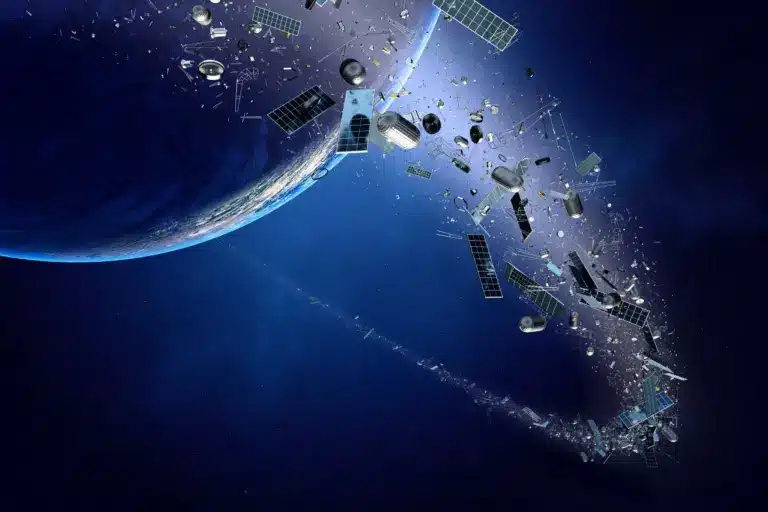
Space debris, or more colloquially known as space junk, is considered to be any human-made object in orbit not serving a useful purpose and typically is a result of space vehicles no longer in service. The objects that fit this classification greatly range in size, from old spacecraft and the rocket stages that launched them to micro-debris like flecks of paint. Much of the debris is in low Earth orbit, within 2,000 km (1,200 miles) of Earth’s surface, though some debris can be found in geostationary orbit 35,786 km (22,236 miles) above the Equator.
Source: Twelve countries sign the Zero Debris Charter






 Last updated on March, 2026
→ UPSC Final Result 2025 is now out.
→ UPSC has released UPSC Toppers List 2025 with the Civil Services final result on its official website.
→ Anuj Agnihotri secured AIR 1 in the UPSC Civil Services Examination 2025.
→ UPSC Marksheet 2025 is now out.
→ UPSC Notification 2026 & UPSC IFoS Notification 2026 is now out on the official website at upsconline.nic.in.
→ UPSC Calendar 2026 has been released.
→ Check out the latest UPSC Syllabus 2026 here.
→ UPSC Prelims 2026 will be conducted on 24th May, 2026 & UPSC Mains 2026 will be conducted on 21st August 2026.
→ The UPSC Selection Process is of 3 stages-Prelims, Mains and Interview.
→ Prepare effectively with Vajiram & Ravi’s UPSC Prelims Test Series 2026 featuring full-length mock tests, detailed solutions, and performance analysis.
→ Enroll in Vajiram & Ravi’s UPSC Mains Test Series 2026 for structured answer writing practice, expert evaluation, and exam-oriented feedback.
→ Join Vajiram & Ravi’s Best UPSC Mentorship Program for personalized guidance, strategy planning, and one-to-one support from experienced mentors.
→ Shakti Dubey secures AIR 1 in UPSC CSE Exam 2024.
→ Also check Best UPSC Coaching in India