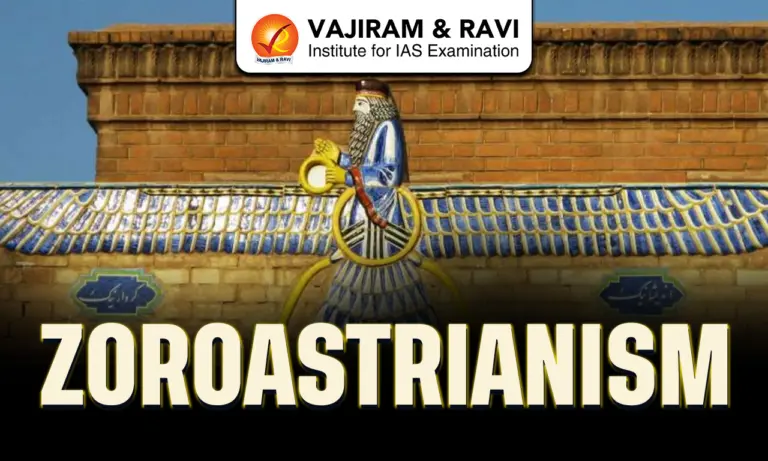
Zoroastrianism is one of the oldest surviving religions in the world, originating in ancient Persia (modern-day Iran). It is widely regarded as one of the earliest monotheistic faiths, emphasizing the worship of one supreme God and a strong moral code based on truth and righteousness.
For centuries, Zoroastrianism flourished as the state religion of powerful Persian empires, shaping political, cultural, and religious life across West and Central Asia. Today, although its followers are limited in number, the religion continues to survive, especially in Iran and India, where its followers are known as Parsis.
Foundations of Zoroastrianism
Zoroastrianism was founded by the prophet Zoroaster (Zarathustra), whose life remains historically uncertain. Most scholars place him between 1500 BCE and 600 BCE, making him one of the earliest religious reformers in human history.
Zoroaster’s teachings were based on divine revelations from Ahura Mazda, the all-powerful creator who represents truth, order, and goodness.
Sacred Literature
- The teachings are preserved in the Avesta
- The oldest portion, called the Gathas, contains hymns believed to be composed by Zoroaster himself
- The Avesta includes:
- Ritual texts
- Prayers and hymns
- Ethical and philosophical teachings
Also Read : Buddhism
Core Philosophical Ideas
- Belief in One Supreme God (Monotheism): Zoroastrianism centers on the worship of Ahura Mazda, who represents truth, light, wisdom, and creation. He is the ultimate source of all goodness.
- Cosmic Dualism (Good vs Evil): The universe is seen as a battlefield between good and evil forces:
- Good: Ahura Mazda
- Evil: Angra Mainyu
- Free Will and Moral Choice: Humans have the freedom to choose between right and wrong. Every individual is responsible for their actions and contributes to the victory of good over evil.
- Principle of Asha (Truth and Order): Asha represents truth, righteousness, and cosmic order. Living according to Asha means following honesty, justice, and moral discipline.
- Ethical Triad (Moral Code): The core teaching is based on:
- Good Thoughts (Humata)
- Good Words (Hukhta)
- Good Deeds (Hvarshta)
- Concept of Afterlife and Judgment: After death, the soul is judged based on its deeds. The righteous go to heaven, while the wicked face punishment.
- Final Judgment and Salvation: Zoroastrianism believes in a future savior (Saoshyant) who will bring the final victory of good over evil, followed by resurrection and purification of the world.
- Purity and Respect for Nature: Natural elements like fire, water, earth, and air are considered sacred. Pollution of these elements is strictly avoided.
- Role of Humanity in Cosmic Order: Humans are not passive; they actively help Ahura Mazda by living morally and fighting evil through righteous actions.
- Optimistic Worldview: Unlike many ancient religions, Zoroastrianism believes that good will ultimately triumph over evil, ensuring hope and moral purpose.
Also Read: Jainism
Rise of Zoroastrianism under Persian Empires
Zoroastrianism rose to prominence as it became closely associated with powerful Persian dynasties, transforming from a regional faith into a major state-supported religion that influenced governance, culture, and society.
- Adoption under the Achaemenid Empire (6th-4th Century BCE): Zoroastrianism gained royal patronage under the Achaemenid Empire, especially during the reigns of Cyrus the Great and Darius I. It became the guiding philosophy of administration and kingship.
- Principle of Asha in Governance: Persian rulers governed based on Asha (truth, order, and justice), promoting fairness, law, and moral rule across the empire.
- Policy of Religious Tolerance: Unlike many ancient empires, rulers like Cyrus allowed conquered people to practice their own religions freely, which helped maintain stability and respect for Zoroastrian values.
- Expansion through Imperial Growth: As the Persian Empire expanded across Asia, Egypt, and parts of Europe, Zoroastrian ideas spread widely, influencing diverse populations.
- Continuation under the Parthian Empire: The religion remained influential during the Parthian Empire, although it was less centralized and coexisted with other belief systems.
- Institutionalization under the Sassanian Empire: Zoroastrianism reached its peak under the Sassanian Empire (3rd–7th century CE):
- Became the official state religion
- Development of a strong priesthood (Magi)
- Construction of fire temples across the empire
- Compilation and preservation of religious texts like the Avesta
- Royal Support and Religious Authority: Kings were seen as protectors of the faith, and religion was closely linked with political power, strengthening both institutions.
- Cultural and Intellectual Influence: Zoroastrianism shaped Persian art, architecture, law, and philosophy, leaving a lasting impact on ancient civilizations.
- Spread via Trade Routes: Through networks like the Silk Road, Zoroastrian beliefs and practices reached Central Asia and beyond.





Zoroastrian Symbols and Beliefs
Zoroastrianism is a ritual-rich and symbolically deep religion that emphasizes purity, moral discipline, and devotion to divine truth. Its practices are designed to maintain harmony between humans, nature, and the spiritual world.
Religious Symbols
- Faravahar: The most recognized symbol, depicting a winged figure. It represents the human soul, moral progress, and the choice between good and evil.
- Sacred Fire: Fire is the central symbol of purity, truth, and divine light. It is not worshipped as a god but respected as a symbol of Ahura Mazda.
- Water (Aban): Water symbolizes life, purity, and cleansing. It is treated with great respect and never polluted.
- Cypress Tree: Considered a symbol of eternal life and resilience, often associated with Zoroastrian heritage.
Worship and Daily Rituals
- Fire Temple Worship: Zoroastrians worship in fire temples, where a sacred flame is kept burning continuously. These temples serve as spiritual centers for prayer and rituals.
- Daily Prayers (Kusti Ritual): Devotees perform prayers several times a day, tying and untying a sacred thread called the Kusti around their waist while reciting prayers.
- Navjote Ceremony (Initiation): This is the initiation ritual through which a child is formally inducted into the faith. The child wears:
- Sudreh (sacred shirt)
- Kusti (sacred thread)
- Festivals and Celebrations: Important festivals include:
- Nowruz (New Year) – Celebrates renewal and spring
- Seasonal festivals linked to nature and agriculture
Funeral and Death Rituals
- Concept of Purity after Death: Dead bodies are considered impure, and special care is taken to avoid contamination of natural elements.
- Sky Burial Practice: Traditionally, bodies are placed in Tower of Silence (Dakhma):
- Exposed to sunlight and birds (vultures)
- Prevents pollution of earth and fire
- Modern Adaptations: In places where this practice is restricted, some Zoroastrians adopt burial or cremation with modifications.
Decline of Zoroastrianism
Zoroastrianism, once the dominant religion of ancient Persia, gradually declined after the 7th century CE due to major political, social, and religious changes. The fall of imperial support and the rise of new powers significantly reduced its influence in its homeland.
- Arab-Islamic Conquest of Persia (7th Century CE): The defeat of the Sassanian Empire between 633-651 CE marked a turning point. With the establishment of Islamic rule, Zoroastrianism lost its position as the state religion.
- Loss of Royal Patronage: Earlier Persian rulers had actively supported Zoroastrianism. After the fall of the Sassanian Empire, this support disappeared, weakening religious institutions and priesthood.
- Imposition of Jizya (Religious Tax): Zoroastrians were required to pay a special tax (Jizya) as non-Muslims, which created economic pressure and encouraged conversion to Islam.
- Social and Political Pressures: Zoroastrians faced restrictions in administration, public life, and religious practices, making it difficult to sustain their traditional way of life.
- Gradual Conversion to Islam: Over time, many Zoroastrians converted to Islam for social mobility, economic relief, and security, leading to a steady decline in population.
- Decline of Religious Institutions: Fire temples were destroyed, abandoned, or converted, and the authority of the priestly class (Magi) diminished.

 Last updated on April, 2026
→ UPSC Final Result 2025 is now out.
→ UPSC has released UPSC Toppers List 2025 with the Civil Services final result on its official website.
→ Anuj Agnihotri secured AIR 1 in the UPSC Civil Services Examination 2025.
→ UPSC Marksheet 2025 is now out.
→ UPSC Notification 2026 & UPSC IFoS Notification 2026 is now out on the official website at upsconline.nic.in.
→ UPSC Calendar 2026 has been released.
→ Check out the latest UPSC Syllabus 2026 here.
→ UPSC Prelims 2026 will be conducted on 24th May, 2026 & UPSC Mains 2026 will be conducted on 21st August 2026.
→ The UPSC Selection Process is of 3 stages-Prelims, Mains and Interview.
→ Prepare effectively with Vajiram & Ravi’s UPSC Prelims Test Series 2026 featuring full-length mock tests, detailed solutions, and performance analysis.
→ Enroll in Vajiram & Ravi’s UPSC Mains Test Series 2026 for structured answer writing practice, expert evaluation, and exam-oriented feedback.
→ Join Vajiram & Ravi’s Best UPSC Mentorship Program for personalized guidance, strategy planning, and one-to-one support from experienced mentors.
→ Shakti Dubey secures AIR 1 in UPSC CSE Exam 2024.
→ Also check Best UPSC Coaching in India
Zoroastrianism FAQs
Q1. What is Zoroastrianism?+
Q2. Who is Zoroaster?+
Q3. What is the holy book of Zoroastrianism?+
Q4. What are Zoroastrian places of worship?+
Q5. What is a Tower of Silence (Dakhma)?+
Tags: history religious studies zoroastrianism