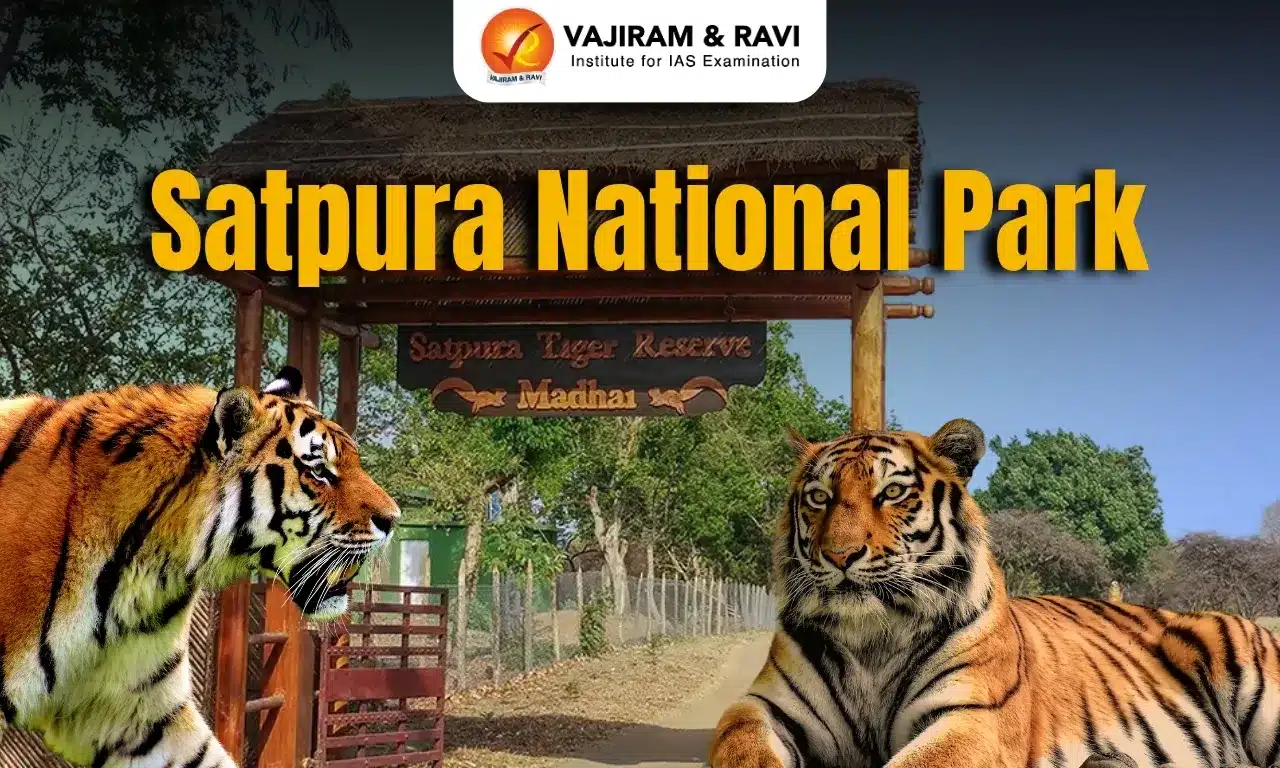
Satpura National Park, situated in Narmadapuram District (Hoshangabad) of Madhya Pradesh was named after Satpura Range. The nearest town is Pachmarhi, located about 170 km southwest of Bhopal. Satpura National Park is known for its rich biodiversity and scenic landscapes and plays an important role in protecting the endangered Bengal tiger and other wildlife species.
Satpura Tiger Reserve
The Satpura Tiger Reserve in Madhya Pradesh spans 1339.26 sq km of core and 794.04 sq km of buffer area, declared as the state’s first biosphere reserve in 1999, it provides shelter to 52 mammal species, 31 reptiles, and 300 bird species, including 14 endangered ones. Comprising Satpura National Park, Bori Sanctuary, and Pachmarhi Sanctuary, Satpura Tiger Reserve promotes eco-tourism activities like cycling, canoeing, and trekking. The Denwa River serves as its primary water source in the region. According to the Tiger Census 2018, Madhya Pradesh leads in tiger population.
Satpura National Park History
The Vindhyachal and Satpura mountain ranges in Central India form vital forest regions, providing habitat for diverse wildlife. Historically, these untouched forests remained undisturbed by human settlements, except for some isolated tribal communities. The Satpura range is archaeologically significant, featuring rock shelters and paintings dating back 1,500 to 10,000 years, depicting tigers, deer, lions, and elephants. This leaves evidence of the historical presence of these species in the region. The UNESCO-listed Bhimbetka Rock Shelters, renowned for ancient cave art, lie near Satpura National Park.


Satpura National Park Flora
Satpura Tiger Reserve holds a diverse vegetation, including moist and dry deciduous forests, bamboo groves, and grasslands. The variety of trees includes Teak, Sal, and Bamboo forests provide essential habitats for wildlife and are valued for their timber.
Other than this variety of shrubs includes Lantana, Grewia, and Indian gooseberry, with Lantana being an invasive species affecting native flora. Herbs include Wild turmeric, Spiderwort, and Bitter apple, known for their medicinal properties. Other than these, there is a variety of grasses as well such as, Blue panic, Khus grass, and Elephant grass, with Khus used in perfumes and cooling mats.
Satpura National Park Fauna
Satpura Tiger Reserve is home to a wide variety of flora and fauna, including several endangered species. Among the mammals, the reserve provides shelter to the majestic tiger, its flagship species, along with leopards, Indian bison (gaur), sloth bears, chital, and sambar deer. Other notable species include wild boars, Indian giant squirrels, barking deer, and Indian foxes. The reserve is also a paradise for birdwatchers, with over 300 species, including the Malabar Pied Hornbill, Indian Pitta, Crested Serpent Eagle, Black Eagle, and various kingfishers. Reptiles and amphibians such as the Indian Rock Python, crocodiles, and monitor lizards are also existing in the region’s diverse habitats.
Satpura Tiger Reserve Interesting Facts
- Indian ornithologist Dr. Salim Ali introduced Satpura National Park in 1981. It forms part of the Satpura Tiger Reserve along with Bori and Pachmarhi Wildlife Sanctuaries.
- "Satpura" is derived from Sanskrit, where Sat means seven and Pura means mountains.
- It is believed that Lord Rama spent 11 years of his exile in the Satpura hills. Shabri Dham, a temple dedicated to Shabri, is located here.
- Due to heavy rainfall, the reserve remains closed from mid June to end September every year.
- In 2010, Satpura Tiger Reserve won the TOFT Wildlife Tourism Award for being the “most visitor-friendly” destination. In 2023, it received India Today’s Editor’s Choice Award in the Best Wildlife Destination category.
- Satpura Tiger Reserve is home to Indian bison, leopards, sloth bears, wild boars, and over 300 bird species also provides 26 species from the Himalayas and 42 species from the Nilgiris.

 Last updated on Sep, 2026
→ UPSC 2027 Notification will be released on 13 January 2027 at upsconline.nic.in.
→ Asian Games 2026 are being held in Aichi-Nagoya, Japan, from 19 September to 4 October.
→ Check out the latest UPSC Syllabus here.
→ Download UPSC Model Answers for Mains 2026
→ UPSC Mains Question Paper 2026 is out now for Essay & GS Paper 1, 2, 3 & 4.
→ UPSC Calendar 2027 has been released.
→ Enroll in Vajiram & Ravi’s UPSC Mains Test Series 2027 for structured answer writing practice, expert evaluation, and exam-oriented feedback.
→ Join Vajiram & Ravi’s UPSC Mentorship Program 2027 for personalized guidance, strategy planning, and one-to-one support from experienced mentors.
→ Go through the UPSC Mains Previous Year Papers to enhance your preparation.
→ UPSC has released UPSC Toppers List 2025 with the Civil Services final result on its official website.
→ Also check Best UPSC Coaching in India
Satpura National Park FAQs
Q1. Why is Satpura National Park famous?+
Q2. In which district is Satpura National Park situated?+
Q3. How many tigers are in Satpura Tiger Reserve?+
Q4. which is the largest tiger reserve in India?+
Q5. Which river is near Satpura National Park? +
Tags: satpura tiger reserve