Biotechnology in Agriculture plays a transformative role in modern farming by integrating advanced scientific tools with traditional agricultural practices to enhance productivity, sustainability, and food security. It involves modifying living organisms, plants, animals, or microorganisms to develop improved varieties that are pest-resistant, nutrient-rich, and climate-resilient.
From genetic engineering and molecular breeding to biofortification and biofuel production, agricultural biotechnology offers innovative solutions for increasing crop yield, nutritional value, and environmental sustainability. However, alongside these benefits, it also raises concerns regarding health safety, environmental impact, ethical issues, and socioeconomic inequalities. Thus, biotechnology in agriculture represents both a promise and a challenge—holding the potential to revolutionise global food systems while demanding responsible use and regulation.
Biotechnology in Agriculture Definition
Agricultural biotechnology refers to a range of scientific techniques used to improve agriculture.
- It includes traditional breeding methods that modify living organisms or their components to create or enhance useful products.
- These techniques also help in improving plant and animal traits or in developing microorganisms for specific agricultural purposes.
- In modern times, agricultural biotechnology largely relies on the advanced tools of genetic engineering.
Biotechnology in Agriculture Benefits
The application of biotechnology in agriculture has resulted in benefits to farmers, producers, and consumers.
- Increase in yield: Agricultural Biotechnology has helped to increase crop productivity by introducing such qualities as pest and disease-resistant (GM) crops.
- Increase in nutritional value: Biofortification of food is the practice of increasing the content of micronutrients (i.e., vitamins and minerals) to enhance nutritional quality with minimal health risks using plant biotechnology.
- Golden Rice, for example, addresses vitamin A deficiency by genetically engineering rice to produce provitamin A. It mitigates the nutritional deficiencies in children/adults.
- Climate-smart agriculture: Biotechnological advancements have increased plants' tolerance to abiotic stresses such as cold, drought, salt, and heat.
- This enhancement, in turn, improves the productivity of crops.
- Increase in crop density: Reduced maturation period results in food products having a longer shelf life.
- Superior to conventional breeding methods: There is a decreased reliance on chemical pesticides through the development of pest-resistant crops, making this method superior to conventional breeding methods.
- Environmental benefits: When genetic engineering results in reduced pesticide dependence, it results in fewer pesticide residues on foods, reduces pesticide leaching into groundwater and minimises farm worker exposure to hazardous products.
- Biofuels: Fourth-generation biofuels are the amalgamation of genomically prepared microorganisms (algae, for example) and genetically engineered feedstock.
- Advanced biotech methods enhance biofuels' potential for reducing emissions and establishing a reliable fuel source, fostering competition and potential price reduction.


Biotechnology in Agriculture Applications
Biotechnology gives farmers tools to make crop production more cost-effective and manageable in an eco-friendly manner. The following are the tools used in plant biotechnology/agriculture biotechnology:
- Traditional cross-breeding: Plant and animal modification is achieved through selective breeding. Traditional plant breeding techniques may include biotechnology elements such as tissue culture and mutational breeding.
- Molecular breeding: Molecular breeding is the use of genetic manipulation performed at the DNA level to improve characteristics of interest in plants and animals.
- The common methods used in this are marker-assisted selection (MAS), marker-assisted recurrent selection (MARS), marker-assisted backcrossing (MABC) and genome-wide selection (GWS) or genomic selection (GS).
- Examples: hybrid maize, HYV rice and wheat seeds used in the green revolution, etc.
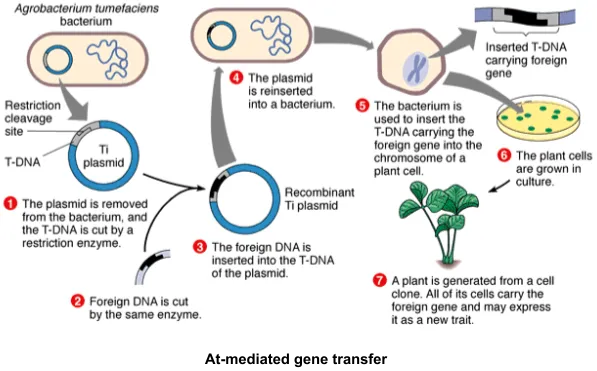
- Genetic engineering and GM crops: It is the manipulation of an organism's genes by adding, deleting or editing specific DNA sequences using recombinant DNA technology to achieve the altered function of the gene.
- The manipulated gene is called a transgene, and the altered organism (which hosts the gene by various methods) is called a Genetically Modified Organism (GMO).
- In agriculture (plant biotechnology), the genes of Bacillus thuringiensis (cry genes) are used to make pest-resistant crop plants.
- The Ti plasmid of Agrobacterium tumefaciens is generally used as the apparatus to make the recombinant gene (using cry genes of Bt) and then transfer it into the host plants.
- Examples of pest-resistant plants include Bt Cotton, GM Mustard and Bt Brinjal.
- Protoplast fusion: It is a type of genetic modification in which two distinct species of plants are fused to develop a new hybrid plant.
-
- The protoplasm is the plant cell whose cell wall has been removed.
- In hybrids, both the nuclei and cytoplasm of both species are fused.
- Cybrids (cytoplasmic hybrids) are also produced by protoplast fusion, in which the nuclear genetic material of one species and the cytoplasm (without a nucleus) of another is fused.
- Both hybrids and cybrids are used as one of the most important tools of plant biotechnology.

- RNAi: RNA interference is the natural defensive mechanism of plants using short double-stranded RNAs to block the gene expression of pathogens.
- This technology is used for gene silencing to make pest-resistant crops.
Biotechnology in Agriculture: Achievements in India
The Department of Biotechnology’s Agricultural Biotechnology Programme promotes innovative research aimed at achieving sustainable agriculture by harnessing the latest technological advancements. Its major accomplishments include:
- Climate-Smart Crops: A new high-yielding, climate-smart, and drought-tolerant chickpea variety named “SAATVIK (NC 9)” has recently been notified.
- This superior variety demonstrates enhanced productivity under drought conditions and has received approval from the Central Sub-committee on Crop Standards.
- Genome-Edited Crops: Genome editing has been used to create loss-of-function mutations in several rice genes that act as negative regulators of crop productivity.
- These modified lines, developed in the genetic background of the widely grown Indian rice variety MTU-1010, have shown higher yields under greenhouse conditions compared to the parent variety.
- Notably, the DEP1 (DENSE ERECT PANICLE) genome-edited rice lines exhibited larger panicles with more grains, resulting in enhanced overall yield.
- Genotyping Arrays: The first-ever 90K Pan-genome SNP genotyping array for rice, named IndRA, has been developed and made commercially available for public use.
- Likewise, a similar 90K Pan-genome SNP genotyping array, called IndCA, has been created for chickpea.
- These advanced arrays will facilitate DNA fingerprinting, variety identification, and genetic purity testing of rice and chickpea varieties.
- Amaranth Genetic Resources: The Department of Biotechnology has established an Amaranth Genomic Resource Database, developed Near Infrared Spectroscopy (NIRS) techniques for assessing the nutritional quality of amaranth grains, and created a 64K SNP chip.
- Using these tools, amaranth accessions have been identified that can help counter high-fat diet-induced obesity.
- These advancements serve as valuable resources for rapid screening, cultivation, and varietal development of amaranth.
- Fungal Biocontrol: A stable nano-formulation of a fungal enzyme derived from Myrothecium verrucaria has been developed as an eco-friendly biocontrol solution for managing powdery mildew in tomato and grape crops.
- Kisan-Kavach: Kisan Kavach is an anti-pesticide protective suit designed to address the widespread issue of pesticide-induced toxicity in agriculture.
- Developed with a keen understanding of the challenges faced by farmers, it represents a significant step forward in ensuring safety, protection, and innovation in the farming sector.
Biotechnology in Agriculture Concerns
Despite the above benefits, biotechnology in agriculture comes with various issues and concerns.
- Health-related issues:
-
- Allergens and toxins: A major safety concern raised about genetic engineering technology is the risk of introducing allergens and toxins into otherwise safe foods.
- Antibiotic resistance: The use of antibiotic-resistance genes as markers in transgenic crops may increase antibiotic resistance to diseases affecting humans and animals.
- Impact on the environment: Pest populations may develop resistance to GM crops designed for pest resistance.
- This could lead to evolved pests challenging traditional control methods, incurring additional costs for farmers, and countering the crop's intended benefits.
- Difficulty in labelling: The challenge of labelling biotech crops has been raised as a concern. The expense of maintaining proper segregation of biotechnology products until they reach the marketplace may be too high.
- Ethical considerations: Ethical concerns arise against the introduction of animal genes in plants, with some individuals also expressing ethical or religious concerns about consuming plants containing animal genes
- For example, antifreeze proteins from flounder are used in tobacco and tomato.
- Issue of cost of seed: Poor farmers are generally unable to afford costly GM seeds.
- This can result in the monopoly of large farmers and seed companies in India.
- Loss of Biodiversity: There are concerns regarding the loss of wild varieties of crops as well as impacts on pollinators due to genetic modifications.
Biotechnology in Agriculture UPSC PYQs
Q1: Explain in processing by giving their two perishable examples, how biotechnology has helped the Indian farmer crops. (UPSC Mains 2026)
Q2: How is science interwoven deeply with our lives? What are the striking changes in agriculture triggered by science-based technologies? (UPSC Mains 2020)
Q3: How can biotechnology help to improve the living standards of farmers? (UPSC Mains 2019)
Q4: With reference to the Genetically Modified mustard (GM mustard) developed in India, consider the following statements:
- GM mustard has the genes of a soil bacterium that give the plant the property of pest resistance to a wide variety of pests.
- GM mustard has the genes that allow the plant cross-pollination and hybridization.
- GM mustard has been developed jointly by the IARI and Punjab Agricultural University.
Which of the statements given above is/are correct? (UPSC Prelims 2018)
(a) 1 and 3
(b) Only 2
(c) 2 and 3
(d) 1, 2 and 3
Ans: (b)
Q5: With reference to agriculture in India, how can the technique of genome sequencing, often seen in the news, be used in the immediate future?
- Genome sequencing can be used to identify genetic markers for disease resistance and drought tolerance in various crop plants.
- This technique helps in reducing the time required to develop new varieties of crop plants.
- It can be used to decipher the host-pathogen relationships in crops.
Select the correct answer using the codes given below: (UPSC Prelims 2017)
(a) Only 1
(b) 2 and 3 only
(c) 1 and 2 only
(d) All of these
Ans: (d)

 Last updated on Sep, 2026
→ UPSC 2027 Notification will be released on 13 January 2027 at upsconline.nic.in.
→ Asian Games 2026 are being held in Aichi-Nagoya, Japan, from 19 September to 4 October.
→ Check out the latest UPSC Syllabus here.
→ Download UPSC Model Answers for Mains 2026
→ UPSC Mains Question Paper 2026 is out now for Essay & GS Paper 1, 2, 3 & 4.
→ UPSC Calendar 2027 has been released.
→ Enroll in Vajiram & Ravi’s UPSC Mains Test Series 2027 for structured answer writing practice, expert evaluation, and exam-oriented feedback.
→ Join Vajiram & Ravi’s UPSC Mentorship Program 2027 for personalized guidance, strategy planning, and one-to-one support from experienced mentors.
→ Go through the UPSC Mains Previous Year Papers to enhance your preparation.
→ UPSC has released UPSC Toppers List 2025 with the Civil Services final result on its official website.
→ Also check Best UPSC Coaching in India
Biotechnology in Agriculture FAQs
Q1. What is biotechnology in agriculture?+
Q2. What is the role of biotechnology in agriculture in India?+
Q3. What are the two applications of biotechnology in agriculture?+
Q4. What are the concerns of biotechnology in agriculture?+
Q5. What are the benefits of biotechnology in agriculture?+
Tags: biotechnology in agriculture