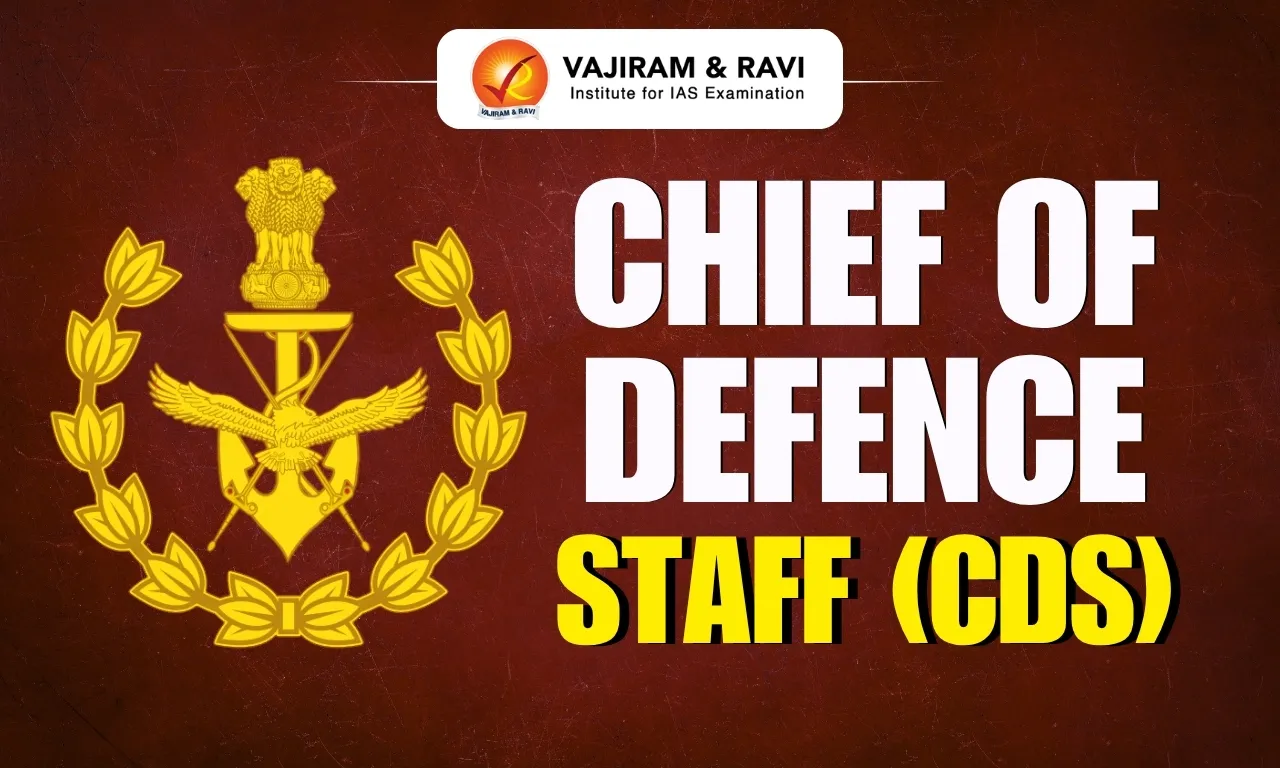
The Chief of Defence Staff (CDS) is the highest-ranking military officer in the Indian Armed Forces and the primary military adviser to the Defence Minister on all three services. The post was formed to improve jointness, integration, and coordination among the Indian Army, Navy, and Air Force.
The current Chief of Defence Staff of India is General N. S. Raja Subramani, who assumed office on 31 May 2026. He is India’s third CDS and also serves as Secretary of the Department of Military Affairs.
Chief of Defence Staff India (CDS) About
The Chief of Defence Staff of India is a four-star military officer responsible for promoting greater coordination among the country's three armed services. The position was approved by the Union Cabinet in December 2019.
- The Chief of Defence Staff of the Indian Armed Forces acts as the Permanent Chairman of the Chiefs of Staff Committee. He is responsible for improving jointness, interoperability, resource optimisation, and long-term defence planning among the three Services.
- The Indian Chief of Defence Staff also oversees the Department of Military Affairs (DMA) within the Ministry of Defence. The DMA was established in December 2019 to optimise the use of defence resources and encourage jointness among the Services.
Need for Chief of Defence Staff in India
India established the position of Chief of Defence Staff (CDS) to provide a single source of military advice to the government and improve joint operations between the Army, Navy, and Air Force.
- Lessons from the Kargil War: The 1999 Kargil conflict exposed gaps in coordination, intelligence sharing, and joint planning between the Army and Air Force. The Kargil Review Committee subsequently recommended reforms, including stronger integration of the armed forces and a unified military leadership structure.
- Strengthening Joint Operations: Modern warfare increasingly demands coordinated action by the Army, Navy, and Air Force. The CDS promotes jointness by encouraging integrated training, logistics, communication, and operational planning.
- Integrated Theatre Commands: The CDS plays an important role in advancing theatre commands, where resources from different services can operate under a unified command for a specific geographical or operational area.
- Unified Military Advice: Earlier, the government received advice separately from the three Service Chiefs, which could sometimes lead to differing priorities. The CDS provides a coordinated military perspective to the government on matters involving multiple services.
- Efficient Use of Defence Resources: Greater integration can reduce duplication by encouraging joint procurement, shared infrastructure, common logistics, and coordinated resource planning across the three services.


Chief of Defence Staff India Background
The concept of the CDS was first proposed by the K. Subrahmanyam Committee, also known as the Kargil Review Committee (KRC), formed after the 1999 Kargil conflict to recommend military reforms. However, due to a lack of consensus and concerns among the services, the proposal did not move forward until 2019.
- Group of Ministers (GoM) Recommendation in 2001: In 2001, based on the KRC's findings, a GoM recommended the creation of the CDS position.
- Naresh Chandra Task Force in 2012: This recommendation was further supported by the Naresh Chandra Task Force in 2012, which suggested that the CDS be designated as the Permanent Chairman of the Chiefs of Staff Committee.
- Lt Gen D.B. Shekatkar Committee in 2016: In 2016 Lt Gen D.B. Shekatkar Committee included the CDS as one of its key recommendations.
- First Chief of Defence Staff: On December 31, 2019, General Bipin Rawat was appointed as India’s first CDS, with Lt Gen Anil Chauhan (retd) succeeding him in September 2022.
Chief of Defence Staff Appointment
The CDS is appointed by the Cabinet's Appointments Committee, which is led by the Prime Minister. The officer can be chosen from the Indian Army, Indian Navy, or Indian Air Force.
- Chief of Defence Staff Eligibility Criteria: To be eligible for the position of CDS in India, an individual must be a serving or retired three-star or four-star officer (Lieutenant General, Air Marshal, Vice Admiral, or equivalent) in the Indian Army, Navy, or Air Force and under the age of 62 on the date of appointment.
- Chief of Defence Staff Tenure and Retirement: The CDS can serve until the age of 65 years. There is no fixed tenure, so the officer continues in the post from the date of appointment until reaching the retirement age of 65.
Chief of Defence Staff Rank and Status
The CDS is a four-star General and is regarded as the highest senior military position in the Indian Armed Forces. The CDS is ranked 12th in the Indian order of precedence, alongside the three service chiefs.
- The post is supposed to be "first among equals" with the three Service Chiefs, rather than a superior operational commander over them.
- The CDS thus plays a key coordinating and advisory role, but it does not exercise military command over the Army, Navy, or Air Force Chiefs.
Chief of Defence Staff Roles and Responsibilities
The Chief of Defence Staff (CDS) heads the Department of Military Affairs (DMA) as its Secretary and serves as the Permanent Chairman of the Chiefs of Staff Committee (COSC). The CDS acts as the Principal Military Adviser to the Defence Minister on all tri-Service matters.
CDS Role as Chief of Staff Committee
The COSC is an inter-service body that serves as the main advisory group for inter-service coordination, policy formulation, and strategy development. It includes the chiefs of the three armed services, with the CDS acting as its Permanent Chairman, overseeing the following responsibilities.
- Principal Military Advisor: The CDS serves as the principal military advisor to the Defence Minister on inter-service integration and operations.
- Participation in Key Defence Committees: The CDS is a member of the Defence Acquisition Council (DAC), chaired by the Defence Minister, and the Defence Planning Committee (DPC), chaired by the National Security Adviser.
- Administration of Tri-Service Organisations: The CDS administers tri-Service organisations, agencies and commands. Tri-Service organisations/agencies/commands related to Cyber and Space are also under the command of the CDS.
- Military Adviser to Nuclear Command Authority: He acts as the Military Adviser to the Nuclear Command Authority.
- Defence Acquisition Plans: He is responsible for implementing the Five-Year Defence Capital Acquisition Plan (DCAP) and the Two-Year roll-on Annual Acquisition Plans (AAP) as a follow-up to the Integrated Capability Development Plan.
CDS Role in Department of Military Affairs
As Secretary of the Department of Military Affairs, the CDS oversees matters allocated to the DMA. These include the Armed Forces of the Union, Integrated Headquarters of the Ministry of Defence, works relating to the Army, Navy and Air Force, and measures to promote jointness in procurement, training and staffing.
- Military Command Restructuring: He oversees the restructuring of service-specific military commands to optimise resource use and promote joint operations, primarily through the establishment of joint-service theatre commands.
- Jointness in Procurement and Operations: Encourages jointness in procurement, training, and staffing by integrating the requirements of the three armed services through joint planning.
List of Chiefs of the Indian Defence
Since the CDS post was created in 2019, there have been three Chiefs of Defence Staff of india. The following is the list of CDS holders:
| CDS Holder | Tenure | Important Note |
|
General Bipin Rawat |
Jan 2020 – Dec 2021 |
First Chief of Defence Staff of India |
|
General Anil Chauhan |
Sept 2022 – May 2026 |
Second CDS; appointed after the post remained vacant following General Rawat’s death |
|
General N. S. Raja Subramani |
May 2026 – Present |
Third and current Chief of Defence Staff of India |
Chief of Defence Staff Significance
The significance of the Chief of Defence Staff (CDS) is paramount in driving seamless coordination and integration across India’s armed forces, thereby optimising operational efficiency and strengthening decision-making at the highest levels. By overseeing the three armed services, the CDS fosters jointness, enhancing national security.
- Managing Tri-Service Organisations: As the Permanent Chairman of COSC, the CDS focuses on managing tri-service organisations effectively.
- Operationalising Joint Theatre Commands: The creation of the DMA under the CDS facilitates the deployment of joint theatre commands for efficient force use.
- Optimising Defence Resources: The CDS ensures optimal resource utilisation, enhancing policy-making in operations, procurement, and logistics.
- Nuclear Deterrence Management: The CDS administers India’s nuclear deterrent through the Strategic Forces Command and plays a vital role in reviewing the Nuclear Doctrine.
Chief of Defence Staff Challenges
Despite its strategic importance, the CDS faces several institutional, operational, financial, and administrative challenges that can hinder effective military integration and jointness.
- Limited Operational Authority: The CDS does not have direct operational control over the Army, Navy, or Air Force. Day-to-day operational command continues to rest with the respective Service Chiefs.
- Inter-Service Differences: Variations in the operational priorities, organisational cultures, and institutional interests of the three services can make it difficult to achieve consensus on sharing resources, capabilities, and decision-making authority.
- Challenges in Theatre Command Formation: Differences over the design, jurisdiction, and command structure of integrated theatre commands have contributed to delays in implementing deeper military integration.
- Restricted Financial and Administrative Powers: The CDS primarily oversees matters related to the revenue budget and routine military operations, while major capital acquisitions and long-term procurement decisions remain largely within the civilian defence administration.
- Civil-Military and Bureaucratic Coordination Issues: The division of responsibilities between the Department of Military Affairs, headed by the CDS, and the Department of Defence can sometimes result in overlapping functions, administrative complexities, and uncertainty over institutional roles.
- Lack of a Formal National Security Strategy: The absence of a publicly articulated, comprehensive National Security Strategy makes it harder to establish a clearly defined long-term framework for defence planning, theatreisation, and broader military reforms.
Chief of Defence Staff Way Forward
The CDS is instrumental in shaping India’s defence strategy and must be guided by clear national security objectives to ensure professionalism and independence in fulfilling constitutional duties.
- Strengthen CDS Authority: Clearly define and enhance the CDS's operational, financial, and administrative powers to enable more effective coordination among the three services.
- Accelerate Theatreisation: Build consensus among the Army, Navy, and Air Force and establish integrated theatre commands with clearly defined roles, responsibilities, and command structures.
- Improve Institutional Coordination: Streamline the division of responsibilities between the Department of Military Affairs and the Department of Defence to reduce bureaucratic overlap and administrative delays.
- Adopt a National Security Strategy: Develop a comprehensive National Security Strategy to provide a clear long-term framework for defence planning, resource allocation, military modernisation, and jointness reforms.

 Last updated on Oct, 2026
→ UPSC 2027 Notification will be released on 13 January 2027 at upsconline.nic.in.
→ Check Nobel Prize 2026 Winners List here.
→ Download PIB PRiSM Monthly Magazine 2026 here.
→ Check UPSC Monthly Current Affairs Magazine The Recitals here.
→ Check out the latest UPSC Syllabus here.
→ Download UPSC Model Answers for Mains 2026
→ UPSC Mains Question Paper 2026 is out now for Essay & GS Paper 1, 2, 3 & 4.
→ UPSC Calendar 2027 has been released.
→ Enroll in Vajiram & Ravi’s UPSC Mains Test Series 2027 for structured answer writing practice, expert evaluation, and exam-oriented feedback.
→ Join Vajiram & Ravi’s UPSC Mentorship Program 2027 for personalized guidance, strategy planning, and one-to-one support from experienced mentors.
→ Go through the UPSC Mains Previous Year Papers to enhance your preparation.
→ UPSC has released UPSC Toppers List 2025 with the Civil Services final result on its official website.
→ Also check Best UPSC Coaching in India
Chief of Defence Staff India FAQs
Q1. Who is the current Chief of Defence Staff of India?+
Q2. Who is the Chief of the Army, Navy, and Air Force?+
Q3. Is CDS higher than Army Chief?+
Q4. What is the CDS salary in the Army?+
Q5. Is CDS a 5-star rank?+
Tags: chief of defence staff quest UPSC Internal Security Notes