Ecology is the study of how organisms interact with each other and their environment. It examines roles as producers, consumers, and decomposers, and their responses to environmental factors. Its branches reflect life’s diversity across habitats, while core principles like species conservation and habitat protection form its foundation.
It also studies key processes such as energy flow, nutrient cycling, species interactions, and the water cycle, with concepts like ecological pyramids and succession explaining ecosystem structure and change.
Ecology Meaning
Ecology is the study of relationships between organisms and their environment, including both living and non-living components. Ecology explores how organisms interact with one another within populations, communities, and ecosystems, highlighting the dynamic connections that sustain life.
- Term Meaning: The term was coined by German biologist Ernst Haeckel in 1869, derived from the Greek word oikos, meaning “household” or “place to live.”
- Ecology Father: Eugene Pleasants Odum is widely recognized as the father of modern ecology, while Alexander von Humboldt is often credited as the father of general/early ecology, and Ernst Haeckel coined the term itself.
Ecology Examples
Ecology can be understood through various real-world examples of interactions between organisms and their environment. A forest ecosystem, where trees, animals, microorganisms, soil, and climate interact, is one example. Other examples include food chains in grasslands, predator-prey relationships, pollination between bees and flowering plants, nutrient cycling in ponds, and coral reef ecosystems.
Types of Ecology
Ecology can be studied at different levels, from populations and communities to landscapes, helping scientists understand how organisms interact, adapt, and respond to environmental changes.
Landscape Ecology
Landscape ecology studies spatial distribution, patterns, and behaviours over large geographic areas. Landscape ecologists might investigate the effect of development on a specific species of native grass in a given area. One type of grass may be chemically resistant, indicating that the area is ideal for agricultural development.
Population Ecology
Population ecology is the study of the increase and decrease in the number of species. A population ecologist may compare a species' population near a new food source to one without access to that food source. The new food source may increase or decrease the species' numbers, depending on whether it is contaminated.
Behavioral Ecology
Behavioural ecology is the study of how organisms evolve and adapt to environmental changes. Behavioural ecologists frequently investigate mating patterns, or the characteristics that male and female animals prefer when trying to reproduce. For example, behavioural ecologists study bird songs and plumage in relation to mating patterns.


Ecology Components
Ecology has two main components that together determine how ecosystems function and how organisms interact within them.
- Biotic Components (Living Organisms): These are living parts of an ecosystem that are interconnected, including producers (plants, algae) that create food, consumers (herbivores, carnivores, omnivores, parasites) that rely on other organisms for energy, and decomposers (fungi, bacteria) that recycle nutrients back into the system.
- Abiotic Components (Non-Living Factors): These include the physical and chemical conditions that influence life, such as sunlight, temperature, soil, water, air, and minerals. Factors like pH, salinity, and nutrient levels also shape where organisms can live and how ecosystems function.
Ecology Principles
Principles of ecology are fundamental guidelines explaining how ecosystems function, sustain biodiversity, and provide ecological services. They emerge from established ecological concepts and form the basis for conservation planning, especially in the context of climate change.
- Protection of Species and Genetic Diversity: Genetic diversity enables species to adapt to environmental changes and survive stresses such as disease or climate shifts.
- Because genetic traits cannot be managed directly, conserving species across their natural ranges—including subspecies and isolated populations—is crucial.
- Habitat Conservation: Habitats provide food, shelter, and breeding sites necessary for species survival. Conservation must consider all scales, from small microsites like decaying logs to large landscapes such as forests and wetlands.
- Protecting habitat diversity and connectivity prevents fragmentation, sustains ecological processes, and ensures viable populations.
- Area–Species Relationship: Larger and more continuous habitats generally support more species and bigger populations than small, isolated patches.
- According to the theory of island biogeography, bigger areas reduce extinction risk, allow species dispersal, and maintain ecological balance. Conservation networks are most effective when they protect extensive, connected landscapes.
- Interconnectedness of Species: Species in ecosystems are linked through interactions like predation, competition, and mutualism.
- Keystone species have a disproportionate influence on ecosystem structure and function. Losing such species can destabilise ecosystems, so understanding and protecting these interactions is essential.
- Role of Disturbances: Natural disturbances such as fires, floods, storms, and insect outbreaks shape ecosystem composition and diversity.
- Their type, intensity, and frequency determine ecosystem resilience. Conservation strategies that mimic these processes—like controlled burning or selective harvesting—help maintain balance and support species adapted to these dynamics.
- Climate as a Regulator: Climate controls temperature, precipitation, species distributions, and ecological processes like photosynthesis and fire cycles.
- Rapid climate change alters species ranges, disrupts migrations, and intensifies outbreaks (mountain pine beetle). Integrating adaptive strategies into conservation is essential to maintain ecosystem resilience.
Ecology Level of Organisations
Ecology can be studied at different levels, from individual organisms to the entire biosphere. The levels of organisation in living systems range from genes, cells, and organs to organisms, species, populations, communities, ecosystems, biomes, and the biosphere. Each level helps us understand interactions between life and the environment and how ecosystems and global processes function.
- Organism: The basic unit of ecological study. It examines how an individual’s form, physiology, and behaviour enable survival and adaptation.
- Population: A group of individuals of the same species in a specific area. It studies their size, density, distribution, growth, and genetic traits.
- Community: Formed by populations of different species living together. It focuses on species interactions, community structure, and ecological stability.
- Ecosystem: An ecosystem includes both living organisms and their physical environment. Ecosystem ecology studies energy flow in ecosystem, nutrient cycles, and the interactions between biotic (living) and abiotic (non-living) components.
- Biome: Large ecological regions defined by climate and vegetation, such as forests, deserts, grasslands, and tundra. Each supports distinct species and ecological processes.
- Biosphere: The sum of all ecosystems on Earth. It provides insight into global-scale processes, including climate regulation, biodiversity patterns, and human impacts.
Ecology Key Concepts
Ecological concepts such as habitat, niche, adaptation, and species explain where organisms live, their roles in ecosystems, the traits that aid survival, and how populations are organised.
- Habitat: The environment where an organism lives, providing essential resources like food, water, space, and shelter.
- Ecological Niche: The functional role of a species within its habitat, describing resource use, interactions, and contribution to ecosystem stability. Distinct niches allow multiple species to coexist with minimal competition.
- Adaptation: Inherited traits that help organisms survive and reproduce in their environment. Examples include:
- Structural: Camel’s hump for storing fat and water.
- Behavioural: Migration of birds during winter.
- Physiological: Sweating and shivering in humans for temperature regulation.
Ecological Processes
Ecological processes are key interactions and cycles that maintain relationships between organisms and their environment. They support vital ecosystem services such as food production, nutrient cycling, climate regulation, and water purification.
- Energy Flow: Energy moves in one direction through an ecosystem—typically from the sun to producers, then to consumers, and finally to decomposers.
- Example: Plants and algae capture sunlight through photosynthesis. Herbivores eat plants, carnivores eat herbivores, and decomposers recycle nutrients. Only about 10% of energy passes to the next trophic level.
- Nutrient Cycling: Nutrients like carbon, nitrogen, and phosphorus circulate between organisms and the environment.
- Example: Decomposers break down dead plants and animals, returning nutrients to the soil for plant growth.
- Community Dynamics and Species Interactions: Interactions such as predation, competition, and symbiosis regulate populations and maintain ecosystem balance.
- Example: Lions control herbivore numbers, preventing overgrazing, while plants compete for sunlight and nutrients, supporting biodiversity.
- Water Cycle: Water continuously moves through ecosystems via evaporation, precipitation, and transpiration.
- Example: Rain replenishes rivers and lakes, and plants absorb water and release it back into the atmosphere through transpiration.
Ecology Pyramids
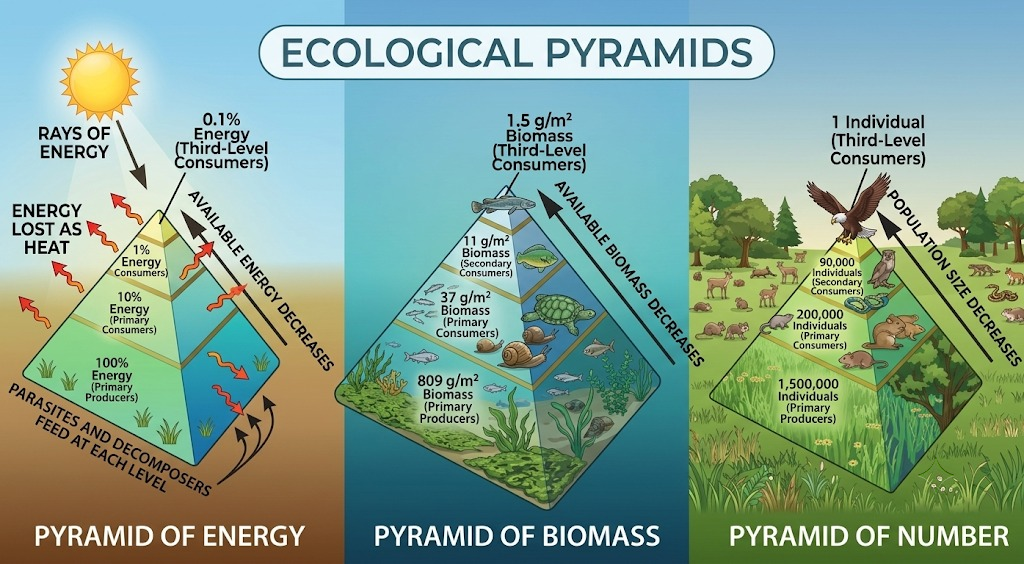
Ecological pyramids are graphical tools that show the distribution of organism numbers, biomass, or energy across trophic levels, helping to understand ecosystem structure and energy flow from producers to top consumers. The different types of ecological pyramids are based on what is measured at each trophic level, namely:
- Pyramid of Numbers: Illustrates the number of organisms at each trophic level, usually decreasing from abundant producers at the base to fewer top consumers. It can be upright or inverted depending on ecosystem dynamics.
- Pyramid of Biomass: Represents total biomass (dry weight or caloric content) at each trophic level, reflecting living matter availability.
- Aquatic ecosystems often show inverted biomass pyramids due to rapid phytoplankton turnover.
- Pyramid of Energy: Shows energy flow across trophic levels over time, highlighting decreasing energy transfer due to metabolic losses. Always upright, it follows the 10% energy transfer rule.
Ecological Succession
Ecological succession is the gradual change in plant and animal communities over time, driven by interactions with the environment, ultimately leading to a stable climax community.
- Primary Succession: Occurs on bare, lifeless areas such as rocks, sand dunes, lava flows, or glacial moraines. Pioneer species colonise first and are gradually replaced by other plants and animals, forming a climax community.
- Secondary Succession: Happens in areas where an existing community has been disturbed or removed, such as after fires, storms, or human activity. Since soil already contains nutrients and seeds, succession progresses faster than primary succession.
- Special Types of Succession: Succession varies with habitat. Xerarch succession occurs in dry areas, starting with lichens and mosses, followed by grasses, shrubs, and trees.
- While Hydrarch succession occurs in water bodies, beginning with algae and submerged plants, then emergent plants and grasses, eventually forming a terrestrial climax community.
Ecology Importance
Ecology is important for understanding the relationships between organisms and their environment, guiding human actions toward sustainability and environmental protection.
- Conservation of Environment: By revealing human impacts, it aids in reducing pollution, preventing habitat loss, and protecting endangered species.
- Resource Management: It supports sustainable use of water, soil, forests, and wildlife, reducing overexploitation.
- Maintaining Ecosystem Balance: Species interactions ensure essential services such as pollination, clean water, and climate regulation are sustained.
- Predicting Environmental Changes: Understanding ecological patterns allows us to anticipate the impacts of climate change, habitat loss, and pollution, aiding biodiversity conservation.
Ecological Imbalance
Ecological imbalance occurs when natural or anthropogenic activities disturb ecosystem stability and organism interactions, causing ecosystem dysfunction.
- Natural Causes: Floods, volcanic eruptions, wildfires, and natural disasters disrupt ecosystems seasonally or episodically.
- Human Activities: Deforestation, overhunting, pollution (air, water, soil), urbanization, overfishing, mining, agriculture mismanagement, and infrastructure expansion are major drivers of ecological imbalance, causing habitat loss and biodiversity decline.
- Key Impacts: Ecological imbalance leads to soil erosion, deforestation, and water depletion.
- It reduces biodiversity through habitat loss and invasive species, and increases greenhouse gases, causing global warming and stressed ecosystems.
Ecology UPSC PYQs
Q1: Sikkim is the first ‘Organic State’ in India. What are the ecological and economical benefits of Organic State? (UPSC Mains 2018)
Q2: Which one of the following terms describes not only the physical space occupied by an organism, but also its functional role in the community of organisms? (UPSC Prelims 2013)
(a) Ecotone
(b) Ecological niche
(c) Habitat
(d) Home range
Ans: (b)
Q3: In the grasslands, trees do not replace the grasses as a part of an ecological succession because of (UPSC Prelims 2013)
(a) Insects and fungi
(b) Limited sunlight and paucity of nutrients
(c) Water limits and fire
(d) None of the above
Ans: (c)

 Last updated on Oct, 2026
→ UPSC 2027 Notification will be released on 13 January 2027 at upsconline.nic.in.
→ Check Nobel Prize 2026 Winners List here.
→ Download PIB PRiSM Monthly Magazine 2026 here.
→ Check UPSC Monthly Current Affairs Magazine The Recitals here.
→ Check out the latest UPSC Syllabus here.
→ Download UPSC Model Answers for Mains 2026
→ UPSC Mains Question Paper 2026 is out now for Essay & GS Paper 1, 2, 3 & 4.
→ UPSC Calendar 2027 has been released.
→ Enroll in Vajiram & Ravi’s UPSC Mains Test Series 2027 for structured answer writing practice, expert evaluation, and exam-oriented feedback.
→ Join Vajiram & Ravi’s UPSC Mentorship Program 2027 for personalized guidance, strategy planning, and one-to-one support from experienced mentors.
→ Go through the UPSC Mains Previous Year Papers to enhance your preparation.
→ UPSC has released UPSC Toppers List 2025 with the Civil Services final result on its official website.
→ Also check Best UPSC Coaching in India
Ecology FAQs
Q1. What do you mean by ecology?+
Q2. Who is the father of ecology?+
Q3. What are the 7 types of ecology?+
Q4. What is ecology vs zoology?+
Q5. What are 5 examples of ecology?+
Tags: ecology quest UPSC Environment and Ecology Notes