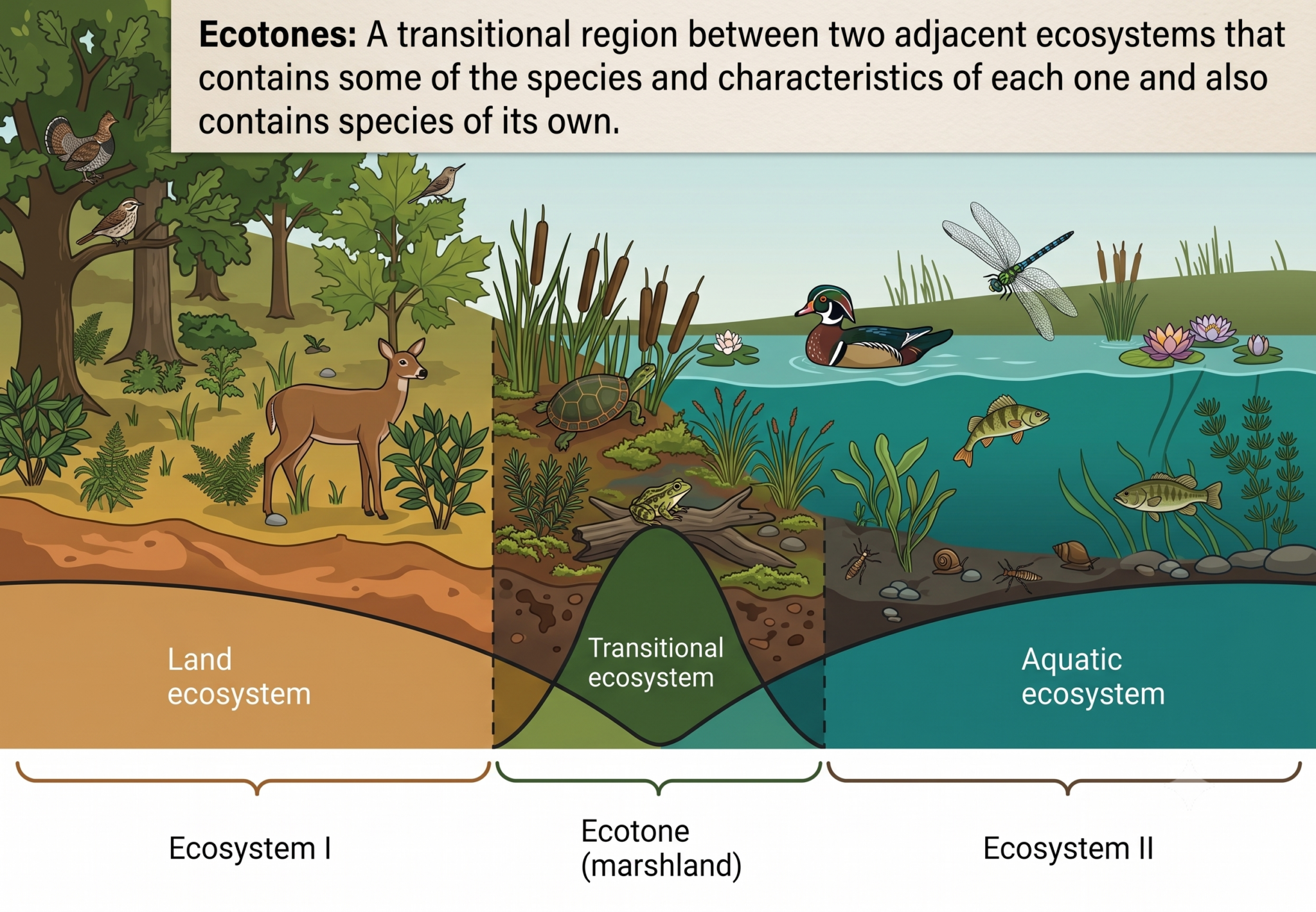
An ecotone is a zone that connects two adjacent ecosystems or biological communities. It contains features, environmental conditions, and species common to both neighbouring ecosystems; it may also support organisms found primarily in the transition zone.
For example, the transition between a forest and grassland, a river and land, or freshwater and seawater is an ecotone. These areas often show high biodiversity because they offer varied resources, habitats, and ecological conditions. This increase in diversity at habitat boundaries is called the edge effect.
Ecotone Definition
The word 'ecotone' combines 'eco', meaning environment or habitat, and “tone,” meaning tension or transition. It refers to the zone where two ecosystems meet, overlap, and gradually or sharply change into one another.
- Ecotone Zone: They can vary in scale from extensive areas like the boundary between forests and grasslands to smaller patches such as forest clearings where local habitats blend naturally.
- Mechanism of Formation: Ecotones develop along environmental gradients or abrupt changes in factors such as soil, temperature, moisture, or salinity.
- Species interactions and ecological niche construction, where organisms modify their surroundings, further shape these transitional zones.
Ecotone Examples
Examples of ecotones show where ecosystems meet and blend, creating areas rich in biodiversity and supporting unique species. Key examples include:
- Mangrove Forests: These act as an ecotone between terrestrial and marine ecosystems, often found along tropical coastlines.
- Lagoon Edges: Where lagoons meet land or other aquatic habitats, ecotones promote biodiversity, including unique aquatic and terrestrial species.
- Marshlands and Riverbanks: Marshlands are transitional zones between dry (terrestrial) and wet (aquatic) environments, while riverbanks are ecotones between aquatic river systems and adjacent terrestrial land.
- Field–forest Boundaries: Man-made ecotones exist at the edges of agricultural fields and forests, supporting mixtures of species found in both landscapes.
- Riparian Zones: Riverbanks and adjacent land areas, marking the intersection of aquatic and terrestrial ecosystems, are critical ecotones, especially in temperate regions.
Ecotone Species
Ecotone species, also called edge species, are organisms that occur mainly or most abundantly in transition zones.
- Species found in an ecotone can broadly include:
- Species from the first ecosystem
- Species from the second ecosystem
- Species specifically adapted to the transitional zone
- For example, an estuary may support freshwater fish, marine fish, migratory birds, mangroves, shellfish, and species adapted to brackish water. Such species richness makes ecotones valuable for biodiversity conservation.
Ecotone Formation
Ecotones are transitional zones formed where two ecosystems meet, shaped by both natural processes and human activities. They arise from changes in physical and biological conditions, creating areas with unique environmental and species characteristics.
- Natural Ecotones: These form due to abiotic factors such as changes in soil, moisture, temperature, or altitude. Examples include:
- Mountain slopes with varying climatic conditions.
- Riverbanks separate aquatic and terrestrial habitats.
- Coastal zones where marine and terrestrial ecosystems meet.
- Natural ecotones support species from both adjoining ecosystems and unique edge-specialist species.
- Human-induced Ecotones: Created by activities like agriculture, deforestation, urbanisation, or land clearing, which replace one ecosystem with another.
- Example: Boundaries between forest patches and farmland form artificial ecotones.
Types of Ecotone
Ecotones can be classified into several types based on the ecosystems they connect, each showing a gradual transition between different habitats:
- Terrestrial Ecotones: These occur at the boundaries between different land ecosystems, such as forests and grasslands, where characteristics of both habitats overlap.
- Aquatic Ecotones: Found where freshwater and marine environments meet, like estuaries and wetlands, blending features of both aquatic systems.
- Riparian Ecotones: Located along rivers and streams, these zones connect aquatic and terrestrial ecosystems, supporting species from both.
- Urban Ecotones (Anthropogenic Ecotones): Formed at the interface of urban areas and natural landscapes, these ecotones reflect human-influenced ecological transitions.
- Vertical Ecotones: Created by changes in elevation, such as mountain slopes transitioning from forest to alpine tundra, showing gradual shifts in climate, vegetation, and wildlife.


Ecotone Characteristics
Ecotones can be narrow or wide and show a gradual shift in species from one community to another, often including unique organisms.
- Width Variation: It can range from very narrow to wide, depending on the landscape and the ecosystems it connects.
- Intermediate Conditions: The environment reflects characteristics of both adjoining ecosystems, creating a zone of tension and overlap.
- Gradual Species Shift: Species from one community decrease gradually while those from the other increase, forming a continuous, linear change in composition.
- Unique Species: Well-developed ecotones may support organisms that are not found in either of the neighbouring communities.
- Species diversity: Ecotones generally exhibit higher species diversity than adjacent ecosystems because they harbour species from both communities, along with edge-specialist species that exclusively inhabit the ecotone.
- This diversity is supported by environmental gradients, increased availability of light and nutrients, and complex ecological interactions.
Ecotone and Edge Effect
Edge Effect describes how ecotones support higher species richness and population density compared to the adjoining ecosystems. This occurs due to the combination of resources and environmental conditions available from both ecosystems. Examples include:
- Bird species are often more abundant along land–water ecotones, where terrestrial and aquatic habitats meet.
- Similarly, fish diversity tends to be high in ecotones such as river deltas and estuaries.
Ecocline vs Ecotone
The terms ecocline and ecotone are similar but distinct. An ecotone is a transition zone between ecosystems, whereas an ecocline is a gradual environmental gradient that alters species composition.
| Basis | Ecocline | Ecotone |
|
Meaning |
Gradual ecological change along an environmental gradient |
Transition zone between two ecosystems |
|
Boundary |
Usually gradual |
May be gradual or relatively sharp |
|
Species change |
Progressive |
May show overlap between communities |
|
Main basis |
Environmental gradient |
Ecological community transition |
|
Example |
Vegetation changing gradually with moisture |
Forest–grassland transition |
Ecotone Importance
Ecotones host high biodiversity and unique species. They are ecologically sensitive, support critical ecological processes, and provide important resources for humans.
- High Biodiversity: Ecotones often support more species than neighbouring ecosystems by combining habitats and resources, providing food and shelter.
- Shallow, sunlit waters support diverse vegetation and provide critical spaces for foraging, nesting, and breeding.
- Human Benefits: Ecotones like riverbanks and floodplains offer fertile soil and water, making them ideal for agriculture and human settlements.
- Conservation Significance: Protecting and restoring ecotones efficiently preserves biodiversity, maintains ecosystem connectivity, and strengthens ecological stability.
- Ecological Resilience: Species adapted to the changing conditions of ecotones enhance ecosystem resilience and offer insights into natural responses to environmental changes.
Ecotone UPSC PYQs
Q1: Which one of the following terms describes not only the physical space occupied by an organism, but also its functional role in the community of organisms? (UPSC Prelims 2013)
(a) Ecotone
(b) Ecological niche
(c) Habitat
(d) Home range
Ans: (b)

 Last updated on Oct, 2026
→ UPSC 2027 Notification will be released on 13 January 2027 at upsconline.nic.in.
→ Check Nobel Prize 2026 Winners List here.
→ Download PIB PRiSM Monthly Magazine 2026 here.
→ Check UPSC Monthly Current Affairs Magazine The Recitals here.
→ Check out the latest UPSC Syllabus here.
→ Download UPSC Model Answers for Mains 2026
→ UPSC Mains Question Paper 2026 is out now for Essay & GS Paper 1, 2, 3 & 4.
→ UPSC Calendar 2027 has been released.
→ Enroll in Vajiram & Ravi’s UPSC Mains Test Series 2027 for structured answer writing practice, expert evaluation, and exam-oriented feedback.
→ Join Vajiram & Ravi’s UPSC Mentorship Program 2027 for personalized guidance, strategy planning, and one-to-one support from experienced mentors.
→ Go through the UPSC Mains Previous Year Papers to enhance your preparation.
→ UPSC has released UPSC Toppers List 2025 with the Civil Services final result on its official website.
→ Also check Best UPSC Coaching in India
Ecotone FAQs
Q1. What is an ecotone?+
Q2. What is the meaning of ecotone?+
Q3. What is an example of an ecotone?+
Q4. Who first coined the term ecotone?+
Q5. What is ecotype and ecotone?+
Tags: ecotone quest upsc enviornment and ecology notes