Ecological niche defines a species’ unique role and way of life within its ecosystem, shaped by both biotic and abiotic factors. It illustrates how a species survives, acquires resources, interacts with other organisms, and influences ecosystem processes.
Ecological niches can be potential (fundamental), representing the full range of conditions and resources a species could theoretically use in the absence of competitors, or actual (realised), which is the portion of the niche a species occupies in reality, constrained by competition, predation, and environmental factors. These niches determine species distribution, interactions, biodiversity, ecosystem stability, and conservation strategies.
Ecological Niche Meaning
An ecological niche is the functional role a species performs in its ecosystem — encompassing how it survives, reproduces, interacts with other organisms, and utilises environmental resources.
- It reflects a species' “way of life,” including its use of food and shelter, responses to competition and predation, and contributions to ecosystem functioning. A niche influences species distribution, abundance, and evolutionary adaptations.
- Historical Background: Joseph Grinnell (1917) introduced the concept of ecological niche, focusing on habitat and environmental conditions that permit species survival.
- Charles Elton (1927): Emphasised the role of species in food chains and their functional position within ecosystems.
- G. Evelyn Hutchinson (1957): Formulated the niche as an n-dimensional hypervolume, incorporating all abiotic and biotic factors that affect a species' existence, competition, and coexistence in ecological communities.
Ecological Niche Examples
Ecological niche examples show how different species adapt to specific environmental conditions, resources, and habitats, determining their distribution, survival, interactions, and ecological roles.
- Forest Niche: Forest niches in temperate regions (fir, spruce, pine, beech, birch) differ from tropical forest niches (Brazil nut, rubber tree, mahogany), shaped by temperature, soil, and altitude.
- Mangrove Niche: Species like Rhizophora and Avicennia inhabit intertidal zones, with niches defined by salinity tolerance, tidal range, and sediment preferences, supporting ecosystem structure and function.
- Amphibian Niche: Japanese fire-bellied newts (Cynops pyrrhogaster) occupy specific climatic niches shaped by temperature and precipitation, influencing their distribution and evolutionary diversification.


Ecological Niche Characteristics
An ecological niche is unique to each species, defining its role and position in the ecosystem. It shows how the species interacts with biotic and abiotic factors, contributes to energy flow, and ensures that vacant niches can be occupied to maintain ecosystem balance.
- Link to Environment: A niche shows how a species interacts with both abiotic factors (like climate, soil, and water) and biotic factors (like other organisms) in its ecosystem.
- Species Position: It defines the species’ role in the environment, explaining how it survives and meets essential needs such as food, shelter, and reproduction.
- Energy Flow Insight: Understanding a niche reveals how energy moves through the ecosystem, highlighting a species’ feeding habits and its role in food chains and webs.
- Vacant Niches Filled: When a niche becomes unoccupied, other species may adapt to fill that role, ensuring ecosystem stability.
- Species-Specific: Each species has a distinct niche, preventing two species from occupying the same role and reducing direct competition for resources.
Ecological Niche Components
The components of an ecological niche describe the resources, environmental conditions, and biological interactions that determine how a species survives, grows, reproduces, and functions.
- Food and Feeding Habits: The type of food an organism consumes, how it obtains its food, and its position within the food chain or food web.
- Abiotic Factors: The range of non-living environmental conditions an organism can tolerate, including temperature, moisture, light availability, soil characteristics, and other physical factors.
- Biotic Interactions: The ways an organism interacts with other living organisms, including competition for resources, predator-prey relationships, and mutually beneficial associations.
- Competition: Species sharing a habitat compete for resources like food, space, and light, which can limit populations and influence niche use.
- Predation: Predators control prey populations, affecting where and how species live.
- Parasitism: Parasites and pathogens impact host survival, further shaping population dynamics and niche interactions.
Ecological Niche Types
Ecologists classify niches majorly based on habitat, resource use, temporal activity, and ecological functions. The major types of ecological niches include:Ecological niche types.
- Habitat Niche: The habitat niche refers to the physical space or environment a species occupies. It includes the abiotic factors such as climate, shelter, and terrain that allow a species to survive and reproduce.
- Example: Lions inhabit grasslands and savannas, while polar bears live on Arctic ice.
- Trophic Niche: The trophic niche describes a species’ feeding role in the ecosystem, including what it eats, how it obtains food, and its position in the food chain. Different species occupy different trophic levels, which reduces direct competition and maintains ecosystem balance.
- Reproductive Niche: The reproductive niche involves the conditions and behaviors necessary for successful reproduction, such as mating rituals, breeding season, or nesting sites. This niche ensures the continuation of the species.
- Example: Sea turtles lay eggs on sandy beaches, while penguins build nests in cold coastal areas.
- Spatial (Microhabitat) Niche: The spatial or microhabitat niche focuses on the specific area within a larger habitat that a species occupies. It allows similar species to coexist in the same habitat by using different physical spaces or microhabitats.
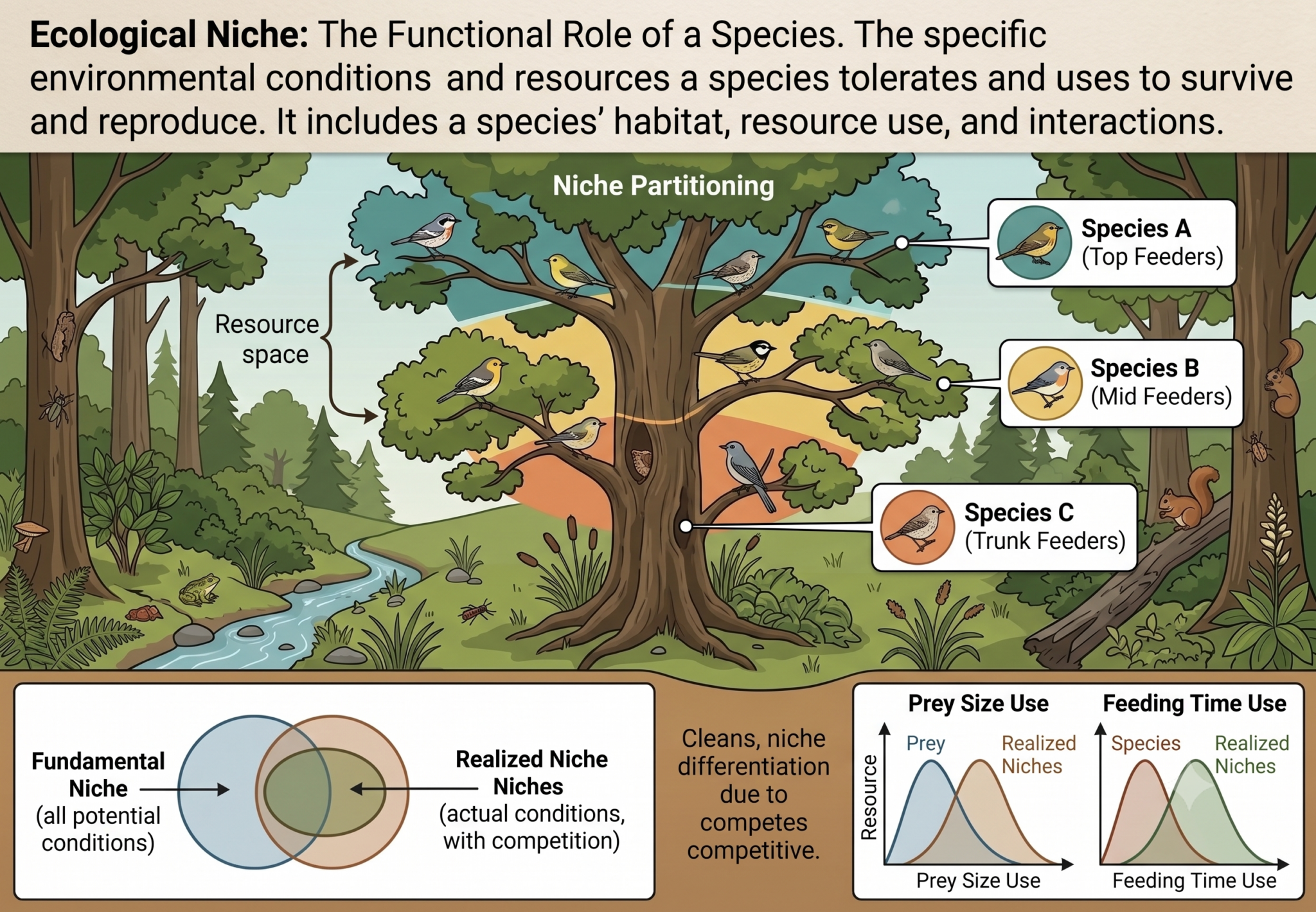
- Example: Multiple bird species may live on the same tree, but occupy different heights or branches to reduce competition.
- Temporal Niche: The temporal niche is determined by the timing of activity — when a species is active or uses resources. Temporal separation reduces direct competition among species that share similar resources.
- Example: Owls are active at night (nocturnal), while hawks are active during the day (diurnal).
- Functional Niche: The functional niche describes how a species interacts with both the abiotic environment and other organisms. Within this, two key concepts are:
- Fundamental Niche: This is the full range of environmental conditions where a species can survive and reproduce, determined by its physiological and behavioural traits, without competition or other biotic pressures.
- Realised Niche: This is the actual range a species occupies in nature, narrower than the fundamental niche, and limited by competition, predation, and other biological interactions.
- Adaptive and Evolutionary Niches: These involve changes over time where species evolve traits suited to specific niches, enabling them to adapt to shifting environments or exploit new resources.
- Examples: African cichlid fishes in the Great Lakes have evolved diverse jaw shapes and teeth to specialise in different diets, such as algae scraping, scale eating, or hunting other fish.
Difference Between Habitat and Ecological Niche
Ecological niche is the functional role a species plays within its ecosystem, including how it eats, reproduces, and interacts with other organisms. In contrast, habitat is the place where a species lives, like a forest, river, or desert, providing shelter and resources.
| Aspect | Ecological Niche | Habitat |
|
Definition |
The role a species plays in an ecosystem, including feeding, reproduction, and interactions with other organisms. |
The physical place where a species lives, providing shelter and resources. |
|
Specificity |
Unique to each species due to differences in roles and behaviours, even if species share habitat. |
Can be shared by many species living in the same physical environment. |
|
Nature and Scope |
Multidimensional, involving both biotic and abiotic interactions shaping survival and reproduction. |
Primarily spatial and physical, focused on environmental and geographical conditions. |
|
Example |
Tiger as a top predator regulating prey populations. |
Tigers inhabiting forests, grasslands, or mangroves. |
Ecological Niche Rules of Coexistence
The coexistence of different species depends on their ability to reduce direct competition for identical resources. It reduces competition and supports biodiversity.
- Niche Construction: Organisms actively modify their environment, shaping habitats and influencing resource availability for themselves and other species. These changes promote species coexistence, niche diversity, and ecosystem stability.
- Example: Snails consuming endolithic lichens help form soil in desert ecosystems, and seabird guano enriches island vegetation, transforming shrublands into lush grasslands.
- Niche Overlap: Occurs when two or more species use similar resources, such as food, habitat, or activity time, resulting in direct competition. Strong competition can reduce populations or exclude a species.
- Examples: Different species of ground beetles in the Chinese steppes live in the same areas and rely on similar patches of vegetation.
- Competitive Exclusion Principle: When species compete for the same limited resources, one may outcompete and exclude the other, forcing the weaker species to adapt, shift niches, or face extinction.
- In an experiment by Gause, Paramecium caudatum and Paramecium aurelia were grown together. P. aurelia outcompeted P. caudatum, causing its extinction.
- Niche Partitioning: Also called niche differentiation, is the process by which different species utilise distinct resources, habitats, or times within an ecosystem, reducing competition and promoting biodiversity. This differentiation can be shaped by factors like light, temperature, and spatial variability.
- Example: During the day, honey bees gather nectar from flowers on a ligustrum bush. At night, moths visit the same flowers to feed on nectar.
Ecological Niche Importance
Ecological niche importance lies in enabling resource partitioning, regulating populations, strengthening food webs, driving species evolution, and guiding conservation under climate and habitat changes.
- Resource Partitioning: Species adapt their niches to utilise different resources or the same resources differently (spatially, temporally, or dietarily), reducing interspecies competition and promoting coexistence within ecosystems.
- Population Regulation: A species’ niche shapes its distribution and abundance by influencing responses to resources, predators, and environmental limits.
- Ecosystem Stability: Different niches strengthen food webs, nutrient cycles, and overall ecosystem balance.
- Adaptation and Evolution: Niches drive changes in traits, encourage speciation, and promote evolutionary progress.
- Conservation Planning: Knowing species’ niches helps predict effects of climate change, habitat loss, or invasions, supporting biodiversity management.
Ecological Niche UPSC PYQs
Q1: Which one of the following terms describes not only the physical space occupied by an organism, but also its functional role in the community of organisms? (UPSC Prelims 2013)
(a) Ecotone
(b) Ecological niche
(c) Habitat
(d) Home range
Ans: (b)

 Last updated on Oct, 2026
→ UPSC 2027 Notification will be released on 13 January 2027 at upsconline.nic.in.
→ Check Nobel Prize 2026 Winners List here.
→ Download PIB PRiSM Monthly Magazine 2026 here.
→ Check UPSC Monthly Current Affairs Magazine The Recitals here.
→ Check out the latest UPSC Syllabus here.
→ Download UPSC Model Answers for Mains 2026
→ UPSC Mains Question Paper 2026 is out now for Essay & GS Paper 1, 2, 3 & 4.
→ UPSC Calendar 2027 has been released.
→ Enroll in Vajiram & Ravi’s UPSC Mains Test Series 2027 for structured answer writing practice, expert evaluation, and exam-oriented feedback.
→ Join Vajiram & Ravi’s UPSC Mentorship Program 2027 for personalized guidance, strategy planning, and one-to-one support from experienced mentors.
→ Go through the UPSC Mains Previous Year Papers to enhance your preparation.
→ UPSC has released UPSC Toppers List 2025 with the Civil Services final result on its official website.
→ Also check Best UPSC Coaching in India
Ecological Niche FAQs
Q1. What is Ecological Niche?+
Q2. What are examples of ecological niches?+
Q3. Who coined the term "ecological niche"?+
Q4. What is a niche and examples?+
Q5. What best describes an ecological niche?+
Tags: ecological niche quest UPSC Environment and Ecology Notes