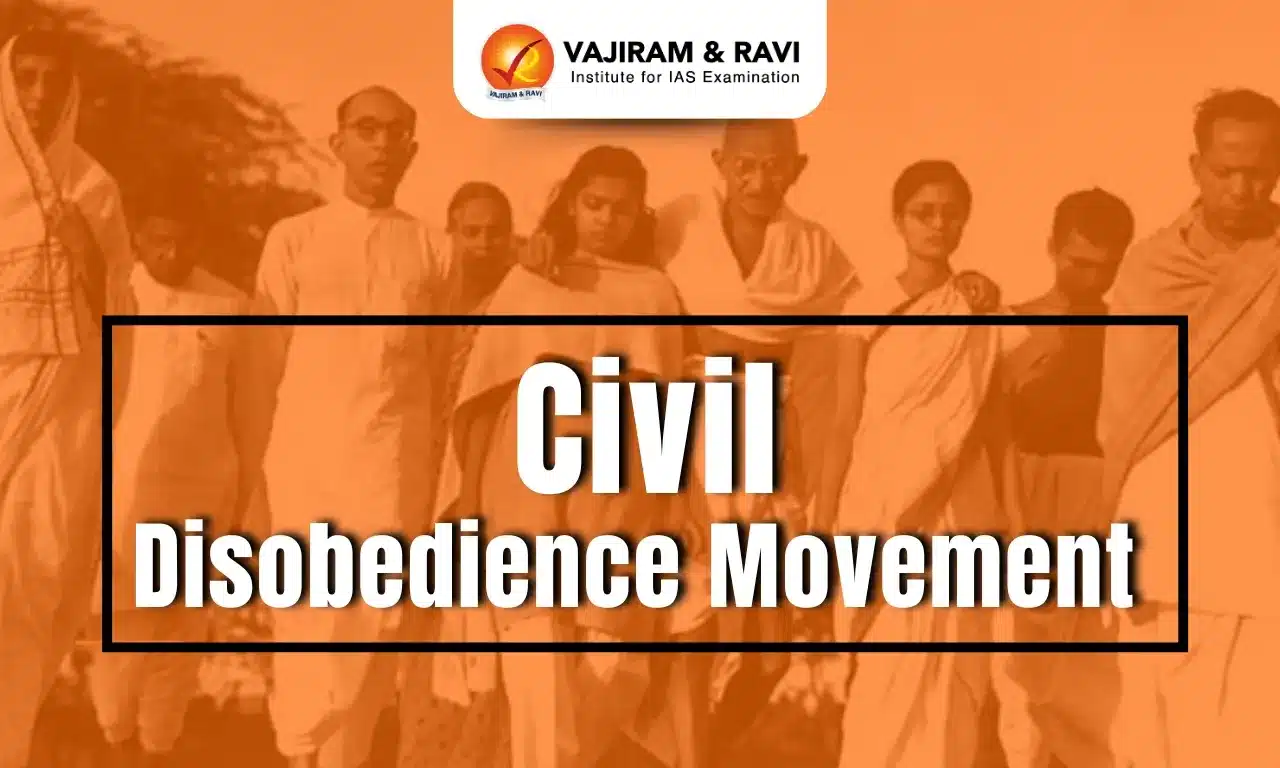
Civil Disobedience Movement (1930) is regarded as the second major mass movement and a distinct advancement in widening the social reach of India's struggle for freedom after the Non-Cooperation Movement. Known also as the Salt Satyagraha, it was also the first time that the Congress put the objective of complete independence from the British authority as well as to the Indian masses.
The Civil Disobedience Movement was formally launched by Mahatma Gandhi on 6 April 1930 by breaking the salt law after his historic Dandi March. It was followed by the widespread arrest of national leaders throughout the nation.
Civil Disobedience Movement Background
The background for the Civil Disobedience Movement lies in rising political unrest, including widespread protests against the arrest of revolutionary leaders and India's push to frame its own constitution. It gained further momentum as the demand for complete independence grew after the British rejected the Nehru Report's proposal for Dominion status.
Events Leading to the Civil Disobedience Movement
- Calcutta Session (1928): It endorsed the Nehru Report and demanded Dominion status. A clash between factions led to a one-year grace period for the British to grant Dominion status by December 31, 1929, or face a Civil Disobedience Movement.
- Irwin’s Declaration (October 1929): Viceroy Lord Irwin promised Dominion status and a Round Table Conference post-Simon Commission's report. The lack of a timeline frustrated Congress, leading to the Purna Swaraj resolution.
- Delhi Manifesto (November 2, 1929): National leaders outlined prerequisites for attending the Round Table Conference: immediate adoption of Dominion status, majority Congress representation, and amnesty for political prisoners.
- Lahore Session (1929) and Purna Swaraj: Irwin rejected the Delhi Manifesto's demands. Jawaharlal Nehru led the session, emphasising Purna Swaraj. Key decisions included declaring complete independence, hoisting the tricolour on December 31, 1929, boycotting Round Table Conferences, taking the Independence Day pledge on January 26, 1930, and launching the Civil Disobedience Movement under Gandhi.
Civil Disobedience Movement Gandhi’s Eleven Demands
Gandhi's eleven demands were a compromise formula that appealed to a wide range of political opinions. He gave the British until January 31, 1930, to accept or reject the demands. If the demands were not met by March 11, Gandhi threatened civil disobedience.
- Reduce rupee-sterling ratio to 1s 4d
- Reduce Agricultural tax by 50% and make it a subject of legislative control
- Eliminate the government's monopoly on salt and abolish the salt tax
- Reduce military expenditure and salaries of highest-grade services
- Release all political prisoners
- Reform in the Criminal Investigation Department
- Accept Postal Reservation Bill
- Protect Indian Textiles
- Prohibition of intoxicants
- Reserve coastal shipping for Indians
- Allow popular control of the issue of firearm licences
Civil Disobedience Movement Causes
Causes of the Civil Disobedience Movement stemmed from the demand for complete independence (Purna Swaraj), severe economic distress from the Great Depression, and oppressive British policies like the salt tax.
- Simon Commission (1927): This all-British commission outraged Indians because it excluded native members from deciding India's constitutional future.
- Demand for Purna Swaraj: The Indian National Congress declared complete independence as its ultimate goal during the 1929 Lahore session.
- Ignored Eleven Demands: Viceroy Lord Irwin rejected the 11-point ultimatum of Mahatma Gandhi for administrative and financial reforms, leaving no room for compromise.
- Great Depression (1929): Agricultural prices crashed across the country, but the colonial government refused to lower heavy land revenue taxes.
- Salt Monopoly and Tax: The British tax on salt affected every Indian, which helped unify rich and poor citizens against colonial rule.


Civil Disobedience Movement Date and Launch
With no response from the government regarding the 11 demands, Gandhi decided to launch the Civil Disobedience Movement. Among all the demands, he chose to violate the salt law because the British were inhumanely taxing this basic necessary item and had a near monopoly over it.
Dandi March
Dandi March, also known as the Salt Satyagraha, was announced by Gandhi after informing Irwin in advance that he would break the salt laws. The place where the Civil Disobedience Movement was launched was Ahmedabad, from where Gandhi and his 78 supporters started the Dandi March on March 12, 1930, and reached it on April 5, 1930. He broke the salt regulations on April 6 (Civil Disobedience Movement Date) and, thus, officially started the Civil Disobedience Movement.
Forms of Protest
Forms of the Civil Disobedience Movement included illegal salt making, tax refusal, forest law violations, foreign goods and liquor boycotts, resignations, mass participation, and non-violent resistance.
- Law Violations: Manufacturing salt illegally, breaking forest laws, and refusing to pay land or chowkidara taxes.
- Boycotts: Picketing of foreign cloth and liquor shops; lawyers giving up practices and public rejecting courts; resignation by government servants from their posts.
- Widespread Participation: Unprecedented numbers of women, peasants, tribal groups, and business communities joined.
- Truth and Non-violence: Adherence to the truth and non-violence as means to attain swaraj; Obedience of the local leaders after Gandhi’s arrest.
Civil Disobedience Movement Time Period
The Civil Disobedience Movement time-period began with Gandhi's Dandi March, promoting non-violent defiance of British laws, mass participation, and demanding complete independence for India. The spread of the Civil Disobedience Movement is detailed in the table below:
|
Region |
Associated Leaders |
Significant Activities |
|
Tamil Nadu |
C. Rajagopalachari |
- Break of the salt law on the Tanjore coast by a march from Tiruchirapalli to Vedaranniyam (Vedaranyam Salt Satyagraha) - Picketing of foreign cloth shops - Anti-liquor campaign |
|
Malabar |
K. Kelappan P. Krishna Pillai |
- Organised salt marches ( Calicut to Poyannur) |
|
Bengal |
Subhas Chandra Bose and J.M. Sengupta |
- Salt satyagraha, anti-chaukidari tax and anti-Union Board agitation - Collective protests and assault on officers who attempted to seize the property of those refusing to pay the chowkidari tax |
|
Peshawar |
Khan Abdul Gaffar Khan |
- Organisation of a volunteer brigade, ‘Khudai Khidmatgars’ (Red-Shirts) - Refusal by Garhwal Rifles soldiers to fire on an unarmed crowd |
|
Dharasana |
Sarojini Naidu, Imam Sahib, and Manilal |
- Raid on the Dharasana Salt Works. (Gandhi was to lead the satyagraha but was already arrested.) |
|
Bardoli and Kheda Region |
- No tax movement and refusal to pay land revenue - Exodus of a large number of people from British India into the neighbouring princely states |
|
|
United Provinces |
Jawaharlal Nehru |
- No-revenue campaign - No-rent campaign |
|
Bihar |
Ambika Kant Sinha |
- Breaking of the salt law in Patna - Salt Satyagraha in Champaran and Saran - Replacement of salt satyagraha by non-payment of chowkidari tax |
|
Orissa |
Gopalbandhu Choudhuri |
- Satyagraha in the coastal regions of Balasore, Cuttack, and Puri districts |
Truce period
Tribal and Peasant militancy, Congress leaders being in jail, and decreasing support of Rich peasants as well as Business classes in the later months of 1930 compelled Gandhi and Congress to retreat from the Movement.
Gandhi-Irwin Pact
The Gandhi-Irwin Pact was an agreement signed on March 5, 1931, between Gandhi and Lord Irwin, the then Viceroy of India. It marked the end of the Civil Disobedience Movement's first phase.
- The key provisions included the release of political prisoners, the right to make salt for personal use, and the withdrawal of ordinances against civil disobedience.
- In return, Gandhi agreed to suspend the movement and attend the Second Round Table Conference in London.
Karachi Session, 1931
The Karachi Session of the Congress held in March 1931 aimed to endorse the Gandhi-Irwin Pact. During this session, resolutions were passed endorsing the Delhi Pact, reiterating the goal of Purna Swaraj. This session marked a crucial moment aligning Congress with the agreements made under the Gandhi-Irwin Pact.
Civil Disobedience Movement Withdrawal
The Civil Disobedience Movement was initially withdrawn in 1931 after the Gandhi-Irwin Pact. However, following the failure of the Second Round Table Conference, Gandhi resumed the movement. Arrested in January 1932, he faced severe repression, including confiscation of Congress funds and occupation of buildings.
- Despite initial momentum, the movement began to decline due to intense government repression. By late 1932, it was tapering off but continued in some form until 1934.
- Gandhi, still in jail, suspended the movement in May 1933 and formally withdrew it in April 1934.
Civil Disobedience Movement Participation
The participation in Civil Disobedience Movement was widespread, involving peasants, students, women, workers, merchants, and tribal communities who collectively challenged British rule through non-violent resistance and mass mobilisation.
- Urban areas: In the urban areas, the support for Gandhian ideology was less than that during the Non-Cooperation Movement. Only a few lawyers gave up their practice, and a few students joined ‘national schools’ instead of government-controlled institutions.
- Muslims: Muslim participation was nowhere near the NCM, and there was even communal discontent in some places.
- Business class and Merchants: Business groups showed considerable support during the initial phase that filled the gap of other sections, especially Gujarati business communities.
- Women: Women were active in picketing outside liquor stores, opium dens, and shops selling foreign clothing. It was a liberating experience for them.
- Peasants: Peasants organised numerous protests against the policies of the British Government and took part in them in large numbers.
- Tribal: During the Civil Disobedience movement, tribal people launched a nonviolent protest (or Satyagraha) against these imposed restrictions.
- Students: The Civil Disobedience Movement was heavily influenced by students and youth. They organised protests, strikes, and boycotts, and they took an active role in the Salt Satyagraha.
Civil Disobedience Movement Limitations
The limitations of the Civil Disobedience Movement stemmed from deep social fractures, class conflicts, and intense British repression despite expanding the national struggle.
- Limited Dalit Participation: The minimal participation of Dalits restricted mass outreach because Congress hesitated to push radical social reform to avoid alienating the upper caste.
- Ambedkar-Gandhi Political Rift: Severe ideological clashes between Dr. B.R. Ambedkar and Mahatma Gandhi over separate electorates during the Round Table Conference weakened unified social backing.
- Muslim Alienation: Muslim involvement dropped drastically after the Khilafat movement's decline, deepening communal alienation from Congress initiatives. Mutual distrust over reserved seats and fears of Hindu majority dominance alienated minority communities further.
- Conflicting Economic Aspirations: Conflicting economic demands between rich landlords, landless peasants, factory workers, and big industrialists made reconciling all interests impossible for Congress.
- Capitalist vs. Labor Tensions: Industrialists feared militant labour actions, while workers withdrew when Congress avoided anti-capitalist positions to protect elite business funding.
- Intermittent Momentum: Brutal colonial repression, mass arrests, property seizures, and the temporary suspension under the Gandhi-Irwin Pact severely disrupted momentum.
Civil Disobedience Movement Assessment
Despite missing Purna Swaraj, the Civil Disobedience Movement strengthened Congress, promoted radical socio-economic reforms, inspired socialist politics, secured political legitimacy, and established Indians as equals.
- Not a Failure for Congress: Congress could mobilise great political support and got moral authority that was reflected in the massive victory in the 1937 election.
- More Radical Forms of Congress: The resolution of Purna Swaraj and its attributes, declared in the Karachi Resolution, show the drifting of Congress towards greater radicalisation.
- Further, a separate party, but under the overall supervision of Congress, called the Congress Socialist Party, was founded in 1934. It was founded by ideologically Fabian socialists Jai Prakash Narayan, Acharya Narendra Deva and Ram Manohar Lohia.
- Equal Treatment to Indians: Although many Congress supporters were considerably disappointed, especially the youth and peasants whose lands were not restored, they were also jubilant that Indians were treated for the first time as equals in signing the pact and holding the RTCs.
Civil Disobedience Movement Significance
The Civil Disobedience Movement (1930–1934), led by Mahatma Gandhi for Purna Swaraj, had a profound political impact, beginning with the Dandi Salt March, by deepening national consciousness across diverse social groups.
- Demand for Complete Independence: The movement officially shifted the national goal from dominion status to absolute freedom (Purna Swaraj).
- Challenging Colonial Moral Legitimacy: Deliberately breaking the salt tax during the Salt Satyagraha stripped the British Raj of its moral authority to govern without consent.
- Mass Mobilisation: Sparked by the historic Dandi March, the movement broadened the national movement's social reach through participation by peasants, workers, and students.
- Women’s Participation: Women stepped onto the frontlines to picket shops and march, breaking traditional gender boundaries.
- Power of Non-Violent Resistance: The widespread defiance during the Salt Satyagraha demonstrated the immense power of non-violent resistance against British monopoly.
- Pressure on British Colonial Rule: The economic boycotts and tax refusals forced the colonial administration to recognise the growing political strength of the freedom movement.
- Heightened Political Awakening: It fostered widespread anti-imperialist political consciousness and a strong sense of national pride across urban and rural regions.
Civil Disobedience Movement UPSC PYQs
Q1: Bring out the constructive programmes of Mahatma Gandhi during the Non-Cooperation Movement and Civil Disobedience Movement. (UPSC Mains 2021)
Q2: With reference to 8th August 1942 in Indian history, which one of the following statements is correct? (UPSC Prelims 2021)
(a) The Quit India Resolution was adopted by the AICC.
(b) The Viceroy’s Executive Council was expanded to include more Indians.
(c) The Congress ministries resigned in seven provinces.
(d) Cripps proposed an Indian Union with full Dominion Status.
Ans: (a)
Q3: The Gandhi-Irwin Pact included which of the following? (UPSC Prelims 2020)
- Invitation to Congress to participate in the Round Table Conference
- Withdrawal of Ordinances promulgated in connection with the Civil Disobedience Movement
- Acceptance of Gandhiji’s suggestion for enquiry into police excesses
- Release of only those prisoners who were not charged with violence.
Select the correct answer using the code given below:
- 1 only
- 1, 2 and 4 only
- 3 only
- 2, 3 and 4 only
Ans: (b)
Q4: Who of the following organized a march on the Tanjore coast to break the Salt Law in April 1930? (UPSC Prelims 2015)
- V. O. Chidambaram Pillai
- C. Rajagopalachari
- K. Kamaraj
- Annie Besant
Ans: (c)
Q5: The 1929 Session of the Indian National Congress is of significance in the history of the Freedom Movement because the (UPSC Prelims 2014)
- attainment of Self-Government was declared as the objective of the Congress
- attainment of Poorna Swaraj was adopted as the goal of the Congress
- Non-Cooperation Movement was launched
- Decision to participate in the Round Table Conference in London was taken
Ans: (b)
| Other Related Posts |
|
| Round Table Conference | Gandhi-Irwin Pact |
| Poona Pact 1932 | 1937 Elections in India |

 Last updated on Oct, 2026
→ UPSC 2027 Notification will be released on 13 January 2027 at upsconline.nic.in.
→ Check Nobel Prize 2026 Winners List here.
→ Download PIB PRiSM Monthly Magazine 2026 here.
→ Check UPSC Monthly Current Affairs Magazine The Recitals here.
→ Check out the latest UPSC Syllabus here.
→ Download UPSC Model Answers for Mains 2026
→ UPSC Mains Question Paper 2026 is out now for Essay & GS Paper 1, 2, 3 & 4.
→ UPSC Calendar 2027 has been released.
→ Enroll in Vajiram & Ravi’s UPSC Mains Test Series 2027 for structured answer writing practice, expert evaluation, and exam-oriented feedback.
→ Join Vajiram & Ravi’s UPSC Mentorship Program 2027 for personalized guidance, strategy planning, and one-to-one support from experienced mentors.
→ Go through the UPSC Mains Previous Year Papers to enhance your preparation.
→ UPSC has released UPSC Toppers List 2025 with the Civil Services final result on its official website.
→ Also check Best UPSC Coaching in India
Civil Disobedience Movement FAQs
Q1. When was the first Civil Disobedience Movement started?+
Q2. Who launched the Civil Disobedience Movement?+
Q3. When did Gandhiji call of Civil Disobedience Movement?+
Q4. Why was CDM called off in 1934?+
Q5. What is civil disobedience according to Gandhi?+
Tags: civil disobedience movement quest upsc modern history