Kelp forests are characterised by large brown algae and are highly productive marine ecosystems that provide food, shelter, and nurseries for a diverse array of species. They support carbon sequestration, oxygen production, and coastal protection, covering around 25-30% of the world’s coastlines.
They are declining at about 1.8% per year due to climate change, pollution, and human pressures; their resilience varies with local conditions. Experts highlight that integrating scientific research with indigenous knowledge can strengthen conservation, promote sustainable use, and support the blue economy.
Kelp Forest Meaning
Kelp forests are rich and productive coastal ecosystems dominated by large brown algae collectively known as kelp. These underwater “forests” form dense, towering canopies that resemble terrestrial forests in structure and function. Firmly anchored to rocky seabeds, kelp grows upward toward sunlight, carrying out photosynthesis that sustains itself and supports a diverse array of marine life.
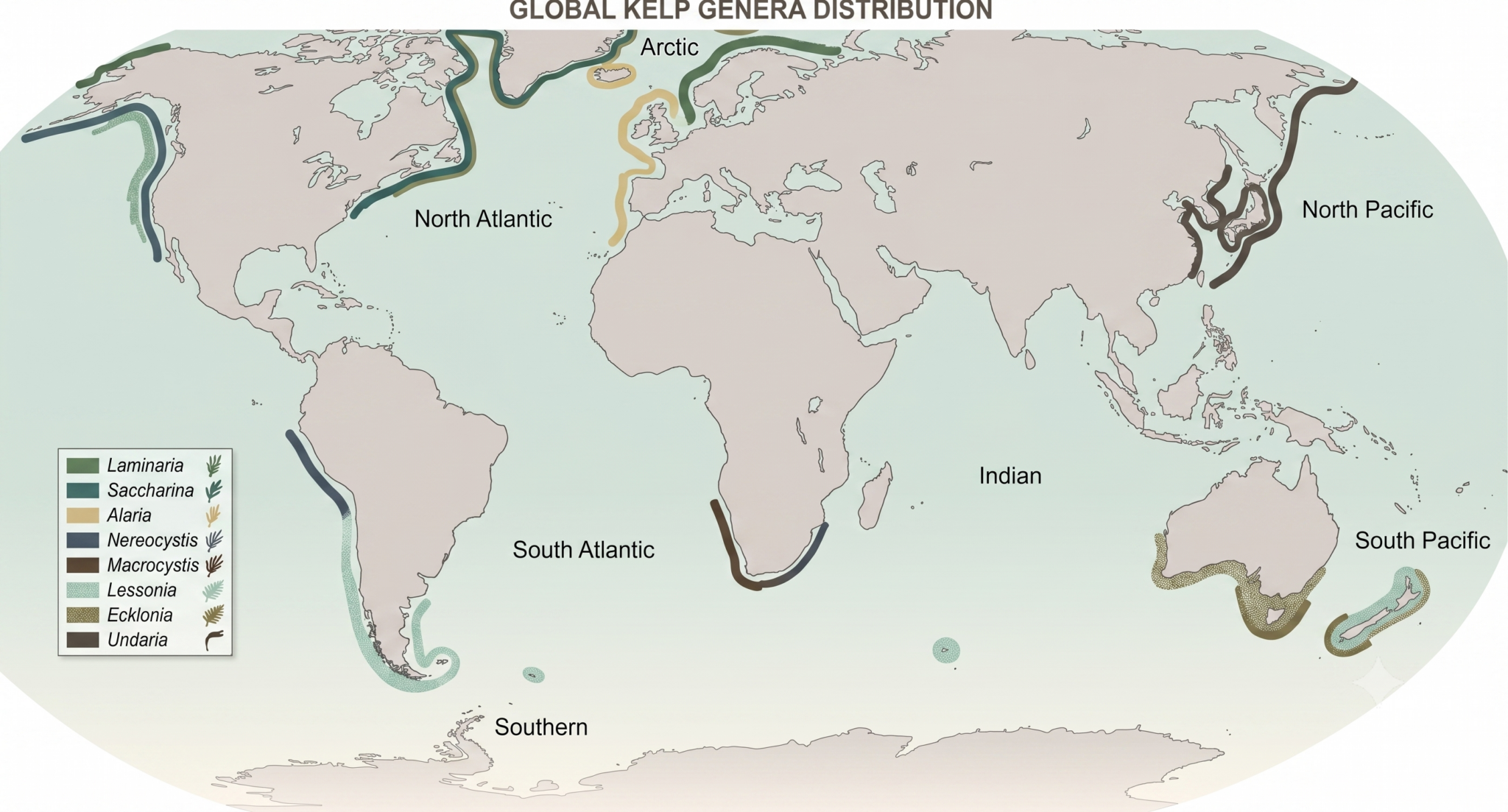
Kelp Forest Global Distribution
Kelp forests are distributed globally along the coastlines of the Northern and Southern Hemispheres, primarily in cool, temperate, and Arctic waters, though some species can be found in tropical deep waters. Key areas include:
- North America: California, Alaska
- South America: Chile, Argentina
- Oceania: Australia, New Zealand
- Africa and Europe: Coastal areas with cold currents
- In India, it is largely absent along tropical coasts due to warm waters and low nutrient availability.
Kelp Forest Features
Kelp forests, often called the “rainforests of the sea,” support diverse marine life, absorb carbon, and shield coastlines from erosion and storms. They contribute to fisheries, offer economic benefits, and hold cultural and scientific importance for coastal communities.
- Habitat and Distribution: Kelp forests are coastal marine ecosystems dominated by large brown algae, typically found along temperate and polar coastlines with cold, nutrient-rich, and well-lit waters.
- Anchored to rocky seabeds, they form dense underwater “forests” that provide habitat for diverse marine species.
- Structure of Kelp Forest: Kelp forests have a distinct vertical structure supporting complex ecological interactions:
- Holdfast: Root-like structure anchoring kelp to rocks, providing stability.
- Stipe: Stem-like structure connecting holdfast to blades, flexible with water movement.
- Blades (Fronds): Leaf-like parts performing photosynthesis and generating organic matter.
- Pneumatocysts: Gas-filled bladders keep blades buoyant for optimal sunlight exposure.
- Canopy Layer: Dense upper fronds that host fish, invertebrates, and marine mammals.
- Understory & Forest Floor: Lower layers with smaller algae and benthic organisms aiding nutrient recycling and providing habitat diversity.
- Food Production and Energy Flow: Kelp fronds perform intense photosynthesis, producing organic matter and energy that fuel the kelp forest ecosystem food web, supporting invertebrates (sea urchins, snails, crabs), fish (rockfish, kelp bass), and top predators (sea otters, seals, seabirds).
- Adaptability and Rapid Growth: Some species, notably giant kelp (Macrocystis), can grow 30–60 cm per day, regenerate quickly after disturbances, and persist for decades under favorable conditions, showing high resilience to environmental changes.
- Trophic Interdependence: Predators such as sea otters regulate herbivore populations like sea urchins, preventing overgrazing, while mutualistic and symbiotic relationships stabilise the ecosystem.
- Environmental Sensitivity: Despite adaptability, kelp forests are vulnerable to ocean warming, storms, pollution, overfishing, and invasive species, which can reduce kelp cover and disrupt the kelp forest ecosystem food web.
Kelp Forest Ecosystem Food Web
The kelp forest ecosystem food web is highly complex and balanced, supporting both predator and prey species.
- Producers: Kelp and associated algae perform photosynthesis to produce biomass.
- Primary Consumers: Invertebrates such as sea urchins, snails, and crabs feed directly on kelp tissues and detritus.
- Secondary Consumers: Fish species like rockfish and kelp bass prey on invertebrates.
- Top Predators: Sea otters, seals, and birds such as herons and gulls consume fish and invertebrates, maintaining ecological balance. These interactions sustain energy flow, biodiversity stability, and ecological resilience within the kelp forest ecosystem.


Kelp Forest Importance
The importance of kelp forests extends across ecological, economic, and cultural dimensions. They are biodiversity hotspots, supporting a wide range of species such as fish, invertebrates, marine mammals, and seabirds, and play a crucial role in maintaining marine ecosystem balance.
- Biodiversity Hotspots: They support a wide variety of animals. They provide essential habitat, food, and breeding grounds for diverse marine species, including lobsters, abalone, and seabirds, sustaining overall ecological stability.
- Trophic Interdependence: Predators like sea otters regulate herbivores such as sea urchins, preventing overgrazing and maintaining kelp density. Symbiotic and mutualistic relationships further stabilise the ecosystem.
- Efficient Nutrient Cycling: They thrive in nutrient-rich waters and enhances ecosystem productivity by facilitating nutrient uptake, organic matter recycling, and detritus formation, which supports lower food web levels.
- Climate Regulation and Carbon Sequestration: Kelp forests absorb significant amounts of CO₂ through photosynthesis, acting as blue carbon sinks and contributing to global climate change mitigation.
- Coastal Protection: Dense kelp stands reduce wave energy, buffer shorelines from storms, prevent erosion, and enhance the resilience of coastal zones.
- Economic Importance: Support fisheries and aquaculture by sustaining commercially valuable species. Kelp-derived products such as alginates are used in food processing, pharmaceuticals, fertilizers, and biofuels, generating substantial economic benefits.
Coral Reef vs Kelp Forest
Coral reefs are found in warm tropical waters, and kelp forests thrive in cold, nutrient-rich coasts, both support rich marine biodiversity and provide crucial ecosystem services, yet face growing threats from climate change and human impacts.
| Feature | Coral Reef | Kelp Forest |
|
Environment |
Warm, shallow tropical and subtropical seas |
Cold, nutrient-rich temperate and subpolar coastal waters |
|
Structure |
Hard calcium carbonate skeletons form complex, three-dimensional reefs |
Dense underwater forests of large brown algae form vertical canopies |
|
Biodiversity |
Extremely high; supports ~25% of all marine species globally |
High biodiversity; includes fish, invertebrates, marine mammals, and seabirds |
|
Ecological Functions |
Coastal protection, habitat for diverse species, fisheries, and tourism |
Carbon sequestration, wave energy buffering, nursery habitats, nutrient cycling |
|
Growth Rate |
Slow-growing coral skeletons |
Rapid-growing kelp, up to 30–60 cm (12–24 inches) per day |
|
Vulnerability |
Highly sensitive to ocean warming, bleaching, acidification, and pollution |
Vulnerable to warming, overgrazing by sea urchins, invasive species, and climate change |
|
Global Distribution |
Tropical and subtropical oceans |
Temperate and subpolar coasts worldwide |
Kelp Forest Threats
Kelp forest deforestation or loss is seen due to various reasons such as overfishing of predators, climate change, pollution, and others. The harmful impact of kelp includes reduced growth and survival.
- Overfishing and Predator Loss: Overfishing and disease have reduced keystone predators like sunflower sea stars and sea otters that control sea urchin populations. Their decline has allowed purple sea urchins to multiply, overgraze kelp, and create “urchin barrens” where kelp cannot regenerate.
- Climate Change: Rising sea temperatures, marine heatwaves, and ocean acidification weaken kelp growth, reproduction, and survival. Warming also increases disease risk and encourages invasive algae and bryozoan outbreaks, which damage kelp.
- The 2014–16 Pacific marine heatwave caused massive kelp die-offs along North America’s west coast.
- Pollution and Eutrophication: Agricultural runoff and coastal pollutants introduce excess nutrients that trigger algal blooms, reducing light and oxygen and limiting kelp survival. Some kelp species are less tolerant to environmental stress, making them more prone to decline.
- Bryozoa Infestation: Dense colonies of moss animals attach to kelp fronds, increasing their weight and causing them to sink and decay, especially in warmer waters.
- Invasive Species and Grazing Pressure: Non-native algae and herbivores compete with kelp for space, and along with unchecked sea urchin grazing, this can lead to the destruction of kelp forests.
Kelp Forest Conservation
Kelp conservation aims to protect and restore ecosystems, improve water quality, and adapt to climate change. Key approaches, such as Marine Protected Areas, can lead to sustainable management of forests.
- Marine Protected Areas (MPAs): Designating regions as MPAs limits harmful activities like fishing and coastal development, allowing predator populations to recover. This helps control herbivores such as sea urchins, enabling kelp forests to regenerate naturally.
- Active Restoration: Kelp forests can be restored by transplanting healthy kelp, seeding spores, or creating artificial reefs. Managing grazers either by removing them or supporting natural predators prevents overgrazing and encourages kelp growth.
- Water Quality Improvement: Reducing pollution, nutrient runoff, and sedimentation creates better water conditions for kelp growth.
- Climate Change Adaptation: Planting climate-resilient kelp varieties and monitoring ocean warming helps kelp forests withstand environmental changes.
- Community Engagement: Involving local and indigenous communities in conservation efforts ensures sustainable management, protects livelihoods dependent on kelp, and promotes long-term ecosystem health.

 Last updated on Oct, 2026
→ UPSC 2027 Notification will be released on 13 January 2027 at upsconline.nic.in.
→ Check Nobel Prize 2026 Winners List here.
→ Download PIB PRiSM Monthly Magazine 2026 here.
→ Check UPSC Monthly Current Affairs Magazine The Recitals here.
→ Check out the latest UPSC Syllabus here.
→ Download UPSC Model Answers for Mains 2026
→ UPSC Mains Question Paper 2026 is out now for Essay & GS Paper 1, 2, 3 & 4.
→ UPSC Calendar 2027 has been released.
→ Enroll in Vajiram & Ravi’s UPSC Mains Test Series 2027 for structured answer writing practice, expert evaluation, and exam-oriented feedback.
→ Join Vajiram & Ravi’s UPSC Mentorship Program 2027 for personalized guidance, strategy planning, and one-to-one support from experienced mentors.
→ Go through the UPSC Mains Previous Year Papers to enhance your preparation.
→ UPSC has released UPSC Toppers List 2025 with the Civil Services final result on its official website.
→ Also check Best UPSC Coaching in India
Kelp Forest FAQs
Q1. What is a kelp forest?+
Q2. Is kelp found in India?+
Q3. Where is the biggest kelp forest in the world?+
Q4. What is kelp used for?+
Q5. What eats kelp?+
Tags: kelp forest quest UPSC Environment and Ecology Notes