Fly ash is a fine powdery residue from coal combustion in thermal power plants, which enhances concrete strength, durability, and workability. Beyond construction, fly ash finds applications in soil stabilisation, road construction, brick manufacturing, and land reclamation.
However, improper disposal of fly ash can lead to air pollution due to fine particulate emissions and contamination of water and soil from toxic elements. Therefore, effective management and sustainable use are essential to safeguard the environment. India has implemented regulations and missions to ensure proper utilisation and minimise ecological impact.
Fly Ash Meaning
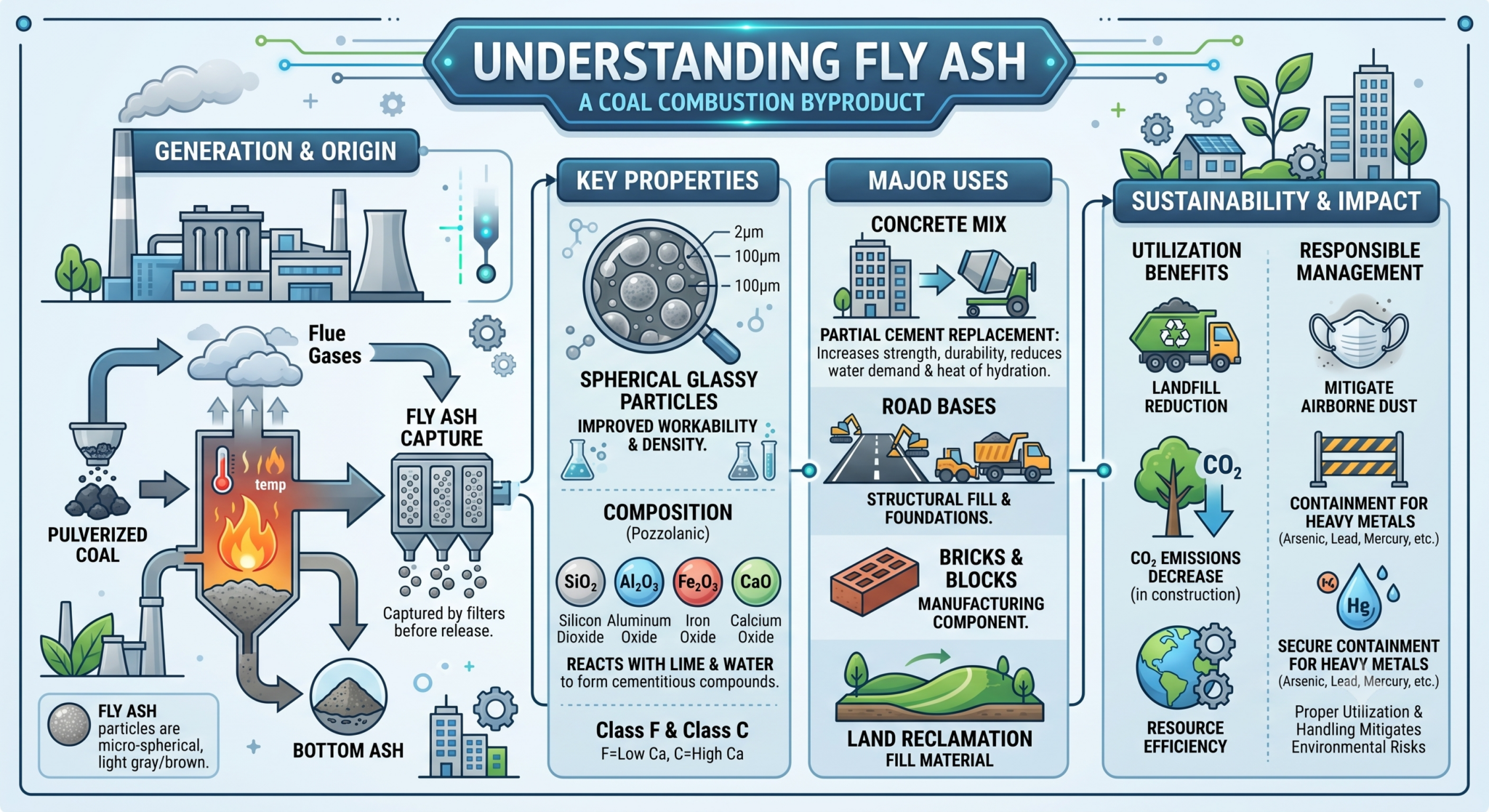
Fly ash is a fine, powdery residue produced when pulverised coal burns in thermal power plants. Its tiny, spherical particles are even finer than Portland cement, helping concrete flow better and improving its strength, durability, and resistance to chemicals and water penetration. Fly Ash production process includes:
- Combustion of Coal: Coal is burned in suspension, leaving non-combustible minerals in the flue gas.
- Particle Melting: High furnace temperatures partially melt these minerals, forming fine, spherical particles due to surface tension.
- Rapid Cooling: As flue gases cool, some molten particles solidify in a glassy state, giving them high pozzolanic activity. The fine particles are then captured by dust collectors before emission.
- Pozzolanic activity refers to the ability of a material to react with calcium hydroxide (CH) in the presence of water to form compounds with cementitious properties.
Fly Ash Composition
Fly ash chemically consists mainly of amorphous glass, crystalline minerals, and trace amounts of unburned carbon. Its dominant oxides are silicon dioxide (SiO₂), aluminium oxide (Al₂O₃), ferric oxide (Fe₂O₃), and calcium oxide (CaO), forming the bulk of its composition.
- Minor amounts of magnesium, potassium, sodium, titanium, and sulphur may also be present, along with trace elements depending on the coal source.
- Primary phase: Unaltered minerals originally present in coal.
- Secondary phase: Oxides and silicates formed during combustion.
- Tertiary phase: Compounds such as portlandite and gypsum are produced during post-combustion reactions.


Fly Ash Properties
Fly ash appearance, particle size, calcium content, and density of fly ash determine its pozzolanic activity, workability, and suitability for use in concrete, mortar, and other building materials.
- Appearance: Ranges from milky white to dark grey, primarily composed of glassy amorphous particles with minor crystalline phases and unburned carbon.
- Structure: Fine particles are used as a partial replacement for cement, while coarser fractions are suitable for mortars or aggregates.
- Density: Fly ash particles are very fine and light, with bulk density around 0.6–1.3 g/cm³ and true density 1.8–2.3 g/cm³. Rapid cooling produces small, glassy, highly reactive particles, while slower cooling forms larger, less reactive crystalline particles.
- Classification: Fly ash is classified based on its calcium oxide (CaO) content. Higher CaO content generally corresponds to lower SiO₂, Al₂O₃, and Fe₂O₃, while alkalis (Na₂O, K₂O) and SO₃ tend to increase.
- Class F Fly Ash (Low-Calcium): Derived mainly from bituminous and anthracite coals, Class F contains less than 10% CaO. It is predominantly composed of alumino-silicate glass and exhibits pozzolanic properties, reacting with lime or cement to form cementitious compounds.
- Class F improves sulfate resistance, reduces alkali–silica reactivity (ASR), and enhances the durability of fly ash concrete. It is typically grey in colour.
- Class C Fly Ash (High-Calcium): Produced from sub-bituminous coals, Class C contains more than 20% CaO and includes calcium alumino-sulfate glass, quartz, tricalcium aluminate, and free lime.
- It exhibits both pozzolanic and self-cementing properties, enabling it to gain strength even without added cement. The ash is generally light brown to reddish in colour.
- Class F Fly Ash (Low-Calcium): Derived mainly from bituminous and anthracite coals, Class F contains less than 10% CaO. It is predominantly composed of alumino-silicate glass and exhibits pozzolanic properties, reacting with lime or cement to form cementitious compounds.
Fly Ash Uses
Fly ash is recognised as a useful and eco-friendly material. Its pozzolanic and cement-like properties make it a reliable alternative to traditional raw materials in construction and industry.
- Construction Use: It is used as a partial cement replacement (15-30%, up to 50-60% in high-volume fly ash concrete), improving strength, durability, workability, and reducing heat generation and water.
- It is also utilised in the creation of asphalt concrete, lightweight fly ash bricks, blocks, mortar, insulation bricks, and precast components, enhancing thermal insulation while reducing reliance on sand and clay.
- Specialised Materials: When sintered, fly ash forms ceramsite, a lightweight aggregate with excellent thermal insulation, suitable for high-rise and energy-efficient buildings.
- Industrial and Soil Applications: Alumina and silica extracted from fly ash are used to make silicon carbide, polymer fillers, and synthetic bauxite.
- Soil Stabilisation: Mineral-enriched fly ash improves soil structure and stability while enhancing fertility, making it useful for soil stabilisation and the production of nutrient-rich fertilisers.
- Environmental and Economic Benefits: Recycling fly ash reduces landfill use, lowers greenhouse gas emissions, cuts disposal costs, and provides a cost-effective alternative to raw materials. Safe storage and handling prevent air pollution and chemical leaching.
Fly Ash Impacts
Fly ash disposal and use have significant environmental and health consequences. Improper handling can pollute air, soil, and water, posing risks to humans, agriculture, and ecosystems.
- Environmental Impacts: Fly ash contains silica, alumina, iron oxide, toxic metals (arsenic, mercury, cadmium, chromium, lead, uranium, thorium), organic pollutants, and crystalline silica. These can leach into soil and water, contaminating crops, water bodies, and reducing soil fertility.
- Air Pollution: Fine particles (PM2.5 and PM10) can become airborne, lowering air quality and causing respiratory problems such as asthma, bronchitis, and other lung diseases.
- Ecosystem Effects: Fly ash can hinder plant growth, reduce crop yields, and damage vegetation and aquatic life through chemical and thermal pollution.
- Radioactive Impact: Fly ash contains trace radioactive elements like uranium and thorium, concentrated during coal combustion.
- Radiation levels near coal plants can sometimes exceed those of nuclear plants producing similar energy, but public exposure remains low. The main risk is occupational exposure and environmental leaching.
- Health Impacts: Inhalation of fly ash, particularly crystalline silica, can cause respiratory diseases such as asthma, bronchitis, silicosis, lung fibrosis, and lung cancer.
- Long-term exposure may also affect the heart, kidneys, and nervous system, and cause developmental delays in children due to heavy metals and polycyclic aromatic hydrocarbons (PAHs).
Fly Ash Related Government Initiatives
Fly Ash is generated significantly in India primarily from coal-based thermal power plants, with production reaching around 340 million tonnes in 2024-25. India has implemented several fly ash management strategies focusing on sustainable utilisation and minimising environmental impact.
-
- Fly Ash Management and Utilisation Mission: Set up under National Green Tribunal (NGT) directives, this mission coordinates fly ash management nationwide.
- It monitors utilisation, addresses operational challenges, and manages legacy stockpiles exceeding 1,670 million tonnes.
- Fly Ash Management and Utilisation Mission: Set up under National Green Tribunal (NGT) directives, this mission coordinates fly ash management nationwide.
- Fly Ash Mission: It was commissioned in 1994 but approved in 2002, and has been managed by the Department of Science and Technology’s (DST) Fly Ash Unit (FAU) since May 2007.
- This programme promotes the use of fly ash bricks for construction and industrial applications, transforming it from waste into a valuable resource.
-
- Fly Ash Notification 2021: The Fly Ash Notification 2021 mandates 100% utilisation of fly ash and bans its disposal on land or in water.
- AshTrack: It is a digital platform launched by the Ministry of Power in 2018 to monitor and manage fly ash from thermal power plants. It provides real-time data on ash availability, connects producers with users, and promotes environmentally sustainable utilisation while reducing illegal dumping.
- Collaborative Efforts: Cement and construction industries, along with Indian Railways and supportive state policies, such as in Maharashtra, ensure steady, eco-friendly use and distribution of fly ash.
Fly Ash UPSC PYQs
Q1: With reference to ‘fly ash’ produced by the power plants using coal as fuel, which of the following statements is/are correct? (UPSC Prelims 2015)
- Fly ash can be used in the production of bricks for building construction.
- Fly ash can be used as a replacement for some of the Portland cement content of concrete.
- Fly ash is made up of silicon dioxide and calcium oxide only, and does not contain any toxic elements.
Select the correct answer using the code given below:
(a) 1 and 2
(b) 2 only
(c) 1 and 3
(d) 3 only
Ans: (a)

 Last updated on Oct, 2026
→ UPSC 2027 Notification will be released on 13 January 2027 at upsconline.nic.in.
→ Check Nobel Prize 2026 Winners List here.
→ Download PIB PRiSM Monthly Magazine 2026 here.
→ Check UPSC Monthly Current Affairs Magazine The Recitals here.
→ Check out the latest UPSC Syllabus here.
→ Download UPSC Model Answers for Mains 2026
→ UPSC Mains Question Paper 2026 is out now for Essay & GS Paper 1, 2, 3 & 4.
→ UPSC Calendar 2027 has been released.
→ Enroll in Vajiram & Ravi’s UPSC Mains Test Series 2027 for structured answer writing practice, expert evaluation, and exam-oriented feedback.
→ Join Vajiram & Ravi’s UPSC Mentorship Program 2027 for personalized guidance, strategy planning, and one-to-one support from experienced mentors.
→ Go through the UPSC Mains Previous Year Papers to enhance your preparation.
→ UPSC has released UPSC Toppers List 2025 with the Civil Services final result on its official website.
→ Also check Best UPSC Coaching in India
Fly Ash FAQs
Q1. What is fly ash and why is it bad?+
Q2. What is fly ash used for?+
Q3. Why is it called fly ash?+
Q4. Is fly ash stronger than cement?+
Q5. How expensive is fly ash?+
Tags: fly ash quest UPSC Environment and Ecology Notes