Question
Discuss the aim and goals of Kunming-Montreal Global Biodiversity Framework. Mention India’s commitments and initiatives to achieve the goals and targets of this framework giving suitable examples.
Detailed Solution
Kunming-Montreal Global Biodiversity Framework (KMGBF), adopted at CBD COP15 in 2022, provides global roadmap for reversing biodiversity loss, with a vision of “living in harmony with nature by 2050.”Its mission is to halt & reverse biodiversity loss by 2030 while ensuring sustainable use and equitable benefit-sharing.
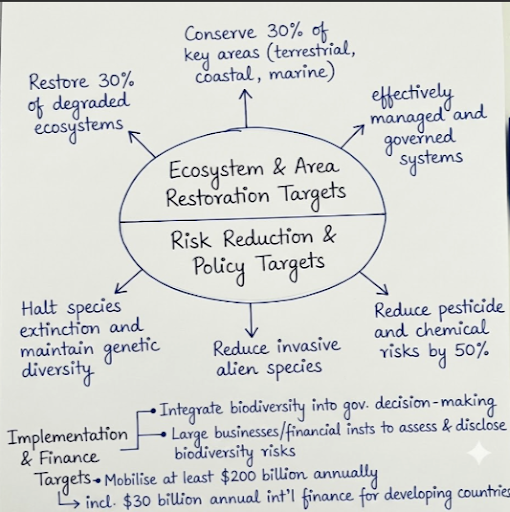
Aim and Goals of the KMGBF
- Ecosystem Integrity: Restore and strengthen theintegrity, connectivity & resilience of ecosystems by 2050; Target 2 operationalises this through restoration of at least 30% of degraded ecosystems by 2030.
- Species & Genetic Security: Halt human-induced extinction, recover threatened species and maintain genetic diversity of wild and domesticated species; Target 4 also seeks better management of human–wildlife interactions.
- Nature-Positive Development: Ensure biodiversity is sustainably used & nature’s contributions to people are maintained and enhanced; Target 10 extends this to biodiversity-friendly agriculture, forestry, fisheries and aquaculture.
- Equitable Benefit Sharing: Ensure fair sharing ofmonetary and non-monetary benefits from genetic resources, associated traditional knowledge & digital sequence information (DSI); Target 13 specifically strengthens access and benefit-sharing mechanisms.
- Biodiversity-Responsive Governance: Mainstream biodiversity into spatial planning, policies, businesses & financial decision-making;Target 15 requires large businesses and financial institutions to assess and disclose their biodiversity-related dependencies, risks and impacts.
- Finance & Global Cooperation: Ensure adequate finance, technology transfer, capacity-building & scientific cooperation, particularly for developing countries; the framework seeks to progressively close $700-billion annual biodiversity finance gap, while Target 19 aims to mobilise at least $200 billion annually by 2030.
India’s Commitments and Initiatives
- National Biodiversity Roadmap: India’s NBSAP 2024–2030 contains 23 National Biodiversity Targets and 142 indicators, aligned with the KMGBF’s 4 goals and 23 targets.
- Ecosystem Restoration: India targets restoration of 26 million hectares of degraded/deforested land by 2030 and has already brought21.76 million hectares under restoration efforts; under MISHTI, the government has set a target to restore 54,000 hectares of mangroves by 2028.
- Species & Habitat Conservation:Project Tiger & Project Elephantcombine habitat protection, anti poaching & technological surveillance; India reported 3,682 tigers & 22,446 wild elephantsin its Seventh National Report.
- Protected Areas & Wetlands: India has 106 National Parks, 574 Wildlife Sanctuaries, 58 Tiger Reserves and 33 Elephant Reserves; Ramsar sites increased to 101 in 2026, strengthening ecosystem conservation.
- Community-Based Conservation:2,76,653 Biodiversity Management Committees and 2,72,648 People's Biodiversity Registers document local biodiversity and traditional knowledge, strengthening community participation.
- Access & Benefit-Sharing:Biological Diversity Act, 2002, National Biodiversity Authority and ABS framework promote equitable sharing of benefits from biological resources and associated traditional knowledge.
- Biodiversity Mainstreaming: India’s NBSAP adopts a “Whole-of-Government & Whole-of-Society” approach involving 23 Central Ministries, integrating biodiversity into sectors such as agriculture, forestry and infrastructure.
- Monitoring & Accountability: India submitted its Seventh National Report to the CBD in February 2026, using 142 indicators mapped to 23 National Biodiversity Targets for measurable implementation.
As Mahatma Gandhi reminded, “The earth provides enough to satisfy every man’s needs, but not every man’s greed.” The KMGBF seeks to translate this ethic into global action by ensuring thatdevelopment remains within nature’s ecological limits.
|
Abbreviations CBD COP: Conference of the Parties to the Convention on Biological Diversity, NBSAP: National Biodiversity Strategy and Action Plan |
Last updated on Oct, 2026