
The Biological Diversity Act 2002 provides India with a comprehensive statutory framework for conserving biological diversity, promoting sustainable use of biological resources and ensuring fair and equitable sharing of benefits arising from their utilisation. Enacted in the context of India’s commitments under the Convention on Biological Diversity (CBD), it addresses the ecological, economic, medicinal and cultural importance of India’s biological resources.
The Biological Diversity Act 2002 regulates access to biological resources and associated traditional knowledge while establishing institutions such as the National Biodiversity Authority, State Biodiversity Boards and Biodiversity Management Committees. Over time, amendments and regulations have sought to balance biodiversity conservation with research, innovation, traditional medicine and sustainable economic utilisation. The Biological Diversity Act 2002 thus links environmental protection with community participation and benefit-sharing.
Biological Diversity Act 2002 Need
The Biological Diversity Act 2002 was needed to addres biodiversity loss, regulate access to biological resources, prevent their unsustainable exploitation and ensure communities benefit from commercial use of their resources.
- The legislation emerged from India's international commitments following the 1992 Convention on Biological Diversity and India's ratification of the Convention in 1994.
- The Act created India's first comprehensive domestic framework specifically addressing biological-resource access and benefit-sharing. The need for legislation arose because:
- India's biological resources have significant ecological, economic, medicinal and cultural value.
- Biological resources can be commercially exploited for pharmaceuticals, agriculture, biotechnology, cosmetics and other industries.
- Traditional communities possess valuable knowledge associated with biological resources.
- Unregulated access can encourage over-exploitation and biopiracy.
- Benefits generated from biological resources need to reach local communities and knowledge holders.
- India needed domestic legislation to implement its obligations under the CBD.
- Conservation needs to be reconciled with sustainable utilisation and economic development.
Biological Diversity Act 2002 Objectives
The objectives of the Biological Diversity Act 2002 combine conservation with sustainable utilisation and equitable benefit-sharing, creating a legal framework that connects biodiversity protection with community interests and economic activity.
- The three foundational objectives are:
- Conservation of biological diversity
- Sustainable use of its components
- Fair and equitable sharing of benefits arising from the utilisation of biological resources and associated knowledge.
- The framework also seeks to regulate access to biological resources and associated traditional knowledge, protect community interests and establish institutional mechanisms for implementing biodiversity policy.


Biological Diversity Act 2002 Features
The Biological Diversity Act 2002 introduced an institutional and regulatory architecture that governs access to biological resources, associated knowledge, research, intellectual property and benefit-sharing across different levels of government.
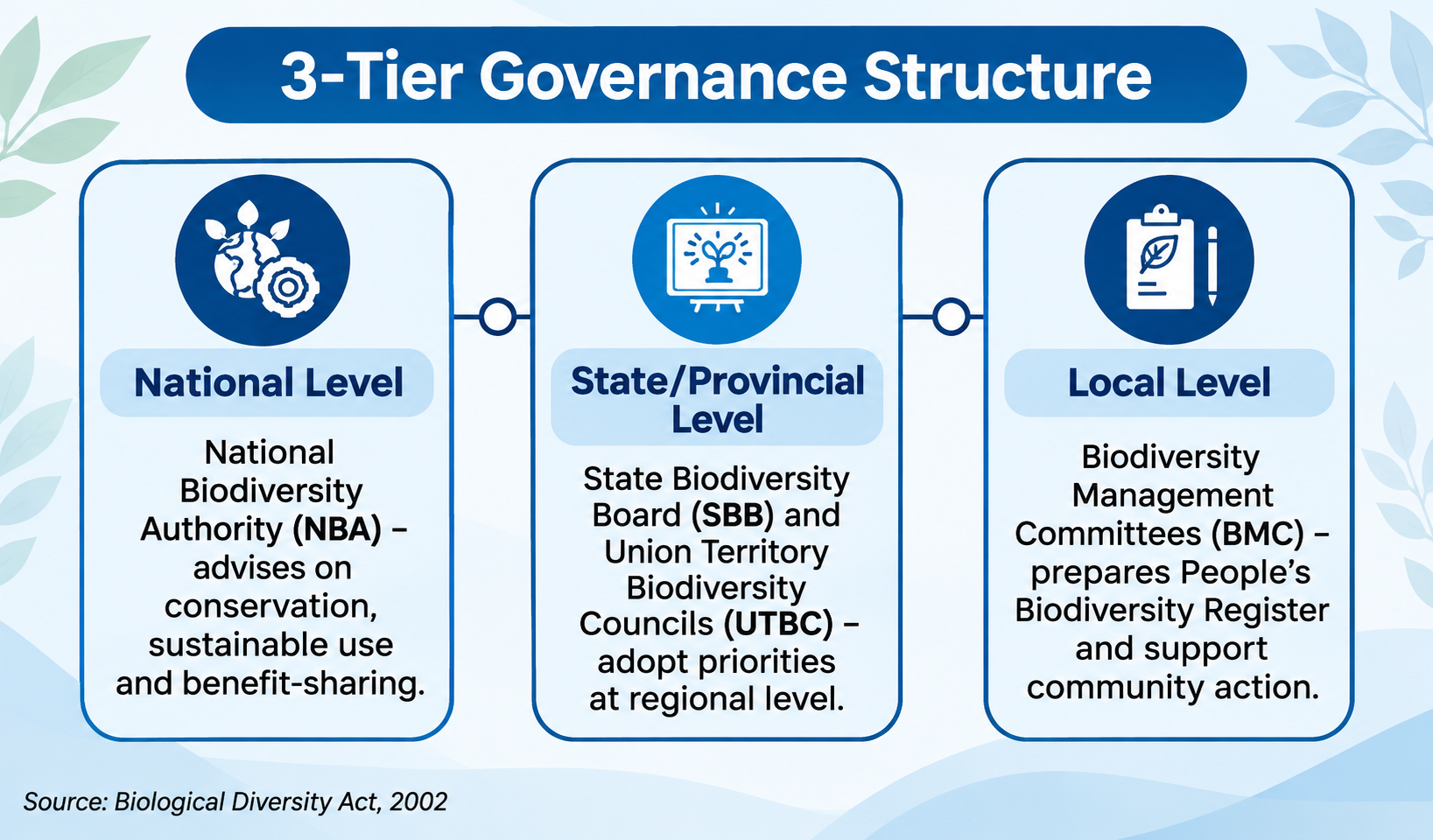
- Three-Tier Institutional Framework: The Biological Diversity Act 2002 establishes a three-level institutional structure;
- National Biodiversity Authority (NBA) – national level
- State Biodiversity Boards (SBBs) – state level
- Biodiversity Management Committees (BMCs) – local level
- This structure enables biodiversity governance to extend from the Union Government to states and local communities.
- Regulation of Access: The Biological Diversity Act 2002 regulates access to India's biological resources and associated traditional knowledge. The amended framework distinguishes between different categories of users, including foreign entities, foreign-controlled Indian entities and Indian entities.
- Access and Benefit Sharing: Access and Benefit Sharing (ABS) is a central feature of the Biological Diversity Act 2002. It seeks to ensure that when biological resources or associated knowledge generate commercial or other benefits, those benefits are shared fairly with recognised benefit claimants.
- Benefits may support conservation, local communities, infrastructure, livelihood development and other agreed purposes, depending on the applicable mechanism.
- India ratified the Nagoya Protocol on Access and Benefit-sharing in 2012 and became a party to it on 12 October 2014. The Biological Diversity Act 2002 and its associated framework provide a domestic mechanism for implementing India's ABS commitments.
- Protection of Traditional Knowledge: The Biological Diversity Act 2002 recognises the importance of knowledge associated with biological resources and provides mechanisms through which access and utilisation can be regulated.
- The 2023 Amendment introduced the concept of "codified traditional knowledge" and excluded it from the benefit-claiming framework in specified circumstances, particularly for persons covered under Section 7. This has generated concerns regarding the extent of benefit-sharing and protection available to communities possessing traditional knowledge.
- Biodiversity Management Committees: BMCs are established by local bodies and are intended to facilitate local-level biodiversity conservation, sustainable use and documentation of biological resources and associated knowledge.
- The 2023 Amendment strengthened the institutional framework of BMCs and empowered state governments to constitute BMCs at intermediate and district local-body levels.
- Biodiversity Heritage Sites: The framework provides for identification and notification of Biodiversity Heritage Sites (BHS) for areas containing unique ecological, species or genetic diversity.
- People's Biodiversity Registers: People's Biodiversity Registers (PBRs) document locally available biological resources and associated traditional knowledge. They provide an important knowledge base for local biodiversity governance and benefit-sharing.
Biological Diversity Act 2002 Institutional Framework
The Biological Diversity Act 2002 distributes biodiversity-governance responsibilities among national, state and local institutions so that regulatory decisions, conservation measures and community participation operate through a coordinated system.
| Institution | Level | Major role |
|
National Biodiversity Authority |
National |
Regulates specified access, advises the government and facilitates benefit-sharing. |
|
State Biodiversity Boards |
State |
Regulate specified activities under the Act and advise State Governments on conservation, sustainable use and benefit-sharing. |
|
Biodiversity Management Committees |
Local |
Promote local biodiversity conservation, sustainable use and documentation. |
|
Central Government |
Union |
Frames policy, rules and guidelines and exercises overarching powers. |
|
State Governments |
State |
Establish SBBs and support implementation within states. |
- National Biodiversity Authority: The NBA was established under the Biological Diversity Act 2002 as the principal national-level authority.
- It deals with specified applications for access to biological resources and associated knowledge and plays a major role in implementing ABS provisions.
- State Biodiversity Boards: SBBs operate at the state level and advise state governments on conservation, sustainable use and benefit-sharing.
- Following the 2023 amendments, their regulatory role was modified, including provisions concerning activities covered by Section 7.
- Biodiversity Management Committees: BMCs provide the local institutional interface of the Act. Their significance lies in bringing local communities into biodiversity governance and facilitating documentation and conservation of local biological resources and associated knowledge.
Biological Diversity Act 2002 and Access and Benefit Sharing
Access and Benefit Sharing ensures that utilisation of biological resources does not become a one-sided commercial activity and that resulting benefits reach appropriate communities and conservation purposes. ABS broadly involves two linked components:
- Access: Access refers to activities involving biological resources and associated traditional knowledge covered by the Act. The amended legislation defines access broadly to include collection, procurement or possession of biological resources found in or obtained from India, along with associated traditional knowledge.
- Benefit Sharing: Where utilisation creates benefits, the framework seeks their fair and equitable distribution to appropriate benefit claimers and for biodiversity-related purposes.
- The 2023 Amendment also modified the mechanisms through which benefit-sharing obligations apply to different categories of users.
Importance of Access and Benefit Sharing
- Prevents exploitation of biological resources without corresponding benefits.
- Recognises the contribution of local and traditional knowledge.
- Supports biodiversity conservation.
- Provides incentives for sustainable resource use.
- Helps address biopiracy.
- Connects biodiversity governance with local livelihoods
Biological Diversity (Access and Benefit Sharing) Regulation, 2025
The Biological Diversity (Access to Biological Resources and Knowledge Associated thereto and Fair and Equitable Sharing of Benefits) Regulations, 2025, were notified on 29 April 2025, replacing the 2014 ABS Regulations. They also bring Digital Sequence Information (DSI) within the benefit-sharing framework. Its key features are:
- Turnover-based ABS: Benefit-sharing is linked to the annual turnover of the user.
- Up to ₹5 crore: No benefit-sharing payment.
- ₹5–50 crore: 0.2% of annual gross ex-factory sale price.
- ₹50–250 crore: 0.4%.
- Above ₹250 crore: 0.6%.
- High-conservation/economic-value resources: Benefit-sharing is at least 5% of the relevant auction, sale or purchase value and may exceed 20% for commercial utilisation.
- DSI: Benefit-sharing provisions extend to the use of Digital Sequence Information associated with biological resources.
- IPR & Research: The Regulations prescribe benefit-sharing requirements for specified researchers and applicants seeking intellectual property rights.
- Community Benefits: A portion of collected benefits is channelled towards recognised benefit claimers and biodiversity conservation.
Biological Diversity Act Amendment 2023
The Biological Diversity (Amendment) Act, 2023, sought to simplify access and research procedures, encourage the Indian traditional-medicine sector and modify regulatory and penalty provisions. The Amendment Act received Presidential assent on 3 August 2023 and came into force on 1 April 2024. Major changes under the 2023 amendment are
- Simplified compliance: Streamlined regulatory procedures and reduced certain compliance requirements for specified categories of users and activities.
- Example: Under the original 2002 framework, patent applicants had to secure approval from the National Biodiversity Authority (NBA) before filing a patent. The 2023 amendment streamlined this process, allowing domestic applicants to register and obtain NBA approval before the grant of the patent rather than before filing.
- AYUSH sector: The amendment provided specified exemptions to registered AYUSH practitioners and traditional medicine practitioners to facilitate the Indian systems of medicine.
- Cultivated medicinal plants: The framework encourages the use of cultivated medicinal plants in specified circumstances.
- Research facilitation: The amendments seek to facilitate research, patent applications and transfer of research results.
- Foreign investment: The amendment sought to facilitate greater foreign investment in activities relating to biological resources, including research, patenting and commercial utilisation, while safeguarding national interests.
- Decriminalisation: Certain offences were decriminalised by replacing imprisonment-based provisions with monetary penalties and establishing an adjudication mechanism for determining penalties.
- Foreign-controlled entities: The amended framework provides greater clarity regarding entities incorporated in India but controlled by foreigners.
- Traditional knowledge: The amendment changed the definition of benefit claimers and the treatment of certain categories of traditional knowledge.
Biological Diversity (Amendment) Rules, 2025
The Biological Diversity (Amendment) Rules, 2025, were notified on 6 May 2025 to amend the Biological Diversity Rules, 2024, and further operationalise the Biological Diversity Act 2002, as amended in 2023. Key changes are:
- Cultivated Medicinal Plants: Commercial utilisation of cultivated medicinal plants is exempted from specified ABS requirements, subject to obtaining a Certificate of Origin from the Biodiversity Management Committee (BMC).
- Codified Traditional Knowledge: Codified traditional knowledge is exempted from the purview of the ABS mechanism for specified Section 7 entities, facilitating the use of recognised traditional-medicine knowledge.
- BMC Role: BMCs are empowered to issue Certificates of Origin for cultivated medicinal plants accessed within their jurisdiction and maintain records of such transactions.
- Institutional Strengthening: The Rules further operationalise the amended roles of the NBA, State Biodiversity Boards and BMCs under the 2023 Amendment.
- Ease of Compliance: The amendments seek to simplify procedures and facilitate legitimate research, traditional medicine and utilisation of biological resources while retaining regulatory safeguards.
Biological Diversity Act 2002 Significance
The Act is significant because it converts India's biodiversity commitments into a domestic legal framework while recognising conservation, sustainable utilisation and community participation as interconnected policy objectives.
- Legal protection: Provides a dedicated statutory framework for biodiversity governance.
- CBD implementation: Gives domestic effect to India's international biodiversity commitments.
- Conservation: Supports protection of ecosystems, species and genetic resources.
- Sustainable utilisation: Seeks to ensure that biological resources are used without undermining their long-term availability.
- Community rights and participation: Brings local institutions and communities into biodiversity governance.
- Benefit sharing: Creates mechanisms for distributing benefits from biological-resource utilisation
- Traditional knowledge: Recognises the importance of knowledge associated with biological resources.
- Research and innovation: Establishes procedures for accessing biological resources for research and development.
- Anti-biopiracy framework: Helps regulate unauthorised exploitation of India's biological resources and associated knowledge.
- International relevance: Supports implementation of the Nagoya Protocol on Access and Benefit Sharing.
Biological Diversity Act 2002 Challenges
The Biological Diversity Act 2002 faces challenges involving regulatory complexity, institutional capacity, community participation, benefit-sharing, traditional-knowledge protection and the need to balance conservation with commercial access.
- Implementation Gaps: The effectiveness of the legislation depends on how consistently provisions are implemented by national, state and local institutions. Differences in administrative capacity can produce uneven outcomes.
- Capacity of Biodiversity Management Committees: BMCs are critical to the decentralised model, but their effectiveness can be affected by limited technical expertise, financial resources, awareness and institutional capacity.
- Benefit-Sharing Concerns: One major challenge is ensuring that benefits actually reach the communities and individuals who conserve biological resources or possess relevant knowledge.
- Traditional Knowledge Protection: The 2023 amendments have generated debate over whether changes relating to codified traditional knowledge and benefit claimers could weaken incentives for communities to document and preserve traditional knowledge.
- Ease of Access vs Conservation: Simplifying access can encourage research, innovation and investment, but excessive relaxation may increase risks of over-exploitation or inadequate monitoring.
- Foreign Access and Biopiracy: Greater international collaboration can generate economic and scientific benefits, but regulatory safeguards remain necessary to prevent unauthorised exploitation of Indian biological resources.
Biological Diversity Act 2002 Way Forward
India needs a balanced biodiversity-governance model that facilitates legitimate research and innovation while strengthening community rights, benefit-sharing, institutional capacity and long-term ecological safeguards.
- Strengthen BMCs: Provide adequate funding, training and technical support to local Biodiversity Management Committees.
- Improve ABS transparency: Develop clearer systems for tracking biological-resource access and the distribution of benefits.
- Protect traditional knowledge: Ensure that simplification of regulatory procedures does not weaken safeguards for traditional and community knowledge.
- Strengthen monitoring: Use digital databases, geospatial tools and traceability systems to monitor biological-resource utilisation.
- Improve coordination: Strengthen coordination between the NBA, SBBs, BMCs, research institutions and other regulatory bodies.
- Build community capacity: Increase awareness among local communities about their rights, biological resources and ABS mechanisms.
- Balance ease of doing research with conservation: Simplified procedures should be accompanied by effective monitoring and safeguards.
Biological Diversity Act 2002 UPSC PYQs
Q1. How is the Government of India protecting traditional knowledge of medicine from patenting by pharmaceutical companies? (UPSC Mains 2019)
Q2. How does biodiversity vary in India? How is the Biological Diversity Act 2002 helpful in the conservation of flora and fauna? (UPSC Mains 2018)
Q3. Consider the following statements: (UPSC Prelims 2023)
- In India the Biodiversity Management Committees are key to the realisation of the objectives of the Nagoya Protocol.
- The Biodiversity Management Committees have important functions in determining access and benefit sharing, including the power to levy collection fees on the access of biological resources within its jurisdiction.
Which of the statements given above is/are correct?
a) 1 only
b) 2 only
c) Both 1 and 2
d) Neither 1 nor 2
Ans: (c)
Q4. How does National Biodiversity Authority (NBA) help in protecting the Indian agriculture? (UPSC Prelims 2012)
- NBA checks the biopiracy and protects the indigenous and traditional genetic resources.
- NBA directly monitors and supervises the scientific research on genetic modification of crop plants.
- Application for Intellectual Property Rights related to resources genetic/biological cannot be made without approval of NBA.
Which of the statements given above is/are correct?
a) 1 Only
b) 2 & 3 Only
c) 1 & 3 Only
d) 1, 2 & 3
Ans: (c)

 Last updated on Sep, 2026
→ UPSC 2027 Notification will be released on 13 January 2027 at upsconline.nic.in.
→ Check out the latest UPSC Syllabus here.
→ Download UPSC Model Answers for Mains 2026
→ UPSC Mains Question Paper 2026 is out now for Essay & GS Paper 1, 2, 3 & 4.
→ UPSC Calendar 2027 has been released.
→ Enroll in Vajiram & Ravi’s UPSC Mains Test Series 2027 for structured answer writing practice, expert evaluation, and exam-oriented feedback.
→ Join Vajiram & Ravi’s UPSC Mentorship Program 2027 for personalized guidance, strategy planning, and one-to-one support from experienced mentors.
→ Go through the UPSC Mains Previous Year Papers to enhance your preparation.
→ UPSC has released UPSC Toppers List 2025 with the Civil Services final result on its official website.
→ Also check Best UPSC Coaching in India
Biological Diversity Act 2002 FAQs
Q1. When did the Biological Diversity Act, 2002 come into force in India?+
Q2. In which year was the Biological Diversity Act passed by the Parliament of India?+
Q3. Which international convention is the Biological Diversity Act based on?+
Q4. What is the National Biodiversity Authority (NBA)?+
Q5. What is the difference between the Biological Diversity Act 2002 and the Biological Diversity Amendment Act 2023?+
Tags: biological diversity act 2002 quest upsc enviornment and ecology notes